
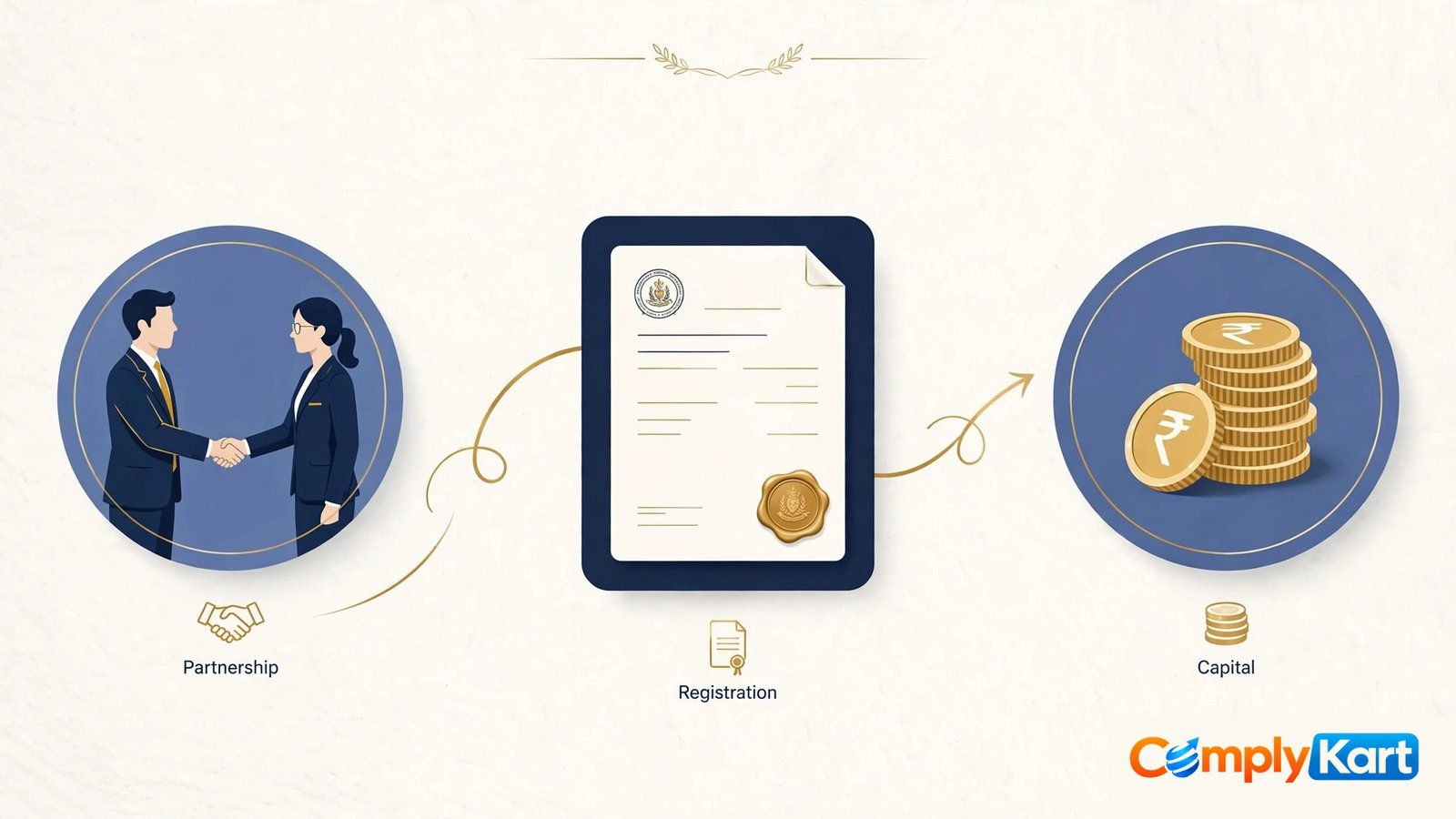
LLP registration cost in India: roughly ₹6,000–₹15,000 all-in for a two-partner firm — about ₹950 in MCA fees (FiLLiP ₹500 + Form 3 ₹50 + RUN-LLP ₹200 + DPINs at ₹100 each), ₹1,600–₹3,000 for DSCs, state-wise stamp duty on the LLP agreement, and ₹2,500–₹10,000 in professional fees.
If you ask five people what it costs to register an LLP in India, you will hear five different numbers. One quote will be ₹1,500. Another will be ₹15,000. Both can be technically true, and that is exactly the problem. The final figure depends on three moving parts: the MCA's own fee slabs, the stamp duty in your state, and what the professional doing the work charges. Let me walk through each one so you know what is a real charge and what is a mark-up.
Key takeaways
- FiLLiP incorporation fees follow capital-contribution slabs: ₹500 / ₹2,000 / ₹4,000 / ₹5,000 (LLP Rules, 2009, Annexure A); Form 3 follows the same slabs at ₹50 / ₹100 / ₹150 / ₹200.
- A two-partner LLP with a ₹1 lakh contribution pays just ₹950 in total MCA fees — the government portion is genuinely cheap.
- Stamp duty on the LLP agreement is state-wise with no single national figure; an outdated rate is the most common cause of last-minute shortfalls.
- Inflating the capital contribution pushes you into a higher MCA slab and raises stamp duty — keep it at what partners genuinely plan to bring in.
What are the MCA fees for LLP registration?
Start with the part nobody can inflate, because these are fixed in the LLP Rules, 2009 (Annexure A). The incorporation fee on the FiLLiP form follows your LLP's capital contribution — what the partners agree to bring in — on these slabs:
- Up to ₹1 lakh: ₹500
- Above ₹1 lakh up to ₹5 lakh: ₹2,000
- Above ₹5 lakh up to ₹10 lakh: ₹4,000
- Above ₹10 lakh: ₹5,000
The LLP agreement filing (Form 3) follows the same slabs at ₹50, ₹100, ₹150 and ₹200. Two small fixed items sit on top: RUN-LLP, the name reservation form, at ₹200, and the DPIN (the designated partner's identification number) at ₹100 per designated partner. Add it up for a typical small firm with a ₹1 lakh contribution and two partners: ₹500 + ₹50 + ₹200 + ₹200. That is ₹950 in government fees. The government portion is genuinely cheap — everything else is where the bill grows.
Three costs people forget to budget
First, the Digital Signature Certificate. Every designated partner needs a DSC to sign the forms, costing roughly ₹800 to ₹1,500 per partner depending on the provider and validity. Two partners, so set aside ₹1,600 to ₹3,000.
Second, stamp duty on the LLP agreement. This is state-wise, and I say that deliberately — there is no single national figure. Some states charge a few hundred rupees, others a percentage of the capital contribution. If your LLP is registered in one state and you looked up another state's rate, you have the wrong number. Check current rates for your state before you budget; an outdated figure here is the most common cause of last-minute shortfalls.
Third, the professional fee. An end-to-end LLP incorporation — name approval, FiLLiP, DPINs, drafting the LLP agreement, Form 3 filing — typically runs ₹2,500 to ₹10,000 depending on the city, the complexity, and whether the professional also handles stamp-duty execution. A lean self-service filing sits at the bottom; a firm with resubmission support sits at the top. Ask what is included before comparing quotes: some "cheap" quotes exclude the stamp-duty drafting entirely.
The one mistake that costs real money
Every few weeks a client asks me to register their LLP with a contribution of ₹10 lakh "to look serious to clients and banks." Please do not do this. A higher contribution pushes you into a higher MCA fee slab — ₹5,000 instead of ₹500 on FiLLiP — and because stamp duty in most states is tied to the contribution, it inflates that too. Worse, it is a legal commitment: the partners are on record as owing that money to the LLP. If they never actually bring it in, the books start life with a hole in them, and the signed agreement can be held against you later. Keep the contribution at what you genuinely plan to put in. A ₹1 lakh or ₹5 lakh contribution is perfectly respectable — nobody serious evaluates your firm on that line item.
The small costs that creep up after the quote
A quote is a snapshot, not a ceiling. If your proposed LLP name gets rejected, each fresh RUN-LLP attempt costs another ₹200 — pick names carefully and check availability first instead of filing on hope. If you add a partner later, you file a supplementary agreement with stamp duty again and re-file Form 3; onboarding a partner in month six is meaningfully more expensive than onboarding them on day one. And if your consultant files from another city, some charge a small outstation fee for the stamp-duty execution. None of these are large alone, but ask about them upfront so the invoice matches the quote.
What registration doesn't include
This trips up first-time founders: the registration cost above gets your LLP born. It does not keep it alive. Every year you file Form 11 (annual return) and Form 8 (statement of account and solvency), plus income-tax returns, plus GST returns if you cross the threshold. Those annual compliance costs are worth knowing before you choose the LLP route at all — our compliance fee calculator breaks them down filing by filing so you can see the first-year and every-year cost side by side.
So, the typical bill for a two-partner LLP with a ₹1 lakh contribution: roughly ₹950 in MCA fees, ₹1,600–₹3,000 for DSCs, stamp duty as per your state, and ₹2,500–₹10,000 in professional fees. Call it ₹6,000 to ₹15,000 all-in for most straightforward cases, higher if your state stamp duty is steep. Anyone quoting far above that should be able to point at exactly which line item is different — and now you know what the line items are.
Frequently asked questions
What is the total cost of LLP registration in India?
For a two-partner LLP with a ₹1 lakh capital contribution: about ₹950 in MCA fees, ₹1,600–₹3,000 for DSCs, state-wise stamp duty on the agreement, and ₹2,500–₹10,000 in professional fees — roughly ₹6,000 to ₹15,000 all-in. Higher contributions or steep state stamp duty push it up; neither the MCA slabs nor the DSC rates are negotiable.
Should I keep the LLP capital contribution low?
Keep it honest, not artificially low or high. A higher contribution raises your MCA fee slab (₹500 becomes ₹5,000 past ₹10 lakh) and usually raises stamp duty too — and it's a legal commitment the partners owe the LLP. Set it at what partners genuinely plan to bring in; ₹1–5 lakh is perfectly respectable for a new firm.
What are the annual costs after LLP registration?
Registration is only the birth cost. Every year an LLP files Form 11 (annual return), Form 8 (statement of account and solvency), income-tax returns, and GST returns if registered. Budget these before choosing the LLP structure — the compliance fee calculator linked above breaks down the first-year and recurring costs filing by filing.
How long does LLP registration take?
Two to three weeks is realistic for a clean filing: a few days for name approval via RUN-LLP, DSC issuance for the partners, FiLLiP filing and MCA processing, then the LLP agreement and Form 3 within 30 days of incorporation. Name rejections and MCA resubmissions are what stretch timelines — careful paperwork keeps it short.
Is an LLP cheaper than a private limited company overall?
At incorporation, yes — MCA fees are lower and there's no share-capital machinery. But compare lifetime cost, not just day one: LLPs skip statutory audit below thresholds, while companies face audits and heavier annual filings. The right choice depends on funding plans and credibility needs, not just the first invoice — get advice before you pick.
If you are weighing an LLP against a private limited company for your new firm, talk to a ComplyKart professional — a ten-minute conversation can save you from picking the wrong structure and paying for it twice.



Comments
No comments yet — ask the first question below.
Join the discussion
Questions go straight to our expert desk. Comments appear after a quick review — no spam, no noise.