

IN BRIEF
Tax planning for a doctor with a private clinic means choosing how practice income is taxed. Under Section 44ADA, a doctor in independent practice can declare 50% of gross professional receipts as income, up to ₹50 lakh — or ₹75 lakh where cash receipts stay within 5% — with no books and no audit. From FY 2026-27 the rule sits in Section 58 of the Income-tax Act, 2025.
You trained for years to treat patients. Nobody trained you to read the Income-tax Act. Yet the moment you open a private clinic, the tax department starts treating you like a business — with books, audits, advance tax and GST, all running on dates you never agreed to.
The short answer: A doctor in independent practice can declare 50% of gross professional receipts as income under Section 44ADA, up to ₹50 lakh of receipts — or ₹75 lakh where cash stays within 5% — with no books and no audit. But if your real costs eat more than half your receipts, keeping books usually saves you money.
Your clinic's income arrives in three buckets — sort them first
Most doctors mix three kinds of income into one mental pile. The law doesn't. Sort them first, because each one is taxed differently.
Bucket one: salary. If a hospital employs you, that pay is salary. Tax is deducted under Section 192, Form 16 tells the story, and you cannot apply 44ADA to it. A salary is a salary.
Bucket two: professional fees. Visiting-consultant fees, chamber fees, procedure fees from hospitals that engage you without employing you — this is professional income. Hospitals deduct 10% TDS under Section 194J once one payer's fees to you cross ₹50,000 in a year. That threshold rose from ₹30,000 on 1 April 2025. Every rupee shows up in Form 26AS and AIS, so reconcile before you file. The department believes 26AS, not your memory.
Bucket three: your own clinic. Consultation fees at your chamber, procedures you bill yourself, pharmacy sales if you dispense. This is where the 44ADA decision lives — and where GST enters the picture. Treat hospital fees as salary and your return won't match the TDS the hospital already reported.
What is Section 44ADA, in plain words?
Section 44ADA is the presumptive scheme for professionals. Instead of tracking every expense and computing real profit, you declare a fixed share of your gross receipts as income. The rest is presumed to cover everything: rent, staff, consumables, equipment, travel.
| Point | The rule |
|---|---|
| Who can use it | Resident individuals and partnership firms in notified professions — medicine is one of them, under Section 44AA(1) |
| Presumptive income | 50% of gross professional receipts |
| Receipts limit | ₹50 lakh; ₹75 lakh where cash receipts stay within 5% of the total |
| Books of account | Not required while you stay in the scheme |
| Tax audit | Not required while you stay in the scheme |
| Who cannot use it | LLPs and companies — even if the entity runs a medical practice |
That last row catches people out. If your clinic runs as an LLP or a private limited company, 44ADA is closed to you. The entity files its own return on real profit, and your salary or director's remuneration from it is separate income. If you are weighing structures, that is one more reason to think before you incorporate — a limited liability partnership gives you limited liability, but it takes 44ADA off the table.
One more thing, because the citations are changing. From FY 2026-27, the Income-tax Act, 2025 replaces the 1961 Act, and 44ADA moves into Section 58 of the new Act (serial number 3 of its table). The return you are about to file — for FY 2025-26 — still runs entirely under the old numbers. Two rulebooks, one overlapping year. Keep them straight.
44ADA or books? Work it out with your own numbers
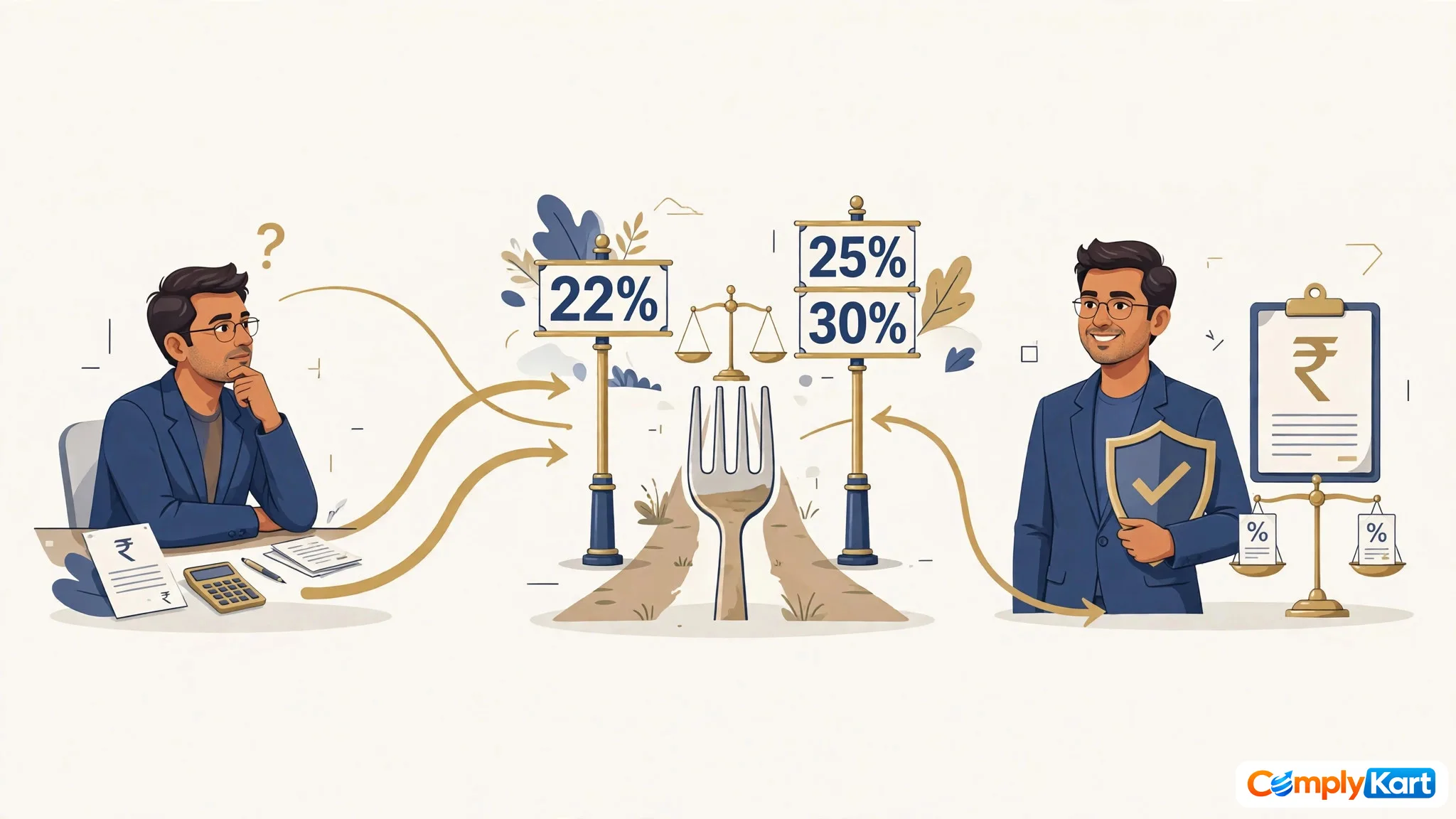
Think of it like a taxi. Keeping books is the meter: you pay exactly what the ride costs. 44ADA is a fixed fare agreed before the ride: 50% of your receipts, whatever the meter would have said. If the meter would have run lower than the flat fare, you overpay. If it runs higher, the flat fare saves you. The only question is your margin.
Take a doctor with ₹48 lakh of gross receipts in the year — all by UPI, bank transfer and insurance payouts, so cash stays under 5% and the ₹75 lakh limit applies.
Scenario A: a busy clinic with real costs. Rent ₹6 lakh, staff salaries ₹12 lakh, consumables and drugs ₹6 lakh, equipment depreciation ₹3 lakh, other running costs ₹3 lakh. Total expenses: ₹30 lakh. Real profit: ₹18 lakh — a 37.5% margin. Under 44ADA she declares ₹24 lakh (50% of ₹48 lakh); on books she declares ₹18 lakh. The difference is ₹6 lakh of extra taxable income under 44ADA — roughly ₹1,87,200 of extra tax at the 30% marginal rate plus 4% cess. Even after paying for bookkeeping and an audit, she is well ahead on books.
Scenario B: a lean consulting practice. Same ₹48 lakh of receipts, expenses of only ₹20 lakh — a small chamber, one assistant, no heavy equipment. Real profit: ₹28 lakh, a 58% margin. Under 44ADA she declares ₹24 lakh — less than her real ₹28 lakh profit. She pays tax on ₹4 lakh less income, keeps no books, and skips the audit entirely. 44ADA wins by a distance.
The decision rule falls out of the maths. If your real margin sits below 50%, books usually win. If it sits above 50%, 44ADA wins. Run your own numbers once — one evening with last year's receipts and expenses — and the answer is usually obvious. Our income tax calculator can run the two bases side by side, and our income-tax return filing service checks the 44ADA-versus-books question before anything is filed.
Two cautions. First, the 50% is a floor, not a ceiling. If your real profit is higher than 50% of receipts, you must declare the higher figure — booking exactly 50% while your bank statement shows a 58% margin hands the assessing officer a ready-made addition. Second, deductions like 80C and 80D stay available under the old regime on top of whichever base you choose. The general scheme — who else it covers, how the ₹2 crore business limit works — is in our presumptive taxation guide for small businesses.
Two traps doctors walk into
Trap one: the five-year lock-in that doesn't apply to you. You will hear that once you use presumptive taxation, you are locked in for five years. That lock-in lives in the business scheme — Section 44AD. It does not sit in 44ADA. A doctor can move between 44ADA and books year to year as the practice changes, subject to the audit rule below. Don't let a half-remembered rule keep you in the wrong scheme.
Trap two: declaring less than 50% and skipping the audit. If you declare profit below the deemed 50% and your total income from all sources crosses the basic exemption limit (₹4 lakh under the new regime, ₹2.5 lakh under the old), the shortcut ends. You must maintain regular books and get a tax audit done. The scheme only protects you while you declare at least the deemed rate.
When does the tax audit clock start?
Three triggers, and any one of them starts the clock.
Receipts cross ₹50 lakh outside 44ADA. A professional whose gross receipts exceed ₹50 lakh must have the accounts audited under Section 44AB(b) — unless 44ADA covers the receipts within its limit. Under the new Act the audit section is Section 63. Skip a required audit and the penalty is 0.5% of gross receipts, up to ₹1.5 lakh, under Section 271B.
You declare less than the deemed profit. As above: lower profit plus total income above the exemption limit means books and audit, even though you were eligible for the scheme.
You keep books, so the books must be proper. Once gross receipts cross ₹1.5 lakh, Rule 6F prescribes the books a medical professional must maintain — cash book, journal, ledger, bills, and a daily case register in Form 3C. That register is the one record most small clinics never keep. Start it now; reconstructing a year's cases from memory is the worst version of this job.
Advance tax: one payment, 15 March
Here is the part doctors actually miss. A professional on the presumptive scheme does not pay advance tax in four quarterly instalments. The whole year's advance tax falls due in a single instalment by 15 March. Miss it and interest runs from 1 April under Sections 234B and 234C. Put the date in your calendar the day you choose 44ADA — the scheme saves you bookkeeping, not the calendar. Our advance tax guide covers the instalment rules and the interest maths in full.
What changes when you cross ₹75 lakh?
Crossing ₹75 lakh of gross receipts is a good problem. It is also a transition, not a cliff. Three things change. First, 44ADA stops, and you move to regular books — every provable expense, from rent to equipment depreciation under Section 32, becomes claimable, so for a clinic with heavy costs the switch is often a saving. Second, the audit applies: receipts above ₹50 lakh outside the scheme mean an audit report before the return — Form 3CB-3CD for the return you file now, under the 1961 Act. Third, the paperwork gets real: Rule 6F books, the daily case register, and a proper reconciliation of every hospital's 194J TDS against Form 26AS before filing. Do it in April, not in the last week before the due date. The full old-to-new section map — 44ADA to Section 58, 44AA to Section 62, 44AB to Section 63, 194J to Section 393 — is in our Income-tax Act 2025 section map.
GST: most of your clinic is exempt — except the parts that aren't
Consultations, diagnosis and treatment by a registered medical practitioner are health care services, exempt from GST under Entry 74 of Notification 12/2017-Central Tax (Rate). That covers most of what a clinic does. Three lines of income sit outside the exemption, and they are the ones that create GST liability.
| What you charge for | GST treatment |
|---|---|
| Consultation, diagnosis, treatment, diagnostic tests | Exempt — Entry 74 |
| Cosmetic or plastic surgery, hair transplant (not reconstructive) | Taxable at 18% |
| Reconstructive surgery after burns, accidents or congenital defects | Exempt — it restores anatomy |
| Pharmacy sales, skincare products sold separately | Taxed at the product's rate — medicines at 5% from 22 September 2025 |
| Facials, skin brightening, laser work done for appearance alone | Usually taxable at 18% |
The test is clinical necessity. Treating a skin disease is health care. A chemical peel for appearance is not. A rhinoplasty that corrects a congenital deformity is exempt; the same procedure for reshaping is taxed at 18%.
Two practical consequences. First, if your taxable lines — cosmetic work, pharmacy, product sales — cross ₹20 lakh in a year, you need GST registration even though your consultations are exempt. Second, bill the two kinds of work separately. One blended invoice for a consultation plus a cosmetic procedure is how exempt income gets taxed by accident.
Which ITR form do you file?
ITR-4 (Sugam) if you declare presumptive income under 44ADA and fit its conditions; ITR-3 if you keep regular books or need an audit. ITR-4 is closed to company directors, holders of unlisted shares, people with foreign assets, and anyone carrying forward losses — if any of those apply, you are on ITR-3 regardless. Salary plus practice income goes on the same return; there is no separate return for the clinic. Our ITR form guide maps all seven forms in plain English.
Five mistakes that cost doctors money
- Declaring exactly 50% when the real margin is higher. 50% is the floor. Declare the real figure.
- Treating hospital fees as salary. If the hospital engages you without employing you, it is professional income under 194J, not salary — and your return must match 26AS.
- Missing the 15 March advance tax date. One instalment, one date. Interest starts 1 April.
- Billing cosmetic work inside an exempt consultation invoice. Split the bill, or the exempt line gets taxed.
- Running the clinic as an LLP and expecting 44ADA. LLPs and companies cannot use the scheme. Choose the structure with the tax in mind, not after.
Frequently asked questions
Can a doctor use Section 44ADA?
Yes. Medicine is a notified profession under Section 44AA(1), so a doctor in independent practice can declare 50% of gross professional receipts as income under 44ADA, up to ₹50 lakh of receipts — or ₹75 lakh where cash receipts stay within 5% of the total. An LLP or a company running a clinic cannot use it.
What is the 44ADA limit for doctors?
₹50 lakh of gross receipts in the year, rising to ₹75 lakh if cash receipts do not exceed 5% of total receipts. The presumptive income is 50% of gross receipts, or more if your actual profit is higher.
Is GST charged on cosmetic procedures in India?
Yes, usually 18%. Healthcare services are exempt under Entry 74 of Notification 12/2017, but the definition excludes cosmetic or plastic surgery and hair transplants, except when undertaken to restore or reconstruct anatomy affected by congenital defects, injury or trauma.
When do doctors pay advance tax under 44ADA?
In a single instalment — 100% of the year's advance tax by 15 March. There are no quarterly instalments for a professional on the presumptive scheme.
Which ITR form does a doctor file?
ITR-4 (Sugam) for presumptive income under 44ADA, within its conditions. ITR-3 if you keep regular books, need a tax audit, or fall outside ITR-4's conditions — for example, if you are a company director or hold unlisted shares.
The cheapest tax structure for your clinic is the one that matches your real margin, your receipts and your plans for next year — not the one your colleague uses. Work the numbers once, keep the daily case register from April, pay the advance tax by 15 March, and split the cosmetic billing from the consultation. That is most of the job. For the rest — the comparison, the reconciliation with 26AS, the filing itself — our income-tax return filing service handles it, and we check the 44ADA-versus-books question before anything is filed.


Comments
No comments yet — ask the first question below.
Join the discussion
Questions go straight to our expert desk. Comments appear after a quick review — no spam, no noise.