
How to Pay TDS Online: E-Payment & Challan ITNS 281 Explained
You deducted tax from a vendor's payment last month. Good — that's the easy half. The harder half is getting that money to the government correctly and on time, because undelivered TDS leaves you holding someone else's tax with interest running every month.
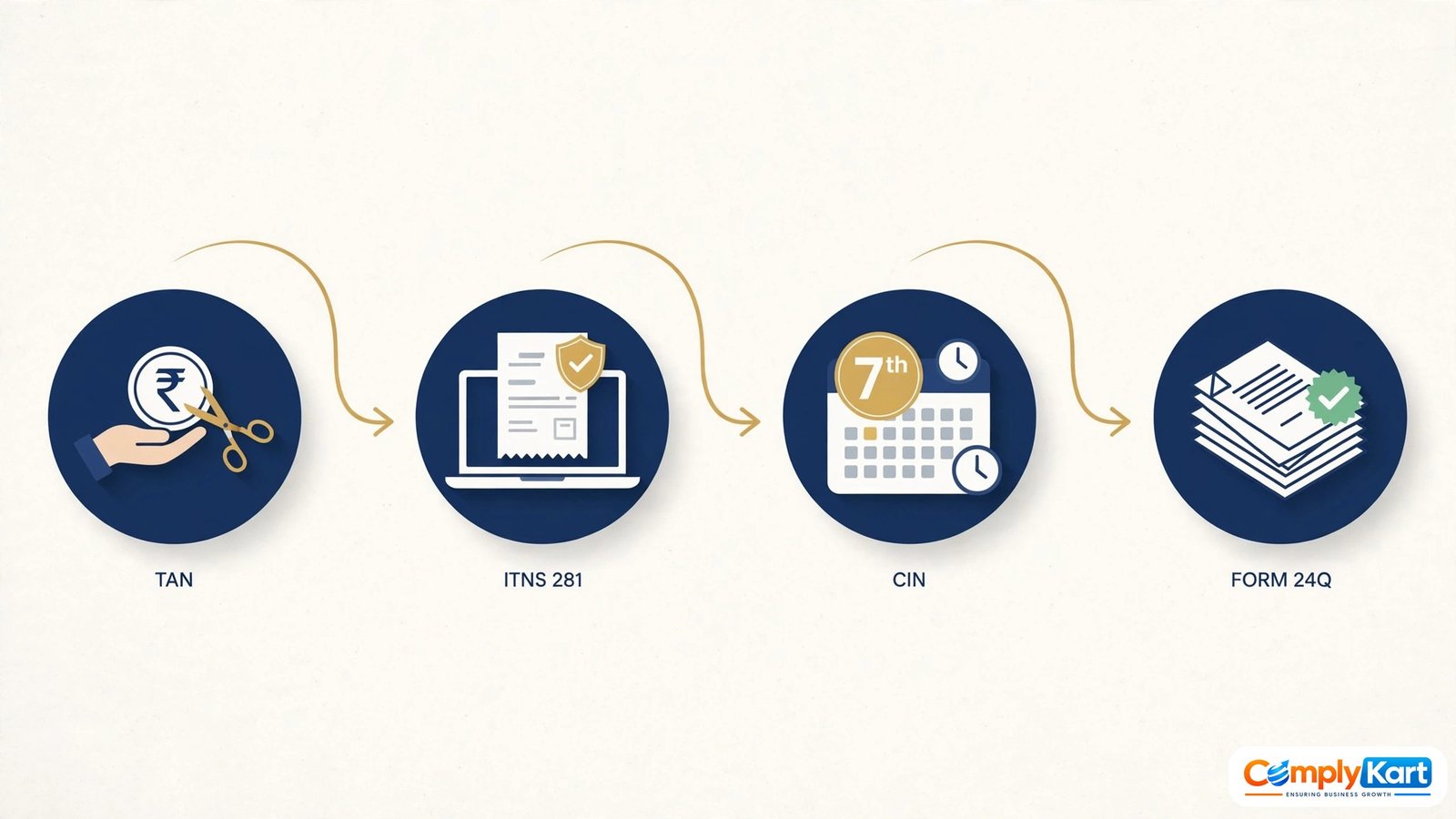
The short answer: Pay TDS online through e-Pay Tax on incometax.gov.in using Challan ITNS 281 (or its current tile) — with TAN login or pre-login OTP. Fill the challan, pay via net banking/UPI/card, save the receipt with its Challan Identification Number. Deadline: the 7th of the following month (30 April for March).
What Challan ITNS 281 actually is
Challan ITNS 281 is the designated challan for depositing TDS and TCS — as opposed to ITNS 280, for advance or self-assessment tax you pay yourself. The old NSDL e-payment route has folded into the income tax portal's e-Pay Tax system. Same challan, new home.
What do you need before paying TDS online?
Four things. Your TAN — the 10-digit Tax Deduction Account Number. No TAN, no TDS — new business? TAN comes with the setup (see private limited company or LLP registration.) The correct section code for the payment (192 salary, 194C contractors, 194J professional fees — it must match what you actually deducted). The exact TDS amount, plus interest if you're late. And a payment method — net banking, debit card, UPI or credit card. The portal routes you to your bank's secure page — your credentials never touch the tax site.
Just set up the business? Our 90-day post-incorporation checklist keeps the first year's filings on track.
How do you pay TDS online, step by step?
One: go to incometax.gov.in and choose e-Pay Tax — logged in with your TAN, or pre-login with a mobile OTP for a one-off payment.
Two: select the deductor (TAN holder) role, choose New Payment, then the TDS/TCS tile — the current equivalent of Challan ITNS 281 — and select the applicable Act (1961 for legacy payments, 2025 for the current year).
Three: choose the deductee type and the nature of payment (section code). This field decides whether your challan matches your TDS return later — the most common failure point. Slow down here.
Four: enter the breakup — tax, surcharge and cess if applicable, interest if late, any fee. Review the summary like an auditor: TAN, tax year, section code, amount. A wrong assessment year is the single most common error, especially early in a new financial year.
Five: pick the payment mode and complete it on the bank's page. The portal issues a Challan Reference Number (CRN) at initiation; once the bank confirms, you get the Challan Identification Number (CIN) and a receipt — download it. That CIN goes into your quarterly TDS return.
Six: check Payment History. No paid status after 30 minutes? Wait a day; still stuck — take it up with the bank.
When is TDS due?
The 7th of the following month — TDS deducted in October is due by 7 November. The one exception is March, which gets till 30 April. Give it a two-day buffer and stop thinking about it.
What late payment actually costs
The interest has two gears. Deducted late — tax that should have come out of the payment but didn't: 1% per month from when it was deductible. Deducted on time but deposited late: 1.5% per month from deduction to payment. Part of a month counts as a full month — one day late is one month's interest.
Beyond interest: the quarterly return carries a ₹200-per-day late fee (capped at the quarter's TDS), plus ₹10,000–₹1,00,000 penalties for serious defaults — and prosecution where tax was deducted but never deposited. The 7th-of-the-month habit is cheap insurance. Want the full year's filing bill? Our compliance fee calculator estimates it in under a minute.
What happens after you pay — the quarterly TDS return
Paying the challan is half the compliance. Every quarter you file a TDS statement — 24Q for salary, 26Q for non-salary — by 31 July, 31 October, 31 January and 31 May. The return ties your challans (via those CINs) to each deductee's PAN, which is why you collect PANs before the first payment. No PAN: 20% TDS.
Think of the challan as a sealed cash box, the quarterly return as the covering note listing whose money is inside. The department opens the box when you pay — but only the note tells it which deductee's Form 26AS to credit. Box with no note: money sits unallocated, someone eventually comes knocking. Note with no box: money that never arrived. Both halves, every time.
Then the certificates — Form 16 for employees, 16A for the rest — so they can claim the credit you deducted.
Buying property from an NRI seller? That's a different routine — the TDS rules for NRI property deals changed on 1 October 2026.
Five mistakes that trigger notices
One: wrong assessment year on the challan. The classic: the payment lands in the wrong year's ledger, your return can't match it, both sides get queried. Confirm the AY/Tax Year before you hit proceed.
Two: wrong section code. Paying under a different section than you deducted under creates a challan-return mismatch the system flags automatically.
Three: TAN errors. Verify it character by character — a wrong TAN credits someone else's account, or nobody's.
Four: paying without filing the return. Unfiled quarterly statements mean your deductees can't see the credit in Form 26AS/AIS — and they'll come asking, usually at the worst time.
Five: ignoring the CIN. No saved receipt, no CIN, no proof. When the department asks — and eventually it does — "I paid it, trust me" is not a defence. Download the receipt every single time.
TDS e-payment: quick answers
Can I pay TDS without logging in to the income tax portal?
Yes — enter your TAN, verify with the mobile OTP, and complete the payment. Useful for one-offs; regular deductors usually prefer the logged-in route for payment history.
What is the difference between Challan 280 and 281?
Challan 280: tax you pay on your own behalf — advance tax, self-assessment. Challan 281: TDS/TCS you deducted from someone else's payment. Wrong challan, misrouted credit.
What happens if I deposit TDS after the 7th?
1.5% per month (part-month counts as full) from deduction till payment, under Section 201(1A) — plus the ₹200-per-day late fee on the quarterly return.
Which TDS return form do I file for salary vs vendor payments?
24Q for salary, 26Q for non-salary — filed quarterly by 31 July, 31 October, 31 January and 31 May.
What if my deductee doesn't give me their PAN?
Deduct at 20% — the higher rate applies when PAN isn't furnished. Collect PANs before the first payment, not after the first notice.
Seven days — your monthly window: deduct correctly, pay by the 7th on the right challan, file the return, issue the certificates. Do that rhythm and TDS becomes background noise. And if you'd rather have the whole routine — deductions, challans, returns, certificates — handled as one managed job, that's what our team does for businesses every week.



Comments
No comments yet — ask the first question below.
Join the discussion
Questions go straight to our expert desk. Comments appear after a quick review — no spam, no noise.