
IN BRIEF
A small company is a private company under the Companies Act 2013 with paid-up share capital up to ₹10 crore and turnover up to ₹100 crore since MCA Notification GSR 880(E). Holding companies, subsidiaries, Section 8 companies and special Act companies can never qualify, and a qualifying company files the abridged annual return MGT-7A with lighter board, reporting and penalty rules.
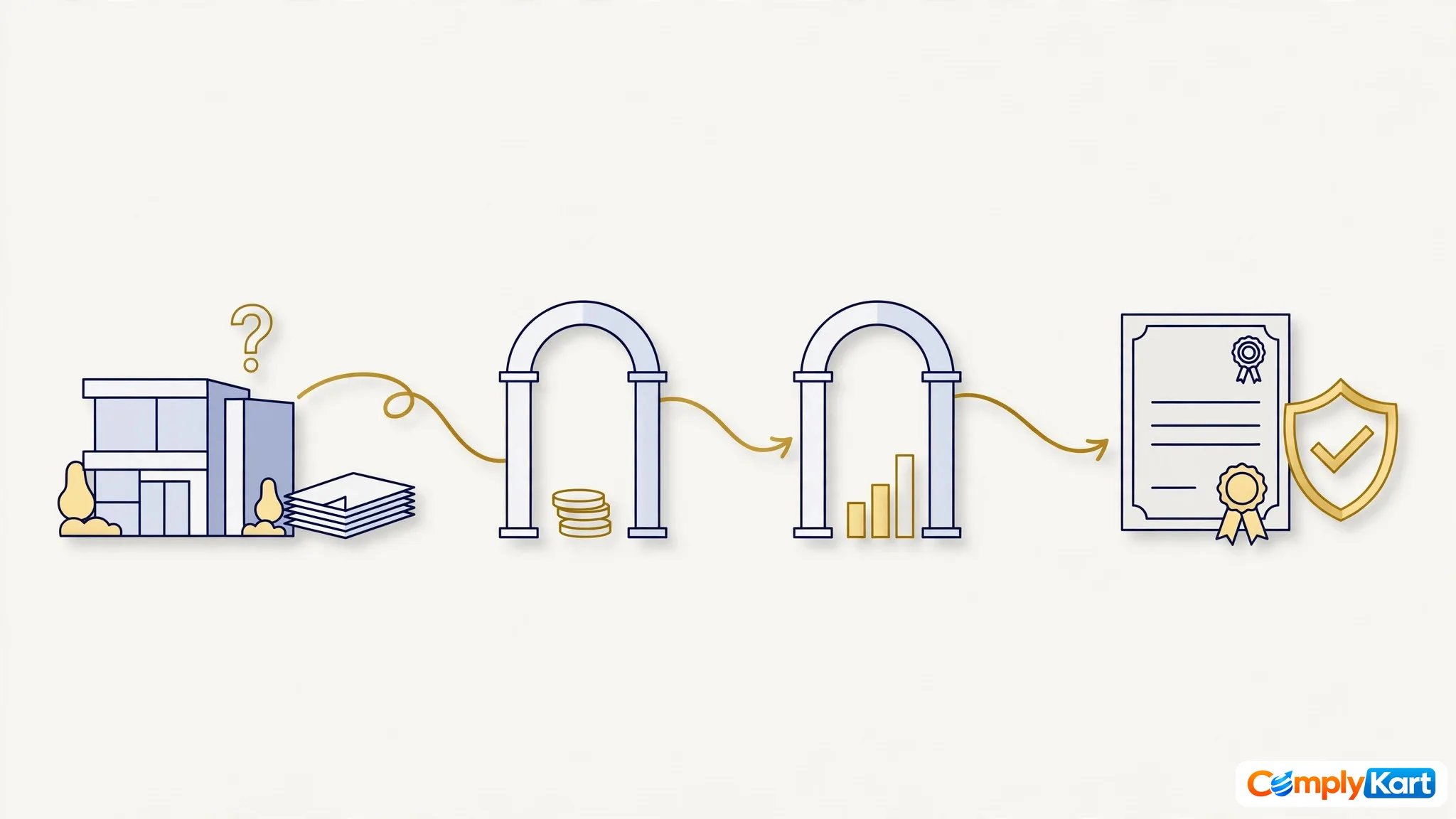
Last year you filed MGT-7. This year your company secretary may hand you MGT-7A instead — a shorter return, fewer disclosures, a smaller bill for mistakes. Nothing about your business changed. The definition did.
On 1 December 2025 the MCA raised the small-company limits to paid-up capital of ₹10 crore and turnover of ₹100 crore. FY 2025-26 is the first filing season run under those limits, and the choice between MGT-7 and MGT-7A is being made right now, inside the extended window that runs to 31 January 2027. Get the test wrong and you file the wrong form. Get it right and a bundle of reliefs opens up.
The short answer: A small company is a private company whose paid-up share capital does not exceed ₹10 crore and whose turnover does not exceed ₹100 crore, both at once. Holding companies, subsidiaries, Section 8 companies and special-Act companies can never qualify. Qualify, and you file MGT-7A, hold two board meetings a year, and pay halved penalties under Section 446B.
Are you a small company now? The two-number test
Section 2(85) of the Companies Act, 2013 sets the test, and the MCA's notification G.S.R. 880(E) dated 1 December 2025 sets the numbers. Both must pass. Think of airline cabin baggage: your bag must fit the frame and stay under the weight limit. Passing one does not excuse the other.
A company with paid-up capital of ₹6 crore and turnover of ₹70 crore is a small company. The same company with turnover of ₹110 crore is not, even though its capital never moved. I see founders get this wrong in one direction only — they check the number they like and stop.
| From | Paid-up capital limit | Turnover limit |
|---|---|---|
| 2013 | ₹50 lakh | ₹2 crore |
| 1 April 2021 | ₹2 crore | ₹20 crore |
| 15 September 2022 | ₹4 crore | ₹40 crore |
| 1 December 2025 | ₹10 crore | ₹100 crore |
Companies that filed the full MGT-7 last year — capital between ₹4 crore and ₹10 crore, or turnover between ₹40 crore and ₹100 crore — may be small companies this year. The MCA confirmed the point in Parliament: in its reply to Rajya Sabha Unstarred Question No. 229 on 21 July 2026, the Ministry listed the reliefs newly qualifying companies now receive.
One exclusion deserves emphasis because it surprises people. Group structure beats size. Size is not enough. A subsidiary of a foreign parent with ₹2 crore of turnover is not a small company. A holding company is not one either. With a corporate parent, the test stops before the numbers start. A private limited company with no parent and no subsidiary is the company this definition was written for.
Which year's numbers count?
Here is the honest complication. The turnover limb of Section 2(85) is worded on the immediately preceding financial year, while paid-up capital is tested as it stands. The MCA has published no clarification pinning down how the new limits apply across the transition, and practitioners argued both readings for the FY 2024-25 filings. For FY 2025-26 the position is cleaner — the new limits were law from 1 December 2025, months before the year ended — but the wording has not changed.
My working rule: test both numbers on your latest audited figures and your current paid-up capital, and file MGT-7A only when both pass with room to spare. If either number sits near its line — turnover hovering around ₹100 crore, a fresh allotment pushing capital toward ₹10 crore — get your company secretary to confirm the call before you file. A wrong MGT-7A is not worth the argument.
What actually changes when you qualify?
The MCA's own list, from that July 2026 Parliament reply, is the reliable catalogue — here are the reliefs that change your year.
First, the return itself. You file MGT-7A, the abridged annual return, instead of MGT-7. It is signed by a company secretary, or by a director where there is no company secretary, and it asks only for the aggregate remuneration drawn by directors rather than person-by-person detail. Our MGT-7 due-date guide walks through the two forms side by side.
Second, the paperwork shrinks. No cash flow statement is required as part of your financial statements (Section 2(40)). The Board's report follows the abridged format under Section 134(3A) and Rule 8A. Your auditor does not rotate under Section 139(2), does not report on internal financial controls under Section 143(3)(i), and does not report under CARO 2020 at all — small companies are expressly outside that order.
Third, the calendar loosens. A small company needs one board meeting in each half of the calendar year, with at least 90 days between the two (Section 173(5)). Four meetings become two. And if two small companies merge, Section 233 lets the Regional Director approve the merger without a trip to the NCLT.
Fourth, the small print helps. Small-company forms do not need professional pre-certification, and the MCA fee table charges small companies lower fees. One more, with a catch: internal audit under Section 138 is triggered for a private company only at turnover of ₹200 crore or bank borrowings above ₹100 crore. A small company escapes on turnover by definition, but borrowings above ₹100 crore still trigger it. Debt, not revenue, is what pulls you back in.
What does not change?
Three things founders assume, wrongly. Audit stays. The reliefs trim what your auditor reports — no CARO, no internal financial controls paragraph — not whether you are audited. Every company still needs a statutory audit under Section 139, and AOC-4 still has to be filed.
Deadlines stay. The annual return is still due within 60 days of the AGM under Section 92(4) — 29 November 2026 for a 30 September AGM — and financial statements within 30 days under Section 137. The fee-free windows come from a circular, not from small-company status, and are covered below.
Other statutes stay. Small-company status is a Companies Act label. It does not change your GST registration, and it does not make you an MSME — Udyam registration runs on its own investment and turnover test under a different Act. Keep the labels separate.
The penalty maths: fees are not penalties
Keep two buckets apart. Additional fees for late filing are fees, not penalties, and Section 446B does not touch them. For MGT-7 and MGT-7A the additional fee runs at ₹100 per day with no cap. Penalties are different: they are imposed through adjudication, and Section 446B halves them for small companies, subject to a cap of ₹2 lakh for the company and ₹1 lakh for an officer in default.
Take a normal year and a 90-day late MGT-7A. The additional fee is 90 × ₹100 = ₹9,000, small company or not. The penalty exposure under Section 92(5) is ₹10,000 plus ₹100 per day — ₹19,000 for the company — and halving under Section 446B brings it to ₹9,500. Same delay, two buckets, two answers.
For this season, the fee bucket is empty for a while. Under MCA General Circular No. 05/2026 dated 24 October 2026, FY 2025-26 returns in MGT-7 and MGT-7A can be filed up to 31 January 2027 without additional fees, and AOC-4 family forms up to 31 December 2026. The circular does not move AGM dates, and once the window closes, additional fees are counted from the original due date, not from the end of the window. If your annual filing is still open, the window is the reason to finish it now rather than in February.
Your filing-season checklist
- Test both numbers — paid-up capital and turnover — and write the answer down. If either fails, file MGT-7.
- If both pass, file MGT-7A, and tell your auditor before the audit starts that CARO and internal financial controls reporting do not apply.
- File AOC-4 by 31 December 2026 and the return by 31 January 2027 to stay inside the fee-free window.
- Reset the board calendar to two meetings, one in each half of the year, at least 90 days apart.
- Track every date on the compliance calendar so the window does not close on you.
Questions owners keep asking
Do we file anything to claim small-company status? No separate application exists. You claim it by filing MGT-7A instead of MGT-7 and applying the reliefs — two board meetings, no cash flow statement, no CARO. Keep a one-page working paper showing both numbers, so the choice is defensible if the ROC ever asks.
Our bank still asks for a cash flow statement. Does the exemption help? Only against the Act, not against a contract. A lender can demand whatever its sanction letter demands. The exemption saves the statutory preparation; it does not stop a bank asking for the same document on its own terms.
Will a funding round cost us small-company status? It can. A priced round that pushes paid-up capital above ₹10 crore ends the status for the next year's return, even if turnover stays small. The next year means MGT-7, four board meetings, and CARO back on the auditor's list.
We crossed a limit this year. What changes first? The form, then the calendar. File MGT-7 for that year, move the board back to four meetings, prepare a cash flow statement, and warn your auditor that CARO applies again. Start that reset in the quarter you cross, not at filing time.
One last thought. The new limits are a gift to companies in the ₹40–100 crore band, but only if they claim them deliberately — right form, right board calendar, auditor told in advance. The companies that lose out are not the ones that fail the test. They are the ones that pass it and keep filing as if nothing changed.




Comments
No comments yet — ask the first question below.
Join the discussion
Questions go straight to our expert desk. Comments appear after a quick review — no spam, no noise.