
IN BRIEF
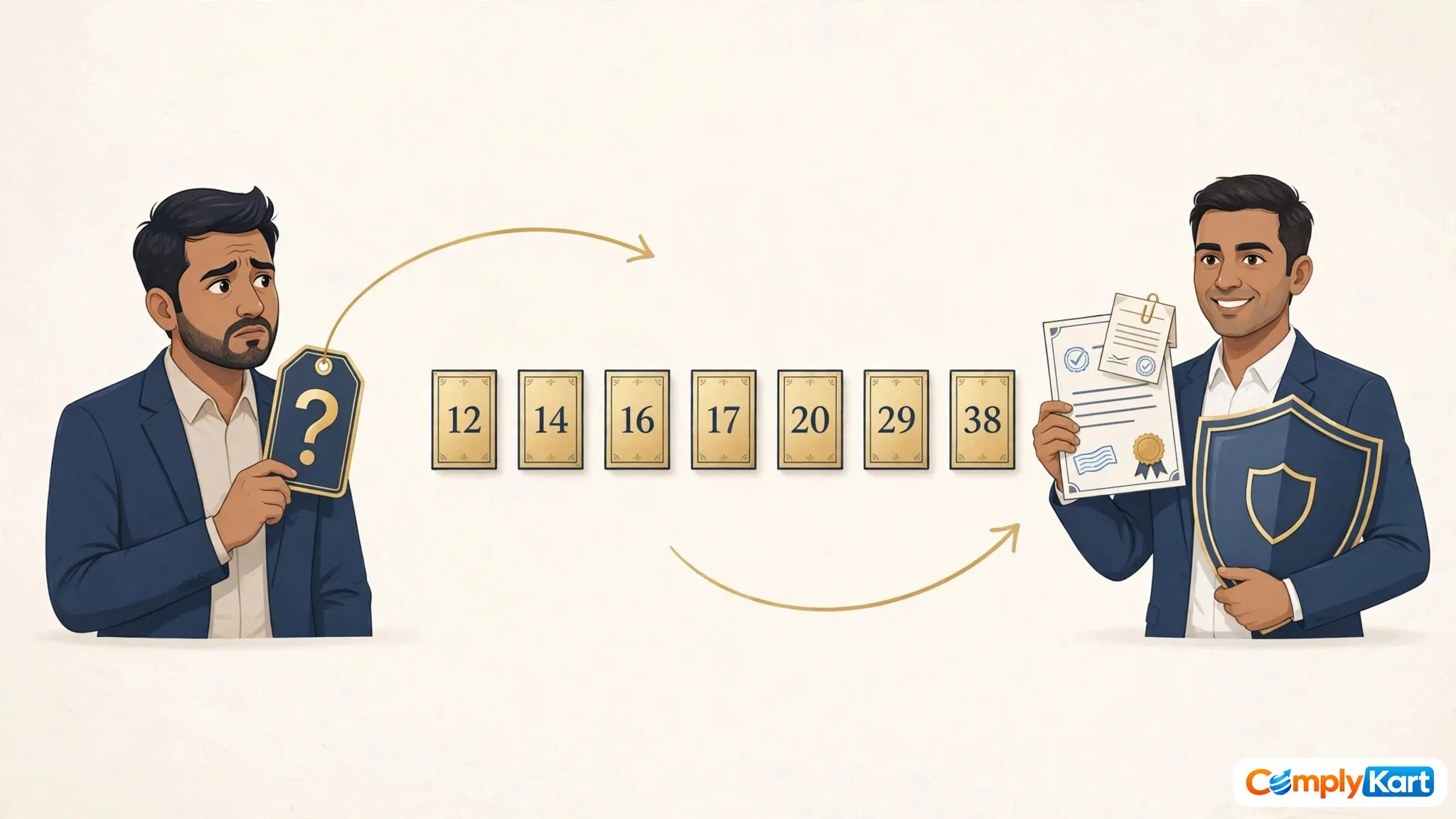
Trademark classes 12, 14, 16, 17, 20, 29 and 38 are seven of the 45 classes of the Nice Classification, which India applies under Section 7 of the Trade Marks Act, 1999 and the Fourth Schedule of the Trade Marks Rules, 2017. They cover vehicles, jewellery and watches, paper and stationery, rubber and insulating materials, furniture, preserved foods and dairy, and telecommunications services.
Short answer: Classes 12, 14, 16, 17, 20, 29 and 38 are seven of India's 45 trademark classes under the Nice Classification. Class 12 is vehicles, 14 is jewellery and watches, 16 is paper and stationery, 17 is rubber and insulation, 20 is furniture, 29 is preserved food and dairy, 38 is telecom services.
You pick your trademark class before you file, and the choice sticks. File in the wrong class and your registration protects a shelf you never stand on, while the shelf you actually sell from stays open to anyone. This guide covers the seven classes the Registry's recent refresh wave touched — 12, 14, 16, 17, 20, 29 and 38 — one by one, with the traps that catch real filings. It follows the first two parts of this series, which covered classes 9, 35, 36, 41 and 23 and classes 10, 11, 13, 15, 19, 34, 37 and 45.
What a trademark class actually decides
Think of the 45 classes as the floors of a department store. Each floor sells one kind of thing. Your trademark buys you a shop on the floors where you actually trade — and nowhere else. A jewellery brand that files only in Class 14 owns its name over jewellery, not over the shop that sells it, and not over the website that takes the orders. Those are different floors.
India uses the Nice Classification, an international list run by WIPO. The Trade Marks Act, 1999, Section 7, adopts it, and the Fourth Schedule of the Trade Marks Rules, 2017 carries the class headings. When there is a doubt about which class a product falls in, Section 7(2) says the Registrar decides — and that decision is final. So the class is not a formality. It is the boundary of the protection you are buying.
The full list of all 45 classes, with the same plain-English treatment, sits in our Nice Classification overview. This post goes deep on seven of them.
What changed in the 2026 edition?
The 13th edition of the Nice Classification, NCL 13-2026, has applied to new applications since 1 January 2026. The headline moves landed in Classes 9 and 10 — spectacles, sunglasses and contact lenses moved from Class 9 to Class 10, and electric toothbrushes moved into Class 10 too. We covered those in Part 2.
For the seven classes in this post, the headings are unchanged in substance under NCL 13-2026. That is useful to know, because it means the older guidance on these classes still holds. One date to keep in mind: the next version, NCL(13-2027), follows on 1 January 2027. The edition that applies to your filing is the one in force on the day you file, so a class that fits today can shift under you if you wait.
Class 12 — which class is my vehicle brand in?
Class 12 covers vehicles and apparatus for locomotion by land, air or water. Cars, motorcycles, scooters, bicycles, e-rickshaws, buses, trucks, boats, aircraft — and their parts. Tyres sit here too.
Who files here: car and two-wheeler makers, EV startups, bicycle brands, boat builders, auto-component makers, tyre brands. If your brand goes on the vehicle itself, or on a part that only makes sense fitted to a vehicle, this is your floor.
The trap: three things that look like Class 12 are not. Vehicle engines are Class 7 — the engine is a machine, the vehicle is the thing the machine moves. Navigation software, dashcams and vehicle GPS units are Class 9. And vehicle repair and servicing is Class 37, a service, not a good. One more, from Part 2: wheelchairs are Class 12, not Class 10. A medical-device maker filing a wheelchair brand in Class 10 files on the wrong floor.
Class 14 — jewellery and watches
Class 14 covers precious metals and their alloys, jewellery, precious and semi-precious stones, and horological and chronometric instruments — watches and clocks, in plain words. Gold jewellery, diamond rings, imitation jewellery, wristwatches, wall clocks: all Class 14.
Who files here: jewellers, diamond houses, watch brands, makers of imitation and fashion jewellery. If your brand goes on the piece itself, this is the class.
The trap: selling jewellery is not the same as making it. The shop, the website, the retail service — that is Class 35. A jewellery house that files only in Class 14 protects the necklace, not the storefront. File both if you do both. And a trademark is not a hallmark. BIS hallmarking is a separate, mandatory regime for gold jewellery in India — your registration does not stand in for it, and a hallmark does not stand in for a trademark. One more boundary: unwrought metals and metal in general sit in Class 6. Class 14 is precious metals only.
Class 16 — paper, books and stationery
Class 16 covers paper and cardboard, printed matter, bookbinding material, photographs, stationery and office requisites (except furniture), adhesives for stationery or household purposes, drawing materials and materials for artists, paintbrushes, instructional and teaching materials, and plastic sheets, films and bags for wrapping and packaging.
Who files here: publishers, stationery brands, notebook and diary makers, packaging companies, art-supply brands, makers of printed forms and labels. If your brand goes on something printed, written on, or used to wrap, this is usually your floor.
The trap: the digital twin lives elsewhere. An e-book, a downloadable workbook, a stationery app — Class 9. A pack of playing cards is Class 28, not Class 16, because cards are games. Paper bags for wrapping and packaging are Class 16, but plastic bags for household use are Class 21. And publishing as a service — the act of publishing someone's book — is Class 41, while the printed book itself is Class 16. Same word, different floor, depending on whether you sell the object or the service.
Class 17 — rubber, plastics and insulation
Class 17 covers unprocessed and semi-processed rubber, gutta-percha, gum, asbestos, mica and substitutes for all these materials; plastics and resins in extruded form for use in manufacture; packing, stopping and insulating materials; and flexible pipes, tubes and hoses, not of metal.
Who files here: rubber-goods makers, plastic-sheet and film manufacturers, insulation-material brands, seal and gasket makers, makers of flexible hoses and pipes. This is the class for materials in the middle of their journey — not raw chemicals, not finished consumer goods, but the semi-processed stuff factories buy.
The trap: the line runs on how finished the material is. Unprocessed plastics and resins are Class 1, chemicals. Semi-processed plastics in extruded form — sheets, rods, films for manufacture — are Class 17. A finished plastic product, like a plastic chair or a plastic container, leaves both and lands in Class 20 or 21. Metal pipes are Class 6; only the non-metal flexible pipe is Class 17. And building materials, even insulating ones sold for construction, are Class 19. If your customer is a builder buying boards, check Class 19 before you settle on 17.
Class 20 — furniture
Class 20 covers furniture, mirrors, picture frames, containers (not of metal) for storage or transport, and unworked or semi-worked bone, horn, whalebone or mother-of-pearl, shells, meerschaum and yellow amber. In practice: chairs, beds, tables, sofas, wardrobes, office furniture, mirrors, frames.
Who files here: furniture brands, home-decor labels, mattress makers, makers of storage boxes and crates, mirror and frame makers.
The trap: the most common wrong turn is Class 19. Building materials are Class 19; furniture is Class 20. A wooden door is Class 19. A wooden chair is Class 20. Same wood, different floor — the test is whether the thing is part of the building or a thing you move around inside it. Metal furniture is still Class 20, by the way; the material does not move it to Class 6. But a metal safe does sit in Class 6. And household containers split too: a storage container for transport is Class 20, while a lunch box or a kitchen container for household use is Class 21. Fitted furniture — a fitted kitchen, a built-in wardrobe — is Class 20 as goods, but the installation service is Class 37.
Class 29 — preserved food and dairy
Class 29 covers meat, fish, poultry and game, meat extracts, preserved, frozen, dried and cooked fruits and vegetables, jellies, jams and compotes, eggs, milk, cheese, butter, yoghurt and other milk products, and oils and fats for food. Pickles, ghee, paneer, canned fish, frozen vegetables, jam, cooking oil: all Class 29.
Who files here: dairy brands, pickle and preserve makers, packaged-meat and seafood brands, edible-oil brands, makers of frozen and canned foods.
The trap: food is split across five classes, and this is where most food-brand filings go wrong. Preserved food and dairy is Class 29. Tea, coffee, spices, flour, rice, bakery goods and confectionery are Class 30. Fresh fruit, vegetables and raw farm produce are Class 31. Non-alcoholic drinks and fruit juices are Class 32. And serving food — a restaurant, a cafe, a catering service — is Class 43, not 29 at all. A pickle brand that files in Class 30 because "food is food" has filed on the wrong floor. A cloud kitchen that files in Class 29 has filed for the goods while its actual business, the service of feeding people, sits in Class 43. File the class that matches what you sell, and file both when you sell both the packet and the plate.
One more thing: a trademark is not a food licence. Selling packaged food needs an FSSAI registration or licence, and your trademark application does not check for it. The two regimes run side by side.
Class 38 — telecom services
Class 38 covers telecommunications services. Mobile networks, internet access, broadcasting, messaging services, data transmission, streaming delivery — the service of carrying the signal, not the device that carries it.
Who files here: telecom operators, internet service providers, messaging and calling apps, broadcasters, streaming platforms, satellite and cable operators.
The trap: the hardware and the software live on other floors. A phone, a router, a set-top box — Class 9. The app you download — Class 9. Software-as-a-service, the platform behind the app — Class 42. Entertainment content itself, the shows and the programmes — Class 41. Class 38 is the transmission: the network, the broadcast, the carrying of the message from one end to the other. And like food, telecom is licensed separately. A telecom service needs a Department of Telecommunications licence; a trademark registration does not grant it and does not replace it.
The seven-class map
| Class | Covers | Who files here | Watch out for |
|---|---|---|---|
| 12 | Vehicles for land, air and water, and their parts | Auto, EV, cycle and boat brands | Engines are 7; vehicle software is 9; repairs are 37 |
| 14 | Precious metals, jewellery, precious stones, watches and clocks | Jewellers, diamond houses, watch brands | Retail is 35; plain metals are 6; hallmarking is separate |
| 16 | Paper, printed matter, stationery, packaging | Publishers, stationery and packaging brands | E-books and apps are 9; playing cards are 28; publishing services are 41 |
| 17 | Semi-processed rubber and plastics, packing and insulating materials, non-metal flexible pipes | Rubber, plastics and insulation makers | Unprocessed plastics are 1; metal pipes are 6; building materials are 19 |
| 20 | Furniture, mirrors, picture frames, non-metal containers | Furniture and home-decor brands | Building materials are 19; metal safes are 6; household containers are 21 |
| 29 | Preserved food, dairy, edible oils | Dairy, pickle, frozen-food and oil brands | Spices and bakery are 30; fresh produce is 31; restaurants are 43 |
| 38 | Telecommunications services | Telecom operators, ISPs, messaging and broadcast services | Devices and apps are 9; SaaS is 42; content is 41 |
What does it cost?
The government fee is charged per class, per application, on Form TM-A. Filing online, an individual, a startup or a small enterprise pays ₹4,500 per class. Any other applicant pays ₹9,000 per class. The fee has not changed since the Trade Marks Rules, 2017.
One application can cover several classes. Section 18(2) of the Trade Marks Act, 1999 allows a single Form TM-A to list goods or services across multiple classes, with the fee charged per class. The Registry calls such an application a multi-class filing — the "Class 99" label you will see on the portal is the Registry's way of marking a multi-class TM-A, not a 46th class. Our Class 99 guide explains that label, and our multi-class versus single-class comparison walks through when to combine and when to split.
A worked example. Take a dairy brand that sells ghee and paneer (Class 29), spice mixes (Class 30) and runs its own retail store (Class 35). Three classes, one TM-A. As a startup, the government fee is 3 × ₹4,500 = ₹13,500. As a private limited company that is not a small enterprise, it is 3 × ₹9,000 = ₹27,000. The professional fee for drafting and filing sits on top, and it varies by firm. What does not vary is the per-class maths: every class you add costs a full fee, so the discipline is to file the classes you actually trade in — no more, no fewer.
If the fee maths matters to your budget, our compliance fee calculator will give you a quick estimate before you file.
Five mistakes that cost filings
- Filing the goods and forgetting the shop. You make the product and you sell it. The product is one class, the retail service is Class 35. File both, or a competitor can open a store under your name and argue, correctly, that you never claimed the shop floor.
- Copying a competitor's class list. Their list fits their business, not yours. A rival dairy files 29 and 30; you also run a cafe, so you need 43 as well. Check your own shelves, not theirs.
- Filing the product name instead of the class. "Pickle" is not a class. Preserved vegetables are Class 29, spice mixes are Class 30. The Registry classifies by what the thing is, not by what you call it.
- Assuming one class covers the whole business. It never does, for any business that both makes and sells, or sells goods and a service. Most founders need two or three classes. The map table above is the quick check.
- Filing after launch, without a search. A public search of the register before filing costs nothing and takes minutes. Finding a conflicting mark after you have printed packaging, signed a lease and launched costs real money. Search first, file second.
What happens if I file in the wrong class?
You cannot simply swap it. Rule 37 of the Trade Marks Rules, 2017 bars an amendment that substitutes a specification not wholly within the original one — in practice, you cannot amend your way from one class to another. The usual fix is a fresh application in the right class, with a new filing date. That means a new fee, and it means you lose the earlier date — which matters, because trademark rights in India turn heavily on who filed first. The cheap time to get the class right is before filing, not after.
FAQs
Can one trademark application cover several of these classes?
Yes. One Form TM-A can list goods or services across several classes under Section 18(2) of the Trade Marks Act, 1999, with the government fee charged per class — ₹4,500 for individuals, startups and small enterprises, ₹9,000 for other applicants, when filed online. A dairy brand filing Classes 29, 30 and 35 in one application pays for three classes, not three applications.
I sell jewellery online. Is Class 14 enough?
No, not on its own. Class 14 protects the jewellery itself — the piece, the metal, the stones. The online store, the retail service of selling jewellery, is Class 35. If you make and sell, file both. If you only trade in other makers' jewellery, Class 35 may be the class that matters most.
My food brand sells pickles and spice mixes. Class 29 or Class 30?
Both, for different products. Pickles — preserved vegetables — are Class 29. Spice mixes are Class 30. File 29 for the pickle range and 30 for the spice range. Filing only one leaves half your shelf unprotected, and a competitor can use your name on the half you skipped.
Does a trademark registration let me sell food or run a telecom service?
No. A trademark protects the brand name; it is not a licence to trade. Packaged food needs FSSAI registration or a licence, and telecom services need a Department of Telecommunications licence. You need both the licence and the trademark, from different authorities, for different purposes.
How do I check whether my brand name is already taken in my class?
Search the public register on the IP India portal before you file — our guide to the public search walks through it step by step. Search your exact name and close variants, in every class you plan to file in. A conflicting mark in your class is the single most common reason applications run into opposition, and it is the easiest to catch early.
Classes are the least glamorous part of a trademark filing and the part that decides whether the filing is worth anything. Get the floor right, and the name you build has somewhere solid to stand. If you want a hand with the filing itself — class selection, the search, the TM-A — our trademark registration service handles it end to end.


Comments
No comments yet — ask the first question below.
Join the discussion
Questions go straight to our expert desk. Comments appear after a quick review — no spam, no noise.