
IN BRIEF
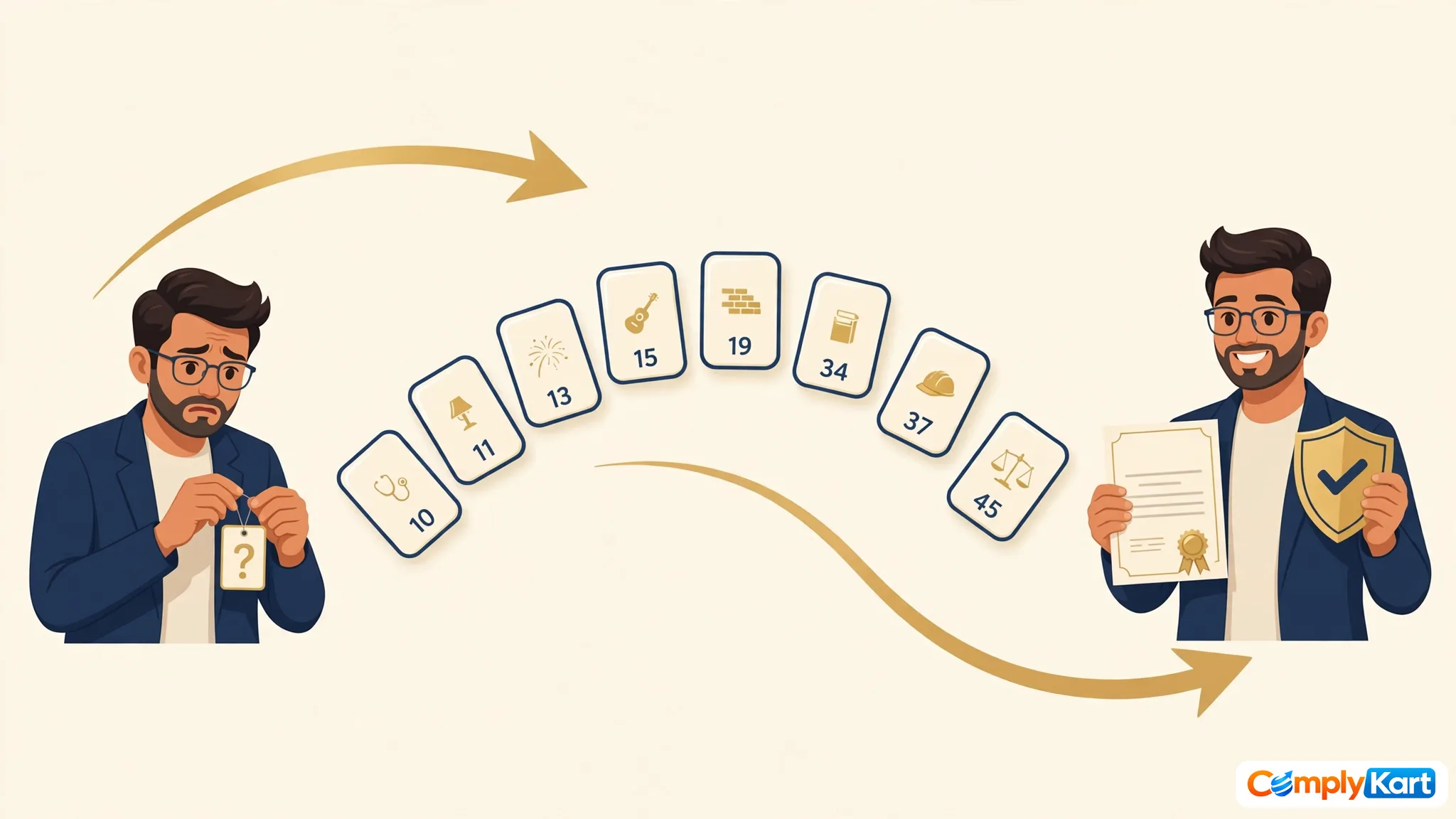
Trademark classes 10, 11, 13, 15, 19, 34, 37 and 45 are eight of the 45 classes of the Nice Classification, which India applies under Section 7 of the Trade Marks Act, 1999 and the Fourth Schedule of the Trade Marks Rules, 2017. They cover medical devices, lighting and heating apparatus, firearms and fireworks, musical instruments, non-metallic building materials, tobacco, construction and repair services, and legal and personal services.
Classes 10, 11, 13, 15, 19, 34, 37 and 45 cover medical devices, lighting and heating appliances, firearms and fireworks, musical instruments, non-metallic building materials, tobacco, construction and repair services, and legal services. Each class protects your brand only for what it lists, under the Nice Classification’s 13th edition, in force in India from 1 January 2026.
If you filed a trademark in the last few years, you probably heard the same advice I give every client: pick the right class, or the registration protects nothing you actually sell. This is the second part of our class-by-class walk through the Nice Classification. Part one covered classes 9, 35, 36, 41 and 23 — the five most-searched classes. This one covers the next eight, the ones a competitor refreshed across 16–20 November 2026 and the ones I see misfiled most often in my own practice.
What a trademark class actually decides
Think of the Trade Marks Registry as a wholesale market with 45 stalls. Your brand name is a shop board. A class is the stall number. Registering in Class 10 puts your board over the medical-devices stall. It does not put it over the medicines stall next door, even if the same customer walks past both. That is the whole idea, and most filing mistakes come from forgetting it.
India follows the Nice Classification, an international system run by WIPO. Classes 1 to 34 are goods. Classes 35 to 45 are services. Section 7 of the Trade Marks Act, 1999 says the Registrar classifies your goods or services under that system, and the Fourth Schedule of the Trade Marks Rules, 2017 adopts it. If there is ever a doubt about which class your goods fall into, Section 7(2) gives the Registrar the final word. You can argue your case in the application. You cannot appeal the classification itself by filing somewhere else and hoping.
One more thing before the classes: a trademark is not a licence. Registering a brand for surgical instruments does not let you sell them without the licences the Medical Devices Rules, 2017 demand. Registering a fireworks brand does not replace the explosives licence. Registering a tobacco brand does not lift the advertising bans. The trademark protects the name. The licence lets you trade. Keep the two separate in your head, because the Registry certainly does.
What changed in 2026
The 13th edition of the Nice Classification, NCL 13-2026, applies to applications filed from 1 January 2026. The move that matters most for this post is the eyewear move: spectacles, sunglasses and contact lenses moved from Class 9 to Class 10. Smartglasses stayed in Class 9. If your brand was filed in Class 9 for spectacles before 2026, that filing is not wrong — it was right under the edition then in force. But a fresh filing for eyewear today belongs in Class 10.
One smaller 2026 point, easy to miss: repair of spectacles is now expressly listed in Class 37. An optician who sells frames and repairs them is looking at Class 10 for the goods, Class 35 for the retail service and Class 37 for the repair service. Three classes, one shop. That is normal. Most real businesses need more than one.
Class 10: medical, surgical, dental and veterinary apparatus
Class 10 covers surgical, medical, dental and veterinary apparatus and instruments, artificial limbs, eyes and teeth, spectacles, contact lenses and sunglasses, orthopaedic articles, suture materials, therapeutic and assistive devices, massage apparatus, and apparatus for nursing infants. In plain terms: the physical things a doctor, dentist, vet or patient uses, plus the eyewear that moved here in 2026.
Who files here? Makers of surgical instruments, diagnostic devices, dental chairs, orthopaedic supports, hearing aids, syringes, BP monitors, X-ray machines for medical use, and eyewear brands. A hospital that sells its own branded diagnostic kit files here too — for the kit, not for the hospital. The hospital service itself is Class 44.
The trap: Class 10 is instruments, not consumables and not services. Tablets, syrups, ointments and vaccines are Class 5. Dressings, plasters and gauze are Class 5. Wheelchairs and mobility scooters are Class 12. A clinic is Class 44. Downloadable health software is Class 9. I have seen a medical-device startup file in Class 5 because “it’s all healthcare” and then discover, at examination, that its own product was never covered. The fix is a fresh application in Class 10, with a new filing date and a new fee. Check the product against the class list before you file, not after.
Class 11: lighting, heating, cooking and refrigeration apparatus
Class 11 covers apparatus and installations for lighting, heating, cooling, steam generating, cooking, drying, ventilating, water supply and sanitary purposes. LED lights, fans, air conditioners, water purifiers, geysers, chimneys, taps and sanitary ware all live here. If it plugs in or pipes in and its job is light, heat, cold, air or water, it is probably Class 11.
Who files here? Appliance brands, lighting brands, water-purifier brands, sanitary-ware makers, HVAC brands. This is a busy class for Indian manufacturing, and it is also where the smart-home confusion starts.
The trap: the device and its software live in different classes. A smart bulb is Class 11. The app that controls it is Class 9. A water purifier is Class 11. The subscription service that monitors it is Class 42. File the hardware class and forget the software class, and a competitor can use your name on the app while you own it on the box. Also, heated clothing moved out of Class 11 to Class 25 under the 13th edition — a heated jacket is clothing now, not an apparatus.
Class 13: firearms, ammunition, explosives and fireworks
Class 13 covers firearms, ammunition and projectiles, explosives and fireworks. It is a small class with a narrow gate. Firecracker makers, licensed arms manufacturers and pyrotechnics brands file here. Diwali-season fireworks brands are the most common Indian filers, and they are also the ones most likely to file late — after the season’s orders are already placed.
The trap: two of them. First, fire-extinguishing apparatus is Class 9, not Class 13. A fire extinguisher is safety equipment, not an explosive. Second, and more serious: a Class 13 trademark does not authorise you to make or sell anything in it. Firearms need an arms licence. Fireworks need an explosives licence. The Registry will register your mark if the class is right. The licensing authority decides separately whether you may trade at all. File the trademark early, but do not print packaging until both are in hand.
Class 15: musical instruments
Class 15 covers musical instruments, music stands and stands for musical instruments, and conductors’ batons. Guitars, keyboards, drums, tablas, sitars, harmoniums — the instrument itself, whatever it is made of and however it is played.
Who files here? Instrument makers, importers who brand their own line, and music shops that sell instruments under a house brand. Indian classical instruments are a real niche here: a tabla maker in Meerut and a guitar brand in Delhi file in the same class, and both need the same precision in the goods description.
The trap: the instrument and the music are different classes. A guitar is Class 15. A recording of guitar music is Class 9. Teaching someone to play the guitar is Class 41. Selling sheet music is Class 16. A music school that also sells its own branded guitars needs Class 41 for the teaching and Class 15 for the instruments. File only one and half the business is unprotected.
Class 19: non-metallic building materials
Class 19 covers building materials (non-metallic), non-metallic rigid pipes for building, asphalt, pitch and bitumen, non-metallic transportable buildings, and monuments not of metal. Cement, tiles, building glass, bricks, plasterboard, roofing sheets made of anything but metal — this is the class.
Who files here? Cement brands, tile brands, sanitary-ware-adjacent building-material makers, AAC block brands, roofing-sheet brands, and building-glass brands. Construction is one of India’s largest brand-building industries, and Class 19 is where its product brands sit.
The trap: the material decides the class, not the building. Metal building materials are Class 6. A steel door is Class 6; a wooden door is Class 19. Furniture is Class 20, even if it is built into a house. And the act of building is not a good at all — construction services are Class 37. A developer who files in Class 19 for “construction” has filed for the materials it does not sell and missed the service it does sell. If you make the material, file Class 19. If you build with it, file Class 37. If you do both, file both.
Class 34: tobacco and smokers’ articles
Class 34 covers tobacco and tobacco substitutes, cigarettes, cigars, smokers’ articles, electronic cigarettes and matches. It is the class for the product itself: the cigarette, the cigar, the bidi, the vaping device, the lighter, the ashtray.
Who files here? Tobacco companies, cigar brands, e-cigarette and vaping brands, match manufacturers. The class is narrow and heavily regulated, which is exactly why the filing has to be precise — there is no room to argue your way out of a wrong class later.
The trap: two, and both cost money. First, nicotine-replacement products — patches, gums, lozenges sold as medicines — are Class 5, not Class 34. The line is whether the product is sold as a tobacco substitute or as a pharmaceutical. Second, retail of tobacco products is Class 35. A shop that sells cigarettes under its own brand needs Class 35 for the retail service and Class 34 only if it makes its own brand. And remember the licence line: a trademark does not override the advertising restrictions on tobacco. You can own the name. You cannot advertise it the way other brands can.
Class 37: construction, installation and repair services
Class 37 covers construction services, installation and repair services, mining extraction, and oil and gas drilling. If you do the work with your hands — on a site, a machine or a vehicle — it is Class 37. Builders, civil contractors, plumbers, electricians, AC technicians, lift installers, solar installers, painters, car workshops, phone-repair shops, building cleaners and pest-control firms all file here. The class lists more than 2,700 services, which tells you how broad it is.
The trap: Class 37 is the doing, not the designing and not the selling. Architectural services and construction drafting are Class 42. Real estate sales and leasing are Class 36. Building materials are Classes 19 and 6. Custom manufacturing of construction products is Class 40. A real estate developer who also builds usually files in Class 36 and Class 37 together. A contractor who also sells flats files in both too. File only Class 37 and your sales brand is unprotected. File only Class 36 and your construction brand is unprotected.
One practical note from the tender world: a Class 37 registration does not make you eligible for a construction tender. Tenders test turnover, net worth, similar-work experience and machinery. The trademark protects your name while you bid. It does not win the bid.
Class 45: legal, security and personal services
Class 45 covers legal services, security services for the protection of property and individuals, and personal and social services rendered by others to meet the needs of individuals. Law firms, security agencies, private investigation firms, matrimonial services, dating services, funeral services and personal concierge services all file here.
Who files here? Law firms and legal-tech brands, security and facility-management companies, detective agencies, matrimonial and dating platforms, and personal-service brands. It is the last class in the system, and the most mixed — the law firm and the funeral service share a class because both are services rendered to meet a person’s needs.
The trap: the service and the software are different classes again. A law firm’s legal service is Class 45. The software it sells to other firms is Class 9 if downloadable, or Class 42 if delivered as a service. A security agency is Class 45. The CCTV camera it installs is Class 9, and the installation is Class 37. A matrimonial platform is Class 45. Its app is Class 9. The pattern from every class in this post repeats here: describe what you sell, not what industry you are in, and file the class that matches the thing itself.
The eight classes at a glance
| Class | What it covers | Typical Indian filer | Most common wrong class |
|---|---|---|---|
| 10 | Medical, surgical, dental and veterinary apparatus; spectacles and contact lenses | Medical-device and eyewear brands | 5 (medicines), 9 (smartglasses) |
| 11 | Lighting, heating, cooling, cooking, refrigeration, water supply and sanitary apparatus | Appliance, lighting and purifier brands | 9 (control software) |
| 13 | Firearms, ammunition, explosives, fireworks | Firecracker and licensed arms brands | 9 (fire extinguishers) |
| 15 | Musical instruments, music stands, conductors’ batons | Instrument makers and music shops | 9 (recordings), 41 (teaching) |
| 19 | Non-metallic building materials, rigid pipes, asphalt, pitch, bitumen | Cement, tile and roofing brands | 6 (metal materials), 37 (building) |
| 34 | Tobacco and substitutes, cigarettes, cigars, smokers’ articles, e-cigarettes, matches | Tobacco, cigar and vaping brands | 5 (nicotine medicines), 35 (retail) |
| 37 | Construction, installation and repair services; mining and drilling | Builders, contractors, repair brands | 42 (architecture), 36 (real estate sales) |
| 45 | Legal, security and personal and social services | Law firms, security agencies, matrimonial platforms | 42 (legal-tech software) |
What it costs, and a worked example
The government fee is charged per class, per application. File online on Form TM-A and it is ₹4,500 per class for an individual, a startup or a small enterprise, and ₹9,000 per class for other applicants — companies, LLPs and partnership firms. Paper filing costs more. Professional fees are extra.
To work out the full cost of a filing, including professional fees, run the numbers through our compliance fee calculator before you commit to a class list.
Take a real combination. An eyewear brand sells frames, runs its own retail stores and repairs spectacles. That is Class 10 for the frames, Class 35 for the retail service and Class 37 for the repair service — three classes. As an individual or startup applicant, the government fee is 3 × ₹4,500, which is ₹13,500. As a company, it is 3 × ₹9,000, which is ₹27,000. Add one more class — say Class 9 for the brand’s app — and the bill becomes ₹18,000 for the individual and ₹36,000 for the company. The maths is simple. The expensive part is discovering a missing class after filing, because the fix is a fresh application with a new filing date, not an amendment. Rule 37 of the Trade Marks Rules, 2017 bars an amendment that substitutes a new specification of goods or services not wholly within the original one.
One application can cover several classes. Section 18(2) of the Trade Marks Act, 1999 allows it, and the fee is charged per class either way. The Registry labels a multi-class application as Class 99 in its records — that is a filing label, not a 46th class, and it does not protect anything by itself.
Whether to put those classes on one application or file them separately is a separate choice, and it affects cost and risk differently — see our comparison of multi-class vs single-class trademark filing.
Five mistakes that cost real money
1. Filing by industry instead of by product. “We are a healthcare company” is not a class. The syringe is Class 10, the medicine is Class 5, the clinic is Class 44. Describe each thing you sell and classify each one.
2. Filing one class for a three-class business. The eyewear shop above is the classic case. Goods, retail and repair are three classes. Budget for all three before you file, not after a competitor takes the one you skipped.
3. Using vague descriptions. “Medical products” or “building items” invites an examination objection. Use the wording from the class list: “surgical scissors, forceps, clamps” or “cement, tiles, non-metallic building materials”. Precise wording is free. Fixing a vague one is not.
4. Assuming the trademark is a licence. It is not. Medical devices, firearms, fireworks and tobacco all need their own licences and comply with their own advertising rules. File the trademark and the licence in parallel, and print nothing until both exist.
5. Searching only the class you plan to file in. Search the neighbouring classes too. A similar name on medicines in Class 5 can still clash with your device brand in Class 10. Run the search in your class and the classes next to it before you pay the fee — our guide to checking trademark availability on IP India walks through it.
How to pick your classes in five steps
First, list everything you sell — goods and services, separately. Second, match each item to the class list, using the official wording, not your own shorthand. Third, check the traps in this post for each item: is the software separate, is the service separate, is the material the deciding factor? Fourth, search the Register in your classes and the neighbouring ones. Fifth, file all the classes you need in one application on Form TM-A. The five-step method is set out in full in Part 1 of this guide, which covers classes 9, 35, 36, 41 and 23 — read it alongside this one if your business touches software, retail, finance, education or textiles.
Once the classes are settled, the next choice is what to protect first — the word or the logo. Our guide to word mark vs logo mark sets out which one to file first and why.
Frequently asked questions
Which trademark class is for medical devices in India?
Class 10. It covers surgical, medical, dental and veterinary apparatus and instruments. Medicines are Class 5, clinics and hospital services are Class 44, and downloadable health software is Class 9. A medical-device brand that also sells an app usually files in Class 10 and Class 9.
Which class are spectacles in now?
Since 1 January 2026, spectacles, sunglasses and contact lenses are Class 10 under the 13th edition of the Nice Classification. Smartglasses stay in Class 9, retail of eyewear is Class 35, and spectacle repair is expressly in Class 37.
What does trademark Class 37 cover?
Building construction, installation and repair services, plus mining extraction and oil and gas drilling. Architecture and design are Class 42, real estate sales and leasing are Class 36, and building materials are Classes 19 and 6.
Which class is for legal services?
Class 45, which also covers security services and personal and social services. Legal-tech software is Class 9 if downloadable and Class 42 if delivered as a service. A law firm that sells software files in Class 45 and Class 9 or 42.
Can one trademark application cover several classes?
Yes. Section 18(2) of the Trade Marks Act, 1999 allows one Form TM-A to cover several classes, with the government fee charged per class — ₹4,500 per class for individuals, startups and small enterprises, and ₹9,000 for others, when filed online. The Registry labels such an application as Class 99 in its records.
Classes are not paperwork. They are the boundary of what your registration actually protects. Get the boundary right before you file, and the registration does its job for ten years. Get it wrong, and you find out at the worst possible moment — when someone else is already using your name on the stall next door. If you want a second pair of eyes on your class list before you file, our trademark registration team checks it as part of the filing. The full 45-class overview and our multi-class filing guide sit alongside this post if you want the whole map in one place.



Comments
No comments yet — ask the first question below.
Join the discussion
Questions go straight to our expert desk. Comments appear after a quick review — no spam, no noise.