
IN BRIEF
Trademark classes are the 45 boxes of the Nice Classification — classes 1 to 34 for goods and 35 to 45 for services — that decide what a registered trademark protects in India. The Registrar applies them under section 7 of the Trade Marks Act, 1999, using the 13th edition in force from 1 January 2026. A mark is protected only in the classes it is filed in.
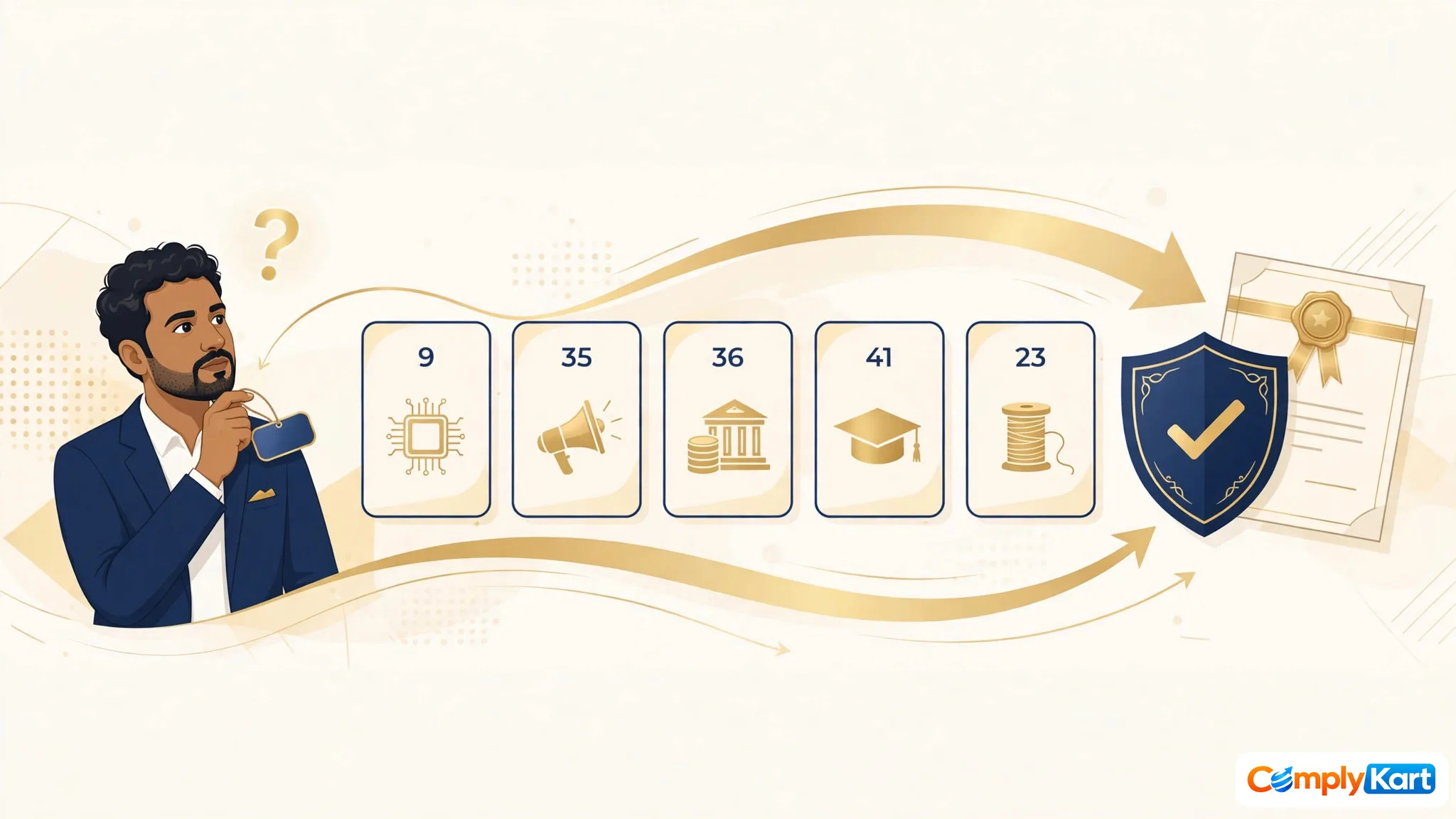
Your trademark does not protect your brand. It protects your brand in the classes you filed it in. File a software brand only in Class 9 and a rival can run the same name as a software service. File a clothing label only in Class 25 and someone else can open an online store under your name. The class is the whole game, and most founders pick it in five hurried minutes. This guide slows that decision down for the five classes people search for most — 9, 35, 36, 41 and 23 — then maps the other forty so you can see your full combination on one page.
The short answer: India sorts every trademark into 45 classes of the Nice Classification — 1 to 34 for goods, 35 to 45 for services. Downloadable software is Class 9, advertising and retail are Class 35, money and property services are Class 36, teaching and entertainment are Class 41, yarns and threads are Class 23. Each class costs ₹4,500 or ₹9,000 in government fees.
What a trademark class actually decides
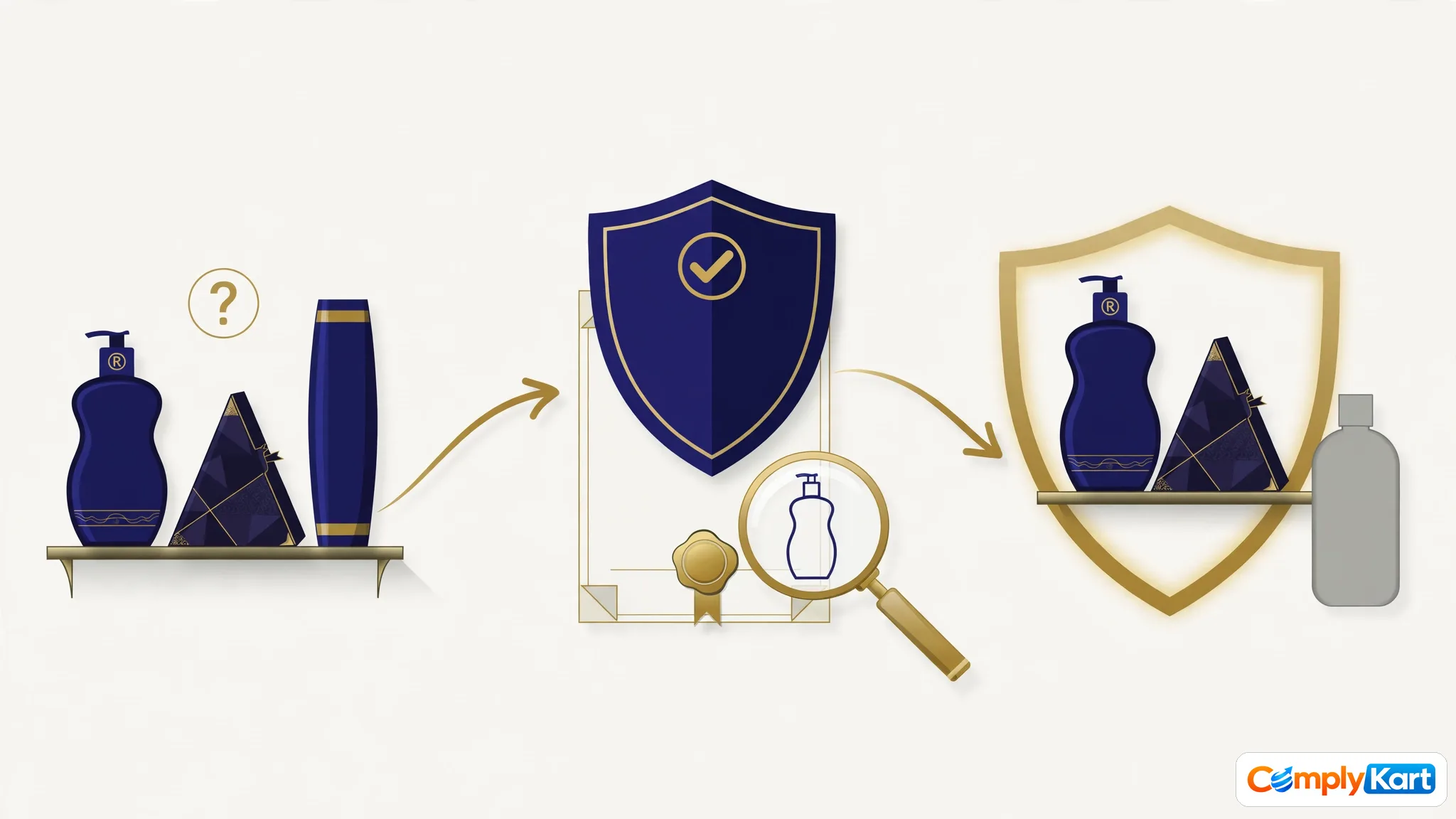
Think of the register as a train with 45 coaches. Your ticket books you a berth in one coach. It does not matter that the train carries your name — if a dispute breaks out three coaches down, your ticket does not cover it. That is how class protection works. A registration gives you the exclusive right to use the mark for the goods or services listed in your classes, and the right to stop others using a confusingly similar mark for similar goods or services. Outside those classes, you are mostly on your own, unless your mark is well known — a high bar most brands never reach.
The Registrar sorts every application under section 7 of the Trade Marks Act, 1999, using the International Classification of Goods and Services — the Nice Classification, maintained by WIPO. The Fourth Schedule of the Trade Marks Rules, 2017 adopts it, and the edition changes every January. The edition that matters right now is the 13th, in force for new applications from 1 January 2026. If the guide you are reading still talks about the 12th edition, it is out of date. I found one this week that still lists spectacles under Class 9. They moved.
The 2026 edition: what moved on 1 January 2026
Most years the January update is housekeeping. This one moved things founders actually file. Corrective spectacles, sunglasses and contact lenses moved out of Class 9 and into Class 10. Fire engines, lifeboats and life-saving rafts moved out of Class 9 and into Class 12. Smartglasses stayed in Class 9 — the lens is the product, the computer is the point. Heated clothing moved from Class 11 to Class 25. And AI delivered as a service sits in Class 42, where services belong.
Two things follow. First, if you filed before 2026, your registration stays valid in the class it was granted in — the Registry does not rewrite old certificates. Second, if you are filing now, the class your competitor used in 2024 may be the wrong class in 2026. Check the current edition, not last year's blog post. The free check is the public search on the IP India portal, which moved to a new address on 1 July 2026 — our IP India public search guide walks through it screen by screen, and it is the step to take before you spend a rupee on fees.
Class 9: software, electronics and instruments
Class 9 is the most-searched class in India, and the most misunderstood. Its heading covers scientific, nautical, surveying, photographic, cinematographic, optical, weighing, measuring, signalling, checking, life-saving and teaching apparatus; apparatus for recording, transmitting or reproducing sound and images; magnetic data carriers and recording discs; cash registers, calculating machines, data-processing equipment and computers; computer software; and fire-extinguishing apparatus.
In plain words: if you sell a thing with a chip in it, or a file a customer downloads, start here. Computers, phones, tablets, wearables, batteries, chargers, headphones, cameras, measuring instruments, safety gear, teaching apparatus — and, crucially, downloadable software and mobile apps, including AI software sold as a download.
The trap is the line between a product and a service. Downloadable software is Class 9. Software delivered online — a SaaS platform, cloud software, software development done for clients — is Class 42. A fintech app you sell as a download is 9; the same product offered as a subscription service is 42. Most tech businesses need both, and one application can cover both — you simply pay the fee for each class. File only in 9 and a rival can offer the same name as a service. File only in 42 and a rival can sell a downloadable app under it. I have watched founders learn this from an opposition notice, which is the most expensive classroom there is.
One more Class 9 habit to break: vague descriptions. Writing "electronics" or "software" on the form is a common cause of examination objections. Name the thing — "downloadable mobile application software for personal budgeting", not "software". The examiner classifies what you wrote, not what you meant.
Class 35: advertising, business and retail
Class 35 is the widest service class and the most misused. Its heading is short: advertising; business management, organisation and administration; office functions. Behind those few words sit advertising and marketing agencies, management consultancies, HR and recruitment firms, business administration and office support, franchising — and the one that catches everyone out, retail and wholesale services.
Retail is a service in trademark law, separate from the things sold. Class 35 covers the service of bringing goods together so customers can view and buy them, whether in a shop, a wholesale outlet or on a website. A D2C clothing brand files Class 25 for the garments and Class 35 for the shop that sells them. A marketplace that sells other people's goods files 35 as its main class. An online seller who files only in the product class has protected the product and left the shop door open — a competitor can open an online store under the same name selling similar goods, and the product-class registration will not stop them.
What Class 35 does not cover matters just as much. It does not cover the physical products being sold — those need their own goods classes. It does not cover software development, apps or IT services — that is Class 42, however much marketing your agency does for tech clients. And it does not cover financial advice, which is Class 36. If your business makes a product and sells it, 35 is an addition to the goods class, never a replacement for it.
Class 36: money, insurance and property
Class 36 covers financial, monetary and banking services; insurance services; and real estate services. If your business handles someone else's money, risk or property, this is your class. Banks, NBFCs, lending and payment platforms, investment advisers, wealth managers, stockbrokers, insurers and insurance brokers, and real estate agents, property managers and rent collectors all file here.
The fintech filing is where people get it wrong in both directions. A payments app usually needs three classes: 9 for the downloadable app, 36 for the payment service itself, and 42 for the software platform behind it. File only in 36 and the app is unprotected. File only in 9 and the service is unprotected. The same logic applies to an insurer with an app, or a broker with a portal.
The property trap is the twin of the fintech one. Real estate agency, brokerage, leasing, management and rent collection are Class 36. But construction and development work — building the flats — is Class 37. A developer who only builds files 37. A developer who also sells or leases the flats usually files in 36 as well. The two classes describe two different businesses that happen to share a hoarding.
Class 41: teaching, training and entertainment
Class 41 covers education; providing of training; entertainment; sporting and cultural activities. Schools, coaching centres, tuition, e-learning platforms, workshops and certification courses, publishing, photography, organising events, gyms, sports coaching and gaming services all sit here. It is the class for anyone whose product is knowledge, delivered live.
The edtech trap mirrors the software trap. A live online course — a teacher, a class, a schedule — is Class 41. A pre-recorded course sold as a downloadable file is a Class 9 good. Most edtech businesses do both and need both classes. Our edtech trademark guide works through the full combination — 41 for the teaching, 9 for the recorded material, 42 where a platform is offered as a service — and it is worth reading before you file, because the three-way split is exactly where founders file one class and lose the other two. The same split applies to a gym with an app, a music school with recorded lessons, or a coaching institute with a test-prep portal.
Class 23: yarns and threads
Class 23 is the smallest class in this guide and the one that shows how precise the system is. Its heading is a single line: yarns and threads for textile use. Sewing thread, knitting yarn, weaving yarn, embroidery thread — if it is spun and sold to be made into something else, it is Class 23.
The precision is the point. Yarn is 23, fabric woven from it is 24, garments cut from the fabric are 25, and work done to order for others — dyeing, weaving or tailoring as a service — is 40. A textile business that spins, weaves and sells garments can genuinely need four classes, and each one protects a different stage of the same supply chain. File only in 25 and a rival can sell yarn under your name to your own weavers. The chain matters more than the size of any single class.
The rest of the 45: a compact map
The five classes above are the ones people search for. The other forty are where the rest of your business lives. Use this table to spot your combination, then check each heading against the current Nice edition before filing — headings change, and a one-line summary is a map, not the territory.
| Classes | What they cover, in one line each |
|---|---|
| 1–8 | Chemicals (1), paints (2), cleaning and cosmetics (3), fuels and oils (4), pharmaceuticals (5), metals (6), machines (7), hand tools and cutlery (8). |
| 10–22 | Medical apparatus (10), lighting and heating (11), vehicles (12), firearms (13), jewellery (14), musical instruments (15), paper and stationery (16), rubber and plastics (17), leather goods (18), building materials, non-metallic (19), furniture (20), household utensils (21), ropes and sails (22). |
| 24–34 | Fabrics (24), clothing and footwear (25), lace, ribbons and buttons (26), carpets and floor coverings (27), games and toys (28), meat and preserved foods (29), staple foods — tea, coffee, rice, spices, bakery (30), agricultural products (31), beer and non-alcoholic drinks (32), alcoholic drinks except beer (33), tobacco products (34). |
| 37–40 | Construction and repair (37), telecoms (38), transport and travel (39), treatment of materials — manufacturing and processing for others (40). |
| 42–45 | Scientific and technological services, software and design (42), food and drink services, hotels (43), medical and veterinary services, agriculture (44), legal and security services, personal and social services (45). |
Two patterns in that table are worth noticing. First, the goods classes follow the supply chain — raw material, component, finished product — so a manufacturer often needs two or three adjacent classes. Second, the service classes follow the customer — the same business can be a retailer (35), a lender (36), a builder (37) and a software provider (42) at once. If your business does four things, expect four classes.
How to pick your classes in five steps
First, write down everything you sell and everything you do, as a customer would describe it — not as your pitch deck does. Second, split the list into things (goods) and work done for others (services). Third, match each item to a class heading in the current Nice edition, using the official wording rather than a blog's summary. Fourth, run the public search on the IP India portal for each class — a clear search in the wrong class tells you nothing. Fifth, file one TM-A application covering every class you need, with a fee for each class. One application can cover several classes under section 18(2) of the Act; the Registry calls a multi-class application Class 99, which is a filing label, not a 46th class. Our Class 99 and multi-class guide explains when one application beats several, and our multi-class versus single-class comparison settles the cost question.
And decide before you file whether the word or the logo comes first. A word mark protects the name in any styling; a device mark protects that exact design. Most founders should read our word mark versus logo mark guide before spending on either, because the class choice and the mark choice interact — a logo filed in the wrong class is wrong twice.
What it costs: fees per class, worked out
The government fee is charged per class, per application. Filing online, an individual, a startup or a small enterprise pays ₹4,500 per class; any other applicant pays ₹9,000 per class. There is no discount for filing several classes at once — the arithmetic is just multiplication.
| Applicant | Fee per class (online) | 3 classes | 5 classes |
|---|---|---|---|
| Individual / startup / small enterprise | ₹4,500 | ₹13,500 | ₹22,500 |
| Company / other applicant | ₹9,000 | ₹27,000 | ₹45,000 |
Take a real example. A fintech startup files for its payments brand in three classes — 9 for the app, 36 for the payment service, 42 for the platform. As a startup it pays 3 × ₹4,500, which is ₹13,500 in government fees. The same three classes filed by a private limited company that is not a recognised startup cost 3 × ₹9,000, which is ₹27,000. Professional fees sit on top of that, and they vary — but the government fee is fixed, published, and worth knowing before anyone quotes you a package. A registration lasts ten years from the filing date, and renewal is a separate filing — our trademark renewal guide covers the Form TM-R fees and the six-month grace period, so budget for year ten while year one is still fresh.
Five mistakes that lose filings
Filing one class when the business needs three. The classic is the app-only filing — 9 without 42, or 42 without 9. Map the business first, then file.
Filing the product class and forgetting the shop. A D2C brand in 25 without 35 has protected the garment and left the store unprotected.
Using last year's edition. Eyewear moved in January 2026. Any guide, checklist or agent note from 2025 that puts spectacles in Class 9 is wrong now.
Writing vague descriptions. "Software", "business services" and "electronics" invite objections. Name the specific goods or services, in the Registry's own words where possible.
Searching in the wrong class. A clear search result means nothing if you searched Class 9 for a Class 42 service. Search every class you intend to file in, not just the first one.
Frequently asked questions
Can I file a trademark in more than one class?
Yes. One TM-A application can cover several classes under section 18(2) of the Trade Marks Act, 1999, with the government fee charged for each class. The Registry labels a multi-class application as Class 99 — that is a filing label, not a 46th class.
My business sells on its own website. Do I need Class 35 as well as the product class?
Usually, yes. The product class protects the goods; Class 35 protects the retail service of selling them, including through your own online store. Without it, a competitor can run a store under your name for similar goods.
What happens if I file in the wrong class?
The application can draw an objection, and even if it slips through, the registration protects only what the class covers. The practical fix is a fresh filing in the right class — which means paying the fee again and losing the earlier filing date for that protection.
Does a trademark in one class stop someone using the same name in another class?
Generally no. Protection is class-specific. The exception is a well-known mark, which gets wider protection — but well-known status is hard to earn and is not something a new brand can rely on.
How long does a trademark last, and does the class affect renewal?
Ten years from the filing date, renewable for further ten-year periods in Form TM-R. The renewal fee is charged per class, so a three-class registration costs three renewal fees — worth knowing before you file in classes you will never use.
If the class list still feels uncertain, that is the point where a short professional check pays for itself. Our trademark registration service covers the search, the class mapping and the filing, and the fee calculator on our compliance fee calculator page will give you the government-fee maths for your combination before you commit. The full 45-class list, for reference, sits in our trademark classes overview — use it as the map, and this guide as the route through the five classes that matter most.




Comments
No comments yet — ask the first question below.
Join the discussion
Questions go straight to our expert desk. Comments appear after a quick review — no spam, no noise.