

Trademark for Restaurants & Cafes: Protect Your Brand Name Before You Expand or Franchise
You built the name over years — regulars ask for it, the Zomato page carries thousands of reviews. Without a filed trademark, whoever files first owns it: a stranger in another city can apply for your restaurant's name tomorrow.
The short answer: File your restaurant name in Class 43, add Class 35 if franchising or packaged retail is planned, and file the word mark first. E-filing is ₹4,500 per class for individuals, startups and small enterprises, ₹9,000 for companies. TM number same-day; certificate in 12–18 months if unopposed.
Your FSSAI license does not protect your name
Owners show me the FSSAI license and say "we are registered." Registered to do what? It is permission to sell food — nothing about who owns the brand on the board. Think of it like a car: the FSSAI license is the driving licence, the trademark is the RC book. Food licence, GST number, company incorporation — all driving licences, none the RC for your name.
Which trademark classes does a restaurant need?
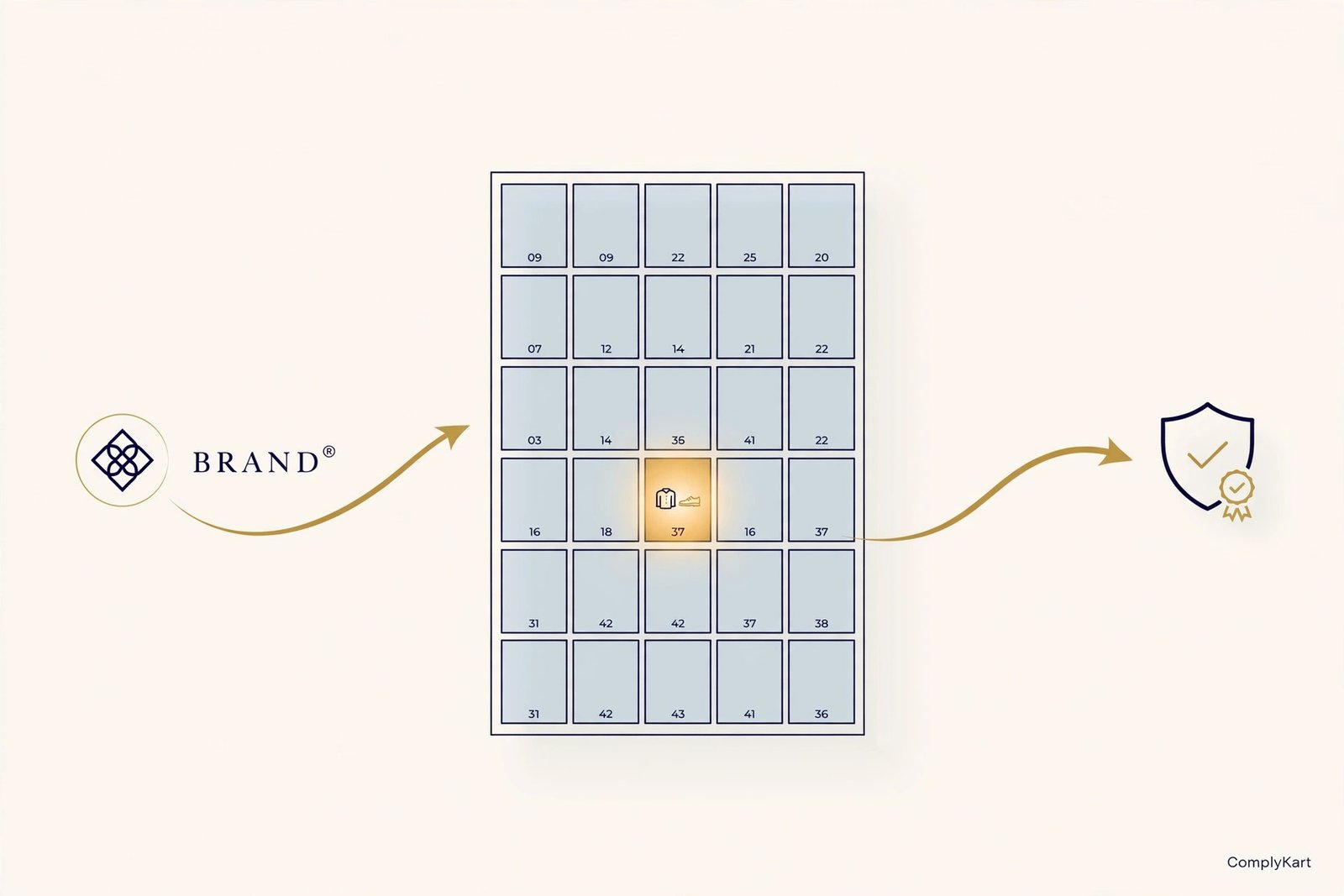
Trademarks are registered class by class, 45 in all — like parking slots in different buildings. A slot booked in the restaurant building does not stop someone parking under your name in the packaged-foods building.
Class 43 — file first, always. Food and drink services: restaurants, cafes, cloud kitchens, catering, takeaway counters. Serve food for money: this is home.
Class 35 — file when franchising or retail is on the roadmap. Covers business management and retail services: licensing your brand to a franchisee, or selling your spice mixes from your counter or website. Franchisors often discover this class only when their lawyer asks for it during the franchise agreement — file it before then.
Class 30 (and 29/32) — for the packaged-goods play. Bottle your signature sauce under the restaurant's name and you have entered the goods business: coffee, tea, snacks, sauces and baked mixes sit in Class 30; dairy and prepared foods in 29; beverages in 32. Class 43 does not cover the retail pack on a shelf.
Start with 43; add 35 when franchising gets serious, and the goods classes when packaged products leave your kitchen. Each class costs a separate fee — file what you need now.
Word mark first, logo second
Owners want to file the logo first. Reorder that instinct. A word mark protects the name itself, in any font or colour; a logo mark protects one specific visual. File only the logo, redesign the signboard in year four, and your registration covers a design you no longer use.
A word mark is owning the name itself; a logo mark is owning one photograph of yourself. File the word mark first — it survives every rebrand — and add the logo once the design is final. (Word mark vs logo mark, explained.)
What does it cost?
Cheaper than a weekend of food cost. Form TM-A e-filing is ₹4,500 per class for individuals, startups and small enterprises, ₹9,000 per class for other companies and LLPs. Get a written quote covering the application plus the examination-reply stage — that is where the real work lands. The fee is non-refundable even if refused, so search the name before filing. Renewal (Form TM-R) is ₹9,000 per class every ten years.
How long does registration take?
File TM-A online, get a TM number within hours, and start using ™ — "I have claimed this."
Then the queue: examination takes 6–12 months. The examiner may object — usually descriptiveness or similarity — and you get 30 days to reply; a well-drafted reply clears most objections. If accepted, the application is advertised in the Trade Marks Journal for four months. No opposition, and the certificate follows: 12–18 months start to finish.
® is reserved for registered marks — using it early is an offence under Section 107 of the Trade Marks Act, 1999, carrying a penalty. ™ from day one; ® after the certificate.
Franchising without a registered mark is a gamble
A franchise is, at its legal core, a trademark license: you let someone pay to trade under your name. Own nothing in law and you have nothing to license.
The failure mode: three franchisees signed, the brand grows, then franchisee two files their own application for your name, or refuses to stop using it after termination. Without a registered mark you argue from invoices and Instagram posts. With one, from a certificate.
File before the first franchise conversation. Franchisees now ask for the trademark application number during due diligence — "we will file it soon" does not survive that question. Your filing date becomes your priority date.
Five mistakes restaurant owners keep making
- A name that cannot be protected. "Delhi's Best Biryani" works as a signboard, but Section 9(1)(b) refuses merely descriptive marks. Quirkier names protect better.
- Assuming the FSSAI license covers the brand. It does not. Neither does GST registration, the trade licence or the company name.
- Waiting for outlet two. The most expensive trademark is filed after the name becomes valuable. File when the name is chosen.
- Filing only the logo. The year-four rebrand leaves you exposed. Word mark first, logo second.
- Printing ® before registration. Section 107 offence. ™ until the certificate arrives.
What to do this week
Search the name on the IP India public search first, fix your classes — 43 for certain, 35 if franchising or retail is in the plan — and file the word mark: the TM number arrives same-day. The trademark filing walkthrough covers the process; the FSSAI state license guide covers the food-side paperwork — different licence, different job, both needed.
FAQs
Can I trademark my restaurant name if a similar name exists?
Depends on similarity and class. The Registry weighs phonetic, visual and conceptual similarity within related classes — "Cafe Aroma" vs "Café Aromaa" in Class 43 will collide. Search before filing, not after.
Do I need this for a single small cafe with no expansion plans?
Plans change, and filings are dated. A one-outlet cafe that becomes two faces chain-level risks. At ₹4,500–₹9,000 per class, early filing is the cheapest insurance a food brand buys. See how fashion brands make the same class-timing call.
Can my franchisee use my trademark?
Yes — the franchise agreement licenses your registered mark for defined outlets, territory and term, with quality-control conditions. But the license is only as strong as your ownership: register first, then license.
What if someone else registers my restaurant's name?
You can oppose or seek cancellation, and prior use counts as evidence — but you fight uphill, pay lawyers, and may rebrand mid-stream. The filing fee is small next to that bill.
Does a trademark protect my recipes?
No — it protects the name and logo, not what is in the kadhai. Recipes survive, if at all, as trade secrets: keep the formulation confidential.
How is a trademark different from the FSSAI license?
FSSAI is permission to sell food — safety compliance, renewed periodically. A trademark is ownership of the brand name — identity, renewed every ten years. You need both; the compliance fee calculator stacks up the first-year bill.




Comments
No comments yet — ask the first question below.
Join the discussion
Questions go straight to our expert desk. Comments appear after a quick review — no spam, no noise.