
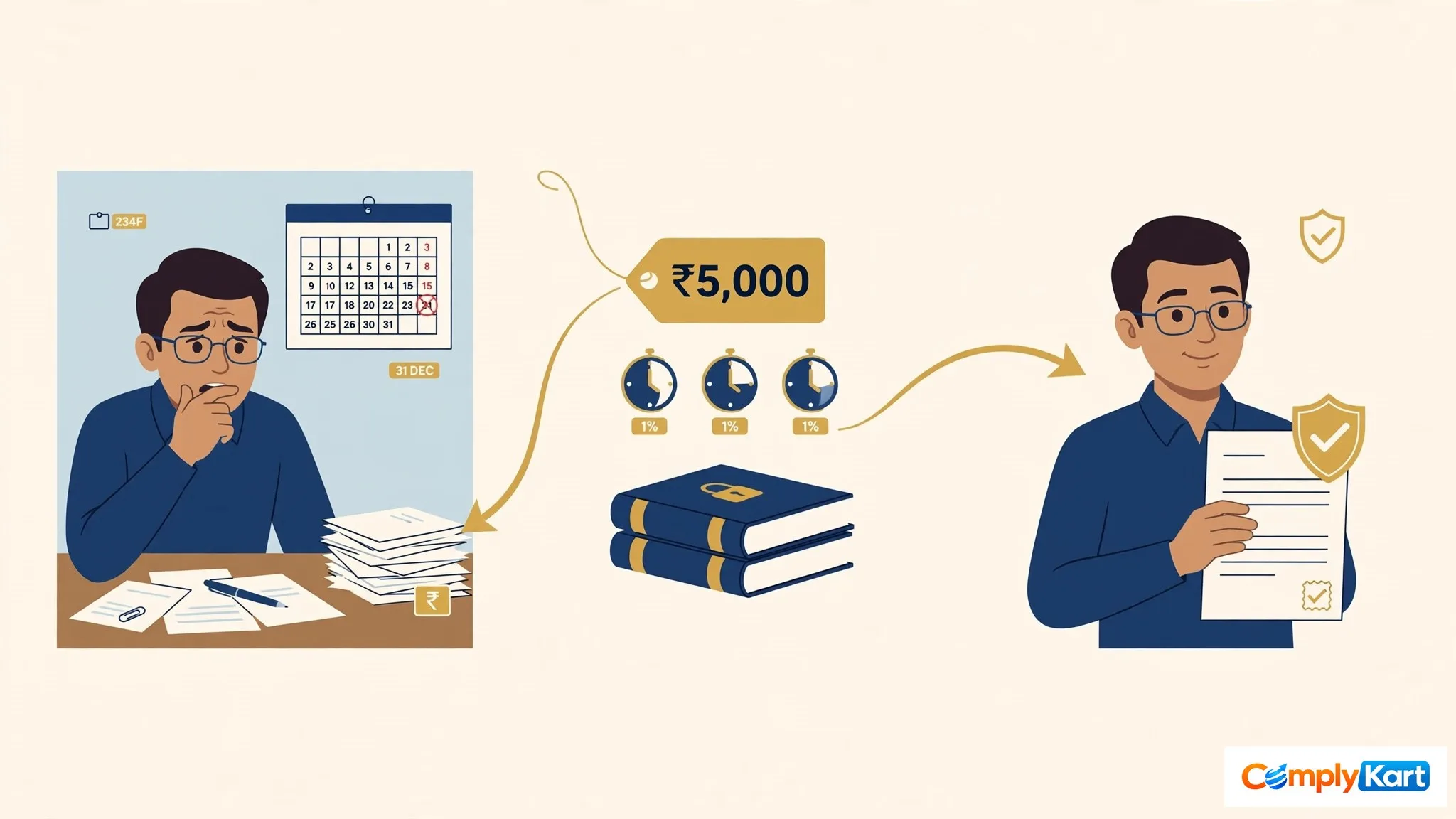
The original deadline passed and the return isn't filed. Every week since, the cost of fixing it has been quietly compounding. Good news first: for AY 2026-27, you can still file a belated return until 31 December 2026. The rest: it costs more than the fee, and the fee is the smallest part.
The short answer: A belated return under Section 139(4) can be filed up to 31 December 2026 for AY 2026-27. It carries a mandatory late fee under Section 234F — ₹5,000, or ₹1,000 if total income doesn't exceed ₹5 lakh — plus 1%-per-month interest under Section 234A on unpaid tax. Belated filers lose the right to carry forward most losses.
What is the Section 234F late fee — really?
Section 234F is a fee, not a penalty in the technical sense, and it's mandatory — no officer can waive it, no "first offence" leniency exists. ₹5,000 if your total income exceeds ₹5 lakh; ₹1,000 if it doesn't. Below the basic exemption limit, where you weren't required to file at all, there's no fee.
But the fee is the visible part. Interest under Section 234A runs at 1% per month — or part of a month — on any unpaid tax, from the original due date until you actually file. Salaried staff with full TDS usually owe only the fee; freelancers and business owners with unpaid balances face 234A on top, and the months keep counting. (Advance tax through the year keeps 234A away — our advance tax guide covers the December instalment.)
What do you lose by filing a belated return?
This is where the real damage sits. A belated return cannot carry forward business, capital or speculative losses — only house property loss and unabsorbed depreciation survive. If you had F&O or share-market losses this year, filing late can cost multiples of the ₹5,000 fee in lost set-offs against future gains.
Think of it like insurance bought after the accident: the ₹5,000 fee is the premium, and paying it gets you cover — but the claim for the accident that already happened isn't payable. Your business and capital losses from this year are that accident. A belated return pays the premium and still can't claim them.
Two more quiet losses: with business income, you lose the option to choose your tax regime for the year — the new regime becomes compulsory — and any refund due gets processed later than everyone else's. None shows up as a line item. All of them cost money.
Crossed the audit threshold? A missed tax audit report carries its own penalty under Section 271B — half a percent of turnover, up to ₹1.5 lakh — and a belated return doesn't fix a missing audit. Get the audit position sorted before you file.
How do you file a belated return?
Five steps. One: gather Form 16, Form 26AS, AIS/TIS, bank interest certificates and capital-gains statements — reconcile them before touching the portal. Two: compute the tax (our income-tax calculator handles the slab maths), add 234F and 234A, pay the full balance first. Three: on the income-tax portal, start the AY 2026-27 return — pick the right form for your income mix (our ITR-form guide maps ITR-1 to ITR-7) — and file under Section 139(4), the belated option. Four: pay the fee when prompted. Five: e-verify within 30 days — an unverified return is treated as not filed. Double-check the section reads 139(4) before submitting; the wrong section doesn't get fixed by good intentions.
Don't confuse belated with revised. A revised return under Section 139(5) fixes a return you filed on time — for AY 2026-27 it's available till 31 March 2027. A belated return is for not filing at all. Filed on time but found a mistake? Revise. Never filed? Belated. The wrong label changes which deadlines and consequences apply.
Skip filing entirely? The department's non-filer analytics have gotten good. A 142(1) notice followed by a best-judgment assessment — where the officer computes your income without your cooperation — is worse in every dimension than a belated return with a ₹5,000 fee.
What is the e-verification trap?
Filing is half the job. E-verify within 30 days — via Aadhaar OTP, net banking or DSC — or the return is treated as never filed. The belated window doesn't extend because your verification lapsed. People file on 28 December, forget to verify, and discover in January that legally they filed nothing. Then download the acknowledgement and the ITR-V, and keep both with your records for the year.
What if 31 December passes too?
Then the belated window is closed, and your only route is an updated return — ITR-U under Section 139(8A), up to 31 March 2031, carrying additional tax of 25% to 70% on top of everything else. The hierarchy is clear: file on time, else file belated, else pay the ITR-U premium. Never let it reach the third stage by choice.
Belated ITR: quick answers
How much is the Section 234F late fee?
₹5,000 if your total income exceeds ₹5 lakh; ₹1,000 if it doesn't. Mandatory — no officer can waive it, no "first offence" leniency. Below the basic exemption limit, where you weren't required to file at all, there's no fee.
What do I lose by filing late besides the fee?
The quiet losses: no carry-forward of business, capital or speculative losses (only house property loss and unabsorbed depreciation survive); with business income, you lose the year's tax-regime choice and the new regime becomes compulsory; any refund gets processed later. For F&O or share-market losses, lost set-offs can cost multiples of the ₹5,000 fee.
How long do I have to e-verify a belated return?
30 days from submission — Aadhaar OTP, net banking or DSC. An unverified return is treated as never filed, and the belated window doesn't extend because your verification lapsed. Verify the same day you file; it takes two minutes.
What if 31 December passes and I still haven't filed?
Then the belated window is closed and your only route is ITR-U under Section 139(8A), up to 31 March 2031 — carrying additional tax of 25% to 70% on top of everything else. File on time, else file belated, else pay the ITR-U premium. And your business has its own calendar running in parallel — our compliance fee calculator totals the year's ROC and tax filing costs so nothing else slips.
Two months left, one fixed fee, interest that grows monthly, and losses that vanish if you wait. File this week — the portal slows in the last ten days of December, and "the website wasn't working" has never been accepted as an excuse. If the computation or the loss position needs a professional eye, our ITR filing team reviews exactly these cases every week.



Comments
No comments yet — ask the first question below.
Join the discussion
Questions go straight to our expert desk. Comments appear after a quick review — no spam, no noise.