
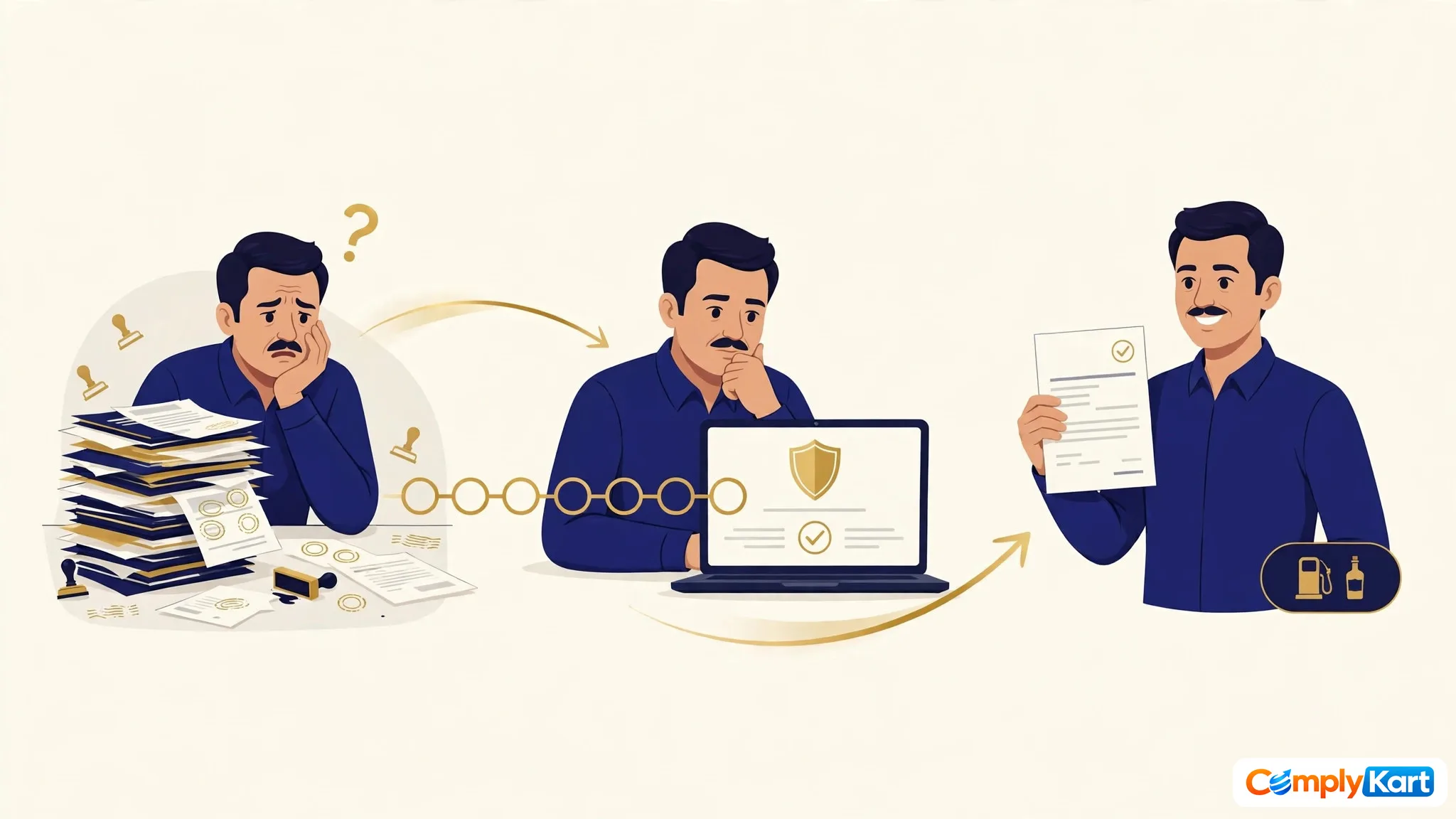
IN BRIEF
VAT was India's state-level tax on the sale of goods from 1 April 2005, with each state setting its own rates and rules while services were taxed separately. GST, in force from 1 July 2017 under the CGST Act, 2017, replaced VAT and most other indirect taxes with one national tax on the supply of goods and services. VAT still applies to alcoholic liquor and five petroleum products.
Short answer: VAT was India's state-level tax on the sale of goods from 1 April 2005, with each state setting its own rates. GST replaced it on 1 July 2017 with one national tax on goods and services, a credit chain and the same rules in every state. VAT did not vanish — it applies to alcoholic liquor and five petroleum products.
Nine years after GST arrived, I still get asked this question in client meetings. Sometimes by a trader who started under VAT and never quite trusted the new system. Sometimes by a founder pricing a product and wondering why the same item carries a different tax in a different state. And sometimes by a student who needs the difference in plain words, not a textbook paragraph.
The confusion is fair. GST replaced VAT, but VAT still shows up on your petrol bill. GST has two main rates now, but half the internet still lists four. And the old system's paperwork — CST, Form C — still exists for a handful of goods. So here is the comparison as it stands today, with the numbers you can check and the traps worth avoiding.
What was VAT?
Value Added Tax was the tax each state levied on the sale of goods inside that state. It arrived across Indian states from 1 April 2005, replacing the old sales tax system. The idea was sound: tax only the value added at each stage, and let a business claim credit for the VAT it had already paid on its purchases.
Two limits broke it. First, every state ran its own version — its own rates, its own forms, its own registration threshold, its own return dates. A business selling in five states dealt with five tax departments. Second, VAT covered goods only. Services lived in a separate world run by the Centre under service tax, and the two credit chains barely spoke to each other. A manufacturer who paid service tax on a logistics contract could not set it off against the VAT on the goods he sold.
Worse, the taxes stacked. Central excise duty sat inside the price before VAT was charged on it, so you paid tax on tax. Buy goods from another state and you paid Central Sales Tax — CST — which mostly became a cost, not a credit. That stacking had a name: cascading. It is the single biggest reason VAT had to go.
What is GST?
The Goods and Services Tax is one indirect tax on the supply of goods and services, in force from 1 July 2017 under the CGST Act, 2017 and the Constitution (One Hundred and First Amendment) Act, 2016. It subsumed 17 indirect taxes and 13 cesses — VAT, central excise, service tax, CST, entry tax, luxury tax, entertainment tax and the rest — into a single framework.
Three things changed at a stroke. Goods and services came under one tax, so a business could claim credit on both. The credit chain ran across state borders through IGST, so tax paid in one state no longer died at the border. And the law, the rates and the portal became the same in every state, so a business in Jaipur and a business in Kochi file the same returns on the same website.
Think of it like a road with toll booths. Under VAT, every town had its own booth, each one charged you on the tolls you had already paid, and the booth for services did not accept the receipts from the booth for goods. Under GST there is one toll system, and every toll you paid on the way gets knocked off your final bill. The booth is still there — you still pay — but you stop paying tax on tax.
VAT vs GST: the differences that actually matter
| Aspect | VAT (before 1 July 2017) | GST (today) |
|---|---|---|
| What it covers | Sale of goods only; services taxed separately under service tax | Supply of goods and services, in one law |
| Who makes the rules | Each state — its own Act, rates, forms, thresholds | Centre and states together, through the GST Council; one law, one portal |
| Tax base | Origin-based: tax where the goods were sold from | Destination-based: tax where the goods or services are consumed |
| Input tax credit | Credit on goods, mostly within the same state; service tax credit sat in a separate chain | One credit chain across goods and services, and across states through IGST |
| Cascading (tax on tax) | Common — excise sat inside the VAT base; CST on inter-state purchases was largely a dead cost | Largely removed, though some blocked credits remain under section 17(5) |
| Rates | Varied by state and product — typically 4–5% for essentials and 12.5% for general goods in many states | Two main slabs since 22 September 2025: 5% and 18%, plus 40% for select luxury and sin goods |
| Registration | Separate registration in every state, each with its own threshold | One registration per state on a common portal; ₹20 lakh general threshold, ₹40 lakh for suppliers dealing only in goods |
| Inter-state sales | CST at 2% against Form C, largely non-creditable | IGST, fully creditable in the destination state |
| Compliance | State VAT returns plus separate service tax returns, different formats and dates | Common returns (GSTR-1, GSTR-3B) on one portal, same dates everywhere |
| Where it still applies | — | VAT still applies to alcoholic liquor and five petroleum products (see below) |
The same ₹100 product under VAT and under GST
Tables tell you the structure. A worked example shows you the money. Take a simple illustration, using the rates that applied to general goods in Delhi before GST — 12.5% central excise and 12.5% VAT — and compare it with today's 18% GST.
Under VAT: a manufacturer sells goods worth ₹100. Excise at 12.5% adds ₹12.50, so the price becomes ₹112.50. The dealer then charges VAT at 12.5% — not on ₹100, but on ₹112.50. That is ₹14.06 of VAT. Total tax collected on a ₹100 product: ₹26.56. The ₹1.56 extra is tax charged on tax already paid.
Under GST: the same ₹100 product attracts 18% GST — ₹18. And here is the part the table hides: every business in the chain claims credit for the GST it paid on its purchases, so the tax that actually sticks is 18% of the value each business added, not 18% of a price already loaded with tax. Run your own numbers for your product on the compliance fee calculator before you quote a customer — the difference between ₹26.56 and ₹18 on every ₹100 of goods is the margin the old system quietly ate.
What are the GST rates today?
This is where a lot of online content is out of date. Before 22 September 2025, GST had four main slabs — 5%, 12%, 18% and 28% — plus cesses. The 56th GST Council meeting on 3 September 2025 rationalised them, and the new structure took effect on 22 September 2025 through Notification No. 9/2025–Central Tax (Rate) for goods and Notification No. 15/2025–Central Tax (Rate) for services.
Today, most goods and services fall under two slabs: 5% for essentials and mass-use items, and 18% as the standard rate. A 40% rate applies to a narrow list of luxury and sin goods — tobacco, pan masala, aerated drinks, premium cars and the like. The 12% and 28% slabs are gone as general categories. If a supplier, a marketplace listing or an old blog still quotes 28% on your product, check the current notification before you invoice — the GSTR-9 guide for FY 2025-26 walks through how the revised rates flow into the annual return. Restaurants sit in a special corner of this picture: a standalone restaurant charges 5% without input tax credit, while a restaurant in specified premises charges 18% with credit, and the choice between them is explained in our GST guide for restaurants.
Is VAT still applicable in India?
Yes — and this is the part most comparison pages rush past. VAT never died; it shrank to the goods GST does not cover.
Alcoholic liquor for human consumption is outside GST by the Constitution itself. Article 366(12A) defines GST as a tax on the supply of goods and services other than alcoholic liquor for human consumption. States tax it under their own excise and VAT laws, and bringing it into GST would need a constitutional amendment. Your state's liquor shop still runs on VAT.
Five petroleum products — petroleum crude, high-speed diesel, motor spirit (petrol), natural gas and aviation turbine fuel — sit in a different position. Section 9(2) of the CGST Act says GST will apply to them from a date the Government notifies on the GST Council's recommendation. No such date has been notified. On 8 December 2025 the Government clarified in the Lok Sabha that these products are not presently proposed to be brought under GST unless the Council recommends it. So the petrol you buy today carries central excise plus state VAT, and no input tax credit flows from it — a transport business cannot claim GST credit on diesel the way it can on any other input.
One more survivor: the Central Sales Tax Act, 1956 still governs inter-state sales of these six goods, and Form C still matters for them. If you trade in petroleum products or liquor across state borders, you are still living partly in the pre-GST world — get the documentation right or the 2% CST becomes your cost.
How do registration and compliance differ?
Under VAT, a business selling in five states registered five times, filed five sets of returns, and kept five sets of records. Thresholds differed by state, and the service tax registration was a separate exercise altogether.
Under GST, registration is on one portal, and the threshold rules are the same everywhere. Section 22 of the CGST Act makes registration compulsory once aggregate turnover in a financial year crosses ₹20 lakh — ₹10 lakh in the notified special-category states. Notification No. 10/2019–Central Tax raises that to ₹40 lakh for a person engaged exclusively in supplying goods, with exclusions for ice cream, pan masala and tobacco products and for people who need compulsory registration under section 24. Cross ₹20 lakh because of a single taxable service alongside your goods, and you fall back to the ₹20 lakh limit — a trap that catches traders who take on a small service contract. If you are starting out, GST registration is the first step, and it is worth getting the threshold call right before you cross it rather than after a notice arrives.
Compliance follows the same pattern. One portal, one set of returns — GSTR-1 for outward supplies, GSTR-3B for the summary return and payment — and the same due dates in every state. The trade-off is that GST asks for more detail, more often, and matches your returns against your suppliers' returns. VAT let errors sit quietly for years; GST flags a mismatch in the same month.
5 mistakes people still make about VAT and GST
- Quoting the old slabs. 12% and 28% stopped being general GST rates on 22 September 2025. Check the current rate before every price list revision.
- Assuming VAT is dead. It lives on in petrol, diesel and liquor. A business that buys diesel cannot claim input tax credit on it, and a bar cannot pass GST credit to its customers on liquor.
- Claiming credit on everything. Section 17(5) blocks credit on several categories — motor vehicles, food and beverages, personal consumption, to name the common ones. Credit is a right with conditions, not a refund on every purchase.
- Treating the ₹40 lakh threshold as universal. It applies only to suppliers dealing exclusively in goods, and it falls away the moment you add a taxable service.
- Ignoring the CST survivor. Inter-state sales of petroleum products and liquor still run under the CST Act with Form C. Treat them like any other inter-state sale and the tax becomes your cost.
Should you handle this yourself or get help?
For a straightforward business — one state, one product line, clean purchase records — GST is genuinely manageable once the registration and the first two returns are done. The portal does the arithmetic; your job is feeding it correct invoices on time.
Get help when the picture has edges: you deal in petroleum products or liquor, you sell across states, you claim large input tax credits, or a notice has already arrived. The cost of a wrong rate or a missed credit is usually a multiple of the fee for getting it checked. And if your business still has old VAT-era assessments open — many states are still closing those files — do not assume GST made them disappear. It did not.
Frequently asked questions
What is the main difference between VAT and GST?
VAT was a state-level tax on the sale of goods only, with each state setting its own rates and rules. GST is one national tax on the supply of goods and services, with the same law and rates across India and a single input tax credit chain. GST also removed most tax-on-tax cascading that VAT could not fix.
Is VAT still applicable in India after GST?
Yes, for a small set of goods. VAT still applies to alcoholic liquor for human consumption, which the Constitution keeps outside GST, and to five petroleum products — crude, petrol, diesel, natural gas and aviation turbine fuel — on which the GST levy has not yet been notified under section 9(2) of the CGST Act.
What are the GST rates in India now?
From 22 September 2025, most goods and services attract either 5% or 18% GST, with a 40% rate for select luxury and sin goods such as tobacco, pan masala, aerated drinks and premium cars. The old 12% and 28% slabs were abolished as general categories by the 56th GST Council's rate rationalisation.
Which is better, VAT or GST?
For most businesses, GST — one law, one portal, credit across goods, services and states, and no tax on tax. VAT was simpler in one narrow sense: fewer returns and less invoice-level matching. But that simplicity came with cascading, border friction and five different rulebooks for a five-state business.
Do I need GST registration if my turnover is below ₹20 lakh?
Generally no, unless you fall under compulsory registration — inter-state supply of goods, e-commerce sellers in some cases, or reverse-charge liability, for example. Voluntary registration is allowed and sometimes worth it if your buyers need input tax credit on your supplies. Check section 22 and section 24 of the CGST Act for your exact position.
VAT and GST are not two names for the same thing. One was a state tax on goods that stacked tax on tax; the other is a national tax on supply that gives the tax back at every step it was already paid. The comparison matters less as history than as a working fact: your prices, your credits and your registration all run on the GST side now — except at the petrol pump and the liquor shop, where VAT never left. If you are unsure which side a product of yours falls on, talk to our GST team before the invoice goes out, not after the notice comes in.


Comments
No comments yet — ask the first question below.
Join the discussion
Questions go straight to our expert desk. Comments appear after a quick review — no spam, no noise.