
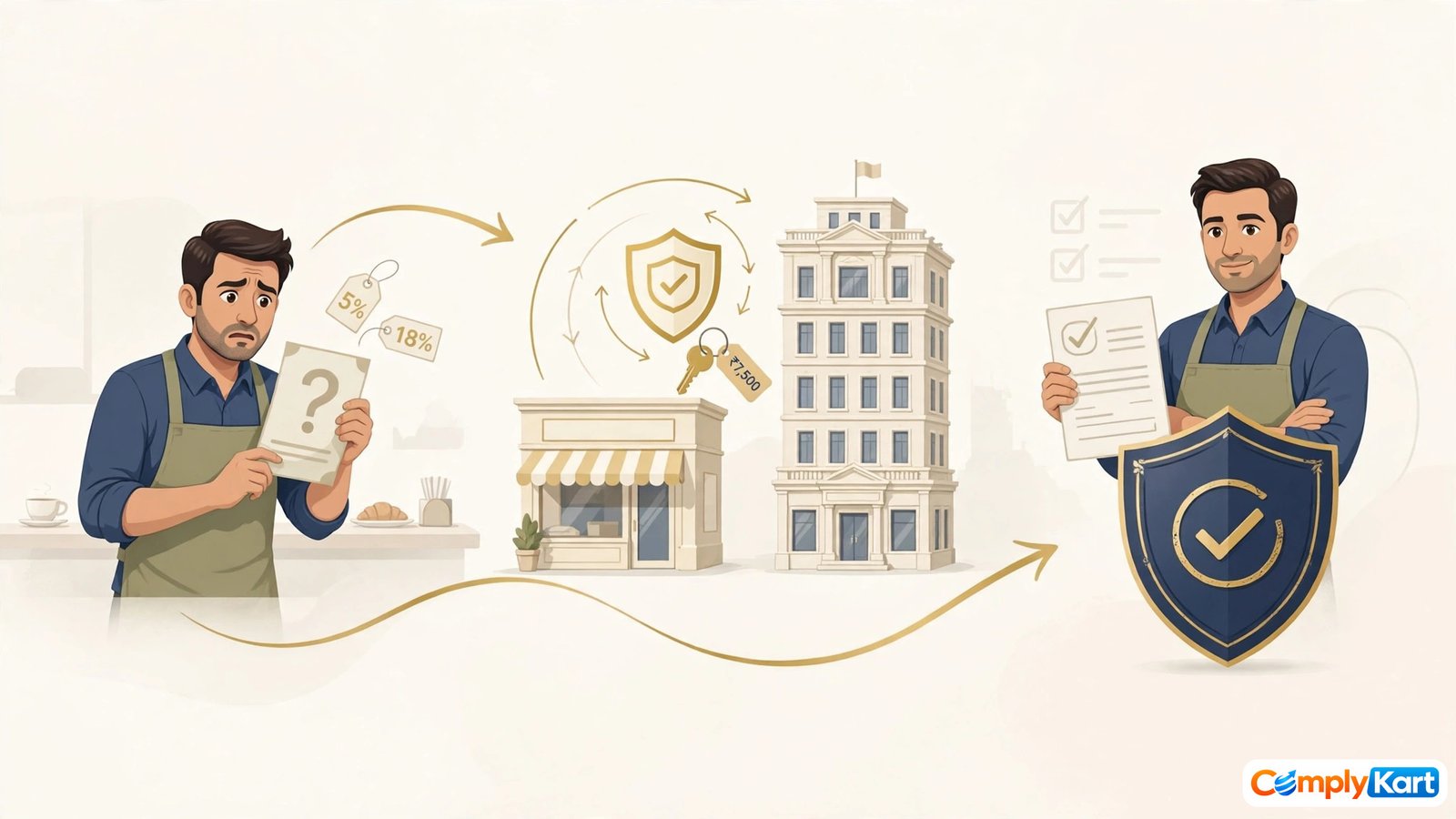
If you run a restaurant, the most expensive line on your P&L might not be rent or staff — it might be the GST rate you are charging wrong. I have seen café owners charge 18% on every bill because "that's what big hotels charge," and hotel restaurants charge 5% because "food is food." Both bleed money.
The short answer: Standalone restaurants charge 5% GST with no input tax credit. A restaurant inside a hotel where any room tariff exceeded ₹7,500 per day in the previous year — a "specified premises" — charges 18% with input tax credit. Composition offers a flat 5% of turnover for restaurants up to ₹1.5 crore. Alcohol is never under GST.
What GST rate does your restaurant charge?
Restaurant service is SAC 9963, and the rate depends on where the food is served, not what is on the plate. The rules (Notification 11/2017-CT(R)) survived the September 2025 GST 2.0 reshuffle untouched.
Standalone restaurant — 5%, no ITC. Dine-in, takeaway, QSR, cloud kitchen, catering: 5% (2.5% CGST + 2.5% SGST), and you cannot claim input tax credit on anything — the rate is conditional on forgoing ITC (Section 17(5), CGST Act).
Restaurant at specified premises — 18%, ITC allowed. At a specified premises, food is taxed at 18% and you can claim input tax credit on your inputs. That single difference changes the economics of your kitchen.
Air conditioning has nothing to do with your rate (the AC/non-AC distinction died in November 2019). Ice-cream parlours serving manufactured ice cream are a supply of goods at 18% with ITC — not a restaurant service.
What is a "specified premises," and does your hotel qualify?
Notification 05/2025-Central Tax (Rate), dated 16 January 2025, gives the rule: a hotel's premises become "specified premises" if any room was supplied above ₹7,500 per day at any point in the previous financial year. One suite, one night — that is enough.
Think of it like two rent agreements. The 5% rate is a flat-rent deal: cheap on the bill, but nothing you spend comes back to you. The 18% rate is a higher rent where the landlord refunds your maintenance bills — you charge guests more, but GST on your inputs (F&B supplies, housekeeping, security, refurbishment) comes back as credit. Which deal is cheaper depends on how heavy your input bills are.
A hotel that never crossed ₹7,500 can opt in via Annexure VII (filed 1 January–31 March of the preceding year; opt out via Annexure IX). A standalone restaurant cannot do the reverse — the 56th GST Council shut that door.
Composition scheme: the flat 5% route
Under Section 10(1) of the CGST Act, a restaurant with turnover up to ₹1.5 crore in the preceding year (₹75 lakh in special-category states) can opt for composition: a flat 5% on turnover in the state (Rule 7, CGST Rules).
Notice: the regular rate for a standalone restaurant is also 5%. Composition does not save tax — it changes who pays and how much paperwork you do. Under the regular scheme you add 5% to the customer's bill and file GSTR-1 and GSTR-3B. Under composition you cannot collect tax from the customer — the 5% comes out of your own pocket, you cannot issue tax invoices, and you cannot make inter-state outward supplies. In return you file only a quarterly CMP-08 and one annual GSTR-4.
A café doing ₹1 crore a year pays ₹5 lakh either way — funded by the customer under the regular scheme, absorbed by you under composition. For a neighbourhood dine-in joint, composition is the calmer choice; for corporate banquets needing formal tax documentation, the regular scheme fits better. And the "1%" you hear about is for traders — restaurants are 5% under composition, always.
Who pays GST on your Zomato and Swiggy orders?
The platform does. Since 1 January 2022, Zomato and Swiggy collect and remit 5% GST on app orders under Section 9(5) of the CGST Act — but you must still report those sales in your GSTR-3B, Table 3.1.1(ii). The delivery fee is taxed separately at 18%.
And if you run a cloud kitchen selling only through aggregators, GST registration is mandatory from your very first order — no ₹20 lakh threshold to hide behind. Get your GST registration in place before the first listing goes live, alongside your FSSAI licence and Shops and Establishment registration.
What is changing: the 57th Council's annual-return plan
On 8 October 2026, the 57th GST Council approved in principle a simplified scheme for small B2C businesses — restaurants explicitly named. Taxpayers up to ₹5 crore turnover would pay quarterly and file one return a year from 1 April 2027. The framework is still pending, so it is not law yet.
Mistakes that cost restaurant owners real money
- Charging 18% at a standalone outlet "to be safe." Standalone means 5%. You overcharge customers and cannot keep the excess.
- Charging 5% at a hotel restaurant that crossed ₹7,500. Any room tariff above ₹7,500 per day last year means 18% with ITC — the shortfall compounds monthly.
- Claiming ITC at the 5% rate. The 5% rate and input tax credit are mutually exclusive. Input GST on rent, equipment, and raw materials is a sunk cost at 5% — price your menu accordingly.
- Skipping registration for aggregator-only sales. Cloud kitchens need GST registration from the first order on the apps — no threshold to hide behind.
- Forgetting aggregator sales in GSTR-3B. The platform pays under Section 9(5), but the sales are still yours to report in Table 3.1.1(ii).
A compliance fee calculator estimates the full cost of staying compliant — GST, FSSAI, and Shops and Establishment together. For the other half of the October 2026 law changes, see the 57th Council's decriminalisation drive, and for the licensing side, our FSSAI guide for restaurants and cafés.
FAQs
My café is inside a hotel with one suite at ₹9,000 a night. What rate do I charge?
18% with input tax credit. Any room above ₹7,500 per day in the previous financial year makes the premises "specified premises" — restaurant service there is 18% under Entry 7(vi).
Can I claim GST paid on kitchen equipment and rent?
Only at the 18% rate. At 5%, ITC is blocked — treat input GST as a menu-pricing cost.
Is the composition scheme worth it for my restaurant?
If turnover is within ₹1.5 crore and all sales are intra-state, composition replaces monthly filings with a quarterly CMP-08 and an annual GSTR-4 — but the 5% comes out of your pocket, not the customer's.
Who pays GST on food I sell through Swiggy?
Swiggy collects 5% GST under Section 9(5). You still report the sales in GSTR-3B, Table 3.1.1(ii). The delivery fee is taxed at 18%.
Do I charge GST on beer and liquor?
No. Alcohol is outside GST and attracts state excise or VAT. On a mixed bill, GST applies only to the food portion.
Will the new annual-return scheme apply to my eatery?
The 57th GST Council approved it in principle for B2C businesses up to ₹5 crore turnover from 1 April 2027 — restaurants included. It is not law yet. Keep filing on the current cycle.



Comments
No comments yet — ask the first question below.
Join the discussion
Questions go straight to our expert desk. Comments appear after a quick review — no spam, no noise.