
IN BRIEF
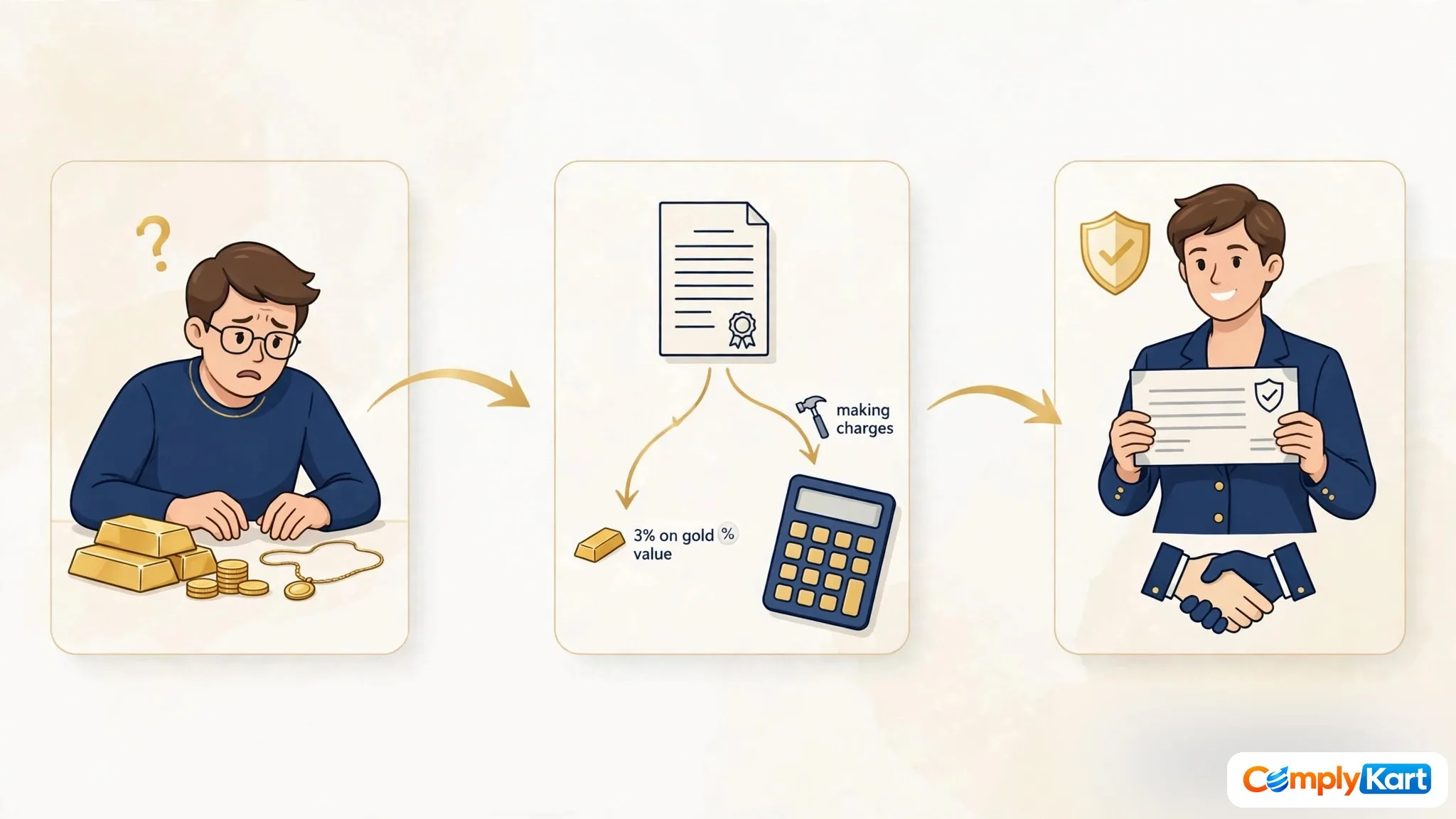
GST on gold is the 3% tax charged on the value of gold in India — 1.5% CGST plus 1.5% SGST within a state, or 3% IGST across states — under the CGST Act, 2017 and Notification 9/2025-IGST (Rate). It covers gold bars, coins and jewellery; making charges are taxed at 3% on a finished piece, and at 5% only for job work on gold supplied by someone else.
Gold is the one purchase where the tax is small and the confusion is large. The rate is only 3%, yet two people buying the same necklace can walk out with different tax on their bills — and both bills can look right. The difference is not the gold. It is the making charges, and how the shop chose to bill them.
This guide decodes a gold bill line by line: the rate on the metal, the HSN code for every form of gold, the making-charges question that most guides get wrong, and three worked calculations you can check at the counter in thirty seconds.
The short answer: GST on gold is 3% of the metal's value — 1.5% CGST plus 1.5% SGST within your state, or 3% IGST from another state. Making charges are taxed at 3% too when a jeweller sells you a finished piece. The 5% rate applies only to job work, where a karigar works on gold supplied by someone else.
What GST do you actually pay on gold?
Three per cent. That is the whole rate on the metal, and it has not moved since GST began in July 2017. A 24-karat bar, a 22-karat chain and an 18-karat ring all attract the same 3% — the karat decides the price per gram, nothing about the percentage. Buy inside your state and the bill shows it as 1.5% CGST and 1.5% SGST. Buy from another state, or import the gold, and it shows as a flat 3% IGST.
The rate survived the big reset. When the 56th GST Council overhauled the slabs on 3 September 2025 and the new rates took effect on 22 September 2025, gold stayed exactly where it was. The Council has looked at the gold rate more than once since 2017 and has never raised it. If someone tells you the rate went up in 2026, they are confusing GST with customs duty — a different tax, covered below.
So the metal is simple. The argument starts on the next line of the bill.
The rate and HSN code for every form of gold
Every gold item on a bill carries an HSN code — the classification number that tells the GST system what was sold. Most buyers never look at it. Jewellers live by it, because the returns ask for sales by HSN code. Here is the table that matters, with the rates from Notification 9/2025-IGST (Rate), the notification that has governed goods rates since 22 September 2025:
| What you are buying | HSN code | GST rate |
|---|---|---|
| Gold bars and biscuits, unwrought or semi-made gold | 7108 | 3% |
| Gold coins | 7118 | 3% |
| Gold jewellery and ornaments, plain or set with stones | 7113 | 3% |
| Goldsmiths' and silversmiths' wares (plates, glasses, articles that are not worn) | 7114 | 3% |
| Imitation jewellery | 7117 | 3% |
| Waste and scrap of precious metal | 7112 | 3% |
| Loose diamonds, cut or polished (not rough) | 7102 | 1.5% |
| Rough or simply sawn diamonds | 7102 | 0.25% |
| Loose precious and semi-precious stones, not set | 7103 | 0.25% |
| Job work on gold, silver and other Chapter 71 goods | SAC 9988 | 5% |
| Job work on diamonds (cutting, polishing) | SAC 9988 | 1.5% |
Two details in that table catch people out. First, a diamond ring is still 7113 at 3% — the stone is part of the piece, so the whole ring, metal, diamonds and making, is billed at 3%. The lower diamond rates are for loose stones sold on their own. Second, the code changes with the form, not the metal: the same gold is 7108 as a bar, 7118 as a coin and 7113 as a necklace.
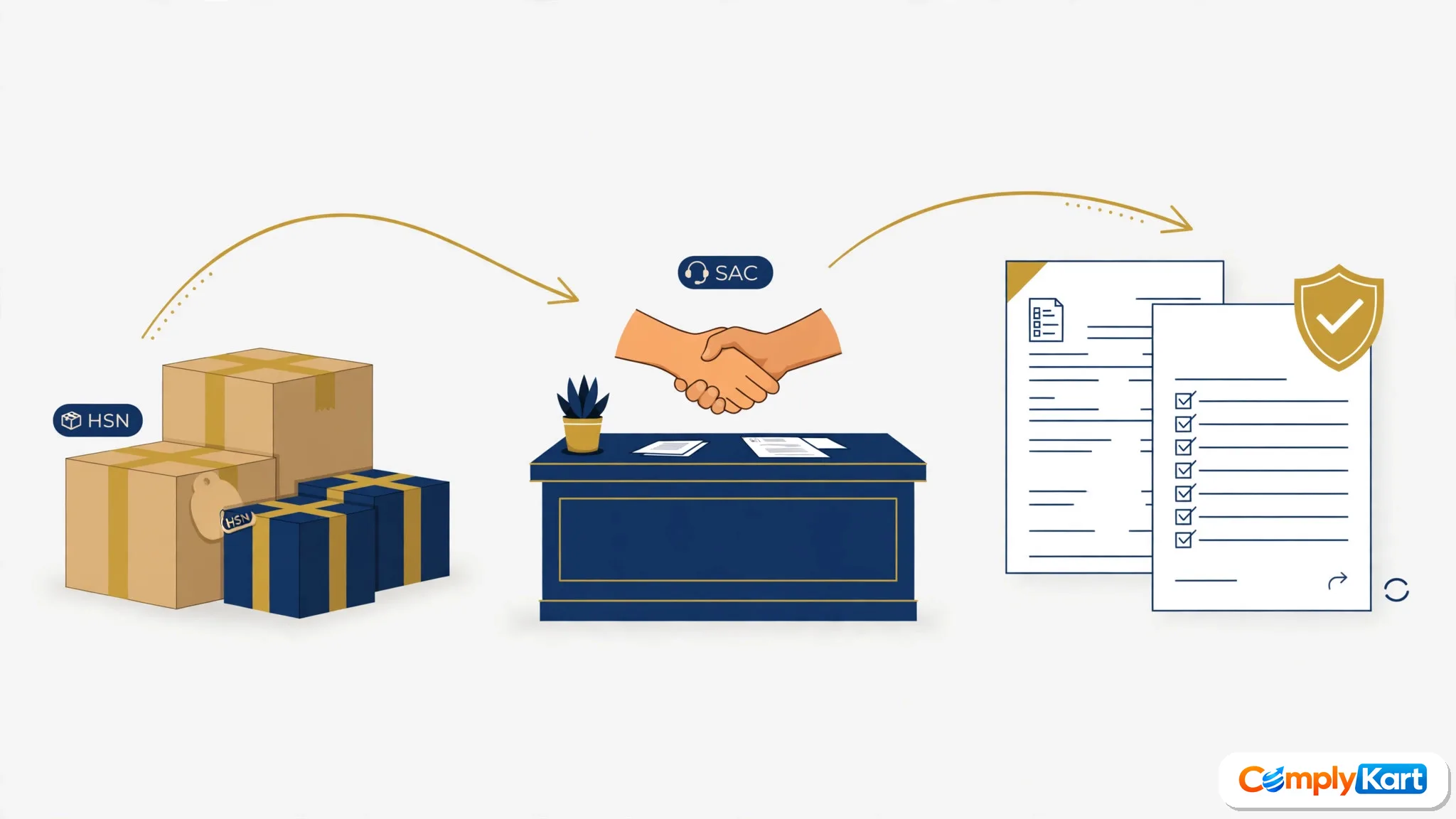
How many digits go on the bill depends on the seller's turnover. Under Notification 78/2020-Central Tax, a business with turnover up to ₹5 crore in the last financial year shows at least four digits — 7113 is enough — and may leave the HSN off bills to customers without a GSTIN. Above ₹5 crore, at least six digits go on every bill. The general rules for choosing between HSN and SAC codes, and how many digits your invoice needs, are mapped in our HSN vs SAC code guide.
Making charges: 3% or 5%? The honest answer
Search for the GST on making charges and you will find two answers, stated with equal confidence. Most popular guides say 5%. A smaller set — and the CBIC itself — say 3%. One of them is wrong for your purchase, and it is worth knowing which.
The CBIC answered this in its own FAQ for the gems and jewellery sector, and the answer is plain. When a jeweller sells you a finished piece, the sale is a composite supply under section 8 of the CGST Act: the gold is the principal supply, and the making is part of it. GST is payable at 3% of the total transaction value of the jewellery, whether the making charge is shown separately or not. The FAQ works its own example — a 10-gram gold chain sold for ₹30,000, made of ₹28,000 of gold and ₹2,000 of making — and the answer is 3% on the full ₹30,000, which is ₹900.
Then where does 5% come from? It is the rate for job work, and job work is a different transaction. A jeweller hands gold to a karigar, the karigar makes the pieces and returns them, and bills only for the work. The gold never belonged to the karigar. That bill is for a service, not for goods, so it uses the service code SAC 9988 at 5% — and the jeweller takes credit for that GST against the GST on the jewellery sold. Job work on diamonds is 1.5% under the same code.
Think of it the way you would buy a stitched suit. Walk into a shop and buy the finished suit off the rack, and you pay tax on the whole suit — cloth and stitching together, one price, one rate. Take your own cloth to a tailor and pay only for the stitching, and the tailor charges you for a service. Gold works the same way. The finished piece on the counter is the suit off the rack. The karigar working on a jeweller's gold is the tailor.
One case is genuinely unsettled, and I will not pretend otherwise. A private customer gives their own gold to a retail jeweller and pays only for the making — no new metal changes hands. Shops treat this differently, and the CBIC FAQ does not settle it squarely. Agree the treatment with your CA before you bill it that way, and bill it the same way every time.
What should you do as a buyer? Ask the jeweller to show the split — metal value on one line, making on another — and check that the GST line is 3% of the total. If the bill shows 5% on the making, ask why. Some shops bill it that way out of habit, and the difference is real money, as the calculation below shows.
How to calculate GST on a gold purchase
The formula fits on one line. GST on gold is the gold value multiplied by 3%, and GST on making charges is the making charges multiplied by 3% on a retail sale. Work it on round figures first, then swap in the day's rate.
Example one — a jewellery bill. Take an ornament with a gold value of ₹1,00,000 and making charges of 12%, which is ₹12,000. The taxable value is the two together: ₹1,12,000. GST at 3% is ₹3,360. The total you pay is ₹1,15,360. Inside your state that ₹3,360 shows as ₹1,680 CGST and ₹1,680 SGST.
Example two — a gold bar or coin. There are no making charges, so the maths is shorter. A bar worth ₹1,00,000 carries ₹3,000 GST and costs ₹1,03,000. That is the whole story for bullion — which is why investors who buy bars instead of jewellery are really buying their way out of the making-charges line altogether.
Example three — the same jewellery bill, done the other way. Suppose the shop bills the making at 5% instead of 3%. The gold still takes 3% — ₹3,000 — but the making takes 5% of ₹12,000, which is ₹600. Total GST is ₹3,600, and the bill comes to ₹1,15,600. That is ₹240 more than the CBIC FAQ position on a ₹1,00,000 purchase. On a wedding set worth ₹5,00,000 with the same 12% making, the gap is ₹1,200. Small on one bill, worth noticing across a family's wedding season.
One more thing the examples hide: making charges are not recoverable. When you sell the piece back, the jeweller pays you for the metal — the making you paid for is gone. That is the real cost of an ornate design, and it is why a plain bangle at 5% making and a machine-cut design at 18% are two different purchases even when the gold weighs the same.
Exchanging old gold? GST is charged on the full new piece
This is the question jewellers argue about most, because customers expect the obvious answer and the law gives the other one. You hand in a 20-gram bangle and take home a 25-gram necklace. Surely GST applies only to the extra 5 grams? It does not.
The exchange is two separate supplies. You sell your old gold to the jeweller, and the jeweller sells you new jewellery. You pay no GST on handing in the old gold — selling your own jewellery is not a business supply, and the Finance Ministry has clarified that the reverse-charge rule in section 9(4) does not catch an individual selling old ornaments. But GST is charged on the full value of the new piece, because the jeweller is supplying the entire 25 grams regardless of how you paid for it. The old gold is treated as part-payment, not as a discount on the taxable value.
Traders tried a cleverer route and lost it. Some argued that second-hand gold should be taxed only on the profit margin under Rule 32(5) of the CGST Rules, the way second-hand goods are. The Kerala Authority for Advance Ruling said no in 2023, in the Best Money Gold Jewellery case: gold does not diminish with use — a 22-karat piece stays 22 karat no matter how many hands it passes through — so it is not second-hand goods at all, and the full transaction value is taxed under section 15.
Ask for the exchange to be shown as a separate line on the bill, so the calculation is visible: the new piece at full value with 3% GST, and the old gold credited as part-payment underneath. If the bill shows GST only on the difference, the shop is under-charging tax, and that is their problem to fix with their CA — but you should know the number is wrong before you rely on it.
What changed in 2026 — and what did not
Nothing about GST on gold changed in 2026. The rate is still 3%, exactly as it was when the 56th GST Council left it alone in September 2025. What changed is the tax on bringing gold into the country, and the price of the metal itself.
Customs duty on imported gold went to 15% on 13 May 2026 — 10% basic customs duty plus 5% agriculture infrastructure and development cess — up from 6%, where it had sat since July 2024. The February 2026 Budget had actually cut the effective duty to 5% first, so the May hike reversed direction within three months. With the 3% IGST on top, the effective total on an import is around 18.4%. The duty does not appear on your retail bill, but it is inside the price per gram before GST is calculated. Gold imports fell by more than 27% in April to September 2026, to $19.27 billion, after the hike.
The price moved too, and sharply. Market reports put 24-karat gold at about ₹1,43,950 per 10 grams on 5 November 2026; by 20 November it was about ₹12,557 a gram, down roughly ₹13,310 per 10 grams since the start of the month. Making charges did not fall with the rate — they still run roughly 5% on a plain bangle to 18% on a machine-cut design. A falling gold price is a good moment to buy the metal; it is not a moment to stop comparing making charges, because that line is now a bigger share of the bill than it was a month ago.
GST rates work the same way on other things you buy or rent — the rate follows the form of the supply, not the buyer. Commercial property rent, for instance, carries 18% under reverse charge when the landlord is unregistered, a completely different treatment from the 3% on gold. Knowing which rate belongs to which supply is the whole skill.
Digital gold, gold bonds, ETFs and gold loans
Not every way of owning gold is taxed the same way, and the differences are worth one paragraph. Digital gold — gold bought through an app and stored in a vault — attracts 3% GST, the same as physical gold. Sovereign Gold Bonds attract no GST at all: they are securities, and the interest and redemption are outside GST. Gold ETF units are the same — no GST on buying the units, though the fund's expense ratio is a separate matter. And pledging your jewellery for a gold loan is not a supply at all, so there is no GST event when you pledge or redeem it; the interest on the loan is a financial service, not a tax on the gold.
The practical line is simple: GST follows the metal changing hands. Buy gold, pay 3%. Hold paper that represents gold, or borrow against gold you already own, and there is no GST to pay.
Five mistakes that cost gold buyers money
Not reading the bill split. The two lines that matter are the metal value and the making charges. If the bill shows a single lump sum, ask for the split — you cannot check the GST without it.
Expecting GST only on the difference in an exchange. GST is charged on the full value of the new piece. If a shop offers you GST on the difference, the arithmetic is wrong even if it feels generous.
Paying ₹2 lakh or more in cash. Receiving ₹2 lakh or more in cash from one person in a day is not allowed under section 269ST of the Income-tax Act, 1961. Jewellers will ask for PAN and a bank transfer above that line — that is the law working, not the shop being difficult.
Skipping the hallmark check. BIS hallmarking with a HUID — a six-character alphanumeric identifier — is mandatory for gold jewellery sold in the notified districts. Check the HUID on the piece and match it to the bill before you pay. A hallmarked bill is also the document you will need when you sell the piece back.
Treating making charges as value. Making charges buy design, not metal. On resale only the metal counts. A heavy, ornate piece can lose a fifth of its purchase price the day you sell it, entirely through the making line.
Frequently asked questions
What is the GST rate on gold in India?
3% on the value of the gold — 1.5% CGST plus 1.5% SGST within your state, or 3% IGST across states. The rate is the same for bars, coins and jewellery, and the same for 24K, 22K and 18K gold.
Is GST on making charges 3% or 5%?
3% when a jeweller sells you a finished piece — CBIC's gems and jewellery FAQ says GST is 3% on the total transaction value, whether the making charge is shown separately or not. 5% applies only to job work under SAC 9988, where a karigar works on gold supplied by someone else.
Is GST charged on old gold exchange?
Yes, on the full value of the new jewellery — not just the difference between the new piece and the old gold. You pay no GST on handing in your old gold, because that is not a business supply.
Does GST apply to gold coins and bars the same way as jewellery?
Yes, the rate is 3% for all three. Only the HSN code differs: bars are 7108, coins are 7118 and jewellery is 7113. Bars and coins have no making charges, so their bills are a single line.
Is there GST on a gold loan or on Sovereign Gold Bonds?
No. Pledging jewellery for a loan is not a supply, so there is no GST event, and Sovereign Gold Bonds are securities, outside GST. Digital gold is different — it attracts 3% GST like physical gold.
Gold's tax is a small number with a long shadow. The 3% is settled and has been settled since 2017 — what moves your bill is the making-charges line, the exchange treatment, and the customs duty sitting inside the price per gram. Check those three lines and the rest of the bill checks itself.
If you sell gold for a living, the billing has to be right every single day — the HSN codes, the composite-supply treatment, the GSTR-1 HSN summary. Our GST registration service and GST returns service handle that side, and the compliance fee calculator works out what your filings cost. Real estate developers face the same kind of rate-depends-on-form question — their 1%, 5% or 12% problem is mapped here.




Comments
No comments yet — ask the first question below.
Join the discussion
Questions go straight to our expert desk. Comments appear after a quick review — no spam, no noise.