
IN BRIEF
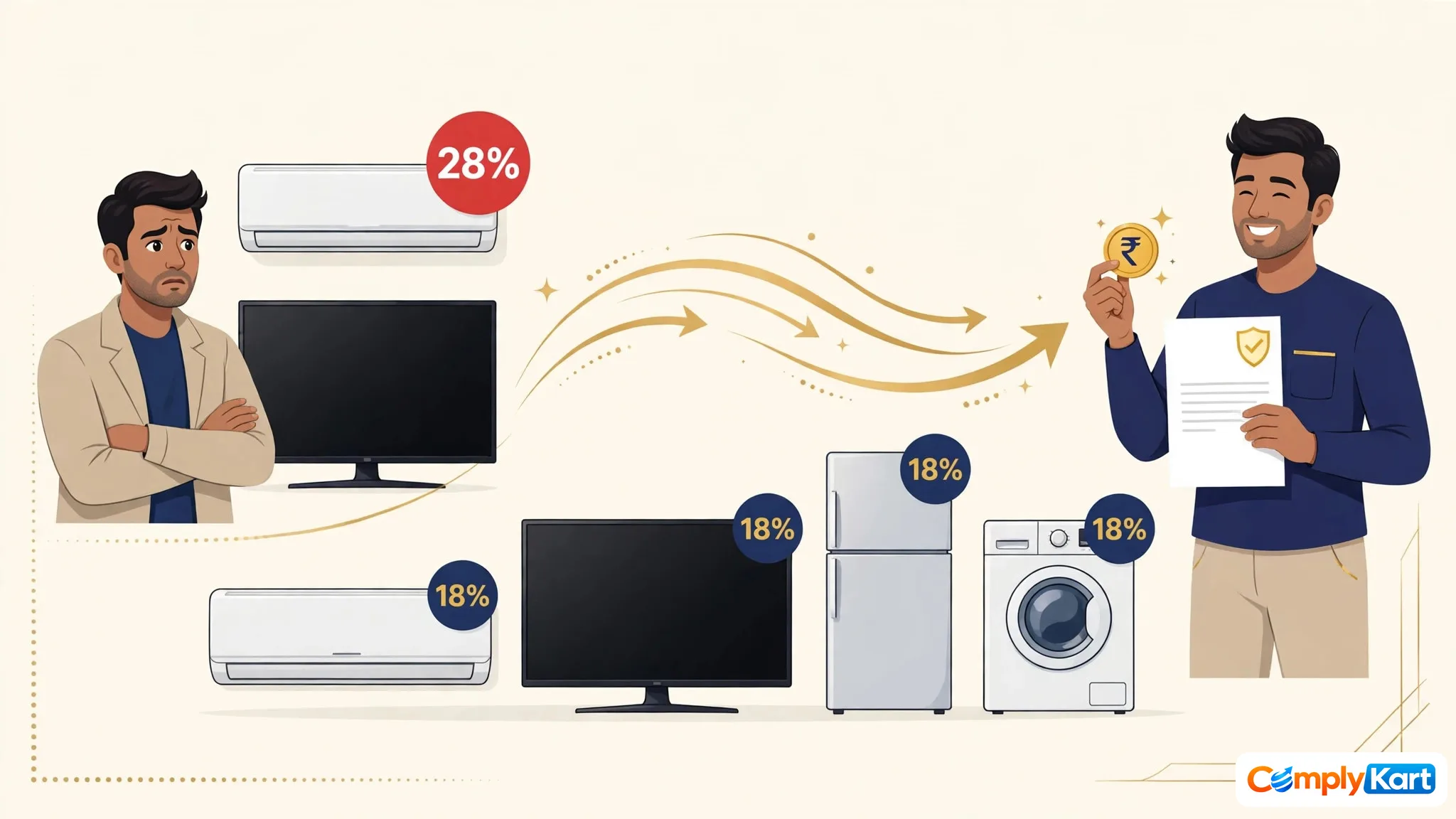
GST on air conditioners and large appliances is the goods and services tax charged on the sale of cooling and household appliances in India. Since 22 September 2025, air conditioners under HSN 8415, televisions under HSN 8528, refrigerators under HSN 8418, washing machines under HSN 8450 and dishwashers under HSN 8422 all attract 18% GST, down from 28% under Notification 9/2025-Central Tax (Rate) after the 56th GST Council meeting.
You walk into an electronics store with a budget in mind. The salesperson quotes a price for the air conditioner. Then comes the question nobody answers cleanly: how much of that price is GST, and did the rate really fall?
Air conditioners, televisions, refrigerators, washing machines and dishwashers all attract 18% GST in India from 22 September 2025, down from 28% before GST 2.0. Air conditioners sit under HSN 8415, televisions under HSN 8528, refrigerators under HSN 8418, washing machines under HSN 8450 and dishwashers under HSN 8422. No compensation cess applies to any of them.
That is the short version. The rest of this guide is for the two people who need more: the buyer who wants to check the maths before paying, and the business owner fitting out an office, shop or hotel who wonders whether the GST comes back. For most business use, it does — and that is the part almost no appliance page explains.
What actually changed on 22 September 2025?
Before GST 2.0, air conditioners and the big household appliances carried 28% GST. They sat in the top slab because they were once treated as luxury goods. A fridge was taxed like a luxury, even though most Indian homes treat it as a necessity.
The 56th GST Council meeting, on 3 September 2025, swept that treatment away. Notification 9/2025-Central Tax (Rate) put the new rates in force from 22 September 2025. The old four-rate structure collapsed into two main slabs — 5% for essentials and 18% as the standard rate — with a 40% demerit rate kept for a short list of luxury and sin goods. Appliances did not land in the 40% list. They landed at 18%, alongside most other goods:
| Appliance | HSN code | Old GST | New GST |
|---|---|---|---|
| Air conditioners (split, window, portable) | 8415 | 28% | 18% |
| Televisions (all sizes) | 8528 | 28%* | 18% |
| Refrigerators and freezers | 8418 | 28% | 18% |
| Household washing machines | 8450 | 28% | 18% |
| Household dishwashers | 8422 | 28% | 18% |
*Televisions up to 32 inches already paid 18% before the reform. The cut bites on larger sets, which were at 28%. Today every size pays 18% — the screen-size distinction is gone.
One more thing disappeared with the old structure: compensation cess. Air conditioners and large appliances never carried cess the way cars carried cess, or bikes above 350cc, but the reform ended the cess regime for these goods outright. The 18% on your invoice is the whole tax. The full 5% / 18% / 40% map is in our GST rate list for 2026.
What the cut actually saves you
Percentages hide the money. Here is the maths on the taxable value — the price before tax — so you can check any quote yourself.
An air conditioner with a taxable value of ₹40,000 used to carry 28% GST: ₹51,200 in total. Now it carries 18%: ₹47,200. That is ₹4,000 saved on the tax alone.
A television with a taxable value of ₹60,000 used to cost ₹76,800 with 28% GST. Now it costs ₹70,800 with 18% GST. That is ₹6,000 saved — real money on the set most families buy once in five years.
A refrigerator with a taxable value of ₹30,000 used to cost ₹38,400. Now it costs ₹35,400. That is ₹3,000 saved. A washing machine with a taxable value of ₹25,000 used to cost ₹32,000. Now it costs ₹29,500 — ₹2,500 saved.
Now add them up, because nobody furnishes a home one appliance at a time. A new flat with a ₹40,000 AC, a ₹60,000 TV, a ₹30,000 fridge and a ₹25,000 washing machine has a combined taxable value of ₹1,55,000. At the old 28%, the tax came to ₹43,400. At 18%, it comes to ₹27,900. The saving is ₹15,500 — enough to cover the installation of all four, with change left over.
One warning on the maths. The saving lands on the taxable value, and shops quote prices that already include GST. Ask for the pre-tax value on the quote if you want to check the arithmetic. If the shop cannot show it, the quote is doing the hiding for them. And remember that a lower GST rate does not by itself guarantee a lower sticker price — the seller sets the price; the tax only sets the tax. Check the pre-tax value against the old one, not just the final number.
Does the price decide the rate?
No. This is the most common misunderstanding in electronics stores, and it costs people money.
The rate follows the HSN code, not the price tag. A ₹20,000 air conditioner and a ₹60,000 air conditioner both pay 18%. A ₹15,000 television and a ₹1,50,000 television both pay 18%. The cheaper appliance can carry the same rate as the dearest one, because price never enters the test.
Think of the HSN code as the pin code of a product. It decides which tax neighbourhood the product lives in. The price is only the house number inside that neighbourhood — it tells you where the house sits, not which neighbourhood it belongs to. For appliances, every house in the neighbourhood pays 18%.
The star rating does not change the rate either. A 3-star AC and a 5-star AC both pay 18%. The BEE star rating decides your electricity bill, not your tax bill. If a salesperson tells you the 5-star model carries a different GST rate, they are wrong — ask them to show you the HSN code on the invoice instead.
What about installation, stabilisers and the extras?
An air conditioner is rarely just a box. There is installation, copper piping, a stabiliser, a wall bracket. The tax treatment of the extras depends on how they are billed, and this is where invoices get messy.
If the installation is charged on the same bill as the AC, it is part of a composite supply. The whole supply takes the rate of the main item — the AC — so the installation is taxed at 18% as well. If the installation is billed separately, as a standalone service, it still attracts 18% GST. Either way, installation is 18%. The billing route changes the paperwork, not the rate.
Stabilisers, stands and extra copper piping carry their own rates when sold as separate goods, and a dealer who bundles them into one price can blur the picture. Ask for the split on the invoice. The split matters twice: it tells you what you actually paid for each item, and it tells your accountant what can be claimed as input tax credit if the purchase is for business use.
Extended warranties deserve the same check. Ask whether the warranty is shown as a separate line on the invoice, and what it costs on its own. A warranty folded silently into the appliance price is a warranty you cannot see, question or compare.
Is there still cess on appliances?
No. There is no compensation cess on air conditioners, televisions, refrigerators, washing machines or dishwashers under the new structure. The 18% rate is the whole tax — there is no cess line hiding underneath it.
This is worth stating plainly because the old system trained people to look for a second line. Cars carried cess, bikes above 350cc carried cess, and invoices from that era showed it. Appliance invoices do not carry it now. If a bill shows a cess line on an AC or a fridge, something is wrong — ask for it to be corrected before you pay.
Can a business claim the GST back?
Yes, in most cases — and this is where appliances differ sharply from cars and bikes.
Section 17(5)(a) of the CGST Act blocks input tax credit on motor vehicles bought for personal use, with only three narrow exceptions. Air conditioners and large appliances are not on that blocked list. A business that buys ACs for its office, a shop that buys a fridge for its store, or a hotel that fits ACs and televisions into guest rooms can claim the GST as input tax credit through its GST returns, so long as the purchase is used in the course of the business and the ordinary section 16 conditions are met — a valid tax invoice, receipt of the goods, and the supplier having paid the tax. If the business is not yet registered at all, see what GST registration costs in 2026 before the purchase, because an unregistered buyer cannot claim credit.
Two limits still apply. First, section 17(5)(g) blocks credit on goods used for personal consumption. An AC bought for the director's home, or a television installed in an employee's residence for their personal use, does not earn credit — the business purpose has to be real, not a label on the invoice. Second, the credit is only as good as the invoice. If the supplier invoiced the goods before 22 September 2025 at 28%, the credit stays at 28% — the rate on the invoice is what counts, not the rate on the day you claim it.
For a hotel or a serviced apartment, the maths is worth doing properly. Ten rooms fitted with a ₹40,000 AC each carry ₹72,000 of GST at 18%. That is credit the business can use against the GST it collects on room tariffs, instead of a cost buried in the fit-out. The same logic applies to a restaurant fitting a commercial fridge, or a clinic fitting ACs in its consultation rooms. The appliance is a business input, and the law treats it as one.
Bought before 22 September? The transition rule
Some buyers ordered in early September and took delivery after the cut. Others paid in full before the cut and received the goods later. The rate in those cases follows section 14 of the CGST Act — the time-of-supply rule.
The short version: where the invoice was issued and the payment was received before 22 September 2025, the old 28% rate applies even if the appliance reached you later. In every other combination — invoice after the change, or payment after the change — the new 18% rate applies. If you paid an advance before the cut and the balance after it, the advance portion carries the old rate and the balance carries the new one.
Check your invoice date and your payment date before arguing with a dealer about which rate should apply. Both dates matter, and the dealer is bound by the same rule you are.
Exchange offers: what the old AC does to the tax
Most AC and television sales now come with an exchange offer — ₹5,000 off for your old set. The exchange value reduces what you actually pay, and GST is charged on the price actually paid or payable, which is the transaction value under section 15 of the CGST Act.
In practice, that means the exchange value should be knocked off before the GST is worked out. A ₹40,000 AC with a ₹5,000 exchange means you pay ₹35,000 plus 18% GST on ₹35,000 — ₹41,300 in total — not 18% on the full ₹40,000. Check the invoice: the exchange value should appear as a deduction before the tax line, not after it. If the bill shows GST on the full price and the exchange as a discount afterwards, ask for it to be corrected. The difference on this example is ₹900 — small on one AC, real across a whole office fit-out.
Buying online: same rate, one check
The rate does not change because you bought from an app. An AC ordered online pays 18% GST, the same as one bought in a store. What changes is the tax split: a purchase from a seller in your own state carries 9% CGST plus 9% SGST, while a purchase from another state carries 18% IGST. The total is the same either way.
The one check that matters online is the invoice. Marketplaces sell through many sellers, and the invoice comes from the seller, not the platform. Make sure it shows the correct HSN code — 8415 for an AC, 8528 for a television, 8418 for a fridge, 8450 for a washing machine, 8422 for a dishwasher — and the 18% rate. If the invoice is wrong, the marketplace will not fix it for you; the seller has to.
Did the 57th GST Council change anything for appliances?
No. The 57th GST Council meeting, on 8 October 2026, made no rate changes for air conditioners or large appliances. The Council's motor-vehicle items that month — the deferred proposal on section 17(5) input tax credit for vehicles, and a recommended circular on input tax credit under the used-vehicle margin scheme — do not touch appliances at all.
That leaves the 22 September 2025 rates as the current position. Rates are reviewed by the Council, not by sellers, so the next change — if any — will come through a Council decision and a notification, not through a price tag in a store.
Five mistakes that cost buyers money
- Paying on the MRP without asking for the pre-tax value. The saving is in the tax, and you can only see it if the quote splits the price from the tax.
- Assuming the 5-star model carries a different rate. Star ratings change your electricity bill. They never change the GST rate.
- Accepting a bill that charges GST on the full price after an exchange. The exchange value comes off first, then the tax is worked out. Check the order of the lines.
- Losing the ITC on a business purchase. A missing or wrong invoice — wrong HSN, wrong rate, no GSTIN on the bill — is the difference between credit and cost.
- Treating the 40% demerit rate as if it applied to appliances. It applies to a short list of luxury and sin goods. ACs, TVs, fridges, washing machines and dishwashers are not on it.
What to do before you buy
Ask for a written quote that shows the taxable value, the HSN code and the 18% GST separately. If you are exchanging an old appliance, make sure the exchange value is deducted before the tax line. If you are buying for a business, put the business GSTIN on the invoice at the time of purchase — adding it later is a fight nobody enjoys. And keep the invoice. It is the document that proves the rate you paid, the credit you can claim, and the warranty you hold.
The rate cut did something simple: it moved appliances out of the luxury slab and into the standard one. The buyer's job is equally simple — check the three lines on the invoice, and the saving is yours to keep.
Frequently asked questions
What is the GST rate on air conditioners in India?
18% from 22 September 2025, under HSN 8415, down from 28%. The rate applies to split, window and portable air conditioners alike, and no compensation cess applies.
What is the GST rate on large-screen TVs?
18% for televisions of all sizes under HSN 8528. Sets up to 32 inches already paid 18% before the reform; the cut from 28% to 18% applied to larger sets.
Is GST charged on AC installation?
Yes, at 18%. Installation billed with the AC is part of a composite supply taxed at the AC's rate, and installation billed separately as a service also attracts 18% GST.
Can a business claim input tax credit on air conditioners?
Yes, where the AC is used in the course of the business and the section 16 conditions are met. Credit is blocked only for personal consumption under section 17(5)(g) — an AC for a home or for an employee's personal use does not earn it.
Does the 40% GST rate apply to air conditioners or refrigerators?
No. The 40% demerit rate covers a short list of luxury and sin goods. Air conditioners, televisions, refrigerators, washing machines and dishwashers all sit at the standard 18% rate.
What GST applies if I exchange my old AC for a new one?
GST is charged on the price actually paid after the exchange value is deducted, under the transaction-value rule in section 15 of the CGST Act. Check that the invoice deducts the exchange value before the tax line.
If the invoice on your next appliance purchase does not show the HSN code and the 18% rate clearly, it is worth a question before you pay — and if you are buying for a business, our GST registration team can make sure the purchase is invoiced in a way your credit claim survives. You can also check the numbers yourself with our GST calculator.


Comments
No comments yet — ask the first question below.
Join the discussion
Questions go straight to our expert desk. Comments appear after a quick review — no spam, no noise.