
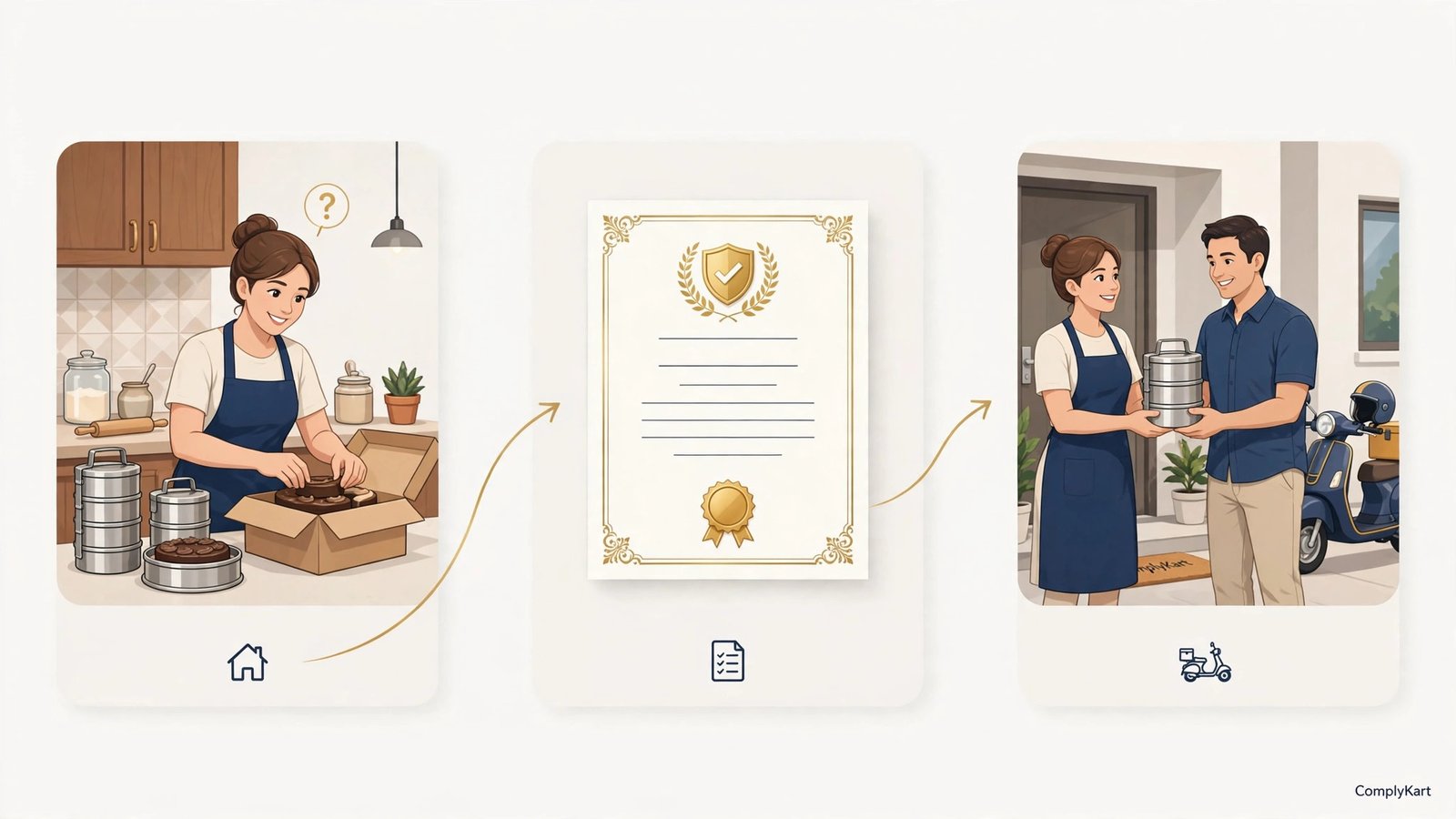
Your brownies are a hit on Instagram. Neighbours want weekly tiffins. Someone just ordered 200 Diwali boxes. It feels like a business — and it is one.
Which raises the question most home food sellers dodge for too long: is your kitchen legal? The answer is simpler than you think, and cheaper than you fear.
The short answer: A home bakery or tiffin service with turnover up to ₹12 lakh needs only FSSAI Basic Registration (Form A, ₹100/year). Cross ₹12 lakh and you need a State License (Form B, ₹2,000–₹5,000/year). Apply on the FoSCoS portal before your first sale — selling without one risks a fine up to ₹5 lakh under Section 63 of the FSS Act, 2006.
Does a home baker really need an FSSAI license?
Yes. The FSS Act, 2006 has no "but I work from home" exception. Every food business operator — manufacturer, seller, caterer, the person selling ladoos over WhatsApp — needs registration or a license.
Section 63 is blunt: no registration or license means up to six months in prison, a fine up to ₹5 lakh, or both. The day a customer falls ill, a competitor reports you, or a platform asks for your license number, "I didn't know" buys you nothing. Registration costs less than one cake order. Skip it and you are gambling.
Which FSSAI tier fits your home food business?
Think of the three tiers like cricket. Basic Registration is gully cricket — you, your home kitchen. Cross ₹12 lakh and you move to the state league: bigger crowds, real umpires. Multi-state or past ₹20 crore and you're playing nationals:
Basic Registration (Form A): turnover up to ₹12 lakh, or production up to 100 kg or litres per day. Almost every home baker and small tiffin service starts here.
State License (Form B): turnover above ₹12 lakh up to ₹20 crore. One premises, one license — it belongs to the kitchen where food is made.
Central License (Form B): turnover above ₹20 crore, or operations across states. Not your problem from a home kitchen — but good to know the ladder exists.
What does FSSAI registration actually cost?
Less than your monthly electricity bill. Basic Registration is ₹100 per year. A State License runs ₹2,000 to ₹5,000 per year depending on category. A Central License is ₹7,500 per year.
Every tier is valid 1 to 5 years — you pick the duration, longer means fewer renewals. Renew at least 30 days before expiry; miss that and the late fee is ₹100 per day. To estimate all your filings in one place, ComplyKart's compliance fee calculator does the arithmetic.
How do you apply — and how long does it take?
Everything runs through the FoSCoS portal. Form A for Basic Registration, Form B for a State License. Upload documents, pay online, wait.
Basic Registration needs only your photo, a photo ID, address proof (your home address works), and the food categories you sell. Most come through in 7 to 15 days, usually without inspection.
A State License asks for more: unit layout, equipment list, a water analysis report. Expect 4 to 6 weeks and a possible officer visit. If the department sits on your application for 60 days without a decision, the license is deemed issued — the law doesn't let files gather dust forever. If you're crossing the ₹12 lakh line, our FSSAI State License service handles the Form B application and follow-ups.
Where do tiffin services land on the ₹12 lakh line?
Same line, no carve-out: under ₹12 lakh, Basic Registration; over it, State License. The part people get wrong is what counts. It's total sales, not profit. Every tiffin subscription, every festive order, every cash payment counts.
The classic trap: the baker doing "only" ₹9 lakh on the books while the festive surge quietly pushes her past ₹12 lakh. If you're within striking distance, apply for the State License before you cross the line — not after.
5 mistakes that get home food businesses in trouble
1. Assuming "small" means exempt. There is no home exemption in the FSS Act. Basic registration is ₹100 a year. Being unregistered is a ₹5 lakh gamble.
2. Borrowing someone else's license. A license belongs to a specific operator at a specific premises. If you rent a commercial kitchen or share a friend's, their license doesn't cover your products — you need your own, in your business name, at that address.
3. Selling unlabeled packs. Your 14-digit FSSAI number and the FSSAI logo must appear on every packaged product, per the Labelling and Display Regulations, 2020. An Instagram handle in your bio is not a label.
4. Forgetting GST. FSSAI registration doesn't exempt you from GST. Cross ₹20 lakh aggregate turnover (₹10 lakh in special-category states) and GST registration becomes mandatory too — separate filing, separate portal.
5. Letting it lapse. Licenses expire. Renew 30 days out; the ₹100-a-day late fee stings, and an expired license counts as no license.
What about hygiene checks and FOSTAC training?
Don't read that as permission to run a sloppy kitchen. The moment you hold a State License, you need one FOSTAC-trained supervisor for every 25 food handlers, and your premises must meet Schedule 4 hygiene standards.
Get FOSTAC training anyway (cheap, online) and keep a cleaning log. An officer's first question is always "show me your records" — a tidy logbook ends most inspections fast. And when your brand starts traveling, protect the name with trademark registration. For the next rung, see our guides to FSSAI for cloud kitchens and registration vs licence.
FAQs
Can I run a home bakery without any FSSAI registration?
No. The FSS Act, 2006 covers every food business, home-based included. Basic Registration is ₹100 per year and takes about two weeks on FoSCoS. Operating without it risks a fine up to ₹5 lakh under Section 63.
My turnover is ₹8 lakh. Basic registration or state license?
Basic Registration (Form A). You move to a State License (Form B) only when annual turnover crosses ₹12 lakh, or production exceeds 100 kg or litres per day.
I bake from a rented commercial kitchen. Whose license applies?
Yours, in your business name. The kitchen owner's license doesn't cover your products — apply for your own registration or license for your business at that address.
Do I need FSSAI to sell on Zomato or Swiggy from home?
Yes. Platforms require a valid FSSAI number and verify it before onboarding. In practice most aggregator onboarding expects a State License, so plan the upgrade before you apply.
What happens if I'm caught selling without registration?
Section 63 provides up to six months' imprisonment and/or a fine up to ₹5 lakh. Heavier penalties apply separately for unsafe or misbranded food (Sections 59 and 52).
Is FSSAI registration enough, or do I need GST too?
Separate laws. FSSAI covers food safety; GST covers taxation. Cross ₹20 lakh aggregate turnover (₹10 lakh in special-category states) and GST registration is mandatory regardless of FSSAI status.
Your recipes built the business. Paperwork keeps it. A hundred rupees and a fortnight on FoSCoS is all it takes to start legal — and when the orders get big, your license grows with you.




Comments
No comments yet — ask the first question below.
Join the discussion
Questions go straight to our expert desk. Comments appear after a quick review — no spam, no noise.