
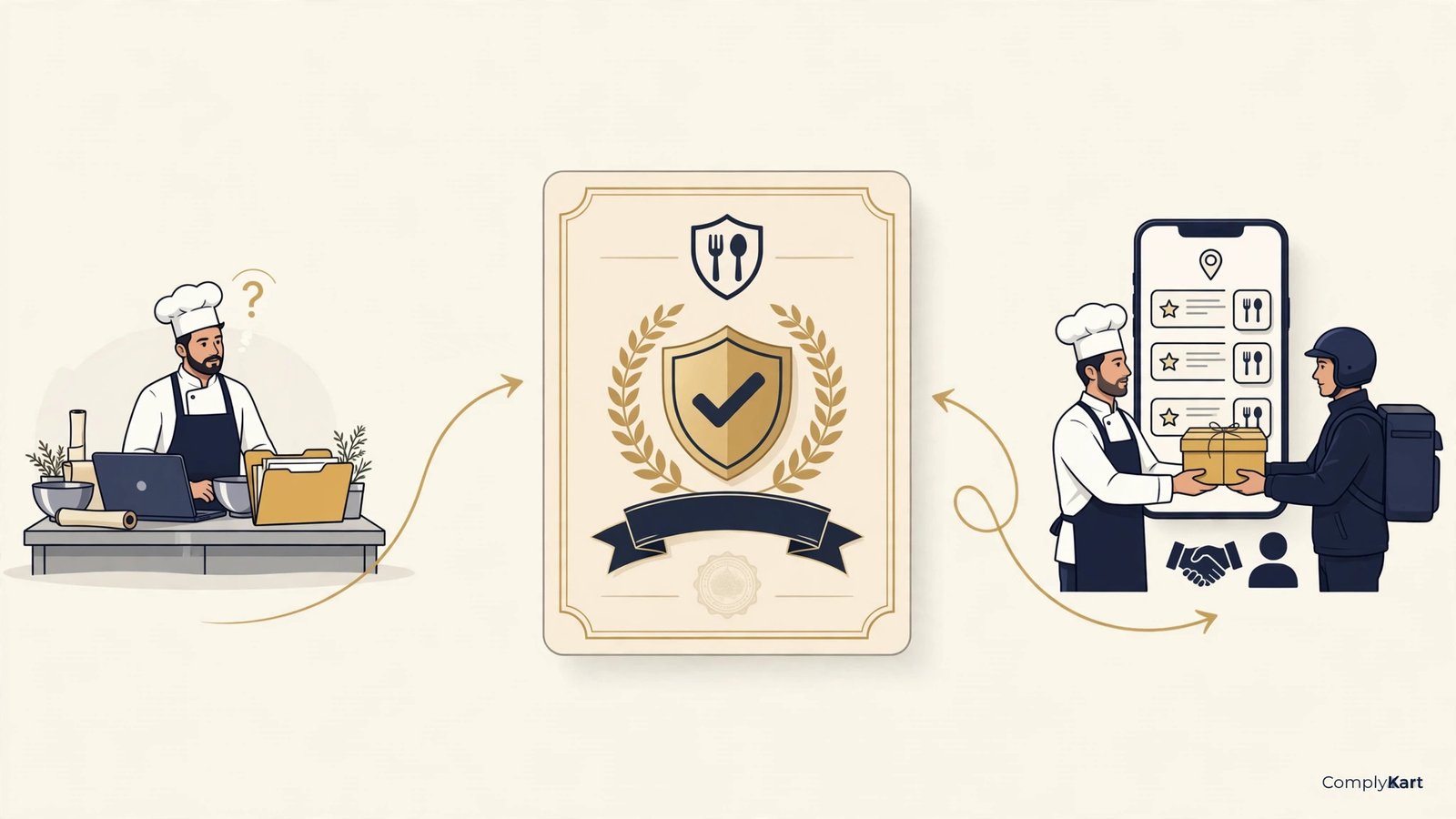
Your kitchen is ready. The menu is final. The aggregator onboarding form is filled — and then it asks for your 14-digit FSSAI license number, and everything stops.
Zomato and Swiggy do not negotiate on this. No valid FSSAI license, no listing. It does not matter how good the food is, or how small you are starting. So here is the straight answer first, details after.
The short answer: Most cloud kitchens in India need an FSSAI State license, applied on the FoSCoS portal with Form B. The government fee runs ₹2,000–₹5,000 a year depending on your kind of business, the license stays valid for 1–5 years, and a clean application usually comes through in four to six weeks. And remember this: the license belongs to the premises, not the brand. Each kitchen address needs its own.
Which FSSAI license does a cloud kitchen actually need?
FSSAI works on three tiers, and turnover decides which one is yours. Up to ₹12 lakh a year: Basic registration (Form A), ₹100 a year. Between ₹12 lakh and ₹20 crore: State license (Form B), ₹2,000–₹5,000 a year. Above ₹20 crore, or operating in more than one state: Central license (Form B), ₹7,500 a year.
Be honest about your own numbers here. A cloud kitchen doing thirty orders a day at ₹250 average crosses ₹12 lakh well before the year ends. If you take Basic registration and outgrow it in six months, you get to do the whole process again. For almost every real cloud kitchen, the answer is the State license. A standard cloud kitchen usually falls at the lower end of the State slab — if you're unsure which tier you sit in, our FSSAI registration vs licence guide walks through the same decision for food businesses generally.
What Zomato and Swiggy actually check during onboarding
The platforms verify three things on your license: the 14-digit number itself (with a scan of the certificate), the business name and validity date, and the address. That third check kills more applications than anything else. Your GST record says "Plot 42, First Floor" and your FSSAI application says "Plot 42" — and suddenly someone wants a clarification letter. Keep the exact same name and address on every document. Everywhere.
Beyond the license, onboarding typically needs your PAN, a GSTIN (the platforms effectively require it for settlements — if you don't have one, get your GST registration sorted first), a or trade license for the kitchen premises, bank details with a cancelled cheque, and your menu with prices and food photographs. The shop & establishment registration is the one founders forget — the aggregator treats it as proof your kitchen is a legitimate commercial premises.
Kitchen vs brand: the rule most founders get wrong
Here is the analogy I give every cloud kitchen client. An FSSAI license works like an occupancy certificate for a building. It belongs to the address, not to whoever is running the business inside.
Three virtual brands cooking out of one kitchen? One license. Each brand's aggregator listing displays the same 14-digit number, because the number certifies the kitchen, not the brand. Second kitchen across town? Second license — the first one cannot cover it. And if you are a brand owner working with partner kitchens, you cannot umbrella-license them. Each partner kitchen must hold its own license, or your brand is one inspection away from trouble.
What it costs and how long it takes
The government fee for a cloud kitchen's State license is ₹2,000–₹5,000 per year, set by the kind-of-business slab. You choose validity of one to five years when you apply; take five. It saves you from doing this paperwork again next year. (You can check the exact fee for your setup on our compliance fee calculator.)
The process runs on the FoSCoS portal: create an account, fill Form B, upload your documents (PAN, Aadhaar, kitchen address proof, kitchen photographs or layout plan, and an FSMS plan for a State license), pay the fee, and wait. An inspection is possible. In my experience, a clean application comes through in four to six weeks.
Two legal lines worth knowing. The regulations say that if the authority does not decide within 60 days of a complete application, you may commence on deemed approval. But do not start selling before that — operating with no license at all invites a fine of up to ₹5 lakh under the Food Safety and Standards Act, 2006, and the aggregators will pull your listing the moment they find out.
The six mistakes that get cloud kitchen listings pulled
I see these repeat with boring regularity:
- Wrong tier. Basic when you will cross ₹12 lakh, or Central for a single-city kitchen. Reapplying costs you a month.
- Name and address mismatch across FSSAI, GST, PAN and aggregator records. Same spelling, same address. Everywhere.
- One license, two kitchens. Each address needs its own. No exceptions.
- Letting it expire. There is no grace period worth relying on — an expired license is treated like no license.
- No trained food safety supervisor. FSSAI expects at least one certified supervisor (FOSTAC) per licensed premises, and inspectors ask for the certificate.
- Hiding the number. The 14-digit license number must appear on your packaging, your menu, your board — and on every aggregator listing. Customers look for it.
One more thing while you are at it: your brand names are assets. Before you scale a virtual brand across kitchens, get the name protected with a trademark registration — it is far cheaper than fighting a copycat later. And if the licensing paperwork feels like a lot, our FSSAI State license service handles the FoSCoS filing, documents and follow-ups for you.
Frequently asked questions
Can I run two cloud kitchens on one FSSAI license?
No. An FSSAI license is premises-specific. Each kitchen address needs its own license, even if both kitchens belong to you and run the same brands.
Do multiple virtual brands from one kitchen need separate licenses?
No. One kitchen, one license. Every brand cooked in that kitchen can list under the same 14-digit FSSAI number, because the license certifies the premises.
How long does the FSSAI license take for a cloud kitchen?
A clean State license application on FoSCoS usually takes four to six weeks, including a possible inspection. The regulations allow deemed approval if the authority does not decide within 60 days of a complete application.
Does a home-based cloud kitchen need an FSSAI license?
Yes. If you sell food — even from your home kitchen — you need at least a Basic registration (turnover up to ₹12 lakh). Aggregators do not distinguish between home kitchens and large restaurants on this.
What happens if my FSSAI license expires?
An expired license is treated the same as no license: you are operating illegally, risking fines up to ₹5 lakh under the Food Safety and Standards Act, 2006, and the delivery platforms can delist you. Renew before the expiry date.
Is FOSTAC training mandatory for cloud kitchens?
Yes. FSSAI requires at least one trained and certified food safety supervisor at every licensed premises. Inspectors routinely ask to see the certificate during visits.



Comments
No comments yet — ask the first question below.
Join the discussion
Questions go straight to our expert desk. Comments appear after a quick review — no spam, no noise.