
IN BRIEF
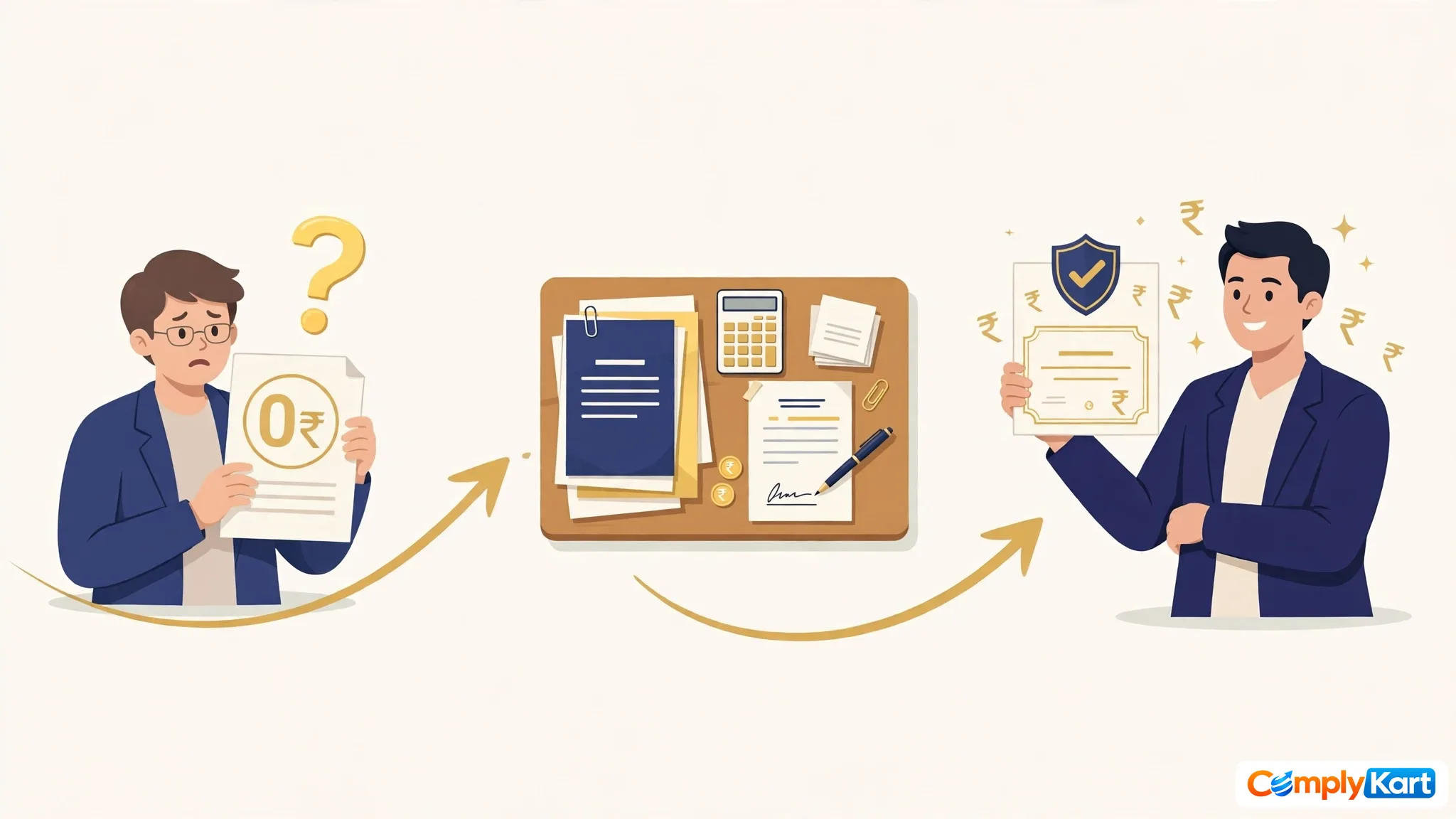
GST registration fees in 2026 are the costs of obtaining a GSTIN under the Central Goods and Services Tax Act, 2017. The government charges ₹0 for Form GST REG-01 on the GST portal, so the money a business actually spends goes to professional help, a Class 3 digital signature certificate where one is needed, and — for casual and non-resident taxable persons — an advance tax deposit under section 27.
The government charges ₹0 to register for GST in 2026 — Form GST REG-01 on the GST portal carries no application, processing or certificate fee. What you actually pay for is professional help (typically ₹500–₹5,000+), a Class 3 digital signature certificate if your entity needs one (about ₹1,000–₹2,500), and an advance tax deposit for casual or non-resident taxable persons.
You have probably seen two kinds of advertisement. One says "Free GST Registration!" in large letters. The other quotes ₹4,999 and calls it a government fee. Both are selling you something, and neither is quite telling the truth. The registration itself is free. The work around it is not. This guide puts a real number on every part of it, including our own published prices — because a fee you can see is a fee you can judge.
If you only want the short version, it is this: the filing is free; the expertise is not. And the most expensive GST registration is the careless one, because notices and blocked credit will invoice you later with interest. We explained the free-versus-paid question in general terms in our GST registration cost guide — this piece is the price list behind it.
The one-line answer: ₹0 to the government
There is no government fee for GST registration. Not a small one, not a hidden one. Form GST REG-01, filed on gst.gov.in, costs nothing to submit. The GSTIN and the registration certificate (Form GST REG-06) that follow approval cost nothing either. Amendments to your registration and cancellation of it are also free to file. Four separate competitor guides refreshed in the last fortnight say the same thing, and the GST portal's own registration flow asks for no payment at any step.
So when someone quotes you a "government fee" for GST registration, stop there. That charge does not exist. Either the seller is confused, or the word "government" is doing work it should not be doing. What they are really charging for is their own time — which is a legitimate thing to sell, as long as it is labelled honestly.
Think of it the way you think about filing your own income tax return. The portal is free. A CA charges for doing it. Nobody calls the CA's fee a government fee, and nobody is surprised that the free portal and the paid professional both exist. GST registration works the same way.
So what are you actually paying for?
Here is the whole bill, line by line. Every figure below is a reported market range or a published price — not a rate the government has fixed, because the government has fixed nothing here.
| What | Who pays it | Typical amount | Paid to |
|---|---|---|---|
| Government fee, Form GST REG-01 | Everyone | ₹0 | Nobody — there is no charge |
| Professional filing (proprietor) | Those who hire help | ₹500–₹2,500 | CA / consultant / filing service |
| Professional filing (partnership / LLP) | Those who hire help | ₹1,500–₹5,000 | CA / consultant / filing service |
| Professional filing (company) | Those who hire help | ₹3,000–₹10,000 | CA / consultant / filing service |
| Class 3 DSC, signing-only, 1–2 years | Companies, LLPs, PSUs, foreign companies | About ₹1,000–₹2,500 | Licensed certifying authority |
| Advance tax deposit | Casual / non-resident taxable persons only | Your estimated tax liability | Government — adjusted against dues later |
Two things in that table surprise people. First, the professional fee moves with the entity, not with the form — the form is identical, but a company's application carries more documents, more signatories and more that can go wrong. Second, the DSC is the only third-party cost most applicants ever meet, and half of all applicants never meet it: proprietors and partners sign with an e-verification code instead.
Our published prices — no "call for a quote"
Most firms in this market will not print a price. We do. These are the plans on our GST registration page, as listed on 11 November 2026, with a written breakup before you pay anything:
| Plan | Price | What it includes |
|---|---|---|
| Starter | ₹999 | Application filed within 48 hours; ARN tracking till approval; GSTIN certificate downloaded and shared; one revision included if the officer raises a query. |
| Growth | ₹1,999 | Everything in Starter, filed within 24 hours instead; documents error-checked before filing, which is what saves you a rejection; LUT guidance if you export; a GST expert on call till your number is live. |
| Scale | ₹2,999 | Everything in Growth; Udyam/MSME registration included free; the first month's GSTR-1 and GSTR-3B filing free; your own GST expert on a direct number, not a ticket queue. |
Read the jump between the plans and you can see what the money buys: speed, a second pair of eyes on the documents, and someone who answers the officer's query the day it lands. The filing itself is the same ₹0 form in every plan. You are paying for the filing to go through the first time. If your turnover is approaching the threshold and you want the maths checked before you commit, the compliance fee calculator gives you the same breakup without a phone call.
Three businesses, three bills
Ranges are useful; a worked bill is better. Here is what three real shapes of business actually spend. Each total is simple addition on the figures above — check it yourself.
A freelance designer, sole proprietor, filing herself. Government fee ₹0. DSC ₹0 — she signs with an e-verification code on her Aadhaar-linked mobile. Professional fee ₹0. Total: ₹0. Her cost is an afternoon of her own time and the seven working days the portal takes with Aadhaar authentication. If she is a freelancer weighing registration at all, our freelancer GST guide walks through the threshold question first.
A private limited company with two directors, using our Growth plan. Government fee ₹0. Professional fee ₹1,999. DSC: one Class 3 signing certificate for the authorised director, about ₹1,500 for a year — say ₹1,500. Total: about ₹3,500 the first time. Next year there is no registration fee again; the only repeat cost is the DSC renewal, if the director does not already hold one for MCA filings. If the company already has a DSC, the whole exercise is ₹1,999.
A trader registering in three states through a professional. Government fee ₹0, three times over. Professional fee roughly ₹2,000 per state — about ₹6,000. DSC about ₹1,500 if the business does not already hold one. Total: about ₹7,500. Each state is a separate registration, because each state registration is a separate person in GST law — our multistate registration guide explains the master-TRN route that now ties them together.
Three costs people mistake for a registration fee
Most of the confusion about GST registration fees comes from three charges that look like a fee and are not one.
The DSC. Companies, LLPs, foreign companies and public sector undertakings must sign Form GST REG-01 with a Class 3 digital signature certificate. A signing-only certificate for one to two years typically costs about ₹1,000–₹2,500 from a licensed certifying authority such as eMudhra, and the USB token it lives on is often a separate line on the invoice. Two practical notes: tokens issued after 21 September 2026 follow the newer FIPS 140-3 standard, so an old token may not accept a fresh download; and the same DSC usually serves your MCA filings too, so check whether the company already holds one before buying another.
The advance tax deposit. A casual taxable person — say, a seller setting up a stall at an exhibition in another state — and a non-resident taxable person must deposit an amount equal to their estimated tax liability when they register, under section 27 of the CGST Act. This is a deposit, not a fee. It sits with the government and is adjusted against the tax you actually owe. If your estimated liability for a ten-day exhibition is ₹40,000, you deposit ₹40,000; it comes back to you through your returns, not through a refund counter.
The "free" bundle. A free registration is almost always the doorway to a paid bundle — monthly return filing, accounting software, an annual compliance package. Nothing wrong with bundling; businesses have to earn. The problem is when the bundle is never mentioned until after the ARN arrives. Ask three questions before you accept: what exactly is free, who replies if the officer raises a clarification, and what am I committing to afterwards. Vague answers mean the real price is whatever you sign next.
What changed in 2026: three days, seven days, thirty days
The fee has not changed — it is still ₹0. The clock has. Two developments in the last fortnight matter more than any price list.
First, the fast-track route. Rule 14A, introduced by Notification 18/2025-Central Tax on 31 October 2025 and in force since 1 November 2025, gives eligible small businesses registration within three working days. The conditions are strict: your monthly output tax on supplies to registered buyers must stay at or below ₹2.5 lakh, Aadhaar authentication is compulsory, and you get one such registration per PAN in a state. A parallel risk-based electronic route, Rule 9A, also clears in three working days where its criteria are met. Our Rule 14A guide works through the eligibility test in full — and if you later outgrow the route, you withdraw from it in Form GST REG-32, a facility the GSTN switched on in February 2026.
Second, CBIC's new applicant-facing circular of 26 October 2026 — thirty-eight pages, issued under section 168(1) of the CGST Act and written for the applicant rather than the officer — sets the timelines plainly: an application with Aadhaar authentication is processed within seven working days; without authentication, or where the system flags the application for physical verification of the premises, the clock stretches to thirty days. If biometric authentication is triggered, it must be completed at a Facilitation Centre or GST Suvidha Kendra within fifteen days of the temporary reference number. The circular's own diagnosis is worth hearing: delays, it found, were often attributable to deficiencies in the applications themselves — incomplete documents, inconsistent details, illegible uploads.
That last line is the quiet connection between fees and timelines. A rejected application costs nothing to re-file — the fee is ₹0 either way — but it costs you the week, and the week is usually what the business cannot spare.
File it yourself or hire someone?
Here is the honest decision rule I give clients. File it yourself if three things are true: you are a proprietor or partner (so no DSC is needed), your documents are clean (PAN, Aadhaar, address proof and bank details all matching), and you can afford a week of waiting if the officer raises a query. The portal is genuinely usable, and the fee is genuinely zero.
Hire someone if any one of these is true instead: you are a company or LLP and nobody in the business holds a DSC; you operate in more than one state; a director or partner has had a registration cancelled before; or you need to start billing this week and cannot absorb a clarification cycle. In those cases you are not paying for the form. You are paying for someone who has watched a hundred applications and knows which documents your state's officer will actually accept — a rent agreement notarised here, a landlord's NOC there — and who replies to a clarification the day it lands.
One more consideration, and it is the one people forget: registration is the start, not the end. The month after your GSTIN arrives, GSTR-1 and GSTR-3B fall due, and the return filing is where the recurring cost lives. If you are comparing plans, compare what happens after registration too — our Scale plan includes the first month's returns free precisely because that is where new registrants stumble. The GST returns page sets out what the monthly rhythm costs once you are live.
What waiting costs you
Registration is mandatory once you cross the threshold — ₹40 lakh of aggregate turnover for goods, ₹20 lakh for services, ₹10 lakh in the special-category states — and the law gives you thirty days from the date you become liable to apply. Miss it and the registration is still free, but the delay is not.
Section 122 of the CGST Act puts the penalty for failing to register at 10% of the tax due or ₹10,000, whichever is higher — and 100% of the tax due where the failure is deliberate. Take a business that should have been collecting tax of ₹2,00,000 and did not register: the penalty alone is ₹20,000 (10% of ₹2,00,000, which clears the ₹10,000 floor), before interest at 18% a year on the unpaid tax. That is ten Growth plans, spent on nothing. Exporters face a related cost: without registration there is no LUT, and without an LUT every export shipment carries IGST out of your pocket until the refund comes back — our LUT guide for exporters shows the maths.
Five mistakes that turn a free filing expensive
- Paying a "government fee" to anyone. It does not exist. If it appears on an invoice, ask for the challan — there will not be one.
- Buying a DSC you already own. Check whether the company holds a Class 3 DSC for MCA filings before paying for a new one.
- Registering under the wrong scheme. Composition does not change the registration fee — still ₹0 — but it changes everything after it, including your right to claim input tax credit. Decide regular versus composition before you apply, not after.
- Mismatched master data. An address on the portal that does not match the rent agreement, or a PAN with an old mobile number, turns a seven-day approval into a thirty-day verification. Keep the records current and amendments stay cheap.
- Treating the advance deposit as a fee. Casual and non-resident applicants who budget the deposit as a sunk cost overpay in their heads and under-claim it in their returns. It is your money, held briefly.
Frequently asked questions
Is GST registration really free?
Yes. The government charges ₹0 for Form GST REG-01, and there is no processing or certificate fee. Registration, amendments and cancellation are all free to file on the portal. What you may pay for is professional help, a DSC if your entity needs one, and — for casual or non-resident taxable persons — an advance tax deposit.
Why do professionals charge ₹1,000–₹5,000 if the government fee is zero?
Because the fee was never the hard part. A professional knows which documents your state's officer will actually accept, tracks the ARN daily, and drafts clarification replies that satisfy an officer rather than a colleague. You are paying for someone else's hundred filings of experience — the judgment that keeps a routine application from turning into a three-week query cycle.
Do I need a DSC for GST registration?
Only some applicants do. Companies, LLPs, foreign companies and public sector undertakings must sign REG-01 with a Class 3 DSC, which typically costs about ₹1,000–₹2,500 for one to two years. Proprietors and partners sign with an e-verification code instead and need no DSC at all.
What is the advance tax deposit for casual taxable persons?
Under section 27 of the CGST Act, a casual or non-resident taxable person deposits an amount equal to their estimated tax liability when registering. It is not a fee — it is adjusted against the tax actually due, so it comes back through your returns.
How long does GST registration take in 2026?
Three working days under Rule 14A if you are eligible; seven working days for a regular application with Aadhaar authentication; up to thirty days if the system orders physical verification. The CBIC circular of 26 October 2026 sets these timelines out for applicants in plain terms.
So: the government charges ₹0, a professional charges roughly ₹500–₹5,000 depending on the entity and the complexity, a DSC costs about ₹1,000–₹2,500 where one is needed, and the only other money that moves is a deposit that comes back to you. The cheapest registration is the one filed right the first time — because the fee was never the expensive part. The delay was.
If your turnover is near the threshold, or an officer has already raised a query on your application, get a ComplyKart GST professional to look at your registration — one review now is cheaper than one notice later.





Comments
No comments yet — ask the first question below.
Join the discussion
Questions go straight to our expert desk. Comments appear after a quick review — no spam, no noise.