
IN BRIEF
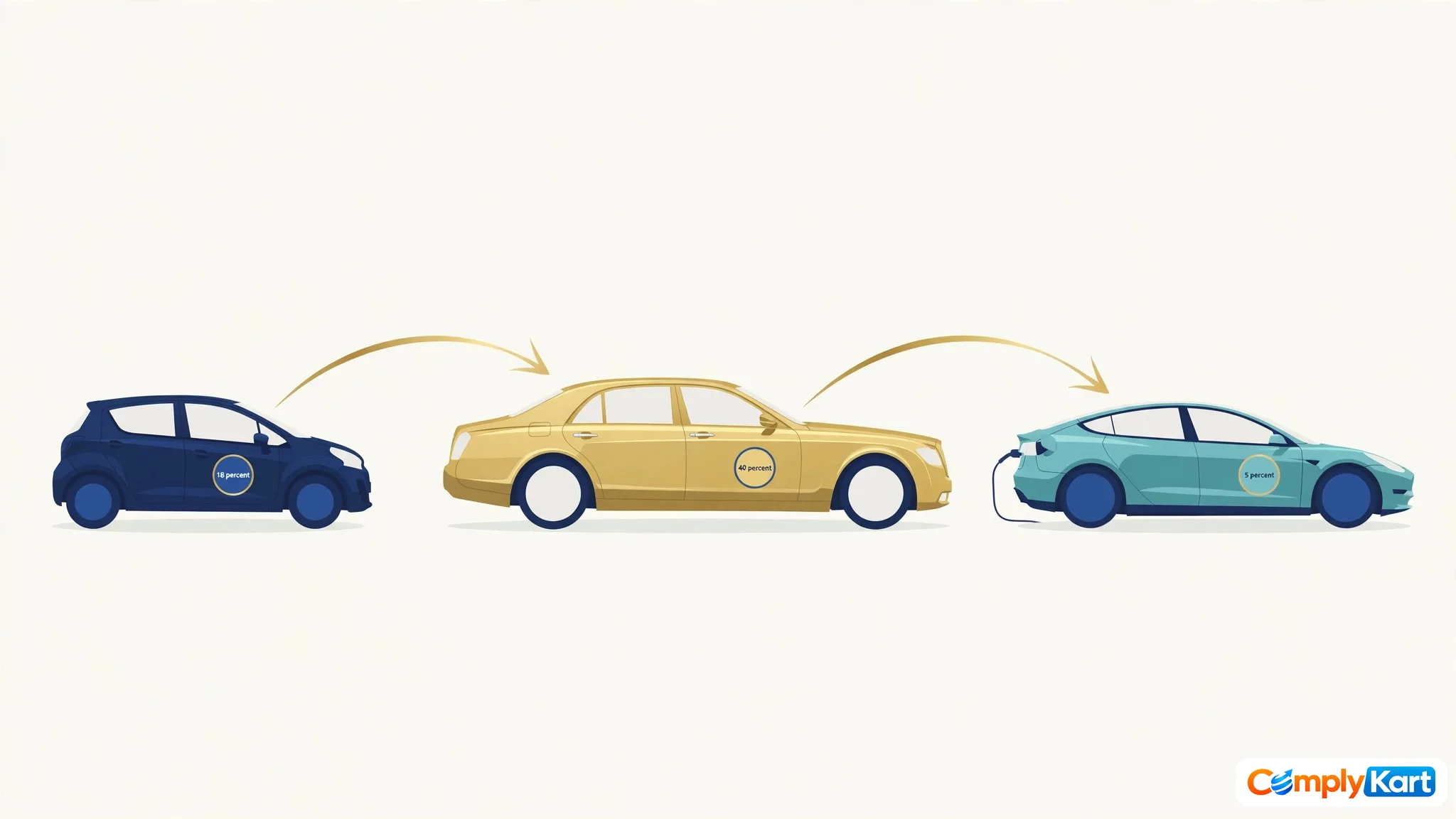
GST on cars is the goods and services tax on the sale of passenger cars in India, under HSN 8703. Since 22 September 2025, small cars — petrol, CNG or LPG up to 1,200cc, or diesel up to 1,500cc, and under 4 metres — attract 18% GST; all other cars attract 40%; electric cars attract 5%. The compensation cess on motor vehicles ended with the same reform.
You walk into a showroom with a budget in mind. The salesperson quotes a price. Then comes the question nobody answers cleanly: how much of that price is GST, and is the rate 18% or 40%?
Small cars pay 18% GST, larger and luxury cars pay 40%, and electric cars pay 5%. The rates changed on 22 September 2025, when GST 2.0 replaced the old 28% plus compensation cess system. The rate depends on engine size, length and fuel type — not price. The compensation cess on motor vehicles is gone.
That is the short version. The rest of this guide is for the two people who need more: the buyer who wants to check the maths before signing, and the business owner who is about to buy a car in the company name and wonders whether the GST comes back. It does not, in most cases, and that is the most expensive surprise in this whole subject.
What actually changed on 22 September 2025?
Before GST 2.0, nearly every car carried 28% GST plus a compensation cess that varied with the car's size and engine — 1% on a small petrol car, 3% on a small diesel, up to 22% on a big SUV. The cess was the part nobody could remember. Two cars with the same 28% rate could carry very different total tax.
The 56th GST Council meeting, on 3 September 2025, swept that structure away. Notification 9/2025-Central Tax (Rate) put the new rates in force from 22 September 2025. Three slabs now cover passenger cars, all under HSN 8703:
| Car type | Old tax | New GST |
|---|---|---|
| Small petrol car (up to 1,200cc, under 4 metres) | 28% + 1% cess = 29% | 18% |
| Small diesel car (up to 1,500cc, under 4 metres) | 28% + 3% cess = 31% | 18% |
| Larger cars, SUVs and luxury cars | 28% + 15–22% cess = 43–50% | 40% |
| Electric cars | 5% | 5% (unchanged) |
Small cars got a straight cut. Big cars got something stranger, which is the next section's whole point.
Which cars pay 18% — and which pay 40%?
The test has three parts, and a car must pass all of them to get 18%. It must be under 4 metres long. And its engine must be up to 1,200cc if it runs on petrol, CNG or LPG, or up to 1,500cc if it runs on diesel. Fail either test and the car pays 40%.
Hybrids follow the same test. A small hybrid — petrol up to 1,200cc and under 4 metres — pays 18%. A bigger hybrid pays 40%. There is no separate hybrid slab.
Read the brochure, not the badge. A compact SUV that measures under 4 metres with a 1,200cc petrol engine is an 18% car, whatever its stance suggests. A sedan with a 1,500cc petrol engine is a 40% car, however modest it looks. Engine and length decide. Nothing else does.
What a small car and a luxury car actually cost now
Percentages hide the money. Here is the maths on the taxable value — the price before tax — so you can check any quote yourself.
Take a small petrol car with a taxable value of ₹8,00,000. Under the old structure it carried 29% tax: ₹2,32,000. Today it carries 18%: ₹1,44,000. The saving is ₹88,000 on the same car. That is why showrooms cut prices within days of 22 September 2025, and why entry-level cars suddenly looked ₹50,000 to ₹1,00,000 cheaper.
Now take a luxury car with a taxable value of ₹50,00,000. Under the old structure it carried 28% plus 22% cess — 50% in all, or ₹25,00,000 of tax. Today it carries a flat 40%: ₹20,00,000. The saving is ₹5,00,000. The rate went up from 28% to 40% and the car still got cheaper.
Think of the old system as two bills for one car — a 28% GST bill and a cess bill of up to 22% stapled behind it. GST 2.0 threw away the second bill and wrote a single 40% bill instead. The headline number looks bigger. The total is smaller. That is the whole trick of the 40% slab, and it is the detail most headlines skipped.
Does the price of the car decide the rate?
No. This is the most-searched wrong idea about car GST, so say it plainly: there is no ₹10 lakh threshold, no ₹20 lakh threshold, and no slab that switches on the invoice value. A petrol car up to 1,200cc and under 4 metres pays 18% whether it costs ₹6 lakh or ₹12 lakh. Cross 1,200cc or 4 metres and it pays 40%, even at a modest price.
Price feels like the trigger because bigger, longer, more powerful cars cost more. The 40% bracket correlates with expensive cars without being caused by them. If you are comparing two cars around ₹10 lakh, check the engine and the length on the brochure rather than the price tag.
Ground clearance is the other ghost. Under the old cess rules, an SUV was defined partly by ground clearance of 170mm or more, and that figure still floats around in rate tables online. It does not decide anything now. The GST 2.0 test is engine size and length only. Any table that still lists ground clearance as a rate test is quoting the old cess definition.
Electric cars stay at 5%
Electric cars were untouched by the reform. They pay 5% GST, as they did before, with no cess. Against 18% on a small petrol car or 40% on a luxury model, that gap is large, and it is a deliberate one — the concessional rate is part of the push for cleaner mobility.
The 5% rate applies to the car itself. Charging is a separate question: a cab or rental operator using electric vehicles was given an option at the 57th GST Council meeting to charge 5% on rides where the charging cost sits inside the fare. That is a service-side option, not a change to the 5% rate on the car.
Is there still compensation cess on cars?
No. The compensation cess on motor vehicles ended on 22 September 2025, the day the new rates took effect. The 18% and 40% rates are the whole tax. There is nothing added on top.
People ask because the cess itself has not vanished from the tax system — it survives on a narrow list of demerit goods while loans raised during the pandemic are repaid. Cars are simply no longer on that list. If a quote after September 2025 still shows a cess line on a car, ask the dealer to explain it. It should not be there.
What GST does not cover — the on-road price
The ex-showroom price carries GST. The on-road price carries more. Road tax and registration are state levies, entirely outside GST, which is why on-road prices differ between states even when the ex-showroom price is identical. Motor insurance is a separate service taxed at 18%. Dealer-fitted accessories generally carry 18% on their own invoice lines, and an extended warranty or annual maintenance contract is 18% as a service.
Ask for insurance and accessories as separate lines on the invoice rather than folded into the vehicle price. It keeps the record clean, and it matters if the car is a business purchase, because the ITC position of each line is different.
Can your business claim the GST back?
This is where buyers lose real money. Section 17(5)(a) of the CGST Act blocks input tax credit on motor vehicles for the transport of persons with an approved seating capacity of up to 13, including the driver. That covers almost every car a business buys. The block applies even when the car is bought in the company name, even when it is used only for client visits, and even when it is used by a director rather than an employee.
There are exactly three exceptions. Credit is available if the vehicle is used for making a further supply of such motor vehicles — you are a dealer; for transportation of passengers — you run a cab fleet, a tourist service or a school bus operation; or for imparting training on driving — you run a driving school. Nothing else qualifies. A consultancy buying a car for client visits cannot claim the GST. A taxi operator buying the same car can.
The block extends further. Section 17(5)(ab) blocks credit on general insurance, servicing, repair and maintenance, so far as they relate to a vehicle already caught by clause (a). If the car is blocked, its insurance is blocked too. If the car qualifies, its insurance qualifies.
Put numbers on it. A consultancy buys a car for ₹10,00,000 plus 18% GST. The ₹1,80,000 of GST is blocked credit. It is not a timing difference and it is not recoverable later. It becomes part of the cost of the car in the books. Anyone who books the car at ₹10,00,000 and the GST as a recoverable credit has overstated the asset and understated the cost — and a wrongly claimed credit that is reversed later attracts interest under section 50(1).
Two details help dealers and fleets. A car dealer's demo vehicles qualify under the "further supply" exception — CBIC Circular 179/11/2022-GST confirmed this — provided the dealer takes ownership and sells the vehicle on its own account. And vehicles outside the block altogether — goods carriers such as trucks, and buses seating more than 13 — carry credit in the normal way when used for business.
Leasing deserves a careful word. The 57th GST Council meeting, on 8 October 2026, clarified how registration charges, road tax, insurance and FASTag recovered from a lessee are treated. It did not change the ITC position on the leased vehicle itself. A proposal to widen input tax credit to passenger vehicles under section 17(5) was discussed at the same meeting and deferred. So do not plan a purchase on the assumption that car ITC is about to open up. It may, one day. It has not.
If you are buying in a company name, settle the ITC answer before you sign, not after. The rate on the invoice is only half the cost question. Whether the tax comes back is the other half.
Buying a used car? The dealer pays GST only on the margin
Used cars work differently. A private individual selling a personal car is outside GST altogether — it is not a supply made in the course of business. A registered dealer is inside GST, but only on the profit margin.
Under Rule 32(5) of the CGST Rules, a dealer who buys a second-hand vehicle without claiming input tax credit pays GST on the difference between the selling price and the purchase price. The rate is a uniform 18% on that margin, in force from 16 January 2025 under Notification 04/2025-Central Tax (Rate), after the 55th GST Council recommended it. If the margin is negative — the car sells for less than it cost — the taxable value is treated as nil. No tax on a loss.
An example. A dealer buys a used car for ₹5,00,000 and sells it for ₹5,80,000. The margin is ₹80,000. GST at 18% on the margin is ₹14,400. That is the whole GST on the transaction — not 18% of ₹5,80,000, which would be ₹1,04,400. If a dealer's quote charges GST on the full price, ask for the margin working.
The 57th GST Council added a useful clarification for dealers, by recommending a circular: a dealer under the margin scheme may claim input tax credit on inputs other than the second-hand vehicles themselves — repairs, refurbishing parts, and general business overheads. The restriction applies only to the tax paid on the second-hand vehicles procured. That circular is still to be issued, so treat it as the Council's stated position rather than law in force, and check for the circular before relying on it.
Cars for persons with disabilities — the 18% concession
One group was already at 18% before GST 2.0, and nothing changed for them. Cars for persons with orthopaedic disability of 40% or more attract a concessional 18% GST, under a Department of Heavy Industries certificate. The car must be one the person can drive or be driven in, the applicant must not have availed the concession in the last five years, and the vehicle must not be disposed of for five years after purchase.
The concession matters here because it did not move. The government confirmed in a Lok Sabha reply in February 2026 that these vehicles were already taxed at 18% and stayed at 18% after the 56th Council's changes. A buyer who qualifies should claim the certificate route rather than paying the 40% rate on a larger car.
What may change next
The 57th GST Council meeting, on 8 October 2026, made no change to GST rates on vehicles, and the Council decided rate matters will now be taken up just once a year at a dedicated meeting. If you were waiting for a slab revision before booking, there is none coming from that meeting.
Two motor-vehicle items from that meeting are worth watching. The section 17(5) proposal on input tax credit for motor vehicles was deferred, not rejected — it may return at a later meeting. And the margin-scheme ITC circular for used-car dealers was recommended and awaits issue. Neither changes what you pay today. Both are worth a check before a big fleet decision next year.
5 mistakes that cost car buyers money
- Booking a car in the company name expecting the GST back. Section 17(5)(a) blocks it for almost every business car. Settle this before you sign, not at the first GSTR-3B.
- Assuming 40% means luxury cars got costlier. The old total was up to 50%. Check the old tax, not just the new headline rate.
- Paying GST on the full price of a used car. A registered dealer charges 18% on the margin only. Ask for the margin working.
- Comparing ex-showroom prices across states. Road tax is a state levy outside GST. Compare on-road prices, or compare ex-showroom and add each state's road tax yourself.
- Trusting the ground-clearance or price test. The rate turns on engine size and length. A 170mm ground-clearance figure and a ₹10 lakh price line are both leftovers from older rules.
Before you sign the booking form
Read the engine capacity and the length off the brochure and work out the rate yourself: 18% if it is a small car by those two tests, 40% if it is not, 5% if it is electric. Check the invoice shows the right rate and HSN 8703. If the car is a company purchase, get the ITC answer in writing from your accountant first — a blocked credit is a permanent cost, not a refund that arrives late. Ask for insurance and accessories as separate invoice lines. And if it is a used car from a dealer, ask to see the margin calculation before you agree the price.
Car GST is simpler than it was a year ago. Two slabs, one cess gone, one clear test. The complexity that remains is not in the rate. It is in the credit, the used-car margin, and the fine print of the invoice. Get those three right and the rate takes care of itself.
Frequently asked questions
What is the GST rate on cars in India?
It depends on the car. Small petrol cars up to 1,200cc and diesel cars up to 1,500cc, both under 4 metres, pay 18%. Larger cars, SUVs and luxury cars pay 40%. Electric cars pay 5%. All passenger cars fall under HSN 8703, and the rates have applied since 22 September 2025.
Is there compensation cess on cars now?
No. The compensation cess on motor vehicles ended on 22 September 2025, when the 18% and 40% rates took effect. The 40% rate is a single rate with nothing added on top. If a quote still shows a cess line on a car, ask the dealer to explain it.
Can I claim GST input tax credit on a car bought for my business?
Usually no. Section 17(5)(a) blocks credit on motor vehicles seating up to 13 persons, even when bought in the company name for business use. Credit is available only for dealers selling vehicles, passenger-transport operators, and driving schools. Goods vehicles and buses seating more than 13 fall outside the block.
What GST applies on a used car?
A private sale between individuals carries no GST. A registered dealer pays a uniform 18% GST, but only on the profit margin — the selling price minus the purchase price — under Rule 32(5) of the CGST Rules. If the dealer sells at a loss, no GST is payable. The dealer cannot claim input tax credit on the vehicle itself.
Did the 57th GST Council change GST on cars?
No. The 57th meeting, on 8 October 2026, made no change to GST rates on vehicles and decided rates will be reviewed once a year. It deferred a proposal to widen input tax credit on motor vehicles, and recommended a circular letting used-car dealers claim credit on repairs and overheads, but not on the vehicles themselves.
Rates change, and this guide states the position as it stands on 11 November 2026. If you are buying a car for your business, check the rate and the credit position with your adviser before you sign — the invoice is easy to correct before it is raised, and expensive to fix after. If the numbers in this guide helped you read a quote, the GST registration and GST returns pages explain the compliance side, and the GST calculator works out the tax on any price in seconds. For the wider rate picture, see our GST rate list for 2026, the GST registration fee breakdown, and GST on health and life insurance after GST 2.0. The 57th Council's enforcement changes are covered in our decriminalisation guide, and the compliance fee calculator puts the cost of the year's filings in one place.


Comments
No comments yet — ask the first question below.
Join the discussion
Questions go straight to our expert desk. Comments appear after a quick review — no spam, no noise.