
IN BRIEF
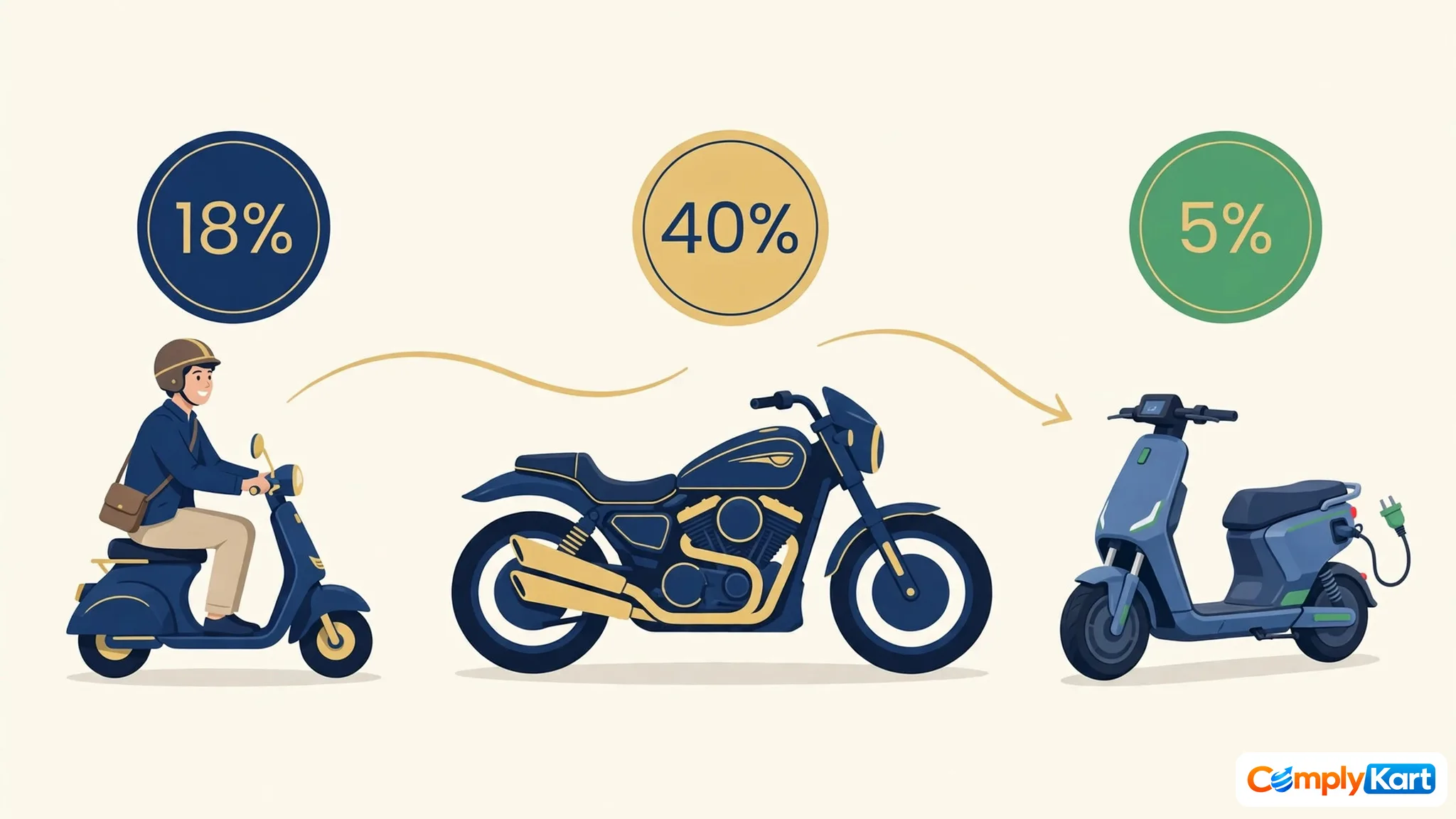
GST on bikes and scooters is the goods and services tax on the sale of two-wheelers in India, under HSN 8711. Since 22 September 2025, petrol and diesel two-wheelers up to and including 350cc attract 18% GST; those above 350cc attract 40%; electric two-wheelers attract 5%. The compensation cess on two-wheelers ended with the same reform.
You walk into a showroom with a budget in mind. The salesperson quotes a price. Then comes the question nobody answers cleanly: how much of that price is GST, and is the rate 18% or 40%?
Bikes and scooters up to and including 350cc pay 18% GST, those above 350cc pay 40%, and electric two-wheelers pay 5%. The rates changed on 22 September 2025, when GST 2.0 replaced the old 28% plus compensation cess system. The rate depends on engine size alone — not on the bike's price. The compensation cess on two-wheelers is gone.
That is the short version. The rest of this guide is for the two people who need more: the buyer who wants to check the maths before signing, and the business owner who is about to buy bikes for delivery riders or staff and wonders whether the GST comes back. It does not, in most cases, and that is the most expensive surprise in this whole subject.
What actually changed on 22 September 2025?
Before GST 2.0, nearly every petrol bike carried 28% GST. Bikes above 350cc carried an extra 3% compensation cess on top, taking their total tax to 31%. The cess was the part nobody could remember. Two bikes with the same 28% rate could carry different total tax, and the difference sat buried in the invoice.
The 56th GST Council meeting, on 3 September 2025, swept that structure away. Notification 9/2025-Central Tax (Rate) put the new rates in force from 22 September 2025. Three slabs now cover two-wheelers, all under HSN 8711:
| Two-wheeler type | Old tax | New GST |
|---|---|---|
| Petrol/diesel bike or scooter up to and including 350cc | 28% | 18% |
| Petrol/diesel motorcycle above 350cc | 28% + 3% cess = 31% | 40% |
| Electric two-wheeler | 5% | 5% (unchanged) |
Commuter bikes and scooters got a straight cut. Big bikes got something stranger, which is the next section's whole point.
The 350cc test — which bikes pay 18%, and which pay 40%?
The test has one part, and it is absolute. Read the engine displacement on the invoice or the registration certificate. Up to and including 350cc, the bike pays 18%. A single cc above 350, it pays 40%.
Think of it like a pass mark in an exam. 350 passes at 18%. 351 fails into 40%. There is no sliding scale, no partial credit for being close, and no rounding down. A 349cc Royal Enfield Classic 350 sits at 18%. A 452cc Himalayan 450 sits at 40%. A 399cc KTM 390 sits at 40%. The model name tells you nothing — only the displacement does.
That matters because the boundary cuts through the middle of the market. A commuter 110cc scooter and a 350cc cruiser pay the same 18%. A 390cc street bike and a 1,200cc superbike pay the same 40%. If you are choosing between two bikes that straddle the line, the tax difference is worth more than the brochure difference. Check the exact displacement before you decide, not after you have paid.
What the cut actually saves you
Percentages hide the money. Here is the maths on the taxable value — the price before tax — so you can check any quote yourself.
A commuter bike with a taxable value of ₹1,00,000 used to carry 28% GST: ₹1,28,000 before road tax and insurance. Now it carries 18%: ₹1,18,000. That is ₹10,000 saved on the tax alone.
A scooter with a taxable value of ₹80,000 used to cost ₹1,02,400 with 28% GST. Now it costs ₹94,400 with 18% GST. That is ₹8,000 saved — real money on the bike most Indian families actually buy.
Now the other side. A premium bike with a taxable value of ₹2,50,000 used to carry 31% in total — 28% GST plus 3% cess — which came to ₹3,27,500. Now it carries a flat 40%: ₹3,50,000. That is ₹22,500 more. The 40% slab is not a small tweak. On a big bike, it is the price of a decent helmet, riding gear and a year's insurance, added in tax.
One warning on the maths. The saving lands on the taxable value, and dealers quote ex-showroom prices that already include GST. Ask for the pre-tax value on the quote if you want to check the arithmetic. If the dealer cannot show it, the quote is doing the hiding for them.
Does the bike's price decide the rate?
No. This is the most common misunderstanding in showrooms, and it costs people money.
The rate follows the engine, not the price tag. A ₹2,00,000 bike with a 350cc engine pays 18%. A ₹1,50,000 bike with a 400cc engine pays 40%. The cheaper bike can carry the higher rate, and the dearer bike can carry the lower one. Price never enters the test.
The confusion is understandable. For cars, the old cess system did use length and engine, and people learned to guess the rate from the car's size and price. For bikes, the rule was always simpler, and GST 2.0 kept it that way: one number, the displacement, decides everything.
Electric bikes and scooters: 5%, unchanged
Electric two-wheelers did not get a cut, because they never needed one. They have paid 5% GST all along, and GST 2.0 left that untouched.
That leaves electrics as the cheapest-taxed two-wheelers on the road. A ₹1,00,000 electric scooter carries ₹5,000 of GST against ₹18,000 on a petrol scooter of the same price. The gap is worth knowing if you are comparing an electric and a petrol model at similar sticker prices — the tax alone closes much of the difference, before you count running costs.
One caution. The 5% rate applies to the vehicle. Batteries sold separately, chargers and accessories carry their own rates, and a dealer who bundles them into one price can blur the picture. Ask for the split on the invoice.
Is there still cess on bikes?
No. The compensation cess on two-wheelers ended with GST 2.0. The 40% rate on big bikes is the whole tax — there is no cess line hiding underneath it.
This is where the 40% number fools people. It looks like a jump from 28%, and in a sense it is: the GST rate itself rose from 28% to 40%. But the old total was 31%, not 28%, because the 3% cess sat on top. So the real rise for a big bike is 9 points, from 31% to 40% — not 12. And on the other side, the commuter bike's real fall is 10 points, from 28% to 18%, with no cess to muddy it. Both directions are smaller than the headlines suggest.
What GST does not cover
GST is only one part of what you pay on the road. Road tax and registration are state levies, outside GST entirely, and they vary by state. Motor insurance carries 18% GST. Dealer accessories generally carry 18%. Extended warranty and annual maintenance contracts carry 18% too.
So when you compare two quotes, compare the same thing. One dealer's "on-road price" may include insurance and accessories; another's may not. The GST rate on the bike is fixed by the engine. Everything around it is where quotes diverge, and where the real comparison happens.
Buying bikes for your business or delivery fleet — the credit trap
This is the section that saves businesses real money, and it is the one no bike-rate page bothers to write.
If you buy bikes in your company's name — for delivery riders, for field staff, for the sales team — you cannot claim the GST back as input tax credit. Section 17(5)(a) of the CGST Act blocks credit on motor vehicles used to transport persons, where the seating capacity is thirteen or fewer. A two-wheeler is a motor vehicle for transporting persons. The block applies.
There are only three exceptions. The block does not apply if you buy the bike for further supply — you are a dealer selling it on. It does not apply if you use it to transport passengers — a taxi or rental business. And it does not apply if you use it to teach people to drive — a driving school. A delivery fleet is none of these. You are moving goods, not passengers, and the bike is not being sold on. The credit stays blocked.
Section 17(5)(ab) closes the side door as well. Insurance, servicing, repair and maintenance on a blocked vehicle are blocked too. So the GST on the bike, the GST on its insurance, and the GST on every service bill all sit as cost. For a fleet of fifty scooters, that is not a rounding error. It is a line in the budget that needs to be there from the start.
Leasing does not dodge the block either. If you lease bikes instead of buying them, the lease rental carries GST, and the same restriction follows the vehicle. The 57th GST Council, on 8 October 2026, discussed widening input tax credit on motor vehicles — and deferred the proposal. It is not law, and there is no date for it. Plan on the block staying.
What can a fleet buyer do? Price the bikes as a full cost, GST included, and compare that against the alternatives: reimbursing riders who own their bikes, or hiring a logistics partner who owns the fleet. The right answer depends on your volumes, but the wrong answer is the one that assumes the GST comes back. It does not.
Used bikes: the margin scheme
Buying second-hand is a different tax story, and a kinder one.
A registered dealer selling a used bike pays GST only on the profit margin — the difference between the selling price and the purchase price — under Rule 32(5) of the CGST Rules. The rate is a uniform 18%, whatever the bike's engine size, and it has applied since 16 January 2025 under Notification 04/2025-Central Tax (Rate). If the dealer sells at a loss, the negative margin is ignored and no GST is payable.
Here is the maths. A dealer buys a used scooter for ₹50,000 and sells it for ₹58,000 after a service and a wash. The margin is ₹8,000. GST at 18% comes to ₹1,440. That is the whole tax on the sale — not 18% of ₹58,000.
Two conditions keep the scheme honest. The dealer must not have claimed input tax credit on the purchase of the bike. And a private sale — you selling your bike to a neighbour — carries no GST at all, because it is not a business supply. If a dealer quotes you GST on the full price of a used bike, ask which rule they are applying. The margin scheme is the answer you should hear.
The 57th GST Council added one clarification that helps dealers. It recommended a circular confirming that a margin-scheme dealer can still claim input tax credit on repairs, spare parts and overheads — just not on the vehicle itself. The credit on the bike stays blocked; the credit on the work around it does not.
The sales record that followed
The cut did what a tax cut is supposed to do: people bought bikes.
In October 2025, two-wheeler retail registrations hit 31.5 lakh units, up 51.8% on the year — the highest monthly figure ever recorded, according to the Federation of Automobile Dealers Associations. The 42-day festive period from Dussehra to Diwali saw 40.5 lakh two-wheelers registered, up 22% on the previous year.
Wholesale numbers tell a quieter story, and the difference is worth knowing. The Society of Indian Automobile Manufacturers reported dispatches of 22.1 lakh two-wheelers in October 2025, up just 2.1% — scooters up 14.3% to 8.24 lakh, motorcycles down 4%. Dispatches measure what factories sent to dealers; registrations measure what customers actually bought. The festive rush cleared showroom stock faster than factories refilled it. Both numbers are true. They measure different things.
The pattern fits the tax change. Scooters — the cheapest bikes, the ones the 18% rate helps most — grew fastest. The cut landed on 22 September, right at the start of the festive season, and buyers who had waited through September walked in during October.
Five mistakes that cost bike buyers money
Assuming the rate from the price. A ₹1,50,000 bike can pay 40% and a ₹2,00,000 bike can pay 18%. Check the displacement, not the sticker.
Forgetting the 350cc boundary is exact. "Up to and including 350cc" means 350 pays 18% and 351 pays 40%. A 1cc difference is a 22-point tax difference.
Buying in the company name and expecting the GST back. Section 17(5)(a) blocks it for delivery and staff bikes. Budget the full cost, GST included.
Paying GST on the full price of a used bike. A registered dealer pays 18% on the margin only. Ask for the margin calculation.
Comparing on-road prices that are not comparable. Insurance, accessories and road tax vary between quotes. Compare the ex-showroom price and the GST rate first, then the extras.
What to do before you buy
Check the displacement on the brochure and confirm it on the invoice before you pay — that one number fixes your rate. Ask the dealer for the pre-tax value so you can check the GST maths yourself. If you are buying for a business, get the credit position in writing from your adviser before the invoice is raised, not after. If you are buying used, ask the dealer to show the margin calculation. And if the bike you want sits just above 350cc, run the numbers on the 350cc version too — the tax gap may be bigger than the performance gap.
Frequently asked questions
What is the GST rate on bikes in India now?
Bikes and scooters up to and including 350cc pay 18% GST. Motorcycles above 350cc pay 40%. Electric two-wheelers pay 5%. The rates apply from 22 September 2025 under Notification 9/2025-Central Tax (Rate), and all two-wheelers fall under HSN 8711.
Is GST 18% or 40% on a 350cc bike?
18%. The rule is "up to and including 350cc", so a bike with exactly 350cc displacement — or 349cc, like the Classic 350 — pays 18%. Only a bike above 350cc pays 40%.
Can a business claim GST input tax credit on bikes bought for delivery staff?
No. Section 17(5)(a) blocks input tax credit on motor vehicles for transporting persons, and the only exceptions are further supply, passenger transport and driving training. Delivery use fits none of them, and section 17(5)(ab) blocks the credit on insurance and servicing too.
What GST applies when I buy a used bike from a dealer?
The dealer pays a uniform 18% GST on the profit margin only — the selling price minus the purchase price — under Rule 32(5) of the CGST Rules, in force since 16 January 2025. If the dealer sells at a loss, no GST is payable. A private sale between individuals carries no GST.
Did the 57th GST Council change GST on bikes?
No. The 57th GST Council, on 8 October 2026, made no change to GST rates on two-wheelers. It deferred a proposal to widen input tax credit on motor vehicles and recommended a circular letting used-vehicle dealers claim credit on repairs and overheads, but not on the vehicles themselves.
Rates change, and this guide states the position as it stands on 11 November 2026. If you are buying a bike for your business, check the rate and the credit position with your adviser before you sign — the invoice is easy to correct before it is raised, and expensive to fix after. If the numbers in this guide helped you read a quote, the GST registration and GST returns pages explain the compliance side, and the GST calculator works out the tax on any price in seconds. For the wider rate picture, see our GST rate list for 2026, the GST guide for cars after GST 2.0, and the GST registration fee breakdown. The 57th Council's enforcement changes are covered in our decriminalisation guide, and the compliance fee calculator puts the cost of the year's filings in one place.


Comments
No comments yet — ask the first question below.
Join the discussion
Questions go straight to our expert desk. Comments appear after a quick review — no spam, no noise.