
IN BRIEF
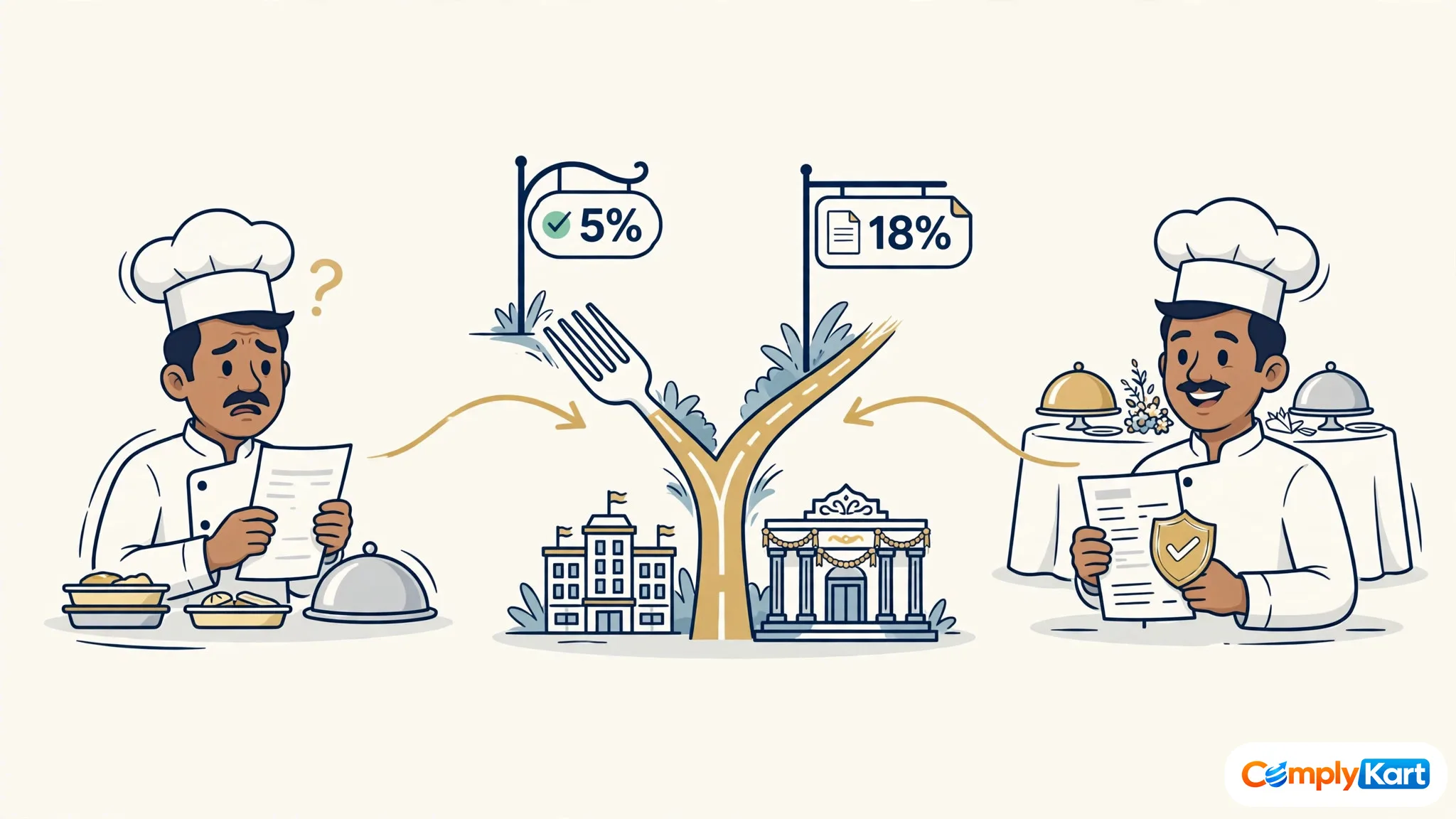
GST on catering services is the tax charged on food and drink served as part of a service at weddings, events, conferences and other functions. Outdoor catering at ordinary venues is taxed at 5% without input tax credit under entry 7(iv) of Notification 11/2017-Central Tax (Rate), while catering at specified premises — hotels that charged over ₹7,500 a night in the previous year — is taxed at 18% with input tax credit.
Short answer: Outdoor catering at an ordinary venue — a marriage hall, a home, an office lawn — is taxed at 5% GST without input tax credit. The same food served by a hotel at "specified premises" is taxed at 18% with input tax credit. The venue decides the rate, not the menu, and the 5% rate is mandatory: you cannot choose 18% just to claim credit.
A caterer quotes a price, the family nods, and then someone asks the question that stalls the whole booking: "GST kitna lagega?" The answer is not one number. It is two numbers, and which one applies depends on where the food is served and who is serving it. Get it wrong and you either overcharge a customer by ₹65,000 on a ₹5 lakh bill, or you claim input tax credit the law never gave you. Both mistakes surface later — one in a lost booking, the other in a department notice.
Think of it like a train ticket. The same meal costs different GST depending on which carriage it is served in. The venue is the carriage.
What is the GST rate on catering services in India?
There is no single catering rate. The rate notification sorts food services by where they are supplied and by whom, and catering falls into four buckets:
| Service | GST rate | Input tax credit | SAC code |
|---|---|---|---|
| Outdoor catering at ordinary venues (marriage halls, homes, offices, open grounds) | 5% | No | 996334 |
| Outdoor catering at specified premises, or by a hotel located in specified premises | 18% | Yes | 996334 |
| Restaurant service at ordinary premises | 5% | No | 996331 |
| Restaurant service at specified premises | 18% | Yes | 996331 |
| Food at canteens and messes under a contract (offices, schools, factories) | 5% | No | 996337 |
| Outdoor catering bundled with renting the venue for the function | 5% at ordinary venues; 18% at specified premises | Only at 18% | 996334 |
Outdoor catering sits under entry 7(iv) of Notification 11/2017-Central Tax (Rate). The venue-plus-catering bundle sits under entry 7(v). The 5% is 2.5% CGST plus 2.5% SGST on an intra-state bill, or 5% IGST when the caterer and the customer are in different states.
Outdoor catering at 5%: what it actually covers
"Outdoor catering" sounds like food served outdoors. In GST law it means something narrower: food and drink supplied as part of a service at exhibition halls, events, conferences, marriage halls and other functions that are event-based and occasional. A wedding, a corporate offsite, a birthday in a banquet hall — all of it is outdoor catering, whether the hall has a roof or not.
Two details catch caterers out. First, the 5% rate covers the whole service, not just the food. Preparation, transport, serving staff, crockery, the counters — when they are naturally bundled into one catering job, the whole bundle is one composite supply of service and the whole bill is taxed at 5%. The Authority for Advance Rulings confirmed this in the Friends Catering CBE case, reported in May 2026: even a caterer who only drops off prepared food at a venue, with no serving staff at all, is still making a composite supply of service at 5%. Delivery without staff does not turn catering into a sale of goods.
Second, the 5% rate is not a choice. A caterer who buys expensive equipment and ingredients, watches the input tax pile up, and decides to charge 18% so the credit can be claimed is breaking the law, not being clever. The AAR rejected exactly that argument: the 5% rate is mandatory for outdoor catering outside specified premises, and the residuary 18% entry does not apply. If you charge 18% and claim credit, the department can demand the credit back with interest — and your customer has overpaid for nothing.
If you also run a restaurant, read the restaurant side of this separately — the GST rules for restaurants use the same specified-premises test but the billing and composition questions are different.
A ₹5 lakh wedding bill at 5% vs 18%
Take a real booking. A family hires a caterer for a wedding: 400 guests, food, counters, serving staff, crockery. The agreed price before tax is ₹5,00,000.
At an ordinary marriage hall (5%, no ITC): GST is ₹25,000 — ₹12,500 CGST and ₹12,500 SGST. The family pays ₹5,25,000 in total.
At a specified-premises hotel (18%, with ITC): GST is ₹90,000. The family pays ₹5,90,000 in total — ₹65,000 more for the same food.
Now look at it from the caterer's side. Suppose the caterer spent ₹2,00,000 on ingredients, fuel, rented equipment and packaging for this wedding, and paid 18% GST on those purchases — ₹36,000 of input tax.
- At 5%, that ₹36,000 is a dead cost. It cannot be claimed. It sits inside the caterer's price, which is exactly why a 5% caterer's quote is not "cheaper by 13%" — part of the gap is tax the caterer has already swallowed.
- At 18%, the caterer claims the ₹36,000 as input tax credit and pays only the balance — ₹90,000 collected minus ₹36,000 credit, or ₹54,000 — to the government. The credit is real, but so is the extra ₹65,000 the customer paid.
That is the trade-off in one line: the 5% rate is cheaper for the customer and costlier for the caterer; the 18% rate is costlier for the customer and lets the caterer recover input tax. Neither side gets to pick. The venue picks.
What is a "specified premises" — and why it matters for your next wedding season
This is the phrase that decides your rate, and it changed recently. Before 1 April 2025, a premises was "specified" if any room's declared tariff was above ₹7,500 a night — the published rate, before discounts. Since 1 April 2025, under Notification 05/2025-Central Tax (Rate) dated 16 January 2025, a premises is specified for a financial year if any one of three things is true:
- the supplier provided hotel accommodation there in the previous financial year with any unit's value of supply above ₹7,500 per day; or
- the supplier filed a declaration between 1 January and 31 March of the previous financial year saying the premises is specified (Annexure VII); or
- a person applying for GST registration filed a declaration within fifteen days of getting the application reference number (Annexure VIII).
Two practical consequences. First, the test now runs on what was actually charged last year, not on a published tariff card — and a hotel can also volunteer for specified status by declaration, even if it never crossed ₹7,500. Second, the declaration is now filed online on the GST portal (Services → Registration → Declaration for Specified Premises), and for financial year 2026-27 the window is 1 January to 31 March 2026. Miss that window and the premises stays non-specified for the whole year, unless it qualifies on last year's values. A hotel that wants the 18% rate with credit for the 2026-27 wedding season needs to file in that window — and a caterer working out of a hotel kitchen needs to know whether the hotel filed, because it decides the caterer's rate too.
The same notification changed hotel room tax from 22 September 2025 (Notification 15/2025-Central Tax (Rate)): accommodation up to ₹7,500 a night is now 5% without input tax credit, down from 12%. Above ₹7,500 it stays 18% with credit. If your catering is part of a hotel stay package, that change touches your bill as well.
Venue plus catering: one bill or two?
Most weddings are not just catering. The family hires the hall and the caterer, sometimes from the same vendor, sometimes from two. The tax treatment follows the contract, not the invitation card.
When outdoor catering comes bundled with renting the premises for the function — one package, one price — it is a composite supply under entry 7(v): 5% at an ordinary venue, 18% at specified premises, on the whole package. The venue rent does not get pulled out and taxed at 18% separately. This is the single most valuable planning point in wedding GST: a standalone hall hired without catering is taxed at 18% on the rent, while the same hall hired with catering is taxed at 5% on the package.
Everything else in the wedding is taxed on its own rate if it is contracted separately. Décor, photography, artists, sound and light — typically 18% each. If one vendor supplies the venue, the catering, the décor and the photography under a single undivided contract, the department can treat the whole thing as one supply at the highest rate. Keep the contracts and the bills separate, with each element priced on its own line, and each element keeps its own rate. The difference between a composite supply and a mixed supply is exactly this question — whether the elements are naturally bundled or just sold together — and it is worth ten minutes of your time before you sign a wedding contract.
Do you need GST registration, and what does compliance look like?
Registration. A caterer must register once aggregate turnover crosses ₹20 lakh in a financial year (₹10 lakh in special-category states). Turnover counts everything — catering, restaurant sales, any other taxable supply — not just one vertical. Below the threshold, registration is optional, but unregistered caterers cannot charge GST and cannot claim input tax credit, and corporate clients will often refuse to book an unregistered caterer because they cannot claim credit on the bill. If you are anywhere near ₹20 lakh, register before the wedding season, not during it. The GST registration process takes a few working days if the documents are ready.
Composition scheme. Small caterers sometimes ask about composition — 5% on turnover, no input tax credit, a quarterly return instead of monthly filings. The scheme covers restaurant services with turnover up to ₹1.5 crore. A standalone outdoor caterer may be able to opt in, but check before you switch: no input tax credit, no inter-state supplies, no alcohol service, no supplies through e-commerce operators, and you issue a bill of supply instead of a tax invoice. If most of your work is event catering invoiced to companies that want input tax credit, composition will cost you clients. It suits a small local caterer with walk-in customers far better than an event caterer with corporate books.
Invoicing. Issue the tax invoice within 30 days of the event. Show the SAC code 996334, the venue and event date, and the rate you charged. Catering is a service, so GST on a booking advance is payable in the month you receive it — issue a receipt voucher for every advance, not just the final bill. And take no more than ₹2 lakh in cash from one person for one event: cash above that is barred under section 269ST of the Income-tax Act, and wedding cash is the classic place it gets missed.
E-invoicing. Once aggregate turnover crosses ₹5 crore, invoices must be reported to the Invoice Registration Portal and carry an IRN. Most standalone caterers never reach this, but a catering company with a restaurant chain and an events arm can cross it faster than it expects — check the group turnover, not one outlet's.
FSSAI. GST is only half the licence question. Every caterer is a food business operator and needs an FSSAI registration or licence for the kitchen — the tier depends on turnover, and the 14-digit number goes on the invoice and the menu. If you do not have one yet, sort the FSSAI licence alongside the GST registration; clients and venues increasingly ask for both before signing.
For the monthly arithmetic — what 5% on a quote actually leaves you after input costs — the compliance fee calculator is a quick way to check the numbers before you quote.
5 mistakes that cost caterers money
- Charging 18% "to be safe" and claiming ITC. The 5% rate is mandatory outside specified premises. The credit gets reversed with interest, and the customer overpaid.
- Forgetting the declaration window. A hotel caterer that wants specified-premises status for 2026-27 must file Annexure VII between 1 January and 31 March 2026. There is no late window.
- Not charging GST on advances. A ₹1 lakh advance received in November is taxable in November, even if the wedding is in February. The receipt voucher is not optional.
- Bundling décor and photography into the catering contract. One undivided contract can push the whole package to 18%. Separate contracts, separate bills, separate rates.
- Invoicing without the FSSAI number or with the wrong SAC. 996334 is outdoor catering; 996331 is a restaurant; 996337 is a contract canteen. The wrong code on an invoice is the first thing a department notice picks up.
FAQs
What is the GST rate on wedding catering?
5% without input tax credit when the catering is at an ordinary venue such as a marriage hall or home, under entry 7(iv) of Notification 11/2017-Central Tax (Rate). If the wedding is at a specified-premises hotel — one that charged over ₹7,500 a night in the previous year or has declared itself specified — the rate is 18% with input tax credit.
Can a caterer claim input tax credit at 5% GST?
No. The 5% rate comes with a mandatory condition that input tax credit on goods and services used for the supply is not taken. A caterer cannot choose to charge 18% instead to claim the credit — the Authority for Advance Rulings confirmed in the Friends Catering CBE case that the 5% rate is compulsory for outdoor catering outside specified premises.
What is the SAC code for catering services?
996334 — catering services in exhibition halls, events, marriage halls and other outdoor or indoor functions. Restaurant services are 996331 and ongoing contract food services, such as an office canteen, are 996337. Use four digits of the SAC on invoices up to ₹5 crore turnover, and six digits above that.
When does a caterer need GST registration?
Once aggregate turnover crosses ₹20 lakh in a financial year (₹10 lakh in special-category states). Registration is compulsory from that point, and many corporate clients will only book a registered caterer because they need a tax invoice to claim input tax credit. Voluntary registration below the threshold is allowed.
Is GST charged on the venue and catering together or separately?
When catering is bundled with renting the venue for a function, the package is a composite supply taxed at 5% at ordinary venues and 18% at specified premises, on the whole package. A venue hired alone, without catering, is taxed at 18% on the rent. Décor, photography and artists contracted separately keep their own rate, usually 18%.
If you cater for a living, get the rate right before the wedding season peaks. One wrong invoice — 18% where 5% applied, or a missed advance — is the kind of error that shows up months later as a notice. ComplyKart's GST team can check your registration, your invoice format and your specified-premises position in a single sitting, so the next quote you send out is one you never have to correct.





Comments
No comments yet — ask the first question below.
Join the discussion
Questions go straight to our expert desk. Comments appear after a quick review — no spam, no noise.