
IN BRIEF
Types of supply under GST are the labels the CGST Act, 2017 puts on every transaction — taxable, exempt, nil-rated, zero-rated or non-GST — and the label decides the rate, whether input tax credit survives, and which row of GSTR-3B the value goes in. Section 7 defines what counts as a supply, and Sections 8 and 16 sort bundled and export supplies.
A client once showed me two invoices for the same kind of sale. Same goods, same customer type, same month. One charged 18% GST. The other charged nothing — and the accountant had still claimed input tax credit on the purchase behind it. One of those invoices was right. The other was a notice waiting to happen.
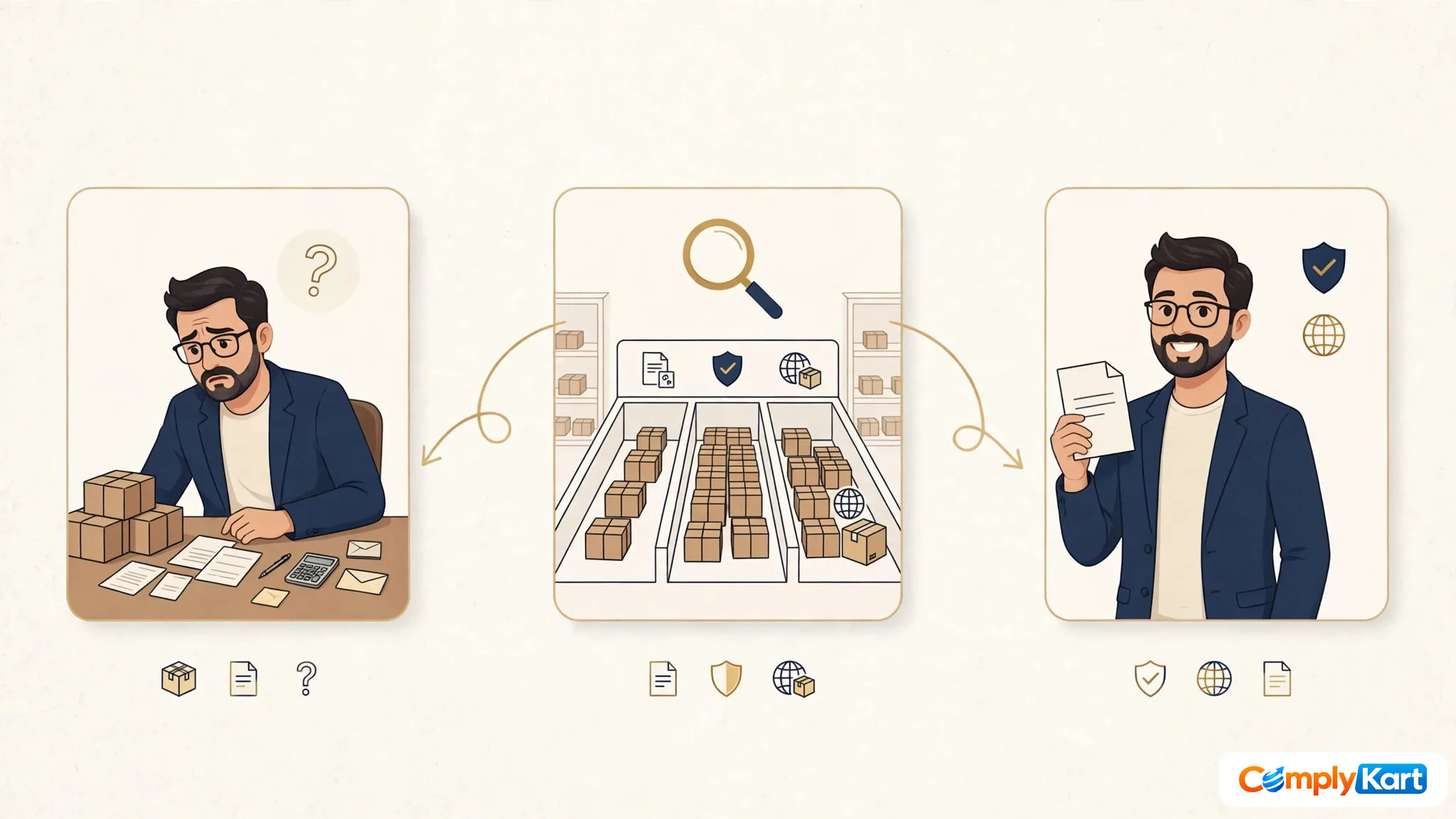
The difference was a label. Under GST, every transaction your business makes gets sorted into a type of supply, and that label decides three things at once: the rate of tax, whether you keep your input tax credit, and which row of GSTR-3B the value goes into. Get the label right and the rest of the return almost fills itself. Get it wrong and you pay tax you did not owe, or lose credit you were owed, or both.
The short answer: Under GST, every supply is sorted by taxability — taxable, exempt, nil-rated, zero-rated or non-GST — and by bundling, location and who pays the tax. The label decides the rate, whether you keep your input tax credit, and which row of GSTR-3B the value goes in.
What counts as a "supply" in the first place?
Before you sort anything, the transaction has to be a supply at all. Section 7 of the CGST Act, 2017 is the gate. A supply covers the sale, transfer, barter, exchange, licence, rental, lease or disposal of goods or services, made for a consideration, in the course or furtherance of business. Three conditions, all three must hold: something moves, money (or money's worth) changes hands, and it happens in business.
Two wrinkles matter. First, the import of services for a consideration is a supply even if it has nothing to do with your business — the Act says so expressly. Second, Schedule I treats some transactions as supplies even when no money changes hands: a branch transfer of goods to your own branch in another state, a supply to a related person, goods handed to your agent to sell, and services imported from your own establishment abroad. The classic tripwire is the employer gift — a gift from employer to employee above ₹50,000 in a financial year is a supply; below it, it is not.
Schedule II then decides whether a given transaction is a supply of goods or a supply of services — a works contract is a service, a lease of goods is a supply of services, and so on. And Schedule III lists the things that are neither: your salary is not a supply, a court's services are not a supply, the sale of land is not a supply, and the sale of a building after the completion certificate is issued is not a supply. If a transaction is in Schedule III, GST does not even start. That is different from exempt, as you will see in a moment.
The five types of supply, by taxability
Think of it like a post-office sorting room. Every parcel that comes in gets a label, and the label decides the postage, whether you get a refund on the stamps you already bought, and which ledger the parcel is entered in. Same parcel, wrong label, different bill.
| Type of supply | GST charged? | Input tax credit | GSTR-3B row |
|---|---|---|---|
| Taxable | Yes — 5%, 18% or 40% | Yes, if eligible | 3.1(a) |
| Exempt | No — exempted by notification | No, on inputs used for it | 3.1(c) |
| Nil-rated | No — 0% in the rate schedule | No, on inputs used for it | 3.1(c) |
| Zero-rated | 0% effective rate | Yes — full credit, refund available | 3.1(b) |
| Non-GST | Outside GST altogether | No — GST does not apply | 3.1(e) |
Taxable supply: the default
A taxable supply is any supply that attracts GST at a notified rate. This is the default bucket. Unless a supply is specifically exempted, nil-rated, zero-rated or outside GST, it is taxable.
Since 22 September 2025, the GST 2.0 rate structure has two main slabs — 5% and 18% — with a 40% rate for select luxury and sin goods. A few special rates survive alongside them, such as 3% on gold and 0.25% on rough diamonds. A laptop at 18%, a restaurant meal at 5% without input tax credit, professional fees at 18% — all taxable supplies. If your business is registered, this is the supply you will deal with most, and it is the only one where the full machinery of GST — charging tax, claiming credit, filing returns — works exactly as most people picture it. If you are still deciding whether you need to register at all, the thresholds and the compulsory-registration triggers are worth checking on our GST registration page before your turnover crosses them.
Exempt supply: no tax, no credit
An exempt supply attracts no GST because the government has exempted it through a notification under Section 11 of the CGST Act (or Section 6 of the IGST Act). Section 2(47) defines exempt supply to cover three things: supplies taxed at a nil rate, supplies wholly exempted by notification, and non-taxable supplies.
The examples are the ones every Indian recognises: healthcare services by a clinical establishment, educational services by a recognised institution, fresh fruits and vegetables, interest on loans and advances. You charge no GST on these. But here is the part people miss — you also cannot claim input tax credit on the inputs used to make an exempt supply. Rules 42 and 43 of the CGST Rules force a reversal of credit attributable to exempt supplies. A hospital that buys taxable equipment and medicines cannot simply claim all the credit and then make exempt supplies with it. The credit has to be split, and the exempt share reversed.
Nil-rated supply: 0% on the tariff, still no credit
A nil-rated supply is taxable in principle but carries a 0% rate in the rate schedule itself — salt, fresh milk, curd, lassi, judicial stamp paper, specified fresh vegetables and cereals. You charge nothing, because the rate is zero.
Readers often ask what the difference is from an exempt supply, since both end at zero tax. The practical answer: almost none, from the buyer's side. Both go into the same GSTR-3B row, Table 3.1(c), and both lose the input tax credit on their inputs. The difference is only in where the zero comes from — the tariff for nil-rated, a notification for exempt. Keep the two labels straight in your books, because your auditor will ask, but do not expect a different outcome on the return.
Zero-rated supply: 0% tax, full credit
Zero-rated supply is the one that trips up even experienced accountants, because it looks identical to exempt on the invoice — 0% tax — and behaves completely differently behind it. Section 16 of the IGST Act defines it: export of goods or services, and supplies to a Special Economic Zone unit or developer.
The supplier keeps full input tax credit on zero-rated supplies and can claim a refund of the unutilised credit. That is the whole point — exports are meant to leave the country tax-free, and the exporter is not meant to carry the tax on their inputs as a cost. You can export under a Letter of Undertaking without paying IGST at all, or pay IGST first and claim it back as a refund. Which route suits you depends on your cash flow — the LUT route keeps money in the business, the refund route ties it up for weeks. Our LUT filing service and the LUT guide for exporters walk through both, including the RFD-11 form and the documents the portal asks for.
Non-GST supply: outside the Act entirely
Some goods sit outside GST altogether. Alcoholic liquor for human consumption is constitutionally outside GST — Article 366(12A) of the Constitution keeps it with the states, which tax it through excise and state VAT. Five petroleum products — crude oil, petrol, diesel, natural gas and aviation turbine fuel — are outside GST for now under Section 9(2) of the CGST Act, with no commencement date notified as of November 2026. State VAT and excise still apply to them, which is why the petrol pump bill looks nothing like a GST invoice. We covered that survival in detail in our VAT vs GST guide.
Schedule III items are non-GST supplies too, and this is where the trap sits. A sale of land or a completed building is not a supply at all — no GST, no GSTR-3B row for tax. But Section 17(3) still counts the value of land and building sales in the value of exempt supply when working out how much input tax credit to reverse. A developer who sells a completed building and thinks "no GST, no problem" can still lose credit on the inputs. That is a small clause with a large bill attached.
Zero-rated vs exempt vs nil-rated: the three-way confusion
Three labels, all showing 0% on the invoice, three different outcomes. This is the single most-tested distinction in GST, and the one most worth pinning to your wall.
| Question | Zero-rated | Exempt | Nil-rated |
|---|---|---|---|
| Tax on the invoice | 0% | Nil | 0% |
| Input tax credit | Yes — full | No | No |
| Refund of credit | Yes | No | No |
| Where it comes from | Section 16, IGST Act | Notification under Section 11 | 0% in the rate schedule |
| Typical example | Software exported to a US client | Hospital treatment | Fresh milk, salt |
| GSTR-3B row | 3.1(b) | 3.1(c) | 3.1(c) |
One sentence to remember: zero-rated means the tax is zero but the credit lives; exempt and nil-rated mean the tax is zero and the credit dies with it.
Composite vs mixed supply: the bundle problem
Most real transactions are not one thing. A seller ships goods with packing, transport and insurance. A shop sells a gift hamper with chocolates, dry fruits and a candle. GST has two labels for bundles, and choosing the wrong one changes the tax. Section 2(30) defines a composite supply: two or more taxable supplies naturally bundled together in the ordinary course of business, one of which is the principal supply. Section 2(74) defines a mixed supply: two or more independent supplies sold for a single price, with no principal supply. Section 8 then gives the treatment — a composite supply takes the principal supply's rate, a mixed supply takes the highest rate among its items.
Work it through with numbers. A composite supply: you sell goods worth ₹1,00,000 at 18%, with packing ₹2,000, transport ₹3,000 and insurance ₹1,000 — naturally bundled, the goods are the principal supply. The whole ₹1,06,000 is taxed at 18%. Tax: ₹19,080. The packing and transport do not get their own rates.
Now a mixed supply: a gift hamper priced at ₹5,000, containing dry fruits worth ₹2,000 (taxed at 5%) and chocolates worth ₹3,000 (taxed at 18%). Sold separately, the tax would be ₹100 plus ₹540 — ₹640. As a mixed supply, the whole hamper takes the highest rate, 18% on ₹5,000 — ₹900. The bundle costs ₹260 more in tax than the same items sold apart. That ₹260 is the price of the label.
The test I use with clients has three questions. Are the items naturally bundled in the ordinary course of business — would a buyer expect them together? Is there one principal supply that the rest serve? And is there a single price because the items belong together, or simply because you chose to price them together? Yes, yes and together — composite. Independent items, one price, no principal — mixed, and the highest rate wins. If you are unsure, assume mixed and budget for the highest rate; the department will not complain if you paid more, but it will notice if you paid less.
Inter-state vs intra-state: which tax goes on the invoice
Location is a separate axis from taxability. An inter-state supply — supplier and place of supply in different states — attracts IGST. An intra-state supply — both in the same state — attracts CGST plus SGST (or UTGST). Imports and supplies to or from SEZ units are treated as inter-state supplies. The classification matters because it decides which tax head appears on the invoice and which input tax credit ledger you draw from. We have a full guide on this — interstate vs intrastate supply under GST — so I will not repeat it here. The one line to carry away: the place of supply decides the tax, not where your office sits.
Who pays: forward charge vs reverse charge
Normally the supplier charges the tax and pays it — forward charge. Under reverse charge, the recipient pays instead. Section 9(3) covers notified goods and services — legal services from an advocate, goods transport agency services, sponsorship services, and a list that grows every year. Section 9(4) covers specified supplies received from unregistered persons. If you are the recipient under reverse charge, you pay the tax in cash — input tax credit cannot be used to discharge a reverse-charge liability — and you report the inward supply in Table 3.1(d) of GSTR-3B. The common mistake is treating a reverse-charge purchase like an ordinary purchase and claiming credit on tax you never paid.
One-time vs continuous supply
A one-time supply happens once and ends — a single sale, a single consultation. A continuous supply runs on a contract with periodic invoicing: electricity, telecom, rent, an annual maintenance contract. Section 2(32) defines continuous supply of goods and Section 2(33) defines continuous supply of services — for services, the contract must run for a period exceeding three months with periodic payment obligations.
Why it matters is invoicing. For a continuous supply of goods with successive statements of account or payments, the invoice goes out before or at the time each statement is issued or each payment is received. For services, if the due date of payment is ascertainable from the contract, the invoice goes out on or before that due date. Get the invoice date wrong and the time of supply shifts — and with it, the month the tax falls due.
Where does each type go in GSTR-3B?
This is where the labels become rows on a return. Table 3.1 of GSTR-3B is the outward-supply table, and every rupee of outward supply lands in exactly one row.
| GSTR-3B row | What goes in it |
|---|---|
| 3.1(a) | Outward taxable supplies, other than zero-rated, nil-rated and exempted |
| 3.1(b) | Outward taxable supplies — zero-rated (exports, SEZ supplies) |
| 3.1(c) | Other outward supplies — nil-rated and exempted |
| 3.1(d) | Inward supplies liable to reverse charge |
| 3.1(e) | Non-GST outward supplies (petrol, alcohol, land, completed buildings) |
| 3.1.1 | Supplies through e-commerce operators under Section 9(5) |
Two errors show up constantly. First, exempt and nil-rated supplies reported together in 3.1(c) is correct — but they must still be classified separately in your books, because your auditor and the department both ask for the split. Second, outward supplies under reverse charge — where the recipient pays — are still taxable supplies. They do not belong in 3.1(c) just because you did not charge tax on them. Report them as taxable supplies and let the recipient's payment handle the tax.
One live deadline to keep in sight: the last date to claim missed input tax credit for FY 2025-26 under Section 16(4) is 30 November 2026, or the date you file the annual return, whichever is earlier. If your books carry unclaimed credit from last year, the classification work above is what decides whether it survives.
Five mistakes that cost real money
1. Calling an exempt supply zero-rated. A clinic that reports its exempt healthcare services as zero-rated and claims the credit will have the credit disallowed with interest. The invoice looks the same. The return does not.
2. Claiming credit on inputs used for exempt supplies. Rules 42 and 43 exist for this. If part of your business is exempt, the credit has to be apportioned and the exempt share reversed every month, not discovered at audit.
3. Treating a mixed supply as composite. The hamper example above — ₹260 on a ₹5,000 sale. Scale that to a festive-season catalogue and the shortfall becomes a demand with interest and penalty.
4. Forgetting the branch transfer. Goods moved from your Delhi warehouse to your own Mumbai branch are a supply under Schedule I, even though no money changed hands and no customer exists. No invoice, no tax — and the department's data analytics will find the e-way bill without a matching supply.
5. Reporting reverse-charge outward supplies as exempt. You did not charge tax because the recipient pays it, not because the supply is exempt. Put it in 3.1(c) and you have understated your taxable turnover — which also feeds your registration threshold and your annual-return reconciliation. If the numbers feel tangled, the compliance fee calculator is a useful place to sanity-check what a filing actually costs before you decide whether to sort it yourself.
Can you classify your own supplies, or do you need help?
For a business with one product line and one rate, you can do this yourself after reading this guide — the table above plus the GSTR-3B map will carry you. The moment you have two or more of these — exports alongside domestic sales, exempt services alongside taxable ones, bundled packages, branch transfers, reverse-charge purchases — the classification starts interacting, and a wrong label in one place quietly corrupts the credit calculation everywhere else. That is the point where a professional pays for themselves: not in the filing, but in the classification that the filing depends on.
Frequently asked questions
What is a supply under GST?
Under Section 7 of the CGST Act, 2017, a supply is the sale, transfer, barter, exchange, licence, rental, lease or disposal of goods or services, made for a consideration in the course or furtherance of business. Certain transactions without consideration, listed in Schedule I, are also treated as supplies.
What is the difference between zero-rated and exempt supply?
Both show 0% tax on the invoice, but a zero-rated supply — exports and supplies to SEZ units or developers — keeps full input tax credit and allows a refund, while an exempt supply loses the credit on the inputs used to make it.
Is salary a supply under GST?
No. Services by an employee to the employer in the course of employment are listed in Schedule III of the CGST Act, which means they are treated as neither a supply of goods nor a supply of services. No GST applies to salary.
What is a composite supply vs a mixed supply?
A composite supply is naturally bundled around one principal supply and takes that supply's GST rate — goods sold with packing, transport and insurance take the goods' rate. A mixed supply is independent items sold for one price with no principal supply, and the whole bundle takes the highest rate among its items.
Where do I report exempt supplies in GSTR-3B?
Exempt and nil-rated outward supplies go in Table 3.1(c) of GSTR-3B. Zero-rated supplies go in Table 3.1(b), taxable supplies in 3.1(a), and non-GST outward supplies such as petrol, alcohol and land sales in 3.1(e).
The label is the tax. Sort the supply right, and the rate, the credit and the return all fall into place. Sort it wrong, and you will find out months later, with interest. If your business mixes exports, exempt services and bundled packages, get the classification checked once — it is cheaper than a demand notice.





Comments
No comments yet — ask the first question below.
Join the discussion
Questions go straight to our expert desk. Comments appear after a quick review — no spam, no noise.