
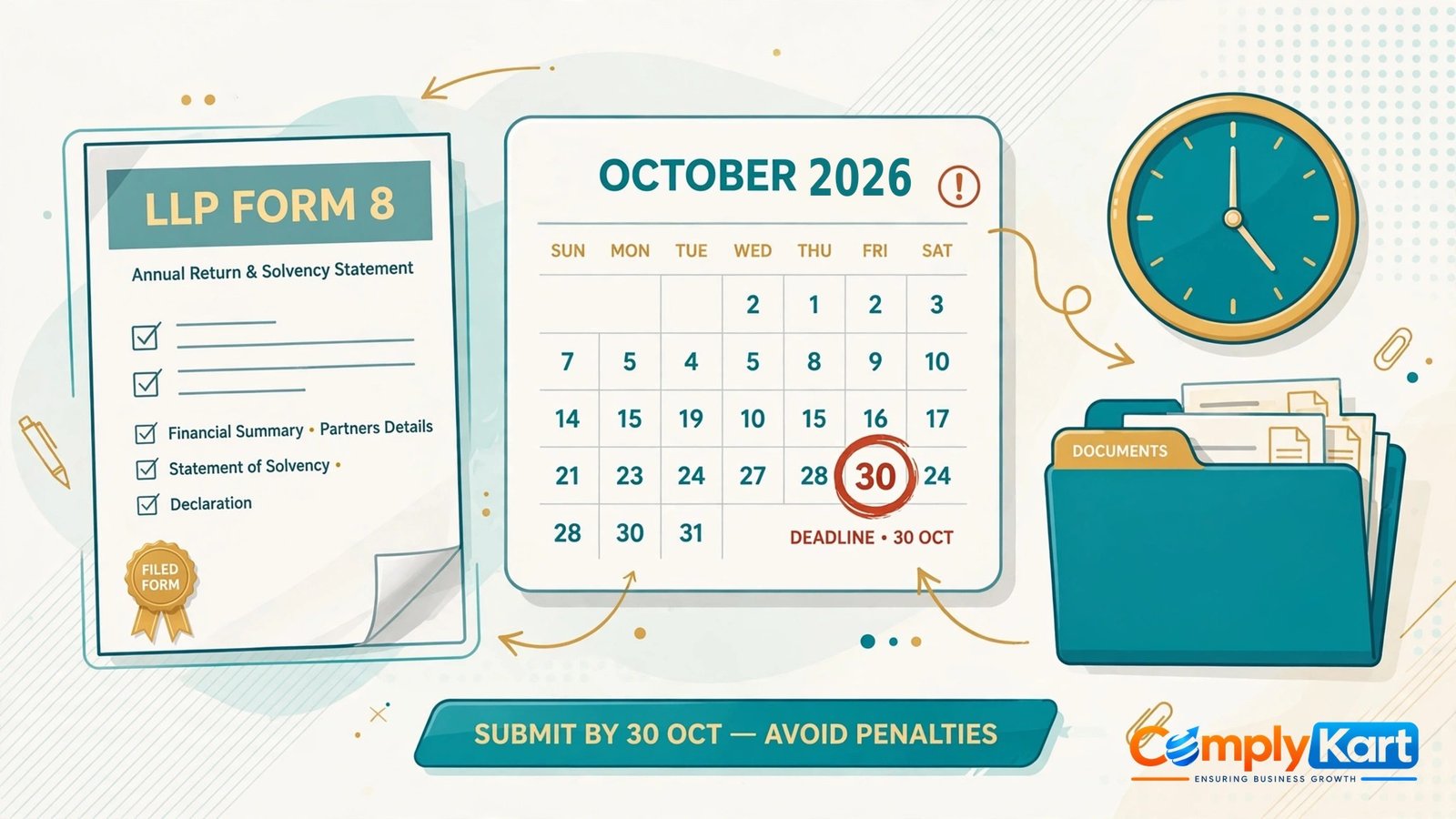
LLP Form 8: Statement of Account & Solvency — Due 30 October
Twelve days. That's what's left between today and 30 October — the due date for LLP Form 8, the Statement of Account and Solvency. If your LLP hasn't filed it yet, this is the week to move. Not because anything dramatic happens on 31 October, but because of what starts happening quietly from that day: ₹100 added to your liability, every single day, with no ceiling, until the form is filed.
The short answer: Every LLP in India must file Form 8 — the Statement of Account and Solvency — by 30 October each year, including dormant LLPs with nil figures. Missing the deadline triggers an additional fee of ₹100 per day with no upper cap, running from the due date until the form is actually filed.
What is LLP Form 8?
Form 8 is the LLP's annual financial statement, filed with the Ministry of Corporate Affairs under Section 34(3) of the LLP Act, 2008. It has two parts. Part A is the declaration of solvency — the designated partners formally stating that the LLP can pay its debts as they fall due. Part B is the statement of accounts: the balance sheet and the income-and-expenditure statement for the financial year.
Think of it as the LLP equivalent of a company's AOC-4, with one crucial addition — the solvency declaration. Companies file their financials; LLPs file their financials plus a sworn statement that the business is solvent. That declaration is signed, on record, and it means something — more on that below.
Which LLPs must file Form 8 — yes, even yours
Every LLP registered in India files Form 8 every year. No exceptions for size, no exceptions for inactivity. An LLP with zero transactions, zero revenue and zero employees files Form 8 — with nil figures — exactly like an LLP doing crores of turnover. (New to the structure? Our LLP registration guide covers the setup, and LLP services handle the filings end to end.)
This is the single most misunderstood point in LLP compliance. "We didn't do any business this year, so there's nothing to file" is wrong — and it's the costliest sentence in LLP compliance. Dormant doesn't mean exempt. Until the LLP is formally struck off or wound up, the filing obligation continues every single year.
What is the due date for LLP Form 8 — and the late-fee maths?
Form 8 is due within 30 days of the end of six months of the financial year — which works out to 30 October every year. For FY 2025–26, that's 30 October 2026.
Miss it and the additional fee is ₹100 per day, per form, with no upper cap, running from the due date until the actual filing date. Let's make that concrete:
File on 15 November instead of 30 October — 16 days late — and you owe ₹1,600. Push it to end-December and you're near ₹6,000. Leave it six months and it's roughly ₹18,000. A full year of delay costs about ₹36,500 — per form, and Form 11 (due 30 May) runs its own parallel ₹100-a-day clock. An LLP that's a year behind on both forms is looking at roughly ₹73,000 in late fees alone, before a rupee of professional charges.
No waiver, no "first offence" leniency, no compounding application that makes it go away. The fee is mechanical — the only variable is how many days you let it run. Wondering what the year's total compliance bill looks like? Our compliance fee calculator estimates it in under a minute.
The solvency declaration is serious
Part A deserves a pause, because partners sign it without reading it. The declaration states that the LLP is able to pay its debts in full as they become due in the normal course of business. The designated partners sign this with their digital signatures.
Signing a solvency declaration for an LLP that you know can't meet its obligations isn't a paperwork formality — it's a false statement on an MCA filing. If the LLP later defaults on debts the partners claimed it could meet, the signatories have difficult questions to answer. Read the numbers before you sign. If the LLP is genuinely struggling, tell your professional first — there are proper ways to handle it, and a false declaration isn't one of them.
Documents you'll need
Get these together before you sit down to file and the process takes under an hour:
Finalised books of account for the financial year — trial balance, profit and loss, balance sheet. If your LLP's turnover exceeded ₹40 lakh or partner contribution exceeded ₹25 lakh, the accounts must be audited by a Chartered Accountant first, and the auditor's report feeds into the filing.
Digital signatures of two designated partners — Form 8 requires DSCs of at least two designated partners (or one, if the LLP has only one designated partner). Check they are valid and unexpired — dead DSCs on deadline day are a depressingly common crisis.
Professional certification where applicable — if audit thresholds apply, the form needs certification by a practising Chartered Accountant, Company Secretary or Cost Accountant.
Contribution and partner details reconciled with Form 11 (filed by 30 May) — the two forms should tell a consistent story. Mismatched contribution figures between Form 11 and Form 8 are a classic scrutiny trigger.
The filing flow, step by step
One: finalise the accounts and get the audit done if thresholds apply — this is the long pole, so start here if you haven't. Two: prepare the solvency declaration and have both designated partners review the numbers. Three: log in to the MCA V3 portal, fill Form 8 (Parts A and B), attach the financial statements. Four: both designated partners sign with their DSCs. Five: pay the fee, download the challan and the filed form, and keep both with your annual records.
If you're already late, the flow is identical — the portal accepts belated filings, computes the additional fee automatically, and you pay and move on. Late filing regularises everything. The worst option is the one many choose: doing nothing and letting the ₹100-a-day clock run while hoping it resolves itself. It doesn't.
Twelve days is plenty — if you start now
Form 8 is a straightforward filing when the accounts are ready; the panic only arrives when they aren't. Books finalised? You can file this week with time to spare. If they aren't, today is the day to call your accountant — not next Monday, not "after Diwali."
LLP Form 8: quick answers
What happens if I miss the 30 October deadline?
An additional fee of ₹100 per day starts running from 31 October, with no upper cap, until the form is actually filed. The maths: 16 days late (filing 15 November) = ₹1,600; a month late ≈ ₹3,000; six months ≈ ₹18,000; a full year ≈ ₹36,500 — per form, and Form 11 runs its own parallel ₹100-a-day clock. There is no waiver and no "first offence" leniency; the fee is mechanical.
Does a dormant LLP with no business need to file Form 8?
Yes. Every registered LLP files Form 8 every year — zero transactions means nil figures, not no filing. "We didn't do any business this year, so there's nothing to file" is the most expensive sentence in LLP compliance; dormant doesn't mean exempt until the LLP is formally struck off or wound up.
What is the solvency declaration in Form 8?
Part A of the form, where the designated partners formally declare that the LLP can pay its debts as they fall due in the normal course of business — signed with their digital signatures. Signing it for an LLP you know can't meet its obligations is a false statement on an MCA filing, so read the numbers before you sign.
What documents do I need to file Form 8?
Finalised books of account for the financial year (audited by a CA first if turnover exceeded ₹40 lakh or partner contribution exceeded ₹25 lakh), valid digital signatures of at least two designated partners, professional certification where audit thresholds apply, and contribution figures reconciled with Form 11.
What is the difference between Form 8 and Form 11?
Form 8 is the annual financial statement — accounts plus solvency declaration — due 30 October. Form 11 is the annual return — partner and contribution details — due 30 May. Both carry the same ₹100-a-day late fee, and the two forms must tell a consistent story; mismatched contribution figures are a classic scrutiny trigger. New LLP? Our 90-day post-incorporation checklist keeps the first year's filings on track, and LLPs crossing the turnover threshold will also need GST registration.
And one forward-looking note: put next year's dates in your calendar the day you file. Form 11 by 30 May, Form 8 by 30 October, ITR-5 by 31 July (or the extended date if audit applies). Three dates, once a year, zero late fees — that's the entire LLP annual compliance discipline. If getting this year's Form 8 filed correctly and on time would help to have handled for you, that's exactly what our team does for LLPs every week.





Comments
No comments yet — ask the first question below.
Join the discussion
Questions go straight to our expert desk. Comments appear after a quick review — no spam, no noise.