
IN BRIEF
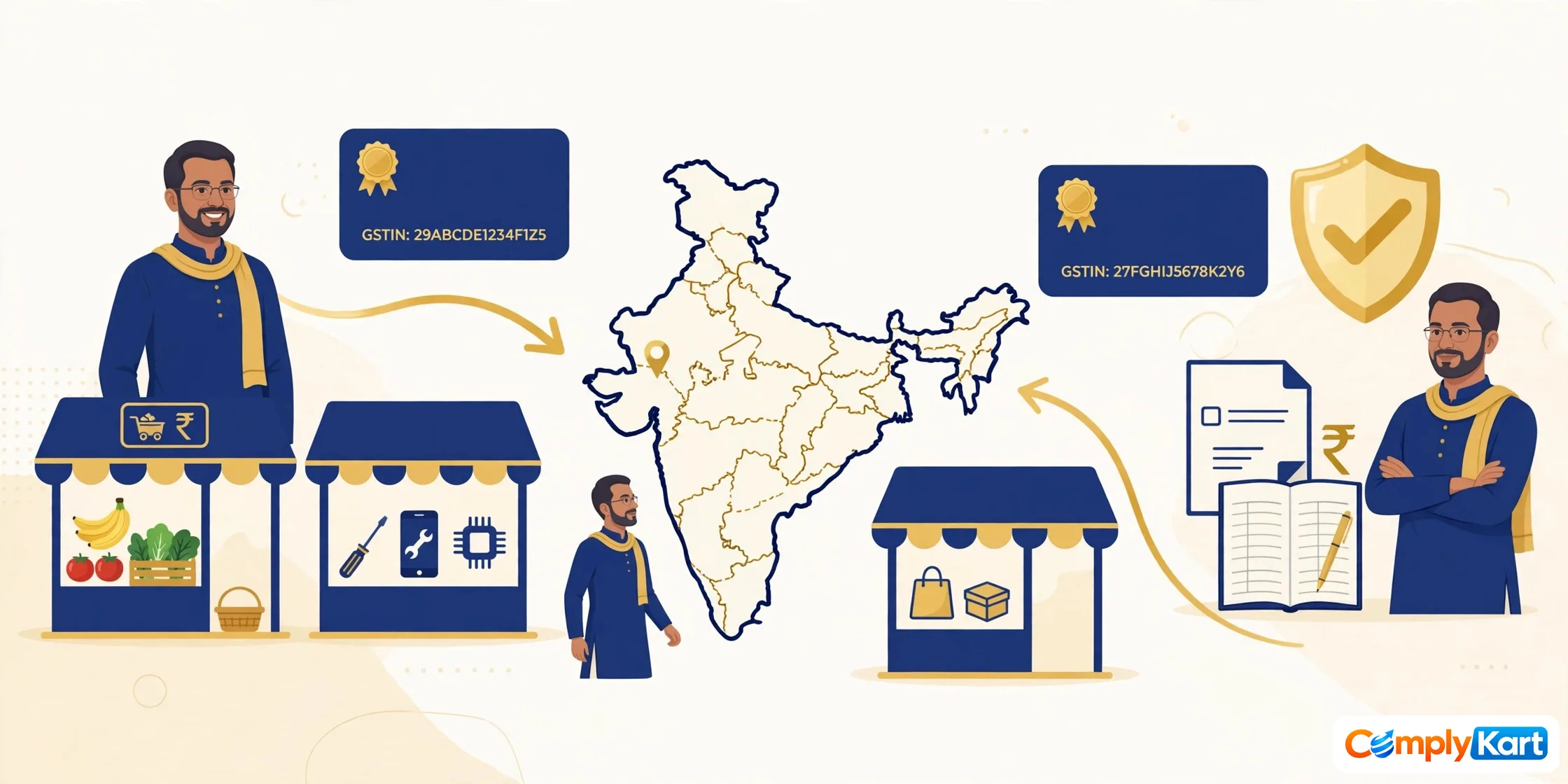
Running multiple businesses under one GST number means operating two or more businesses, brands or branches under a single GST registration. Under section 25 of the CGST Act, 2017, one person with one PAN gets a single registration in each State, so every business that person runs in that State sits under the same GSTIN, while a business in another State or a different legal entity needs a separate registration.
You run a grocery shop in Delhi. Business is steady, so you start a mobile-repair counter in the same shop, under a different name. Then a friend asks whether you want to open a second outlet in Jaipur. Three businesses, one owner. How many GST numbers do you need? Most owners guess wrong in one direction or the other — they either apply for a fresh GSTIN for every new venture, or they assume one number covers the whole country. Both mistakes cost money.
The short answer: one GSTIN covers every business, brand and branch you run in a State under the same PAN. A second business in the same State needs no new number — you add it to the registration you already have. A business in another State, a different legal entity, or an SEZ unit always needs its own GSTIN.
Think of it the way a state issues shop licences. Your PAN is your identity — one person, one PAN, and it never changes. A GSTIN is your trading registration in one State. One person can run five shops in Delhi on one Delhi registration. The moment you open a shop in Jaipur, Rajasthan wants its own registration, because each State keeps its own register and its own tax account for you.
Can I run two businesses under one GST number?
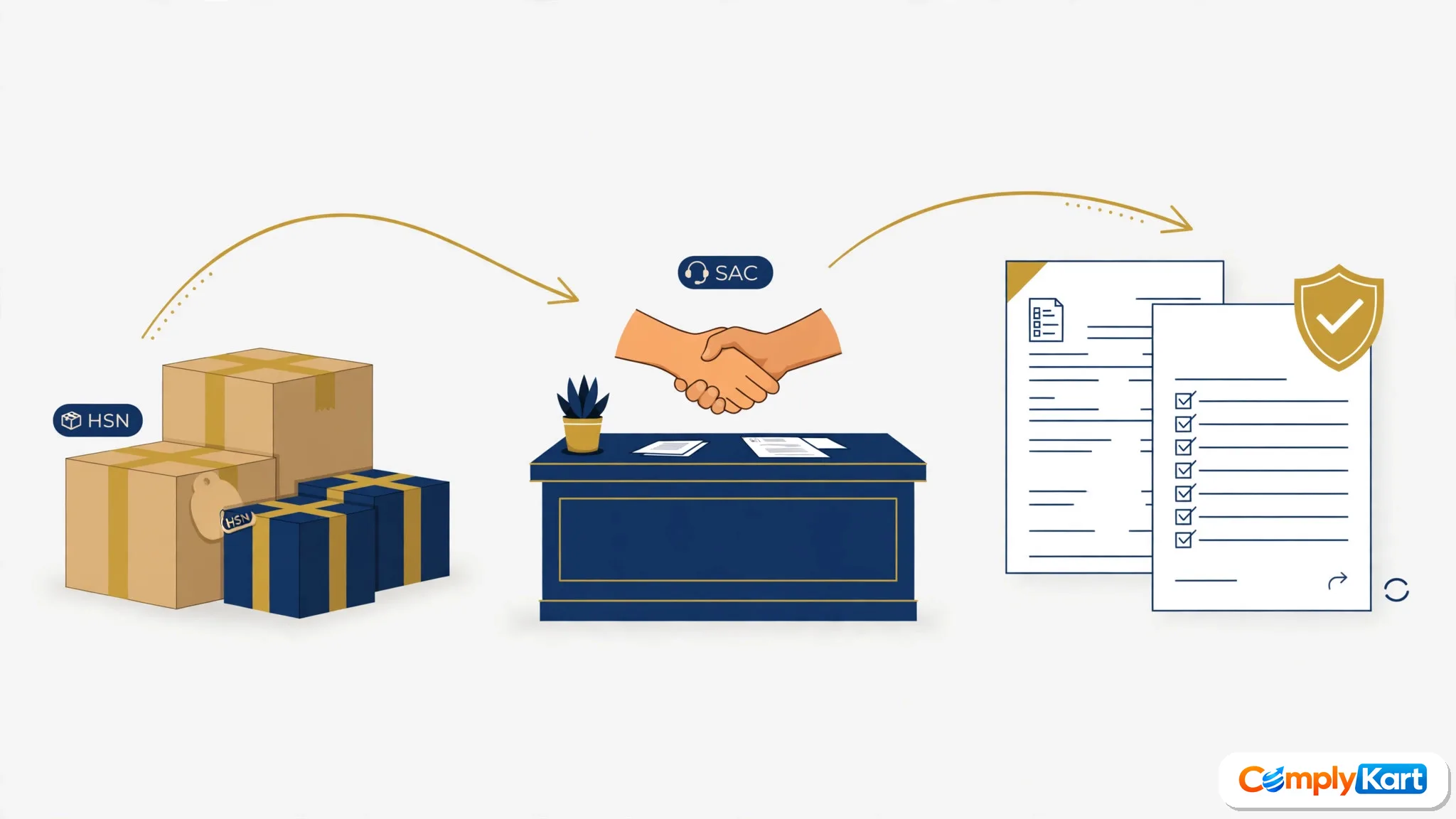
Yes — inside one State, under one PAN. Section 25(2) of the CGST Act, 2017 says a person "shall be granted a single registration in a State or Union territory". One registration, one GSTIN, however many activities sit under it. The grocery shop and the mobile-repair counter are two activities of the same person, so they share the Delhi GSTIN. What you must do is keep the registration honest: add the new trade name, add the new HSN codes for the goods and SAC codes for the services, and add any new premises as an additional place of business. The number stays the same; the record behind it grows.
Two things decide how many GSTINs you need, and only two: who owns the business, and where the supply happens. The owner is the PAN. The place is the State. A brand name decides nothing — selling under a different shop name or brand does not, by itself, create a new registration in the same State. The first two digits of every GSTIN are the State code and the next ten are the holder's PAN, which is why one GSTIN can never stretch across two States.
The registration question is separate from whether you must register at all. That turns on aggregate turnover under section 2(6) of the Act, which is calculated for all persons with the same PAN, on an all-India basis. The thresholds are ₹40 lakh a year for goods and ₹20 lakh for services (₹10 lakh in the special-category States). Two small businesses that look safely below the line on their own can cross it together — and the law counts them together. A worked example is further down.
One GSTIN or two? The decision table
| Your situation | One GSTIN enough? | What to do |
|---|---|---|
| Two or more activities, same owner, same State | Yes | Keep one GSTIN; add the trade name and the HSN/SAC codes for each activity |
| Second shop, office or godown in the same State | Yes | Add it as an additional place of business on the same GSTIN |
| Same business, second State | No | Fresh registration in that State — a new GSTIN on the same PAN |
| Different legal entity — company, LLP, partnership firm, or another person | No | Separate PAN, separate GSTIN, separate returns |
| Unit in a Special Economic Zone, even in the same State | No | Separate registration for the SEZ unit |
| Second place of business in the same State, kept deliberately apart | Your choice | Optional separate registration under Rule 11, if the conditions are met |
Trade names, brands and branches
Three words get mixed up here, and the mix-up causes most of the wrong applications.
A trade name is the name the public sees — "Sharma Mobiles" on the board while the legal name on the certificate is the proprietor's name or the company's name. Your GST certificate (Form REG-06) carries both. Adding a second trade name is an amendment, not a registration. You file it in Form GST REG-14, and from 1 November 2026 most such amendments are approved the moment you submit them — more on that below.
A branch is a second shop, office, warehouse or godown in the same State. It is an additional place of business, and the normal route is to add it to the existing GSTIN. You can instead take a separate registration for it — that is the optional route under Rule 11, covered below — but the default is one number.
A business vertical is the phrase that trips up older guides. Before 1 February 2019, section 25(2) allowed a separate registration in a State only for a distinct "business vertical" — a distinguishable component supplying goods or services that carried its own risks and returns. The CGST (Amendment) Act, 2018 replaced that test with "multiple places of business", so since 1 February 2019 you no longer need to prove a vertical to hold two registrations in one State. Any guide that still tells you to pass the vertical test is quoting repealed law.
One practical point: the codes follow the activity, not the brand. When you add mobile repairs to a grocery business, add the SAC codes for repair services alongside the HSN codes for the groceries. Our HSN vs SAC guide walks through which code goes where and how many digits your invoices need.
When do I need a separate GSTIN?
Three situations are compulsory, and there is no way around any of them.
Another State. Section 25(1) requires registration "in every such State or Union territory" in which you are liable, within 30 days of becoming liable. Open a shop, godown or office in Rajasthan and supply from there, and you need a Rajasthan GSTIN on the same PAN. This is the multi-state position: one PAN, as many GSTINs as States. Our multistate registration guide explains the Master TRN route and the 15-day window. One narrow exception arrived on 1 November 2026: under new Rule 14B, a seller who supplies goods only through an e-commerce operator can register in a State where it has no physical presence by declaring a consenting operator's warehouse as its principal place of business. That route is for e-commerce sellers only — it does not help a shop with a physical outlet.
A different legal entity. A proprietorship uses the proprietor's PAN. A partnership firm, an LLP and a company each have their own PAN. So does your spouse, parent or sibling if they own a business in their own name. Each PAN registers separately and has its own aggregate turnover. Two businesses can share a building and still need two GSTINs if they belong to two different persons. This is also why "my wife's boutique runs on my GSTIN" is not a planning idea — it is a compliance error waiting for a notice.
An SEZ unit. A unit in a Special Economic Zone, or an SEZ developer, needs its own registration even when it sits in the same State as your main business. The SEZ unit is treated separately for GST purposes, and its supplies in and out of the zone follow SEZ rules, not your domestic registration.
When you may take a second GSTIN in the same State
Section 25(2) says you "may" be granted a separate registration for each place of business in a State. It is an option, not a duty, and Rule 11 of the CGST Rules sets the conditions. You need more than one place of business as defined in section 2(85) — a place where the business is ordinarily carried on, where goods are stored or supplied, or where books are kept. You apply separately, in Form GST REG-01, for each place you want registered on its own.
The condition that catches people is the composition rule. Rule 11 says you cannot pay tax under section 10 (the composition scheme) for one place of business while paying under section 9 (the regular scheme) for another. It is all places under composition, or none. And if any one place later becomes ineligible for composition, every place loses it. Think before you split a business that includes a small composition-eligible shop alongside a regular-taxed unit — the split forces a single choice on both.
Why would anyone take the option? Usually for clean books. A manufacturing unit and a trading outlet in the same State, with different teams, different customers and different margins, are easier to account for, audit and eventually sell as separate registrations. The price is real: separate returns, separate ledgers, and supplies between your own GSTINs becoming taxable. That price is the next section.
How do I add a new business to my existing GSTIN?
You amend, you do not re-register. Section 28 of the Act requires every registered person to inform the proper officer of a change in the particulars furnished at registration, and Rule 19 of the CGST Rules sets the form and the clock: Form GST REG-14, within 15 days of the change.
What changed on 1 November 2026 is how the amendment is approved. The CGST (Amendment) Rules, 2026 (Notification No. 05/2026–Central Tax, dated 26 October 2026) substituted Rule 19, and the old core-field versus non-core-field distinction is gone. Under the new Rule 19, changes other than the principal place of business — a new trade name, an additional place of business, a change in legal name, partners, directors or Karta, new HSN/SAC codes, bank details — are approved when you submit the application and the portal's online checks pass. No officer looks at them first. Only a change in the principal place of business still goes to the proper officer, who must approve it within 15 days or raise a query in Form REG-03, to which you reply in Form REG-04 within 7 working days.
Two practical details from the GSTN advisory of 1 November 2026. First, the OTP check is now part of every amendment: finish it within 3 days of submitting, or no Application Reference Number is generated and the application goes nowhere. Second, a change in legal name or in the people who run the business applies to all your registrations on the same PAN, in every State — you file once, it flows everywhere. If you want the full step-by-step for a fresh registration rather than an amendment, our GST registration cost guide covers the documents, the fees and the timeline.
What does splitting into two GSTINs actually cost?
Separate registrations of the same person are treated as distinct persons under section 25(4) and (5). That one sentence has four consequences owners rarely price in before they split.
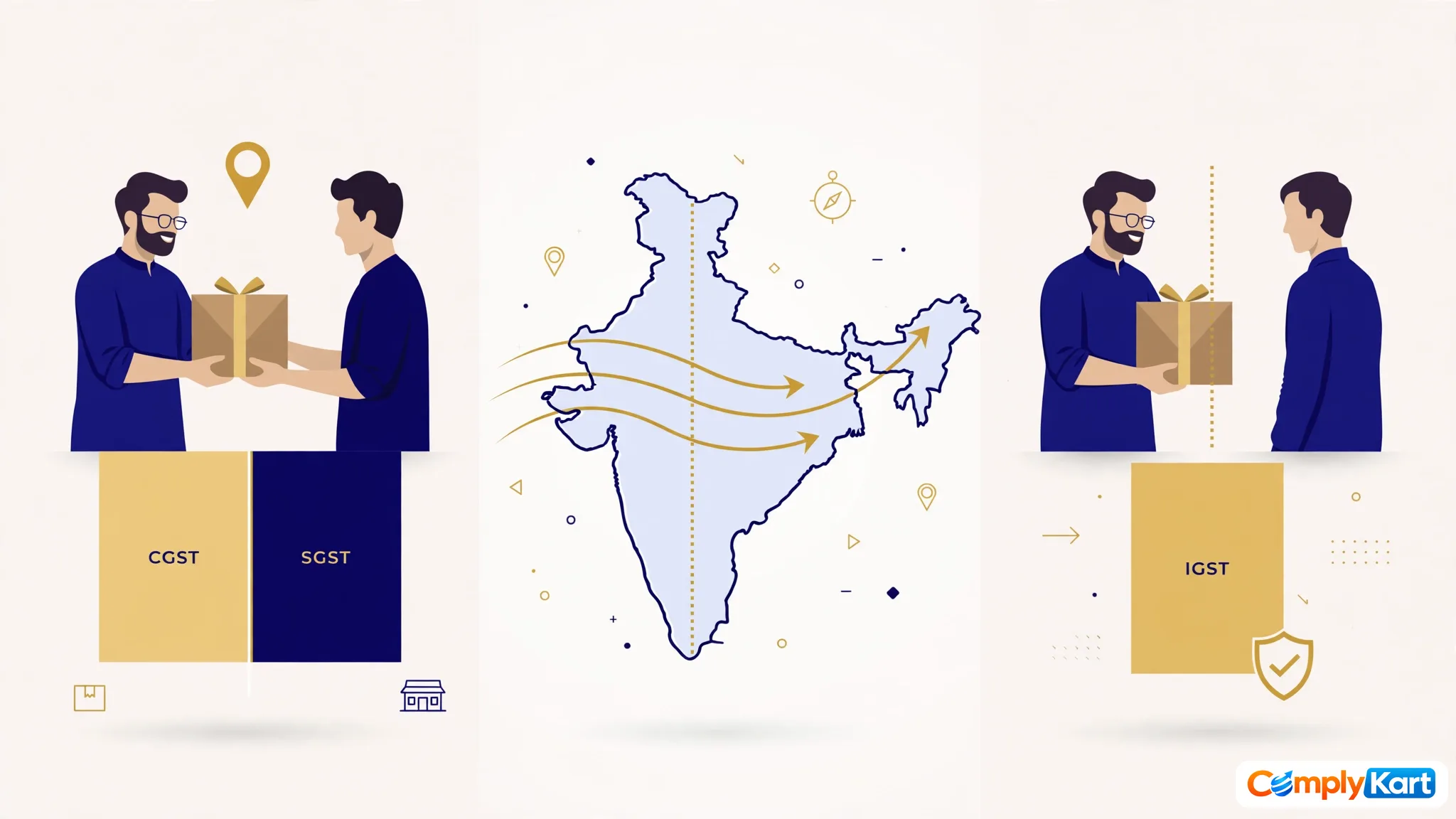
Stock moved between your own GSTINs is a taxable supply. Transfer goods from your Delhi GSTIN to your Jaipur GSTIN and you must issue a tax invoice and charge IGST on the value. Under Rule 28, where the receiving GSTIN is eligible for full input tax credit, the invoice value is generally accepted as the open market value — so you pick the value, but you cannot pick zero. The Jaipur GSTIN then claims the IGST as credit, subject to the usual eligibility conditions. Cash flow takes the hit in between.
Every GSTIN files on its own. Separate GSTR-1 and GSTR-3B filings, separate electronic credit and cash ledgers, separate e-way bills, separate notices. One PAN does not mean one compliance calendar. Businesses that split casually discover this the first month a return is due for a GSTIN nobody was watching.
Unused credit does not move by itself. If you take a separate registration for a place of business in the same State, Rule 41A lets you transfer the unutilised input tax credit in your electronic credit ledger to the new registration — but only by furnishing Form GST ITC-02A within 30 days of obtaining the separate registration, and only in the ratio of the value of assets held by each place. Miss the 30 days and the credit sits where it was.
Composition is all or nothing. As above: one place under section 10 and another under section 9 is not permitted. If a split forces a choice, the choice binds every place.
A worked example: two Delhi businesses, then a Jaipur shop
Priya runs a grocery shop in Delhi with ₹30 lakh of turnover and starts a mobile-repair counter in the same premises, which does ₹18 lakh in its first year. Two activities, one PAN, one State. Her aggregate turnover is ₹48 lakh — above the ₹40 lakh goods threshold — so registration is required, and one Delhi GSTIN covers both. She files a REG-14 within 15 days of starting the repair counter, adds the trade name and the SAC codes for repair services, and files a single GSTR-1 and GSTR-3B covering both lines. The figures are illustrative; the rule is not.
A year later Priya opens a shop in Jaipur. Rajasthan is a second State, so she takes a second GSTIN on the same PAN. When she sends ₹2 lakh of stock from Delhi to Jaipur, that is a supply between distinct persons: she raises a tax invoice from the Delhi GSTIN, charges IGST at 18% — ₹36,000 on the illustrative value — and the Jaipur GSTIN claims it as credit. The Delhi and Jaipur returns are filed separately, and the two ledgers never mix. That is the real cost of the second State: not the registration, which is free, but the permanent doubling of the compliance work.
One GSTIN or two — how do I decide?
Ask three questions, in this order. First, must I? Another State, another PAN or an SEZ unit — the answer is yes, and there is nothing to decide. Second, does the second activity change my registration position? Two businesses under one PAN share one aggregate turnover, so check the combined figure against the threshold before you assume you are below it. Third, would a separate registration in the same State earn its keep? It earns it when the two places have genuinely separate teams, customers and books, and when the business might one day be sold or hived off. It does not earn it when the only reason is a different shop board — that is a trade name, and a trade name is a REG-14, not a GSTIN.
The honest default for most small owners is one GSTIN per State, kept accurate. Splitting is a tool for separation, not a badge of growth. Every extra GSTIN is an extra return, an extra ledger and an extra notice address to watch.
Five mistakes that cost real money
1. Applying for a new GSTIN for a second brand in the same State. A brand is a trade name. You now hold two registrations where one would do, and every return is filed twice.
2. Counting turnover business by business. Aggregate turnover is per PAN, all-India. Two ₹25 lakh businesses are one ₹50 lakh person, and registration is due.
3. Invoicing a second-State outlet from the home-State GSTIN. The supply is made from the State where the goods are, and the registration must be there too. Invoices from the wrong GSTIN are the first thing a scrutiny notice picks up.
4. Splitting registrations and forgetting ITC-02A. The 30-day clock in Rule 41A starts when the separate registration is granted. Credit left behind stays behind.
5. Missing the amendment clock. REG-14 is due within 15 days of the change, and the OTP must be completed within 3 days of submission or no ARN is generated. A registration that does not reflect the business you actually run is the kind of mismatch that draws questions during audits and assessments.
If the choice still feels unclear, that is the point at which a professional earns their fee — not to file the form, which takes an afternoon, but to tell you whether the second GSTIN is worth its permanent compliance cost. Our GST registration service handles both routes, and the compliance fee calculator puts a number on the ongoing filing cost before you decide. If you are starting out as a freelancer rather than a shop owner, the thresholds and the registration logic are the same, but the activity codes differ — see our GST guide for freelancers.
Frequently asked questions
Can a sole proprietor have two GST numbers?
Yes. One PAN can hold many GSTINs — one for each State you supply from, plus optional separate registrations for places of business in the same State under Rule 11. What a proprietor cannot do is hold two GSTINs for the same place of business in the same State, or use a second GSTIN to split turnover and stay below the threshold.
Do I need a new GSTIN for a second shop in the same State?
No, not by default. Add the shop as an additional place of business on your existing GSTIN through a REG-14 amendment. A separate registration for it is your choice under Rule 11, not a requirement.
Can I have two GSTINs in the same State?
Yes, since 1 February 2019 — one for each place of business, under Rule 11. The conditions are real: more than one place of business, a separate REG-01 application for each, and the same tax scheme (composition or regular) across all of them.
Does my second business need its own PAN?
Only if it is a different legal entity — a company, LLP or partnership firm, or a business owned by another person. Two activities of the same proprietor share the proprietor's PAN and, in one State, one GSTIN.
My second business is only online — do I still need a GSTIN in every State I sell to?
No. You register in the State from which you supply. If you sell goods only through an e-commerce operator, Rule 14B (from 1 November 2026) lets you register in a State where you have no physical presence by declaring a consenting operator's warehouse as your principal place of business. If you hold your own stock in a State, you need that State's GSTIN.
One number per State, one PAN per person. Keep the registration current — a REG-14 within 15 days, the OTP within 3 — and the question of a second GSTIN becomes a business decision, not a surprise. That is the whole rule, and it is simpler than the forms make it look.



Comments
No comments yet — ask the first question below.
Join the discussion
Questions go straight to our expert desk. Comments appear after a quick review — no spam, no noise.