
IN BRIEF
A public limited company's annual compliance is the set of filings and meetings it must complete every year under the Companies Act, 2013 — an annual general meeting, AOC-4 financial statements, the MGT-7 annual return, ADT-1 auditor appointment, half-yearly PAS-6 share-capital reconciliation, and at least four board meetings. A public limited company has at least seven members and three directors, and its shares can be offered to the public.
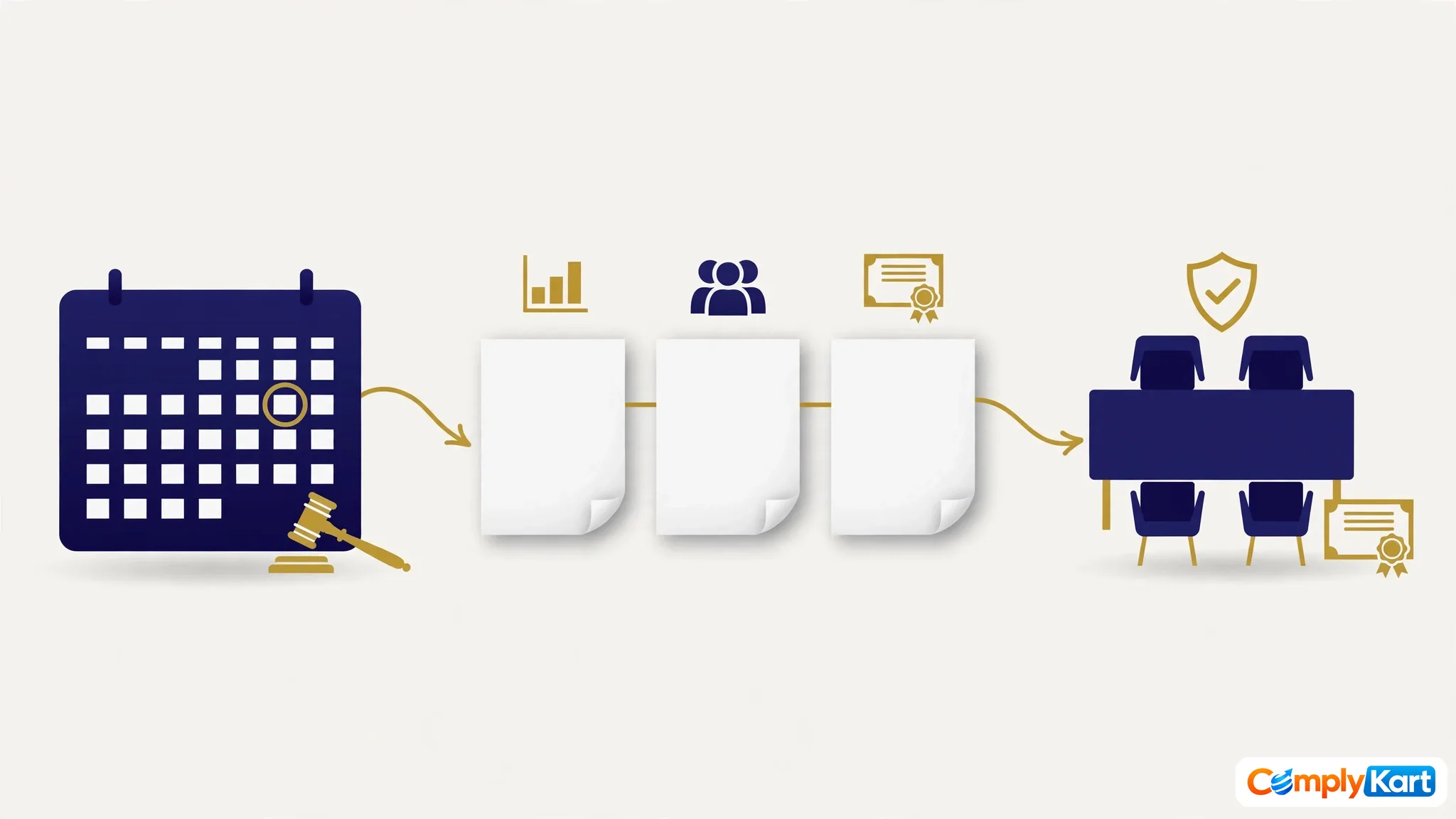
A public limited company carries more dates than a private one, and the dates do not sit neatly on a calendar. They hang off one meeting — the annual general meeting — and if that meeting moves, every filing after it moves too. Founders who convert from a Pvt Ltd discover this the hard way: the same forms, the same portal, but a longer list and sharper penalties.
This guide maps the whole year for a public limited company in India for FY 2026-27: every form, its date, who it applies to, and what it costs to miss it. Two of those dates fall on the same day — 29 November 2026 — which is why this is worth reading now rather than in December.
The short answer: A public limited company's annual compliance is the AGM, AOC-4 financial statements within 30 days of the AGM, the MGT-7 annual return within 60 days, ADT-1 within 15 days, half-yearly PAS-6 share-capital reconciliation, and at least four board meetings a year. For FY 2025-26, AOC-4 is fee-free till 31 December 2026 and MGT-7 till 31 January 2027.
What makes a public limited company different?
A public limited company — a PLC — is a company that can offer its shares to the general public. That single freedom is what makes its compliance heavier. The law assumes that when strangers can own a piece of your company, the public deserves a clearer window into it.
The starting numbers are fixed by the Companies Act, 2013. A PLC needs at least seven members and at least three directors, and at least one director must have stayed in India for 182 days or more in the previous year. A Pvt Ltd needs two members and two directors. There is no minimum paid-up capital for either — that rule went in 2015 — but the authorised capital you choose still decides your MCA fee and stamp duty.
Here is the comparison that matters in practice:
| Point | Public limited company | Private limited company |
|---|---|---|
| Minimum members | 7 | 2 |
| Minimum directors | 3 | 2 |
| Offer shares to the public | Yes | No |
| Shares freely transferable | Yes | Restricted by the articles |
| AGM quorum | 5 members personally present | 2 members personally present |
| Board meetings | At least 4 a year, always | 4 a year — but a start-up or small Pvt Ltd may hold 2 |
| PAS-6 half-yearly filing | Yes, every unlisted PLC | Only non-small Pvt Ltd companies, from 1 July 2025 |
| MGT-8 certification | Trips the thresholds far more often | Only above ₹10 crore capital or ₹50 crore turnover |
If you are weighing the two structures, the cost side of the Pvt Ltd year is mapped in our annual compliance cost guide for private limited companies. The PLC year below is longer, and the governance thresholds in it are the part most founders underestimate. Our public limited company registration service covers the incorporation side; this guide covers the year after.
The one date everything hangs on: the AGM
Think of the annual compliance year as a train timetable. The AGM is the first train. Every other departure — AOC-4, MGT-7, ADT-1 — is timed from it, not from the calendar. Move the AGM by a week and all three filings move by a week. Miss the AGM and the whole timetable collapses.
Under section 96 of the Companies Act, 2013, every company except a One Person Company must hold its annual general meeting within six months of the close of the financial year. For the year ended 31 March 2026, that means on or before 30 September 2026. The first AGM of a new company gets nine months from the end of its first financial year instead of six. Notice of the meeting must go out at least 21 clear days before it, and five members must be personally present for the quorum.
Two things people get wrong. First, the Registrar can extend the date by up to three months on application for a special reason — but that is an application, not a right. Second, the MCA's 2026 fee relief did not touch the AGM at all. General Circular 05/2026 gave companies more time to file AOC-4 and MGT-7 without additional fees; it said nothing about holding the AGM late, and a company that missed its AGM stays liable under the Act. Diarise the AGM first. Every other date follows it.
The full year at a glance
The table below assumes the most common case: a financial year ended 31 March 2026 and an AGM held on 30 September 2026. If your AGM fell on a different date, count forward from your own AGM — 15 days for ADT-1, 30 days for AOC-4, 60 days for MGT-7. The fee-free windows in the last column come from General Circular 05/2026 and apply to FY 2025-26 filings only.
| Form / duty | Section | Statutory date (30 Sep AGM) | Fee-free window (GC 05/2026) |
|---|---|---|---|
| AGM | s.96 | 30 September 2026 | None — no extension |
| ADT-1 (auditor appointment) | s.139 | 15 October 2026 | Not covered |
| AOC-4 (financial statements) | s.137 | 30 October 2026 | Till 31 December 2026 |
| MSME-1 (Apr–Sep half) | MSME rules | 31 October 2026 | Not covered |
| MGT-7 (annual return) | s.92 | 29 November 2026 | Till 31 January 2027 |
| PAS-6 (Sep half-year) | Rule 9A(8) | 29 November 2026 | Not covered |
| DPT-3 (deposits return) | Deposit rules | 30 June 2027 | Not covered |
| PAS-6 (Mar half-year) | Rule 9A(8) | 30 May 2027 | Not covered |
Board meetings and the governance duties in this guide run through the whole year rather than on one date, so they sit outside this table. Most PLCs handle the AGM-anchored filings as one job, which is how the timetable stays intact.
What is AOC-4, and when is it due?
AOC-4 is the form that carries your audited financial statements to the Registrar — balance sheet, profit and loss account, cash flow statement, directors' report and auditor's report, filed on the MCA V3 portal. Section 137 gives you 30 days from the AGM. For a 30 September 2026 AGM, that is 30 October 2026.
Which variant you file matters. A plain AOC-4 covers most unlisted PLCs. AOC-4 CFS is for companies with subsidiaries, associates or joint ventures, whose consolidated statements travel with it. AOC-4 XBRL is for listed companies and unlisted public companies with paid-up capital of ₹5 crore or more or turnover of ₹100 crore or more — the accounts go in machine-readable XBRL tagging, which is the part that eats the most time. File the wrong variant and the form can be rejected while the clock keeps running.
For FY 2025-26, General Circular 05/2026 dated 24 October 2026 lets the AOC-4 family — AOC-4, AOC-4 CFS, AOC-4 XBRL and the specified NBFC variants — be filed up to 31 December 2026 without additional fees. Read that carefully. It is a fee window, not a new due date. The normal filing fee still applies, the AGM is not extended, and a form filed after 31 December pays additional fees counted from the original statutory date of 30 October, not from 1 January. Our explainer on the MCA extension walks through exactly what the circular does and does not do.
What is MGT-7 — and who needs MGT-8?
MGT-7 is the annual return: a structured snapshot of the company's shareholding pattern, directors and key managerial personnel, indebtedness, and meetings held during the year. Section 92 gives you 60 days from the AGM — 29 November 2026 for a 30 September AGM. Under General Circular 05/2026 it can be filed without additional fees up to 31 January 2027.
A PLC files MGT-7, never MGT-7A. The shorter MGT-7A is only for One Person Companies and small companies. If your company secretary hands you a MGT-7A for a PLC, something has gone wrong upstream.
The return is signed by a director and the company secretary — or, where the company has no company secretary, by a practising company secretary. Then there is MGT-8, the part that catches growing PLCs by surprise. Under section 92(2), the annual return of a listed company, or of any company with paid-up capital of ₹10 crore or more or turnover of ₹50 crore or more, must be certified by a practising Company Secretary in Form MGT-8 — in effect, a short secretarial audit attached to the return. A PCS who certifies it wrongly faces a penalty of ₹50,000 to ₹5,00,000 under section 92(6), so expect hard questions before signing. Check the thresholds before you start the MGT-7, not after: if you trip either one, the MGT-8 has to be arranged in parallel, and it takes time.
What is ADT-1?
ADT-1 is the smallest of the three AGM-anchored filings and the easiest to forget. Within 15 days of the AGM — 15 October 2026 for a 30 September AGM — the company must tell the Registrar which auditor it appointed or re-appointed at the meeting, under section 139. The auditor holds office for five years at a time. The first auditor is appointed by the board within 30 days of incorporation, so a new PLC meets ADT-1 in its first year through the board route rather than the AGM route. The filing itself takes minutes. Missing it is what costs money, because it is the form nobody diaries.
What is PAS-6 — and why does it fall due on 29 November?
PAS-6 is the half-yearly Reconciliation of Share Capital Audit Report, and it is the filing that separates a PLC's year from a Pvt Ltd's. Under Rule 9A(8) of the Companies (Prospectus and Allotment of Securities) Rules, 2014, every unlisted public company must reconcile its issued share capital with the capital held in dematerialised form with NSDL and CDSL and in physical form with shareholders — and file that reconciliation with the Registrar within 60 days of the end of each half-year. The report is certified by a practising Company Secretary or a practising Chartered Accountant.
For the half-year ended 30 September 2026, the due date is 29 November 2026 — the same day as MGT-7. For the half-year ended 31 March 2027, it is 30 May 2027. Nidhi companies, government companies and wholly owned subsidiaries are excluded. Note the date: 29 November 2026 is a Sunday. The MCA portal does not stop for Sundays, but your certifying professional and your registrar and transfer agent do. Get the reconciliation and the certification done in the week before, not on the day.
Two traps. First, PAS-6 is due even if nothing changed — no shares moved, no shares dematerialised — once the company has an ISIN, the form is still due. Second, since 1 July 2025 the same rule reaches non-small private companies too. For a PLC there was never a question: it files every half-year, every year.
How many board meetings must a PLC hold?
At least four board meetings every financial year, with no more than 120 days between two consecutive meetings, under section 173(1). The first board meeting of a new company must be held within 30 days of incorporation. Notice of at least seven days goes to every director, and directors may attend by video conference for most business.
The contrast with a Pvt Ltd is narrow: a One Person Company, a small company, a dormant company or a start-up private company is treated as compliant with two meetings a year, one in each half, with at least 90 days between them. A PLC gets no such relaxation — four meetings, every year, whatever its size. In practice most PLCs hold more, because the AGM preparation, the accounts approval and the auditor appointment each need a board meeting of their own. Put the four dates in the diary at the start of the year, not when the gap is about to expire.
The governance thresholds a PLC keeps tripping
Most PLC compliance pain is not the forms. It is the thresholds — the Act switches on extra governance the moment a company crosses a size line, and a growing PLC crosses those lines one by one without anyone announcing it. Check these every year when the accounts are finalised:
Independent directors. A listed company needs at least one-third of its board to be independent directors. An unlisted public company needs at least two independent directors once it crosses any one of three lines: paid-up capital of ₹10 crore or more, turnover of ₹100 crore or more, or outstanding loans, debentures and deposits of ₹50 crore or more in aggregate (section 149(4) with Rule 4).
Whole-time key managerial personnel. A listed company, and every other public company with paid-up capital of ₹10 crore or more, must appoint a whole-time managing director or chief executive, a chief financial officer and a company secretary (section 203). The company secretary is the one founders notice first, because it is a full-time hire, not a retainer.
Audit committee. Every listed company, and every public company with paid-up capital of ₹10 crore or more, turnover of ₹100 crore or more, or aggregate outstanding loans, borrowings, debentures and deposits of ₹50 crore or more, must constitute an audit committee of at least three directors with independent directors in the majority (section 177).
Secretarial audit. Listed companies, and public companies with paid-up capital of ₹50 crore or more or turnover of ₹250 crore or more, must annex a secretarial audit report in Form MR-3 to the board's report (section 204). This is a full audit of the company's compliance with the Act and other applicable laws — a different exercise from the MGT-8 certificate, and considerably longer.
Woman director. Listed companies, and public companies with paid-up capital of ₹100 crore or more or turnover of ₹300 crore or more, must appoint at least one woman director (section 149(1) with Rule 3).
CSR. A company with net worth of ₹500 crore or more, turnover of ₹1,000 crore or more, or net profit of ₹5 crore or more must constitute a CSR committee and spend at least 2% of its average net profits of the preceding three years on CSR activities (section 135).
If the company is listed, the SEBI (Listing Obligations and Disclosure Requirements) Regulations sit on top of all of this — quarterly results, shareholding patterns, annual reports and corporate governance disclosures. This guide covers the Companies Act year; a listed PLC's calendar is longer still.
DIR-3 KYC is now once in three years — do not file it annually
Here is the 2026 change most PLC boards still have wrong. Director KYC used to be an annual filing, due every 30 September. Under the Companies (Appointment and Qualification of Directors) Amendment Rules, 2025 — G.S.R. 943(E), notified 31 December 2025, effective 31 March 2026 — the annual requirement is replaced by a simpler KYC intimation once in every three years, filed in Form DIR-3 KYC Web. Directors who have completed their KYC till date have their next routine filing due by 30 June 2028.
What has not gone away is the event-based duty: if a director's personal mobile number, email address or residential address changes, the change must be intimated through DIR-3 KYC Web within 30 days. A new director still needs KYC when the DIN is allotted. The annual 30 September scramble is over; the diary entry now reads 30 June 2028, plus 30 days after any change of contact details. Our DIR-3 KYC errors guide covers the mistakes that still get DINs deactivated under the new regime.
What does late filing actually cost?
Take a real case. A PLC holds its AGM on 30 September 2026. Its AOC-4 is due 30 October 2026. The accounts are not ready, the auditors are slow, and the form finally goes in on 15 January 2027.
The fee-relief window under General Circular 05/2026 closed on 31 December 2026, so the additional fee is counted from the original statutory date — 30 October — not from 1 January. That is 77 days at ₹100 a day: ₹7,700 in additional fees, on top of the normal filing fee. And the additional fee is the smaller half. Section 137(3) exposes the company to a penalty of ₹10,000 plus ₹1,000 a day up to ₹2,00,000, and every officer in default to ₹10,000 plus ₹1,000 a day up to ₹50,000. MGT-7 late filing is worse on paper: section 92(5) puts the company and each officer in default at ₹50,000 plus ₹100 a day up to ₹5,00,000 each, again on top of the ₹100-a-day additional fee.
Run the numbers before you decide a filing can wait. Our compliance fee calculator works out the additional fee for any filing date, so the cost of a delay is visible before it is incurred. The honest rule I give PLC boards: the fee is rarely what hurts. What hurts is the default sitting on the MCA record while a bank, an investor or a buyer runs a check — and the adjudication notice that follows months later, when the delay is no longer fresh in anyone's mind.
Five mistakes that hurt public limited companies
Treating the fee-relief window as a new due date. General Circular 05/2026 waives additional fees; it does not move the statutory date, extend the AGM, or stop section 137(3) and 92(5) penalties. File to the statutory date. Treat the window as a safety net, not a plan.
Forgetting PAS-6 because nothing changed. The form is due every half-year once the company has an ISIN, even with zero movement in share capital. "Nothing changed" is not a reason to skip it — it is the most common reason it gets missed.
Discovering the MGT-8 threshold at the MGT-7 deadline. Check paid-up capital and turnover when the accounts are finalised. If either crosses ₹10 crore or ₹50 crore, a practising Company Secretary must certify the return, and that certification needs the registers, the minutes and time.
Letting the 120-day board-meeting gap expire. Four meetings a year sounds easy until the gap between the March and July meetings quietly crosses 120 days. Space the meetings when the year starts.
Assuming DIR-3 KYC is still annual. It is triennial now, with the next routine filing due 30 June 2028 — but the 30-day event-based update for a changed mobile number, email or address still applies. A director who moved house in 2026 and told nobody has a live default, not a 2028 problem.
FAQs
Is annual compliance different for a listed and an unlisted public company?
Under the Companies Act, the year is the same — AGM, AOC-4, MGT-7, ADT-1, PAS-6 and board meetings. A listed company adds the SEBI LODR layer on top: quarterly results, shareholding patterns, corporate governance reports and stock-exchange filings. The Companies Act part does not get lighter when a company lists; it gets a second calendar.
Can a public limited company skip the AGM if it had no business during the year?
No. The AGM is mandatory every year. The Registrar may extend the date by up to three months on application for a special reason, but that is an extension, not an exemption — and the extension has to be sought before the date passes, not after.
What happens if a PLC misses PAS-6?
The company and its officers in default face penalties under section 450 — ₹10,000 plus ₹1,000 a day, capped at ₹2,00,000 for the company and ₹50,000 for officers. Beyond the money, a missing PAS-6 leaves the share capital unreconciled on the record, which surfaces the next time the company issues shares, files MGT-7 or faces due diligence.
Does a small public company need a secretarial audit?
Only if it crosses the section 204 thresholds — listed, or paid-up capital of ₹50 crore or more, or turnover of ₹250 crore or more. Below those lines there is no MR-3. But check the MGT-8 line separately: it switches on much earlier, at ₹10 crore of capital or ₹50 crore of turnover.
My PLC has no company secretary. Who signs the MGT-7?
A director signs it, and a practising company secretary signs in place of the company secretary. And if your paid-up capital is ₹10 crore or more, a whole-time company secretary is mandatory under section 203 anyway — so the question usually answers itself at that size. Our OPC annual compliance guide shows the contrast: an OPC files the shorter MGT-7A and holds no AGM at all.
A public limited company's year is not hard because any single form is hard. It is hard because the forms depend on each other — the AGM sets the dates, the accounts set the thresholds, the thresholds switch on the certificates, and the certificates need time. Diarise the AGM first, check the thresholds when the accounts are finalised, and file PAS-6 in the week before it falls due. Do that and the year takes care of itself. If you would rather hand the whole year over — AGM papers, AOC-4, MGT-7, PAS-6 and the board calendar in one pass — our annual filing service runs it for you.



Comments
No comments yet — ask the first question below.
Join the discussion
Questions go straight to our expert desk. Comments appear after a quick review — no spam, no noise.