
IN BRIEF
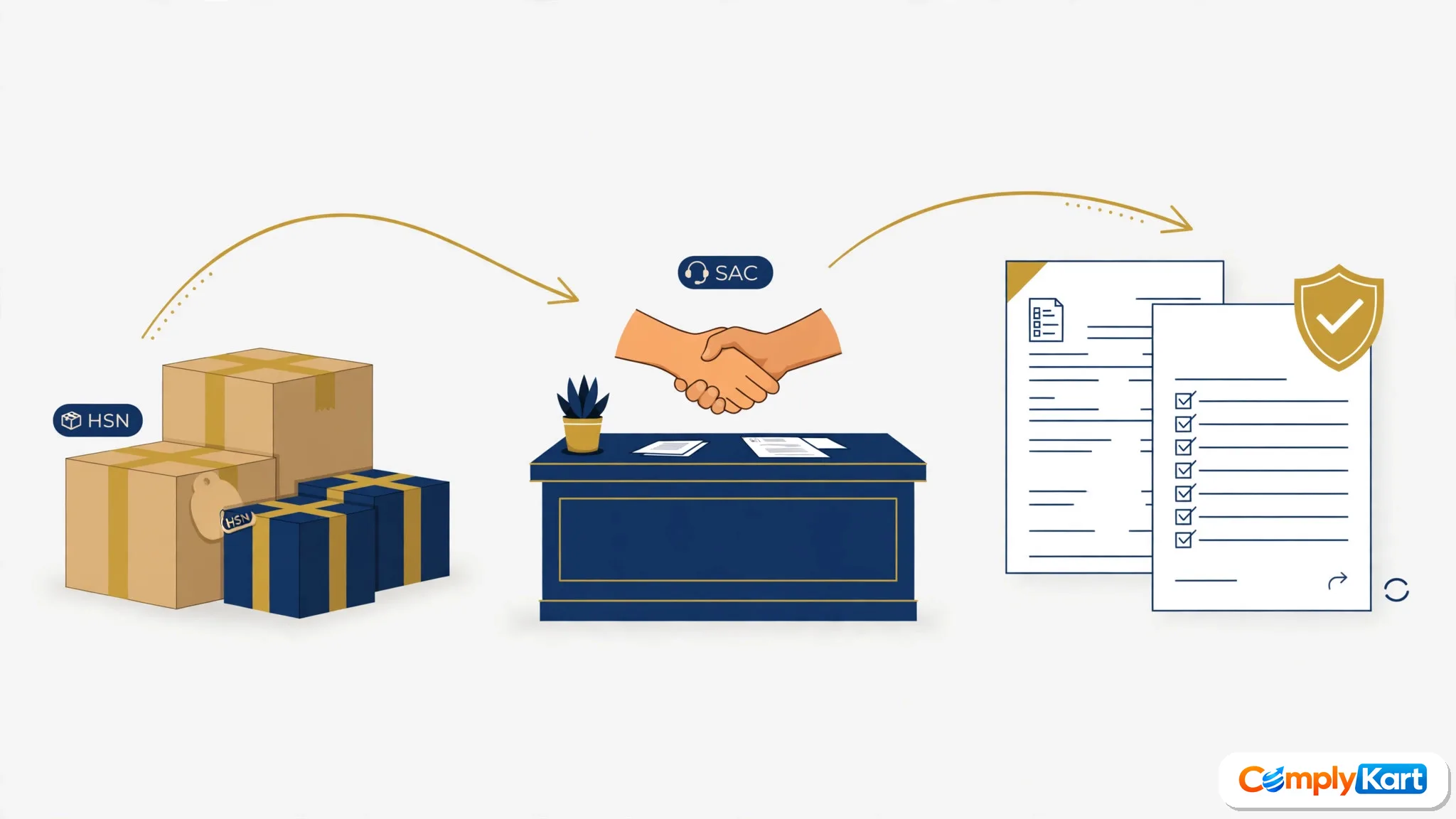
HSN and SAC are the two classification codes under Goods and Services Tax. HSN — the Harmonised System of Nomenclature, maintained by World Customs Organisation — classifies goods, while SAC — the Services Accounting Code, adapted by Central Board of Indirect Taxes and Customs — classifies services. Both appear on tax invoices under Rule 46 of the CGST Rules, 2017, and in the HSN-wise summary in Table 12 of GSTR-1.
Every GST-registered business hits the same small wall the first time it raises a proper tax invoice. The billing software asks for a code, and the owner stares at the field. HSN or SAC? Which one is mine, and how many digits does it want? It looks like a minor detail. It is not. The code decides the rate line your item falls on, it flows into your GSTR-1, and a wrong one can cost you money long after the invoice is forgotten.
The short answer: HSN codes classify goods and SAC codes classify services. If you sell something you can touch, it gets an HSN code; if you sell a service, it gets a SAC code. Both go on your invoice and in GSTR-1, and how many digits you show depends on your turnover — 4 digits up to ₹5 crore, 6 above it.
Think of the two codes the way a library thinks about its shelves. Goods live on one floor, services on another, and every item has a shelf number that gets more precise the further you read it. The first digits tell you the aisle, the later digits tell you the exact shelf. An invoice without the right code is a book returned to the wrong floor — the system notices eventually, and the correction is never free.
What is an HSN code?
HSN stands for Harmonised System of Nomenclature. It is the international system for classifying goods, maintained by the World Customs Organisation and used in more than 200 countries. India adopted it for GST through the Central Board of Indirect Taxes and Customs, so the same code that classifies your product on an Indian invoice also classifies it at a port in Rotterdam.
The structure is a ladder. The first two digits are the chapter — chapter 09 is coffee, tea and spices; chapter 61 is knitted clothing. The next two digits are the heading, which narrows it to a product family. The next two are the sub-heading, and the last two are the tariff item, the most precise level India uses. So 0901 is coffee, 6109 is T-shirts, and 84713010 is a laptop — chapter 84, heading 71, sub-heading 30, item 10. Each pair of digits answers a smaller question than the one before it.
HSN codes appear on tax invoices for goods, on e-way bills, and in the HSN-wise summary in Table 12 of GSTR-1. They also decide the GST rate: the rate notifications list goods by HSN, so picking the wrong code can mean charging the wrong rate — which is how a small classification error becomes a demand notice. If you are unsure which rate your product actually carries, our GST rate list for 2026 walks through the 0%, 5%, 18% and 40% slabs that have applied since 22 September 2025.
What is a SAC code?
SAC stands for Services Accounting Code. It is the equivalent of HSN for services, and unlike HSN it is an Indian creation — built on the United Nations Central Product Classification and adapted by the CBIC for our tax system. No other country uses it, because no other country runs GST the way India does.
Every SAC code has six digits and every one of them starts with 99. That first pair is the giveaway: chapter 99 is reserved for services, and nothing else lives there. The next two digits are the major service group, and the last two name the specific service. So 998311 is management consulting, 996311 is hotel accommodation, and 996511 is freight transport by road. Read it left to right and it tells you the same story as an HSN code — broad category first, exact service last.
If you sell a service, the SAC code is mandatory on your invoice, whatever your turnover. A freelancer billing for design work, a consultant billing for advice, a hotel billing for a room — each of them needs the right six digits on the invoice. Our guide to GST registration for freelancers covers the registration side of the same question, including when a service provider crosses the threshold at all.
HSN vs SAC: the comparison
| HSN code | SAC code | |
|---|---|---|
| Full form | Harmonised System of Nomenclature | Services Accounting Code |
| Classifies | Goods — anything you can touch, store or ship | Services — anything done for a fee |
| Origin | World Customs Organisation; used in 200+ countries | UN Central Product Classification, adapted by CBIC; India-only |
| Digits | 4, 6 or 8, depending on turnover | Always 6 |
| Chapters | Chapters 1 to 98 | Chapter 99 only |
| First digits tell you | The chapter — 09 is coffee, 61 is clothing | It is a service — every SAC starts with 99 |
| Examples | 0901 coffee, 6109 T-shirts, 84713010 laptops | 998311 consulting, 996311 hotels, 996511 road freight |
| Appears on | Tax invoices for goods, e-way bills, GSTR-1 Table 12 | Tax invoices for services, GSTR-1 Table 12 |
The rule of thumb is simple enough to use at the counter: if the customer takes something home, it is an HSN code. If the customer pays for something done, it is a SAC code. The trouble starts only when one invoice carries both.
How many digits of HSN code do I need on an invoice?
This is the part most guides get half right, so here is the rule exactly as Notification No. 78/2020–Central Tax dated 15 October 2020 states it, in force since 1 April 2021. The digit count depends on your aggregate turnover in the previous financial year, and the notification amends the first proviso to Rule 46 of the CGST Rules, 2017.
| Aggregate turnover in the previous financial year | B2B invoices (to registered buyers) | B2C invoices (to unregistered buyers) |
|---|---|---|
| Up to ₹5 crore | 4 digits — mandatory | Optional |
| More than ₹5 crore | 6 digits — mandatory | 6 digits — mandatory |
Two points that catch people out. First, the turnover that decides the digit count is last year's, not this year's — a business that crossed ₹5 crore last year shows 6 digits all this year, even in a slow month. Second, you may always show more digits than the minimum. A small trader showing 6 digits is doing nothing wrong; a large company showing 4 is. And one exception runs longer: specified chemicals need 8 digits on the invoice under Notification No. 90/2020–Central Tax dated 1 December 2020, whatever the turnover.
For services the position is simpler. A SAC code is six digits, full stop — there is no 4-digit version. The same turnover table decides whether you must show it, but when you show it, you show all six. If you are still deciding whether you need to register at all, our GST registration cost guide covers the thresholds and the registration itself.
Where do I find my HSN or SAC code?
Do not guess, and do not copy the code from a competitor's invoice — a similar-looking product can sit in a different heading, and their mistake becomes yours. Four steps, in order:
- Start with the chapter. Ask what the thing broadly is — a food product, a textile, a machine, a transport service. The CBIC publishes the full HSN and SAC schedules on its GST portal, cbic-gst.gov.in, organised chapter by chapter. Find your chapter first.
- Walk down the ladder. Chapter to heading to sub-heading, reading the descriptions at each level. The description is the test: if it does not describe your product, you are on the wrong rung.
- Check the rate notification. Once you have a candidate code, look it up in the rate notification for your category — Notification 9/2025–Central Tax (Rate) for goods, 11/2017–Central Tax (Rate) for services. The rate attached to the code should match the rate you have been charging. If it does not, one of the two is wrong.
- Let the portal confirm it. Since the May 2025 return period, GSTR-1 Table 12 only accepts HSN codes picked from the portal's own dropdown — typed codes are rejected and the description fills itself in from the HSN master. If your code is not in the dropdown, it is not a valid code.
When a product genuinely sits between two headings, read the section notes and chapter notes that sit above the headings — they are part of the law, not commentary, and they settle most borderline cases. If the notes do not settle it, that is a question for your CA before the invoice goes out, not after the return is filed.
What if one invoice has both goods and services?
This is the question the comparison tables never answer, and it is the one that causes the most real-world errors. A business that sells a laptop and charges for installing it, or signs an annual maintenance contract that includes spare parts, has one invoice with both an HSN code and a SAC code on it. The answer comes from section 8 of the CGST Act, which draws a line between two kinds of bundle.
A composite supply is a bundle that is naturally made together, with one principal supply. The annual maintenance contract is the classic example: the service is the principal supply, and the spare parts fitted during a visit are ancillary to it. The whole bundle is taxed as the principal supply — the service — so the invoice carries the SAC code for the maintenance service, and the parts do not get a separate HSN line. A mixed supply is two or more independent supplies sold together for a single price, where neither is clearly the principal one. That bundle is taxed at the highest rate among its components, and each component keeps its own code.
So the practical test is one question: would the customer buy these two things separately, at separate prices? If the spares are only ever fitted as part of the maintenance visit, it is a composite supply and the SAC code leads. If the customer can walk in, buy the spare part off the shelf, and separately hire someone to fit it, the two are independent supplies and each needs its own code and its own rate. Get this wrong and the invoice is wrong in two places at once — the code and the rate.
Restaurants live on this fault line every day, which is why the treatment is its own subject: dine-in service carries a SAC code under 9963, while pre-packaged food taken away is a good with an HSN code. Our GST guide for restaurants works through the 5% and 18% sides of that line in detail.
GSTR-1 Table 12: what changed in May 2025
Table 12 of GSTR-1 is the HSN-wise summary of your outward supplies — the same month's sales, re-sorted by product instead of by buyer. Each row carries the HSN or SAC code, the unit of quantity, the total quantity, the taxable value and the tax. It adds no tax of its own; it is a cross-check on everything else in the return.
From the May 2025 return period, under GSTN's Phase 3 advisory, three things changed. First, Table 12 split into two tabs — B2B supplies and B2C supplies — reported separately. Second, manual entry of HSN codes is gone: you pick the code from a dropdown and the portal fills in the description from the HSN master. Third, the portal now validates each tab against the matching sales tables, so a B2B tab that does not agree with your B2B invoice tables will warn you — and an empty B2B tab when you have B2B invoices blocks the summary from being generated at all. The B2C tab is not mandatory, but leaving it blank while you have counter sales invites the same mismatch warning.
A worked example, using illustrative figures for a small trader with turnover below ₹5 crore, so 4-digit codes apply:
| Tab | HSN | Quantity | Taxable value | Rate | Tax |
|---|---|---|---|---|---|
| B2B | 6109 (T-shirts) | 400 pcs | ₹2,00,000 | 5% | ₹10,000 |
| B2C | 0901 (coffee) | 250 kg | ₹1,50,000 | 5% | ₹7,500 |
Each row's value must agree with the same sales as reported in the other GSTR-1 tables, within the portal's tolerance. When the numbers disagree, the fix is almost always in the invoice coding, not in Table 12 — which is why getting the code right at the billing stage matters more than getting the summary right at the filing stage. If the department has already questioned a return, our guide to replying to an ASMT-10 scrutiny notice covers the 30-day reply window and the ASMT-11 response.
What a wrong code costs
A wrong HSN or SAC code is not a typo the portal forgives. Three consequences, in the order you will meet them.
First, the penalty. Section 125 of the CGST Act carries a general penalty of up to ₹50,000 — ₹25,000 CGST plus ₹25,000 SGST — for failing to mention the code or mentioning a wrong one. It is a general penalty, not an automatic one, but it is the number the department reaches for when the error is found in an audit.
Second, the rate. The code picks the rate line, so a wrong code can mean a wrong rate — too little tax charged, which becomes a demand with interest, or too much, which your buyer will not pay twice and which distorts your input tax credit. A code error that also changes the rate is two mistakes for the price of one.
Third, the buyer's credit. Your buyer's input tax credit is matched against what you reported, and a code mismatch between your GSTR-1 and their GSTR-2B is the kind of discrepancy that shows up in their reconciliation — and in yours, when the department asks why the two do not agree. The code is a small field on the invoice. It carries a long shadow.
Five mistakes that keep showing up
- Using last year's digit count after crossing ₹5 crore. The test is the previous year's turnover. Cross the line and the 6-digit rule applies from 1 April, on every invoice.
- Copying a code from a supplier's invoice. Their product and yours can share a name and sit in different headings. Verify your own code against the CBIC schedule.
- Putting an HSN code on a service. Services take SAC codes, always six digits starting with 99. An HSN code on a service invoice is wrong on its face.
- Leaving Table 12's B2B tab empty. Since May 2025, an empty B2B tab with B2B invoices in the return blocks the summary. Fill it, even when the figures feel obvious.
- Treating the code as a one-time decision. Products change, services get bundled, rate notifications get amended — the 1 November 2026 notifications moved several items between rate lines. Re-check your codes when the product or the notification changes, not when the notice arrives.
Should you do this yourself or get help?
For a business with a short, stable product list, this is a one-afternoon job: find each code once, put it in the billing master, and let the software carry it from there. Get professional help when the list is long, when products sit near a heading boundary, when you sell bundled goods and services, or when a notice has already questioned a code — because at that point the question is not which code to use, it is how to correct the ones already filed. A GST registration that is set up with the right codes from day one, and a return filing routine that reconciles Table 12 every month, cost far less than one audit finding. And if you want a quick sense of what the filings around all of this cost, the compliance fee calculator will give you the number in a minute.
The code on your invoice is a small thing, and that is exactly why it gets ignored. It is also the field the department reads first, because it tells them what you sold, at what rate, and whether your return agrees with itself. Get it right once, keep it in the billing master, and check it when the product or the law changes. The rest of GST compliance is harder. This part is just care.
Frequently asked questions
Is a SAC code mandatory on every service invoice?
Yes. A service provider must show the 6-digit SAC code on tax invoices, whatever the turnover. The turnover table decides how many HSN digits a goods supplier shows; for services, the code is always six digits.
Do composition dealers need HSN or SAC codes?
A composition dealer issues a bill of supply rather than a tax invoice, and the digit rule for tax invoices does not apply in the same way. The dealer still needs to know what it sells for its own records and for GSTR-4, and the moment it moves to the regular scheme the full invoice rules apply.
What is the HSN code for exports?
Exports of goods are reported with 8-digit HSN codes in GSTR-1. The 8-digit level is the most precise classification India uses, and it is also required for specified chemicals on domestic invoices under Notification No. 90/2020–Central Tax.
Can I use the same HSN code for similar products?
Only if they genuinely fall under the same heading. Products that look similar — two kinds of packaged food, two types of fabric — often sit in different headings with different rates. Check each product against the schedule rather than assuming the family shares a code.
What do I do if I discover I used the wrong code last month?
Correct it in the next return through a credit or debit note as the case requires, and fix the billing master the same day so the error does not repeat. If the wrong code also meant the wrong rate, pay the shortfall with interest before the department finds it — voluntary correction is always cheaper than a demand.


Comments
No comments yet — ask the first question below.
Join the discussion
Questions go straight to our expert desk. Comments appear after a quick review — no spam, no noise.