
IEC for Textile & Garment Exporters: RoSCTL vs RoDTEP Claims and the Sampling-vs-Bulk Shipment Paperwork
Quick answer: A textile or garment exporter needs an Importer-Exporter Code from DGFT (₹500, 1–2 working days), an AEPC registration-cum-membership certificate (₹10,620 in year one including GST), and the right claim on each shipping bill — RoSCTL for apparel, garments and made-ups (extended to 31 December 2026) or RoDTEP for other textile products. Samples travel light on paperwork; bulk shipments do not.
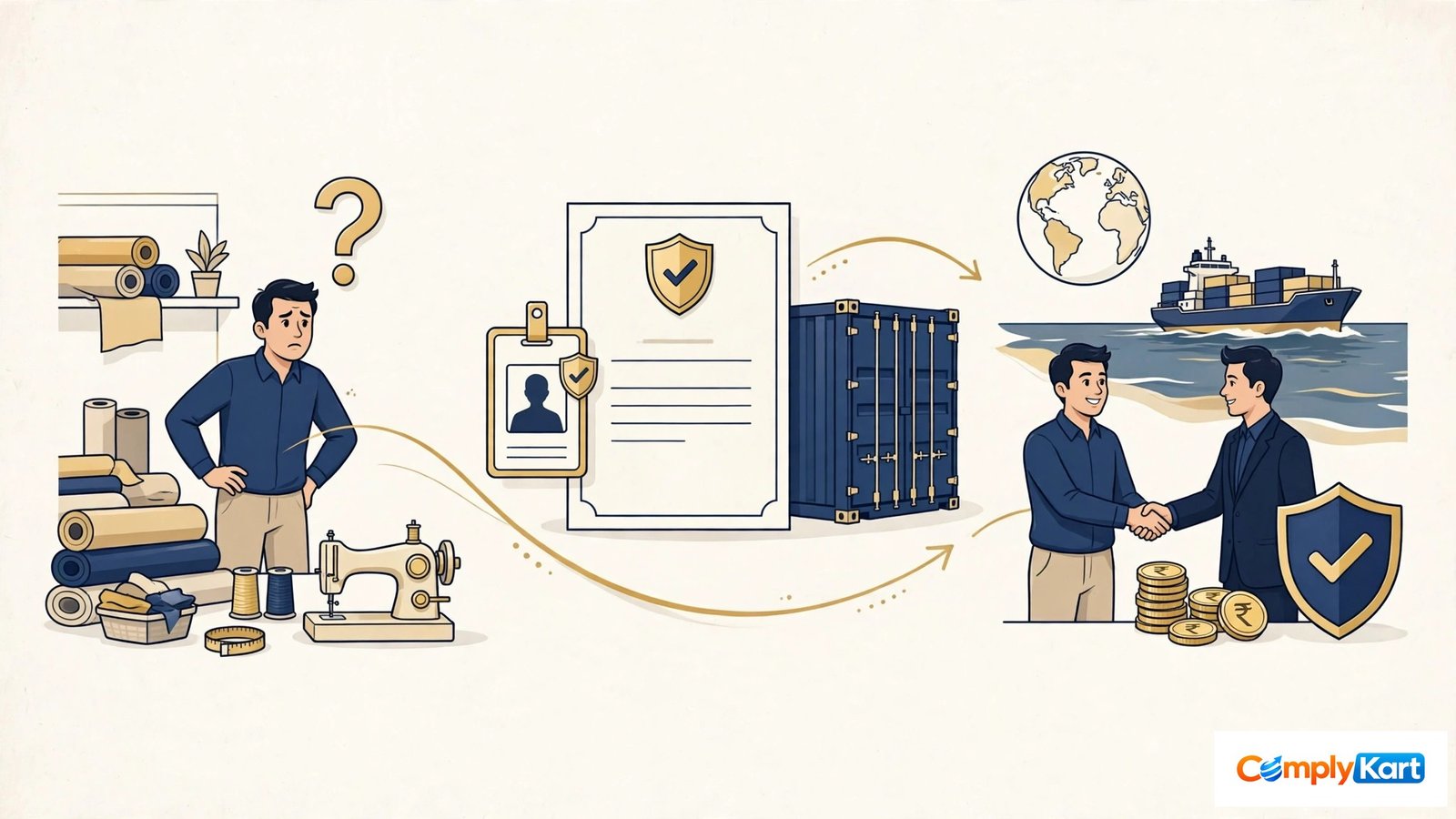
You run a garment unit in Tiruppur or a made-ups factory in Panipat, and a buyer in Hamburg wants 20,000 bedsheets. The stitching is the easy part. I have watched exporters stitch perfect orders and then leave lakhs on the table because their RoSCTL claim was never declared on the shipping bill — one missing line that cannot be added later.
How much does IEC registration cost, and how long does it take?
The Importer-Exporter Code is the 10-digit number the Directorate General of Foreign Trade (DGFT) issues against your PAN. Apply online for ₹500 with the entity's PAN, a cancelled cheque or bank certificate, address proof, and the signatory's Aadhaar for e-sign (companies and LLPs use a Class 3 DSC). The certificate arrives digitally in one to two working days if details match PAN records exactly.
One rule catches people every year. Every IEC holder must complete a free annual update between April and June — even when nothing has changed. Miss it and DGFT deactivates the code, blocking clearance and benefit claims until restored. The late update costs ₹200; the lesson costs a stuck shipment.
ComplyKart handles IEC registration end-to-end.
What does AEPC registration cost a garment exporter?
The Apparel Export Promotion Council (AEPC), under the Ministry of Textiles, is the council for apparel and made-ups exporters. Its registration-cum-membership certificate — the RCMC — opens Foreign Trade Policy benefits to your product line: RoSCTL, RoDTEP, EPCG, Advance Authorisation. Your IEC is the mandatory document for membership — IEC first, then AEPC. Without a valid RCMC, most of those claims are simply not open to you.
Fees: ₹1,000 entrance plus ₹8,000 annual subscription, both plus 18% GST — ₹10,620 all-in for year one, ₹9,440 a year after. The RCMC is valid five years and typically issues in seven to fifteen working days.
Register as a merchant exporter, a manufacturer exporter, or a merchant-cum-manufacturer. Units that stitch their own garments register as manufacturer exporters (AEPC may ask for factory licence plus ESI and EPF proof). Most garment exporters start as merchant exporters — they aggregate from job-work units. Keep ready: IEC, GST certificate, Udyam registration, a CA-certified turnover certificate, and your partnership deed or MOA/AOA. Membership also opens the India International Garment Fair and AEPC buyer-seller meets — a fair stall often beats a year of cold emails.
RoSCTL or RoDTEP: which counter does your product stand in?
Think of RoSCTL and RoDTEP as two cashback desks at the same airport. Desk A handles only apparel, garments and made-ups; Desk B handles the rest. Your product's HS code decides your desk — you cannot queue at both for the same shipment.
RoSCTL refunds embedded State and Central taxes that no other mechanism refunds: state levies, electricity duties, fuel taxes baked into logistics. It has run since 7 March 2019, and the Ministry of Textiles (notification dated 30 September 2026) continued it up to 31 December 2026 at existing rates and caps for apparel, garments and made-ups. The rebate arrives as transferable duty credit e-scrips — issued without insisting on export-proceeds realisation. In 2025–26 the scheme benefited over 15,400 exporters across 444 districts, mostly MSMEs.
RoDTEP covers other textile products not under RoSCTL (yarns, fabrics, lines outside the apparel/made-ups basket), with rates and value caps in Appendix 4R. DGFT extended RoDTEP to 31 December 2026 for DTA, Advance Authorisation, SEZ and EOU exports. One non-negotiable rule: the claim must be declared item-by-item in the shipping bill itself. Your CHA cannot add it later.
Match the 8-digit HS code against the RoSCTL rate schedule and Appendix 4R before filing — a wrong desk means no cashback at all.
Sampling vs bulk shipments: why the paperwork is not the same job
A sampling shipment is a unit test; a bulk shipment is the board exam. Mix them up and the paperwork will embarrass you.
Samples go by courier — small quantities, low declared value, a proforma invoice, and the courier shipping bill (CSB-V). Samples are for buyer approval and carry no export-benefit claims. Buyers still judge quality: send the lab test reports bulk will demand (colour-fastness, Azo-free, REACH for the EU).
Bulk shipments are full commercial exports. The document stack is longer: commercial invoice, packing list, shipping bill, bill of lading or airway bill, certificate of origin (plus preferential FTA certificates where they cut the buyer's import duty), marine insurance, and the buyer's compliance file — test reports from SGS, Intertek or Bureau Veritas, care-label and fibre-content declarations exactly as the purchase order specifies. Export of goods is zero-rated, so file a Letter of Undertaking to ship without locking up IGST — see our GST LUT filing guide for exporters or LUT filing as a standalone service. On the pay-IGST-and-refund route, follow the GST refund application process.
Handicraft exporters face a cousin of this journey — our handicraft guide covers the EPCH/EPCG branch.
Five mistakes that cost garment exporters real money
1. Skipping the April–June IEC update. Deactivation mid-shipment is the most expensive free compliance in Indian trade.
2. Exporting without an RCMC, then claiming benefits. RoSCTL, RoDTEP and EPCG all assume a valid RCMC. Get it before the first commercial shipment.
3. Filing the shipping bill without the rebate declaration. No declaration, no rebate — it must sit in the bill at item level.
4. Queuing at both desks. Claiming RoSCTL and RoDTEP on the same product line invites a demand notice. The HS code picks one desk; file accordingly.
5. Sending bulk without the buyer's test reports. Rejected-at-buyer-warehouse consignments are common. Confirm the testing protocol before cutting the bulk order.
Run your shipment's numbers on the compliance fee calculator before quoting your next buyer.
FAQs
Do I need AEPC RCMC if I only sell garments on Etsy or Amazon Global?
Yes. Marketplace and courier-mode exports still need an IEC for customs clearance and foreign remittance, and the RCMC opens RoSCTL, RoDTEP and EPCG. At roughly ₹10,620 in year one, it pays for itself on a single commercial shipment's rebate.
Can I claim both RoSCTL and RoDTEP on the same garment?
No. They are mutually exclusive per product — apparel, garments and made-ups claim RoSCTL; other textile products claim RoDTEP under Appendix 4R. Your CHA should match the 8-digit HS code against both schedules before filing.
What happens if I miss the April–June IEC annual update?
DGFT deactivates the IEC, blocking clearance and benefit claims until you update. The late update costs ₹200; the real cost is a shipment stuck at port.
How long is RoSCTL available now?
The Ministry of Textiles extended RoSCTL to 31 December 2026 at existing rates and caps (notification dated 30 September 2026). Export proceeds need not be realised first — the duty credit scrips are issued without that insistence.


Comments
No comments yet — ask the first question below.
Join the discussion
Questions go straight to our expert desk. Comments appear after a quick review — no spam, no noise.