
IN BRIEF
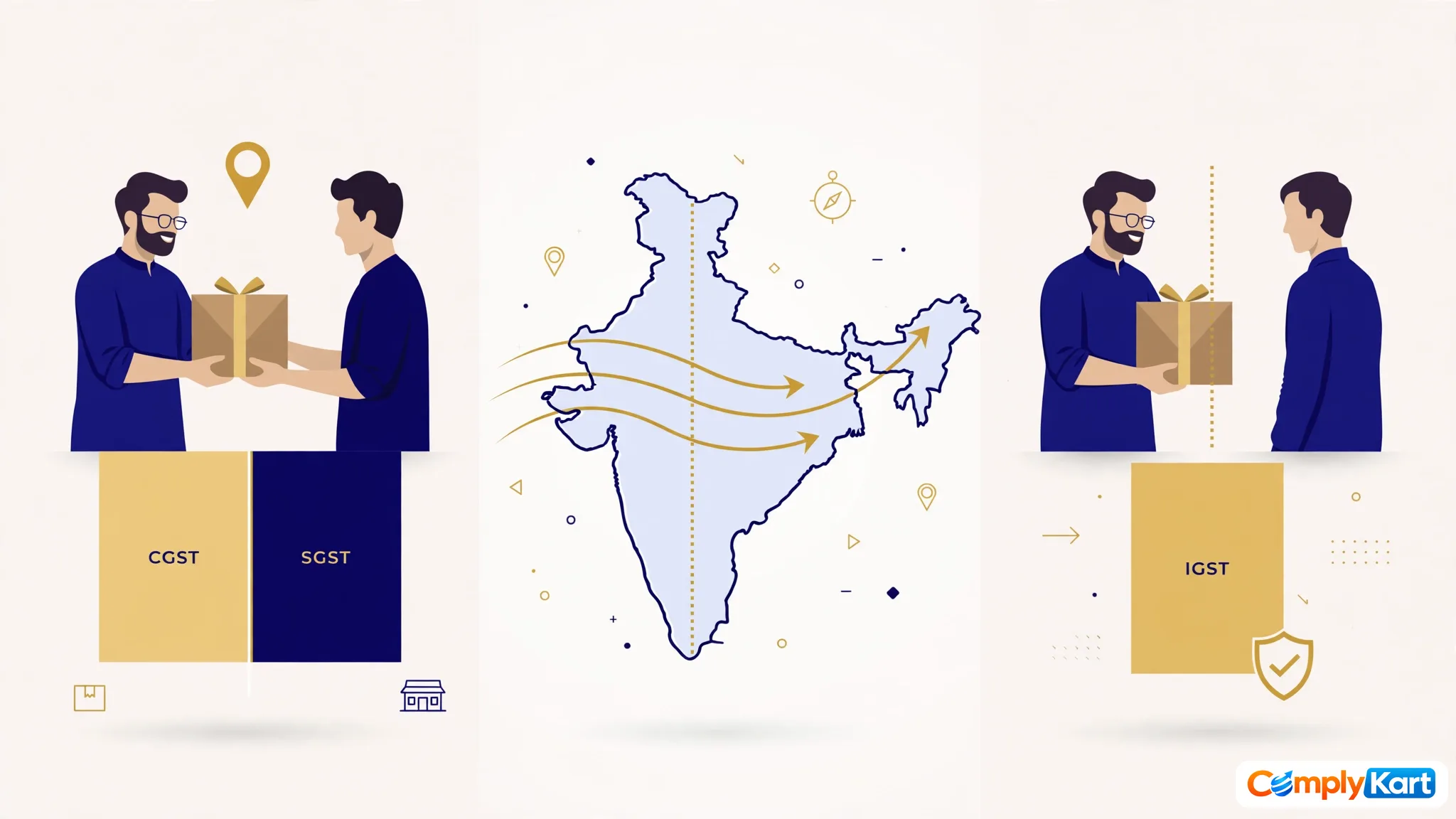
An inter-State supply is a supply where the supplier's location and the place of supply fall in different States or Union Territories, attracting IGST under Section 7 of the IGST Act, 2017. An intra-State supply is one where both fall in the same State or Union Territory, attracting CGST plus SGST — or CGST plus UTGST — under Section 8. Sections 10 to 13 fix the place of supply.
You are about to raise an invoice. The goods are packed, the amount is agreed, and then the billing software asks you one question that stops everything: IGST, or CGST plus SGST? Pick wrong and the buyer cannot claim the credit cleanly, your GSTR-1 carries the wrong state code, and a scrutiny notice eventually asks why. Careful businesses make this mistake, not careless ones. The rule is short. The trouble sits in two traps that look like ordinary sales.
What is the short answer?
An inter-State supply is one where the supplier's location and the place of supply are in different States, and it attracts IGST. An intra-State supply is one where both are in the same State, and it attracts CGST plus SGST. The total tax is the same either way — only the tax head changes.
The one test that decides every invoice
Forget the buyer's address for a minute. Forget where the goods are sitting in your godown. Ask three questions, in this order:
- Where are you supplying from? That is your location as a supplier — normally the place of business the supply is made from. If you have establishments in more than one State, each one counts as a separate person for GST, so the answer is the establishment making this supply.
- Where is the place of supply? This is the legal destination of the supply. For goods it is usually where the movement ends. For most services it is where the recipient is. Sections 10 to 13 of the IGST Act, 2017 fix it, case by case.
- Are the two in the same State? Same State means intra-State: CGST plus SGST. Different States means inter-State: IGST.
Think of the place of supply the way you think of the delivery address on a courier parcel. The tax follows where the parcel is delivered, not where the sender's office sits. Keep that picture in mind. It carries you through every example below.
What is an inter-State supply? What is an intra-State supply?
Section 7 of the IGST Act, 2017 treats a supply as inter-State when the location of the supplier and the place of supply fall in two different States, two different Union Territories, or a State and a Union Territory. Section 8 treats a supply as intra-State when both fall in the same State or Union Territory. In Union Territories without a legislature — Chandigarh, Ladakh, Lakshadweep, and Andaman and Nicobar Islands are the ones you will meet most often — UTGST takes the place of SGST, charged alongside CGST.
| Inter-State supply | Intra-State supply | |
|---|---|---|
| Governing law | Section 7, IGST Act, 2017 | Section 8, IGST Act, 2017 |
| The test | Supplier's location and place of supply in different States or UTs | Supplier's location and place of supply in the same State or UT |
| Tax charged | IGST at the full rate | CGST plus SGST (or UTGST), each at half the rate |
| Who collects | The Centre collects IGST and passes the destination State's share on | The Centre keeps CGST; the State keeps SGST |
| On the invoice | One line: IGST | Two lines: CGST and SGST |
| Registration | Supplying goods across States usually needs registration whatever your turnover — Section 24, explained below | Normal turnover thresholds apply |
One thing worth saying plainly, because it surprises people: GST 2.0 changed the rates, not this test. The 56th GST Council moved most goods and services to 5%, 18% and 40% from 22 September 2025, but a supply is still classified the same way it was before. Our GST rate list for 2026 sets out what sits at each slab.
Worked invoices: the same sale, taxed two ways
Take a Delhi trader selling goods worth ₹1,00,000 that attract 18% GST.
Sold to a buyer in Delhi, delivered in Delhi: intra-State. The invoice shows CGST at 9% (₹9,000) and SGST at 9% (₹9,000). Total tax ₹18,000. Buyer pays ₹1,18,000.
The same goods sold to a buyer in Mumbai, delivered in Mumbai: inter-State. The invoice shows IGST at 18% (₹18,000). Total tax ₹18,000. Buyer pays ₹1,18,000.
Same goods, same rate, same total. Only the split changes. A 5% example makes the same point smaller: a ₹50,000 sale at 5% is ₹1,250 CGST plus ₹1,250 SGST within the State, or ₹2,500 IGST across it. If a buyer tells you IGST "costs more", show them this arithmetic. It does not. What changes is who gets the money, and which credit ledger it lands in. The compliance fee calculator covers the fee side of a filing in a minute.
Place of supply for goods: Section 10 of the IGST Act
Section 10 fixes the place of supply for goods other than imports and exports. Five cases cover nearly every sale you will make:
| Situation | Place of supply |
|---|---|
| Goods move from you to the buyer — Section 10(1)(a) | Where the movement ends for delivery to the recipient |
| Goods delivered to someone else on a third person's direction — bill-to-ship-to, Section 10(1)(b) | The principal place of business of the third person (the bill-to party) |
| Goods do not move at all — Section 10(1)(c) | Where the goods are at the time of delivery |
| Goods installed or assembled at site — Section 10(1)(d) | Where the installation or assembly happens |
| Goods supplied on board a conveyance — Section 10(1)(e) | Where the goods are taken on board |
The first row is the one most invoices live under: the goods travel, and the place of supply is where the journey ends. The second row is Trap 1, and it deserves its own section.
One more goods rule, added recently, catches people who never heard of it. Since 1 October 2023, Section 10(1)(ca) says that where goods go to a person who is not registered, the place of supply is the address recorded on the invoice. Circular 209/3/2024-GST adds the detail that matters: where the invoice carries both a billing address and a delivery address, use the delivery address. That is Trap 2.
Place of supply for services: Sections 12 and 13
Services do not move in a truck, so the law uses the recipient instead. The default rule in Section 12(2) is simple: where the recipient is registered, the place of supply is the recipient's location. Where the recipient is not registered, it is the address the recipient has on record with you — and if you have no address on record, it is your location.
Then come the exceptions, and they are the ones that decide real invoices:
- Immovable property — architects, builders, estate agents, and anyone supplying services directly connected to land or a building: the place of supply is where the property sits. A Kerala architect designing a building in Tamil Nadu charges IGST, because the supplier is in Kerala and the place of supply is Tamil Nadu.
- Restaurant, catering and similar services — the place of supply is where the service is actually performed. A restaurant in Bengaluru serving a customer who lives in Mysuru still charges CGST plus SGST, because the meal is served in Karnataka.
- Cross-border services, Section 13 — where either party is outside India, the default is the recipient's location. But Section 13(8) flips three categories back to the supplier's location: intermediary services, banking services to account holders, and short-term hiring of a means of transport. An Indian intermediary earning a fee from an overseas client still charges IGST with the place of supply in India — a point that has tripped up many exporters of services.
Trap 1: bill-to-ship-to — the goods cross a border, the tax does not
Here is the sale that breaks most billing desks. A supplier in Maharashtra sells goods to a buyer whose office is also in Maharashtra. The buyer tells the supplier to deliver the goods to its warehouse in Karnataka. The truck crosses a state border. The goods end up in Karnataka. What tax goes on the invoice?
CGST plus SGST. Intra-State. The goods travelled, but the place of supply under Section 10(1)(b) is the principal place of business of the third person — the Maharashtra buyer who ordered the goods — not the Karnataka warehouse where they landed. The delivery address is not the test. The bill-to party is.
Go back to the parcel picture: this is ordering a gift for someone in another city. The bill comes to you, the parcel goes to them, and GST asks who ordered it. The clerk who charges IGST here because "the goods went to Karnataka" has overthought it — and the buyer in Maharashtra cannot use IGST credit the way it expects, because the supply was never inter-State.
Flip the facts and the trap flips with them. Supplier in Maharashtra, bill-to buyer in Delhi, delivery to the buyer's warehouse in Rajasthan: the place of supply is Delhi. Inter-State, IGST — but reported against Delhi in GSTR-1, not Rajasthan.
Trap 2: the unregistered buyer — the invoice address decides
A Delhi supplier sells to an unregistered buyer. The invoice carries a Delhi billing address, and the goods are delivered to the buyer's address in Noida, Uttar Pradesh. Since 1 October 2023, the place of supply is the address recorded on the invoice — and where the invoice carries both addresses, Circular 209/3/2024-GST says the delivery address governs. So this is an inter-State supply: IGST.
Now change one fact. The same sale, but the invoice carries only the Delhi billing address and no delivery address. The place of supply is Delhi. Intra-State: CGST plus SGST. Nothing about the goods or the buyer changed — only the address printed on the invoice.
That is why billing discipline matters more than tax knowledge here. If your system prints whatever address the salesperson typed, a data-entry choice is picking your tax head. Check what your template prints for unregistered buyers — and make it a conscious decision.
Supplies that are always inter-State
Some supplies do not go through the test at all. Section 7(5) treats supplies to or by a Special Economic Zone unit or developer as inter-State supplies, even when both parties sit in the same State — a factory in Chennai supplying an SEZ unit in Chennai still charges IGST. Imports of goods and services are inter-State supplies too, and exports are zero-rated supplies, which is a different treatment again: no tax charged, with input credit kept intact. If you deal with an SEZ, do not let the shared pin code fool you. The law has already decided this one for you.
What this does to your GST registration
Classification is not just an invoicing question. It decides whether you must register at all. Section 24 of the CGST Act makes registration compulsory for a person making an inter-State taxable supply of goods, whatever the turnover. Sell goods across a state line once, and the ₹40 lakh goods threshold does not protect you.
Services get a narrower break. Notification 10/2019-Central Tax exempts a person supplying only services across States from compulsory registration if aggregate turnover stays within ₹20 lakh (₹10 lakh in special-category States). A consultant in Jaipur taking a client in Indore can stay unregistered under that exemption. A trader in Jaipur sending goods to Indore cannot.
Registration also multiplies by State: you need a separate GST registration in each State from which you make taxable supplies, as our guide to multistate GST registration walks through. And if you sell through an e-commerce operator, declaring the operator's warehouse as your place of business can make that State your supplier location for every order fulfilled from it. The cost side is covered in our GST registration cost guide.
Input tax credit: the order you must use it in
Charging the right head also decides which credit you can use, and in what order. Sections 49A and 49B of the CGST Act, with Rule 88A of the CGST Rules, fix a strict sequence: IGST credit is used first for IGST, then for CGST, then for SGST. CGST credit pays CGST first, then IGST. SGST credit pays SGST first, then IGST. And the hard wall: CGST credit can never pay SGST, and SGST credit can never pay CGST.
Work it with numbers. Say you have IGST credit of ₹20,000, CGST credit of ₹10,000 and SGST credit of ₹10,000, and this month's liability is IGST ₹15,000, CGST ₹12,000 and SGST ₹12,000. The IGST credit clears the ₹15,000 IGST liability, leaving ₹5,000, which goes against CGST — leaving ₹7,000 of CGST liability, cleared from your ₹10,000 CGST credit. That leaves ₹3,000 of CGST credit sitting unused, because it cannot touch the SGST liability. The SGST credit clears ₹10,000 of the ₹12,000 SGST liability, and the last ₹2,000 comes out of your bank account in cash.
So a wrong head does not only confuse the buyer. It strands your own credit: charge IGST on intra-State sales for a year, and you will keep paying SGST in cash while CGST credit gathers dust. Check your ledgers if that sounds familiar.
Charged the wrong tax? Here is the fix
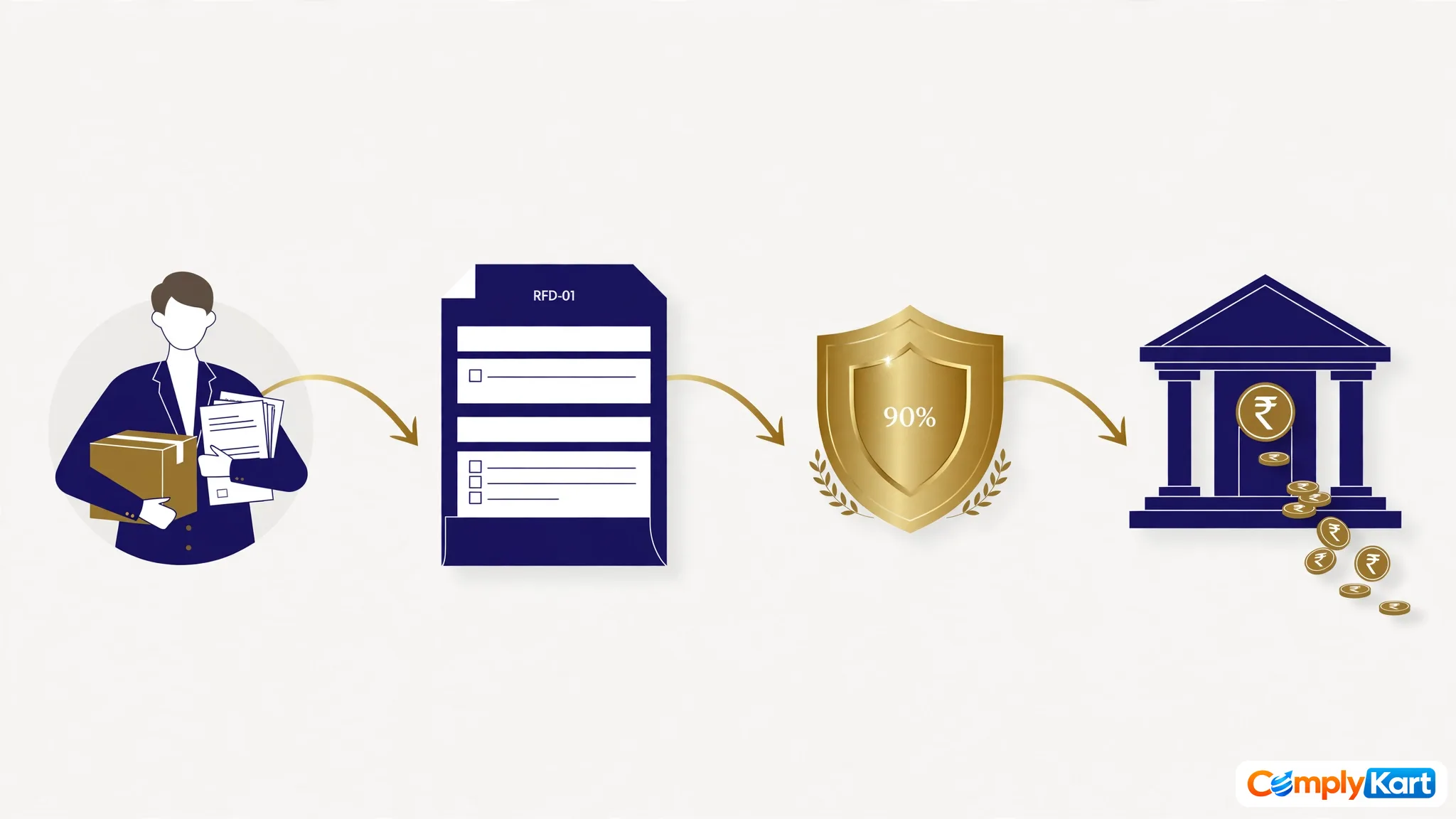
First, the reassuring part: the law expects this mistake. Section 77 of the CGST Act and Section 19 of the IGST Act deal with exactly it. If you paid CGST and SGST on a supply that turns out to be inter-State, you pay the IGST that was actually due, and the CGST and SGST you paid are refunded to you. If you paid IGST on a supply that turns out to be intra-State, the mirror applies. In both directions, no interest is payable on the tax now being paid under the correct head. The refund is claimed in Form RFD-01 under Rule 89(1A), within two years of paying the tax under the correct head, and Circular 162/18/2021-GST explains how the "subsequently held" wording works.
One honest qualification. Recent court discussion — including SYA Homes before the Madras High Court in 2026 — draws a line the sections themselves invite: Sections 77 and 19 cover cases where the character of the supply was wrongly decided, where you genuinely treated an inter-State supply as intra-State or the reverse. Where the classification was right all along and the tax was simply remitted under the wrong head by mistake, the question becomes one of appropriating the payment rather than refunding it — and courts have been more willing to let the payment be re-appropriated than to force a pay-again-and-claim-refund cycle. Work out which situation you are in before you file anything. If it is not obvious, that is where a professional earns their fee — our GST refund filing service handles the RFD-01 side.
Do not wait for the department to find it. A wrong head shows up fast: your GSTR-1 says one thing, the buyer's GSTR-2B says another, and the mismatch lands in a scrutiny notice. Our guide to replying to an ASMT-10 scrutiny notice explains what that letter means — a corrected invoice costs far less.
The e-way bill line
Classification quietly changes your e-way bill duties too. An inter-State movement of goods needs an e-way bill once the consignment value crosses ₹50,000 under Rule 138 of the CGST Rules. For intra-State movement, each State sets its own threshold, so check your State's figure rather than assuming ₹50,000.
Five mistakes that cost real money
- Charging by the buyer's State instead of the place of supply. The buyer lives in another State, but the service is performed in yours. The place of supply decides, not the buyer's address.
- Treating delivery as the test in bill-to-ship-to orders. The place of supply follows the bill-to party's principal place of business, not the warehouse that receives the goods.
- Printing only a billing address for unregistered buyers. Since October 2023, the address on the invoice can flip the tax head. Decide deliberately what your template prints.
- Assuming an SEZ sale in your own city is intra-State. It is inter-State by law, whatever the pin code says.
- Selling goods across a State line while unregistered. Section 24 makes inter-State supply of goods compulsorily registrable. The turnover threshold does not save you — and the first invoice is already the offence.
Should you sort this yourself?
For a business selling inside one State, with walk-in customers and no bill-to-ship-to orders, yes — the three-question test in this guide will carry you, and your billing software will do the rest once it is set up correctly. Bring in a professional when you start selling across States, when you take on SEZ or export customers, when you hold stock in another State's warehouse, or when you have already charged the wrong head and need the refund filed cleanly. Getting this right costs a conversation. Getting it wrong costs interest, blocked credit, and a notice — and the notice always arrives in the busiest month. If that point has come, talk to us through our GST registration service.
GST is a destination-based tax, and that single idea explains almost everything here. The tax belongs to the State where the supply is consumed. Once you see it that way, the test stops feeling like a technicality — it is just the law asking where the parcel actually landed.
FAQs
Is IGST charged at a higher rate than CGST plus SGST?
No. The total rate is identical — 18% is 18% IGST on an inter-State supply, or 9% CGST plus 9% SGST on an intra-State one. Only the collection and the credit ledger change.
What is UTGST, and where does it apply?
UTGST replaces SGST in Union Territories that have no legislature of their own, such as Chandigarh, Ladakh, Lakshadweep, and Andaman and Nicobar Islands. It is charged alongside CGST, each at half the total rate. Delhi, Puducherry, and Jammu and Kashmir have legislatures, so SGST applies there.
I sell through an e-commerce platform with warehouses in other States. Does that change anything?
Yes — it can change your supplier location. If you declare the operator's warehouse as your place of business in a State, supplies fulfilled from that warehouse are made from that State, so the inter-State versus intra-State test runs from there, not from your home State. This is also why many sellers end up needing the multistate registration our guide covers.
Can I use CGST credit to pay my SGST liability?
No. CGST credit pays CGST first and then IGST; SGST credit pays SGST first and then IGST. Neither can cross over to the other. Only IGST credit moves freely across all three heads, in the order IGST, then CGST, then SGST.
How long do I have to claim a refund of tax paid under the wrong head?
Two years from the date you paid the tax under the correct head, in Form RFD-01 under Rule 89(1A) of the CGST Rules. File it once the correct tax is paid — and keep the original invoice and the corrected one, because the refund turns on showing both.


Comments
No comments yet — ask the first question below.
Join the discussion
Questions go straight to our expert desk. Comments appear after a quick review — no spam, no noise.