
IN BRIEF
GST for a cloud kitchen is the 5% tax treatment of restaurant service supplied from a delivery-only kitchen, governed by section 9(5) of the CGST Act, 2017 and Notification 17/2021-Central Tax (Rate). On orders through Swiggy or Zomato the platform pays the 5% tax; on direct orders the kitchen charges it itself. A cloud kitchen charges 5% without input tax credit, except for restaurant service bought from another restaurant provider since 1 November 2026.
A cloud kitchen has no dining room, no waiters and no table to clear. It has a stove, a phone full of orders, and a tax question that trips up almost every new owner: whose GST is this, anyway? Yours or the app's?
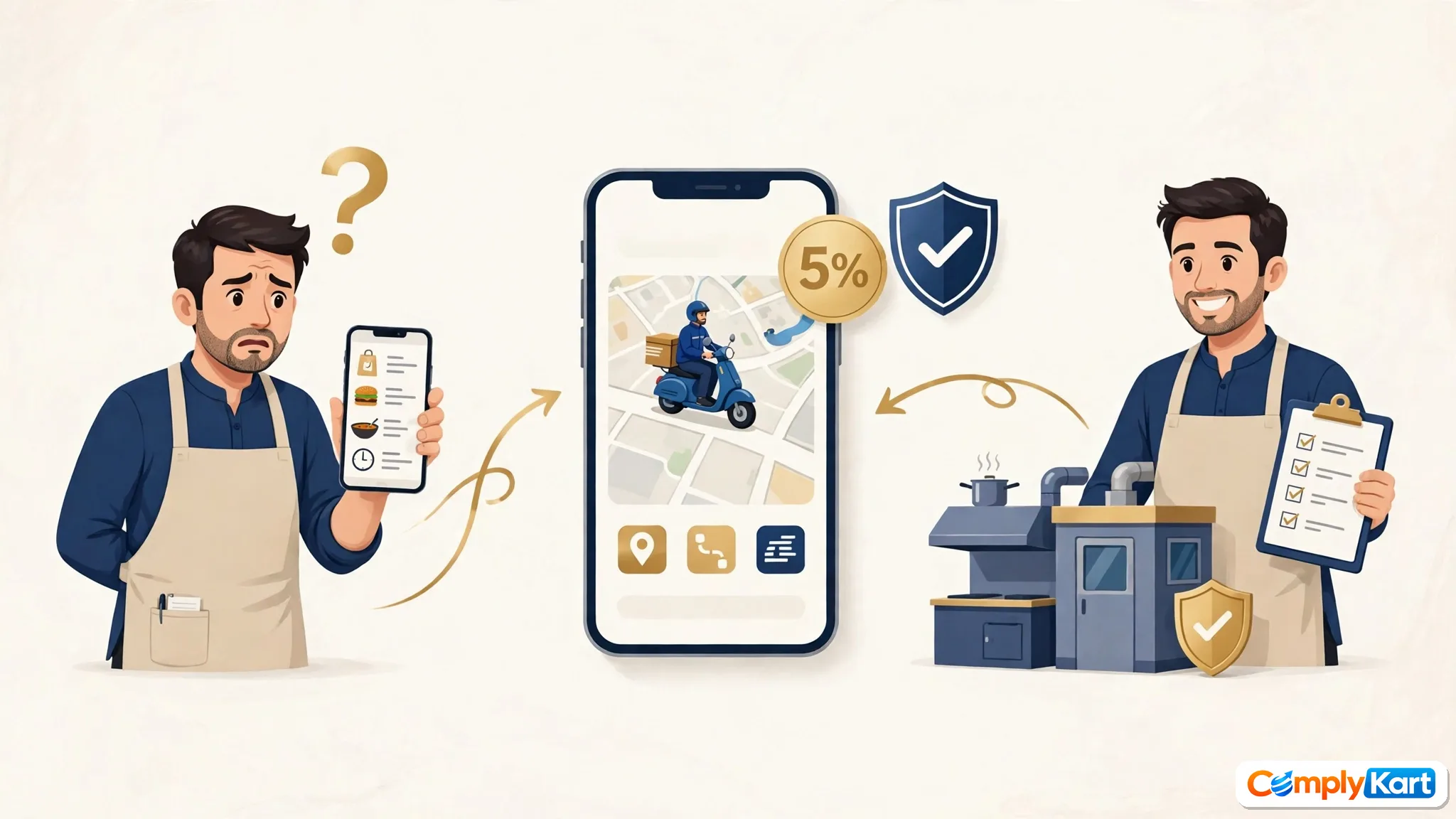
A cloud kitchen charges 5% GST without input tax credit, because a delivery-only kitchen counts as restaurant service. On Swiggy or Zomato orders, the platform pays that 5% under section 9(5) of the CGST Act. On direct orders — your website, WhatsApp, phone — you charge the 5% and pay it yourself.
That split sounds simple. In practice it breaks in four places: registration, the tax on the platform's commission, the new November 2026 rule changes, and the monthly return. I run through each one below, with the numbers worked out so you can check them against your own month.
What counts as a cloud kitchen under GST?
Under Notification 11/2017-Central Tax (Rate), "restaurant service" means supplying food or drink through a restaurant, eating joint, mess or canteen, whether the food is eaten on the premises or away from them. A CBIC circular from October 2021 — Circular 164/20/2021-GST — confirmed that cloud kitchens and central kitchens fall inside that definition. No dining room needed. If you cook food to order and it goes out in a box, you are selling restaurant service.
Two edges matter. First, packaged food you sell as goods — a jar of pickle, a packed snack with a shelf life — is not restaurant service. Each product takes its own GST rate, so do not stamp 5% on everything that leaves the kitchen. Second, corporate catering and bulk orders can be outdoor catering rather than restaurant service, and the rate and credit position can differ. Check what you actually supplied before you pick the rate.
What GST rate does a cloud kitchen charge?
Five per cent, without input tax credit. That is the rate for restaurant service under Entry 7(ii) of Notification 11/2017, and the GST 2.0 rate changes of September 2025 left it untouched — Notification 15/2025-Central Tax (Rate) kept restaurant service at 5% without credit and 18% with credit at specified premises.
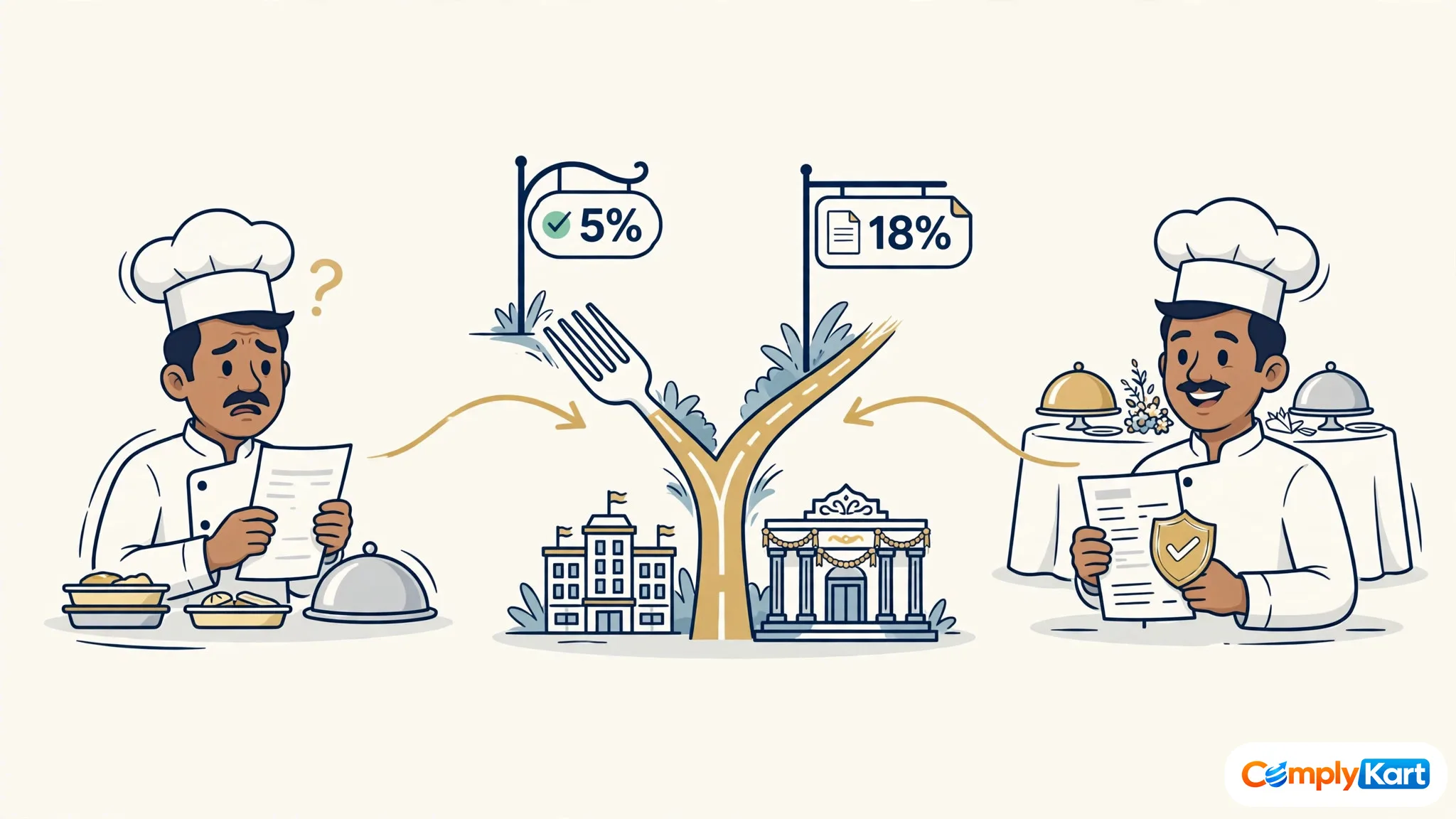
Specified premises means a hotel where a room went above ₹7,500 a day in the previous financial year, or a hotel that filed the opt-in declaration. Your kitchen has no rooms. The 18% rate does not apply to you, and since April 2025 a standalone restaurant cannot declare itself specified premises just to charge 18% and claim credit. Five per cent it is, on every direct order.
If you want the fuller restaurant picture — the specified-premises test, the opt-in windows, and how the 5% vs 18% choice works for a dine-in outlet — my guide to GST for restaurants: 5% vs 18% covers it. This post stays with the kitchen.
Who pays GST on Swiggy and Zomato orders?
The platform does. Since 1 January 2022, restaurant service ordered through an e-commerce operator has been notified under section 9(5) of the CGST Act — Notification 17/2021-Central Tax (Rate), dated 18 November 2021, following the 45th GST Council meeting. The operator is treated as the supplier for tax purposes: it collects 5% from the customer, pays it to the government in cash, and issues the invoice.
Think of it like a food court. The court runs the till, collects the tax and hands the government its share. Your own counter — your website, your WhatsApp orders, walk-in takeaway — is the only till you run yourself. On app orders you are the cook, not the cashier.
CBIC Circular 167/23/2021-GST, dated 17 December 2021, settled the practical questions. The platform pays even where the kitchen is unregistered. It collects no TCS on these orders and files no GSTR-8 for them. It cannot use input tax credit to pay this liability — the whole 5% goes in cash. And your aggregator sales still count in your aggregate turnover, which matters for registration, as the next sections show.
| Order channel | Who pays GST on the food | Who issues the invoice | What you do |
|---|---|---|---|
| Swiggy or Zomato order | The platform, 5% under section 9(5) | The platform | Report as supplies through an e-commerce operator; no tax payable by you |
| Own website, WhatsApp, phone, walk-in takeaway | You, 5% without credit | You | Charge 5%, report as normal taxable sales, pay the tax |
| Packaged goods sold separately | You, at the product's own rate | You | Do not apply the 5% restaurant rate to goods |
What changed on 1 November 2026?
Two things, both under Notification 06/2026-Central Tax (Rate), dated 27 October 2026 and effective from 1 November 2026. If your last GST reading predates November, your notes are out of date on both.
First, the credit door opened a crack. A kitchen charging 5% can now take input tax credit on one thing: restaurant service it buys from another restaurant service provider — a kitchen that is itself not at specified premises. Rent, equipment, raw material, packaging, software and platform commission stay blocked. Only the same line of business counts, and only the service itself, not the goods that went into it. I work an example with real numbers below.
Second, the delivery fee got cheaper. From 22 September 2025, delivery services supplied through an e-commerce operator carried 18% GST with credit. From 1 November 2026 the same delivery carries 5% with no credit — the notification substituted the delivery entry (serial 12, item (iii)) at 2.5% CGST. That covers delivery through an operator where the person supplying the service is not liable for registration, and delivery of goods supplied through an operator. The fee sits on the customer's bill, so a lower rate trims what your customer pays per order — small per order, real across a month.
What input tax credit can a cloud kitchen actually claim?
Almost none, and that is the point most owners get wrong. Charging 5% without credit means the GST you pay on your costs becomes part of your cost. Section 17(5) of the CGST Act blocks the credit, and the November 2026 change adds exactly one exception to that block.
| What you pay GST on | Can you claim it back? |
|---|---|
| Rent for the kitchen | No |
| Kitchen equipment, packaging, raw material | No |
| Software, billing systems | No |
| Swiggy/Zomato commission and fees (18% GST) | No — it is a cost, build it into your menu price |
| Restaurant service bought from another restaurant provider (from 1 Nov 2026) | Yes — the only exception |
| Everything else, if you charge 18% at specified premises | Normal credit rules apply — but a cloud kitchen has no specified premises |
The exception is narrow, so use it narrowly. Say your own kitchen is full on a festival weekend and you buy ₹40,000 of food preparation from another standalone kitchen, which charges you 5%. That ₹2,000 of tax is credit you can now take, and use against the 5% you owe on your direct orders. Buy the same prep from a caterer at specified premises, or buy raw material instead of a finished service, and the exception does not apply.
Do you need GST registration to sell on Swiggy or Zomato?
Not by law until your aggregate turnover crosses ₹20 lakh in a year — ₹10 lakh in special category states. Restaurant service is a supply of services, so the services threshold applies. And the threshold test counts everything: aggregator sales, direct orders, walk-in takeaway and catering, added together. Circular 167 says so in plain words, and it catches people. A home chef with ₹14 lakh of app sales and ₹8 lakh of direct orders is at ₹22 lakh and must register, even though the platform paid the tax on the larger share.
Two things confuse owners here. First, the rule that forces every online seller to register regardless of turnover — section 24 of the CGST Act — does not bite on supplies taxed under section 9(5). A kitchen selling only through aggregators registers when turnover crosses the threshold, not on day one. Some guides state the opposite as law. It is not the law.
Second, the apps have their own onboarding lists, and those lists change. An app may ask for a GSTIN before it activates your listing. That is the platform's document requirement, not a tax rule — but it has the same practical effect on your launch date. If you plan to list, get the number in hand before you promise a launch date. GST registration is free on the portal and takes days, not weeks, when the documents are ready.
Many owners register voluntarily from day one anyway, because a GSTIN smooths onboarding, input invoices and corporate orders. That is a fair choice. Just know it is a choice, not a compulsion.
How do you report aggregator sales in your returns?
Here the paperwork has a wrinkle worth knowing. Circular 167 told registered kitchens to report these supplies in GSTR-1 Table 8 and GSTR-3B Table 3.1(c) — but it said "for the time being", and the portal's tables have since moved on. Current practice puts supplies made through an e-commerce operator in GSTR-1 Table 14 and GSTR-3B Table 3.1.1(ii), with no tax payable by you on those lines. A few CA-written guides still show the old tables. Either way, the figure that matters is the match: your reported aggregator sales must tie to what the platform reports. A mismatch is what draws the notice.
The classic error is billing software that adds GST to aggregator sales and pushes them into normal taxable supplies. Then you pay tax the platform already paid, and your returns disagree with the platform's. Check your software's mapping before the first return, not after the notice arrives.
What about FSSAI — which tier fits a cloud kitchen now?
Every kitchen needs FSSAI registration or a licence before the first sale — the aggregators will not activate a listing without the 14-digit number, and it goes on your invoices, packaging and app listings. The tiers changed on 1 April 2026, and older guides still show the old numbers, so check yours.
Under the Food Safety and Standards (Licensing and Registration of Food Businesses) Amendment Regulations, 2026 — gazetted 10 March 2026, in force from 1 April 2026 — the bands are now: basic registration for annual turnover up to ₹1.5 crore (it was ₹12 lakh); a state licence from ₹1.5 crore to ₹50 crore; a central licence above ₹50 crore. Licences and registrations issued on or after 1 April 2026 carry perpetual validity — no renewal — but the annual fee must still be paid on FoSCoS, or the licence is treated as suspended. Indicative annual fees: ₹100 for registration, ₹2,000 to ₹5,000 for a state licence, ₹7,500 for a central licence.
Two kitchen-specific points. The licence belongs to the premises, so each kitchen location needs its own — one licence does not stretch across two kitchens. And if you run several delivery brands from one kitchen, confirm with the licensing authority how those brand names should be reflected, rather than assuming one licence covers any label. My guide to the FSSAI licence for cloud kitchens walks through the kitchen-vs-brand rule and the onboarding checks in full, and a state FSSAI licence is the usual route once you cross ₹1.5 crore.
One kitchen or many — how does GST work across locations and brands?
GST is state-wise. You need a GSTIN in each state where you have a kitchen. Two kitchens in the same state sit on one GSTIN as additional places of business. Two kitchens in two states need two registrations, and each state files its own returns. Brands are simpler than kitchens: several delivery brands cooked in one kitchen are trade names under the same GSTIN in that state, since the tax follows the premises and the PAN, not the brand on the app.
That structure shapes your entity choice. A proprietorship is the quickest start for a single kitchen. A private limited company or LLP earns its keep when you plan outside funding or several kitchens, because the entity — not you personally — holds the registrations, the leases and the aggregator contracts. If you are weighing that step, the private limited company registration route is worth reading before you sign a second lease.
Does the composition scheme suit a cloud kitchen?
Sometimes. The composition scheme lets a small restaurant or kitchen pay a flat 5% of turnover instead of charging GST on each bill, if the preceding year's turnover was up to ₹1.5 crore (₹75 lakh in some north-eastern and hill states). You file a quarterly CMP-08 statement and an annual GSTR-4, and you issue a bill of supply rather than a tax invoice.
The catch is who bears the tax. Under the regular 5% scheme the customer pays GST on top of your menu price. Under composition it comes out of your margin. You also cannot claim any credit, cannot make inter-state supplies, and cannot serve alcohol. If most of your sales come through Swiggy and Zomato, ask your CA how those app sales are reported in your composition statement before you opt in — the channel mix decides whether the scheme saves you money or quietly costs it.
A month in the life of a cloud kitchen — the GST maths
Take a kitchen doing ₹6,00,000 of food sales in a month: ₹4,50,000 through aggregators and ₹1,50,000 direct, through its own website and WhatsApp. Run the GST calculator on these figures yourself and the same answers come out.
On the ₹4,50,000 of aggregator orders, the platform pays 5% — ₹22,500 — and issues the invoices. That is not your money and not your cost. On the ₹1,50,000 of direct orders you charge 5% yourself: ₹7,500 of output tax.
Now the costs. The aggregator's commission runs 18–30% of order value by contract; take 25% here. Commission on ₹4,50,000 is ₹1,12,500, and the 18% GST on it is ₹20,250. You cannot claim that back — it is a cost, and it belongs in your menu pricing. Then the November 2026 exception: your kitchen was full one weekend and you bought ₹40,000 of food preparation from another standalone kitchen, which charged 5%. That gives you ₹2,000 of input tax credit.
Net GST for the month: ₹7,500 of output tax, less ₹2,000 of credit, is ₹5,500 payable in cash. Add the ₹20,250 of commission GST you absorbed, and the month's total GST cost is ₹25,750 — before a rupee of income tax. The lesson is in the split: the tax you owe is small, but the tax buried in your costs is four times bigger. Price for the second number, not the first.
Six mistakes that cost cloud kitchens money
- Paying GST twice on aggregator orders. Billing software that adds GST to app sales pushes them into normal taxable supplies. The platform already paid it. Check the mapping.
- Counting only direct sales for the threshold. Aggregator sales count. Track combined turnover monthly and register the month you cross ₹20 lakh, not at year-end.
- Treating commission GST as reclaimable. The 18% on Swiggy and Zomato commission is a cost for a 5% kitchen. If your menu price does not carry it, your margin does.
- Charging 5% on packaged goods. A jar or a packed snack sold as goods takes its own rate. The restaurant rate covers the food service, not the shelf product.
- Running on a stale FSSAI tier. Guides written before April 2026 still say registration ends at ₹12 lakh. It ends at ₹1.5 crore now. Check your tier, not your memory.
- One GSTIN across two states. Each state needs its own registration. Register the second kitchen's state before the first order ships from it.
Frequently asked questions
What is the GST rate for a cloud kitchen in India?
Five per cent without input tax credit. A cloud kitchen is restaurant service under the CGST Act, so direct orders carry 5% charged by you, and the platform pays 5% on orders placed through it. The 18% rate applies only to restaurants at specified premises — hotels with rooms above ₹7,500 a day — which a delivery-only kitchen never is.
Do I need GST registration to sell on Swiggy or Zomato?
Not by law until aggregate turnover crosses ₹20 lakh a year (₹10 lakh in special category states), counting aggregator and direct sales together. But the apps may ask for a GSTIN as an onboarding document, so many kitchens register before they list. Registration is free on the GST portal.
Can a cloud kitchen claim input tax credit on aggregator commission?
No. The 18% GST charged on Swiggy and Zomato commission is a cost for a kitchen on the 5% rate, and it cannot be set off. Since 1 November 2026 the only credit available is on restaurant service bought from another restaurant provider — not on rent, equipment, packaging, software or commission.
What GST applies to the delivery fee on app orders?
Five per cent without input tax credit, from 1 November 2026 under Notification 06/2026-Central Tax (Rate). Between 22 September and 31 October 2026 the same delivery service carried 18% with credit. The fee sits on the customer's bill, so the change trims what each order costs the customer.
Can I run two cloud kitchens in different cities on one GSTIN?
No, if the cities are in different states — GST registration is state-wise, so each state needs its own GSTIN. Two kitchens in the same state can sit on one GSTIN as additional places of business. Brands do not change this: several brands from one kitchen share that kitchen's GSTIN.
Cloud kitchens look simple from the customer's side — food appears, the app takes the money. From the kitchen's side the tax splits three ways: the platform's share, your share, and the share buried in your costs. Get the split right in the first month and it stays right. Get it wrong and you pay for it twice — once in tax, once in margin. If you are still setting up, the compliance fee calculator gives you the registration and filing costs to budget for alongside the GST.


Comments
No comments yet — ask the first question below.
Join the discussion
Questions go straight to our expert desk. Comments appear after a quick review — no spam, no noise.