
IN BRIEF
TDS on salary is the income tax your employer deducts from your pay each month under section 392 of the Income-tax Act, 2025, which replaced section 192 of the 1961 Act from 1 April 2026. The employer estimates your total income for tax year 2026-27, applies the slab rates of your chosen regime, and deducts the resulting tax at the average rate across the year's payments.
Your salary hits the bank on the last working day of the month. The number is smaller than your CTC promised, and the payslip blames three letters: TDS. Most people accept the cut and move on. That is a mistake — not because the cut is wrong, but because nobody explains how it was worked out. Once you see the maths, you can check it yourself, and you will spot the months when it goes wrong.
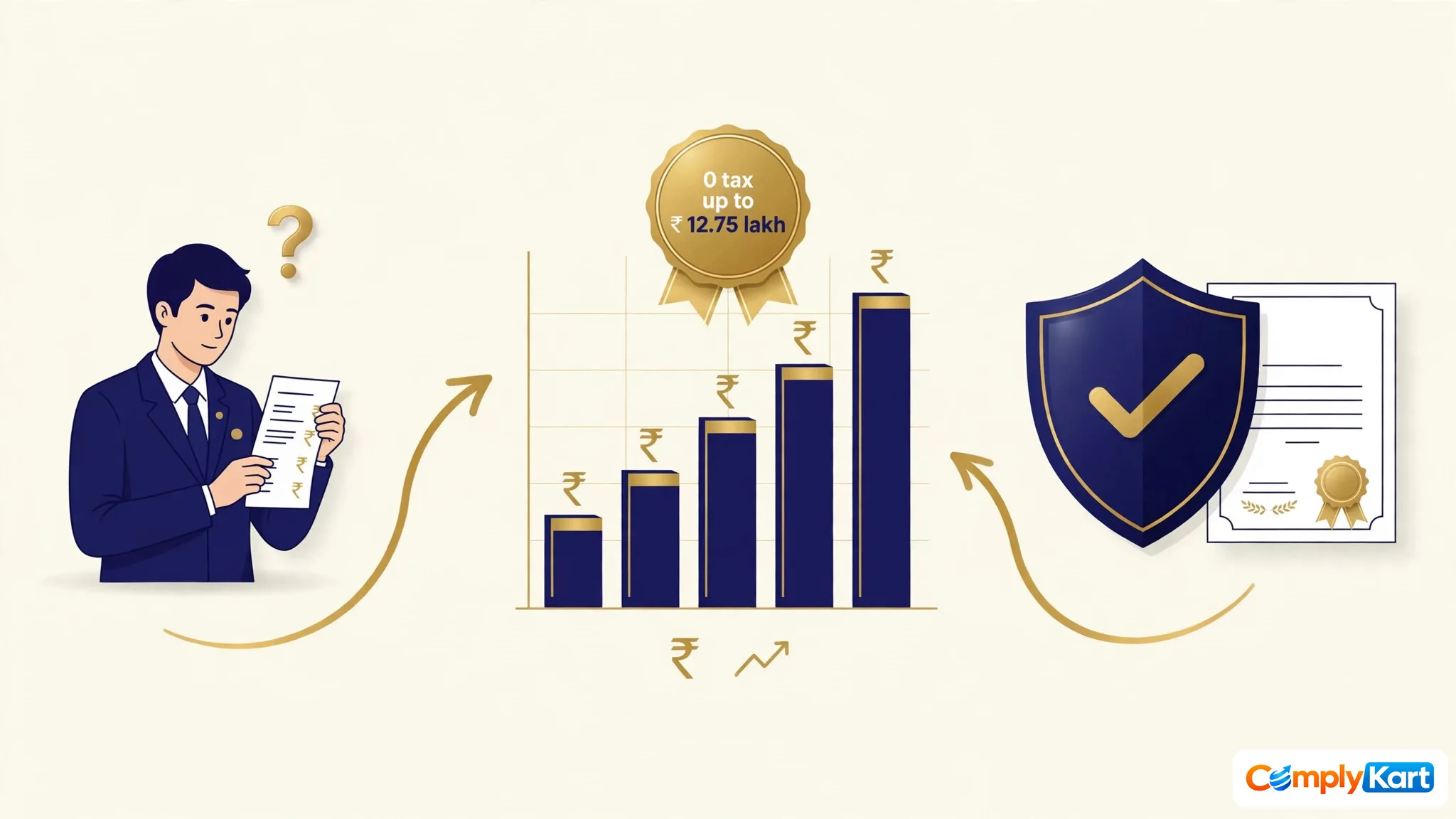
Here is the short answer. TDS on salary is not a fixed percentage of your pay. Your employer estimates your total income for the whole tax year, applies the income-tax slabs of the regime you chose, and deducts the resulting tax in monthly instalments. For tax year 2026-27, under the new regime — the default for everyone — the slabs run from nil up to ₹4 lakh to 30% above ₹24 lakh, and a salary of up to ₹12.75 lakh a year pays no tax at all. The rest of this guide shows the full chart, works three real salaries through it, and lists what changed on 1 April 2026.
What TDS on salary actually is
TDS stands for tax deducted at source. Under section 392 of the Income-tax Act, 2025, your employer must deduct income tax at the time of paying your salary. The section number is new — it was section 192 of the 1961 Act until 31 March 2026 — but the duty is the same.
Think of it like a prepaid meter for the year’s tax. In April your employer makes an estimate: your salary for the year, minus the standard deduction, minus the deductions you declared. That estimate produces one annual tax figure. Your employer then collects it in twelve instalments. When your salary changes, or you declare a new deduction, the estimate is revised and the monthly instalment moves. That is why your TDS can change mid-year even though your salary did not.
The important point: the slab rate is the tariff, not the deduction. A person in the 20% slab does not lose 20% of every payslip. The slabs apply to slices of income, and the tax is then spread across the year at the average rate. If your employer ever deducts a flat 10% or 20% from your whole salary, something is off — ask for the computation sheet.
The new-regime slab chart for FY 2026-27
The new regime is the default. Unless you tell your employer in writing that you want the old regime, these are the slabs your TDS is computed on. They are unchanged from last year — the 2026 Budget changed the section and form numbers, not the rates.
| Taxable income | Rate | Tax on this slice |
|---|---|---|
| Up to ₹4,00,000 | Nil | Nil |
| ₹4,00,001 to ₹8,00,000 | 5% | ₹20,000 |
| ₹8,00,001 to ₹12,00,000 | 10% | ₹40,000 |
| ₹12,00,001 to ₹16,00,000 | 15% | ₹60,000 |
| ₹16,00,001 to ₹20,00,000 | 20% | ₹80,000 |
| ₹20,00,001 to ₹24,00,000 | 25% | ₹1,00,000 |
| Above ₹24,00,000 | 30% | 30% of the excess |
On top of the slab tax comes a 4% health and education cess. And if your income crosses ₹50 lakh, a surcharge applies on top — that is a separate conversation with your CA, and it does not change the chart above.
The old-regime chart, for comparison
The old regime still exists, and it can still win if you have heavy deductions — home-loan interest, 80C investments, HRA, medical insurance. Its slabs are narrower at the top, which is exactly why the comparison matters.
| Taxable income | Rate |
|---|---|
| Up to ₹2,50,000 | Nil |
| ₹2,50,001 to ₹5,00,000 | 5% |
| ₹5,00,001 to ₹10,00,000 | 20% |
| Above ₹10,00,000 | 30% |
Two differences decide the choice. The old regime gives a standard deduction of ₹50,000 against the new regime’s ₹75,000, and its rebate is only ₹12,500 for income up to ₹5 lakh, against the new regime’s ₹60,000 for income up to ₹12 lakh. Senior citizens get a higher basic exemption under the old regime — ₹3 lakh up to 60–80 years, ₹5 lakh above 80 — but the new-regime slabs do not change with age. If you are weighing the two, run both on your actual numbers before you declare a regime to your employer; the income-tax calculator does the comparison in a minute, and our guide to which ITR form is yours covers what happens at filing time.
The ₹12.75 lakh line: where tax becomes zero
This is the number most payslips hide in plain sight. Under the new regime, a salaried person with gross salary up to ₹12,75,000 pays no income tax at all. Two pieces make it work. First, the ₹75,000 standard deduction comes off the top, so ₹12,75,000 of salary becomes ₹12,00,000 of taxable income. Second, the rebate under section 156(2) — the new number for the old section 87A — wipes out tax of up to ₹60,000 for total income up to ₹12 lakh. The slab tax on ₹12 lakh is exactly ₹60,000. Rebate cancels it. Tax: zero.
Cross ₹12 lakh of taxable income by one rupee and the rebate vanishes entirely. That sounds brutal, and it would be, except for marginal relief: your tax cannot exceed the amount by which your income crosses ₹12 lakh. The worked example below shows it in action. One caution: the rebate does not apply to income taxed at special rates, such as capital gains. It covers your salary income.
Three salaries, worked through the chart
Every number below is computed from the slabs in the tables above. You can check each one with a pocket calculator.
Salary ₹12,75,000 a year. Less standard deduction ₹75,000 gives taxable income ₹12,00,000. Slab tax: 5% of ₹4,00,000 is ₹20,000, plus 10% of ₹4,00,000 is ₹40,000 — total ₹60,000. Rebate ₹60,000. Tax payable: nil. Monthly TDS: nil. If your employer is cutting TDS at this salary and you have no other income, hand them the computation and ask why.
Salary ₹13,00,000 a year. Taxable income ₹12,25,000. Slab tax: ₹20,000 + ₹40,000 + 15% of ₹25,000 (₹3,750) = ₹63,750. No rebate — income is above ₹12 lakh. But marginal relief caps the tax at the excess over ₹12 lakh, which is ₹25,000. Add 4% cess of ₹1,000. Tax payable: ₹26,000 a year, about ₹2,167 a month. Without marginal relief you would have paid ₹63,750 plus cess. The relief saves you ₹40,300. This is the cliff most guides never mention.
Salary ₹18,00,000 a year. Taxable income ₹17,25,000. Slab tax: ₹20,000 + ₹40,000 + ₹60,000 + 20% of ₹1,25,000 (₹25,000) = ₹1,45,000. Add 4% cess of ₹5,800. Tax payable: ₹1,50,800 a year, about ₹12,567 a month. That is 8.38% of your gross salary — nowhere near the 20% slab your payslip seems to sit in. When someone tells you they are "in the 20% bracket", this is the number to show them.
What changed on 1 April 2026
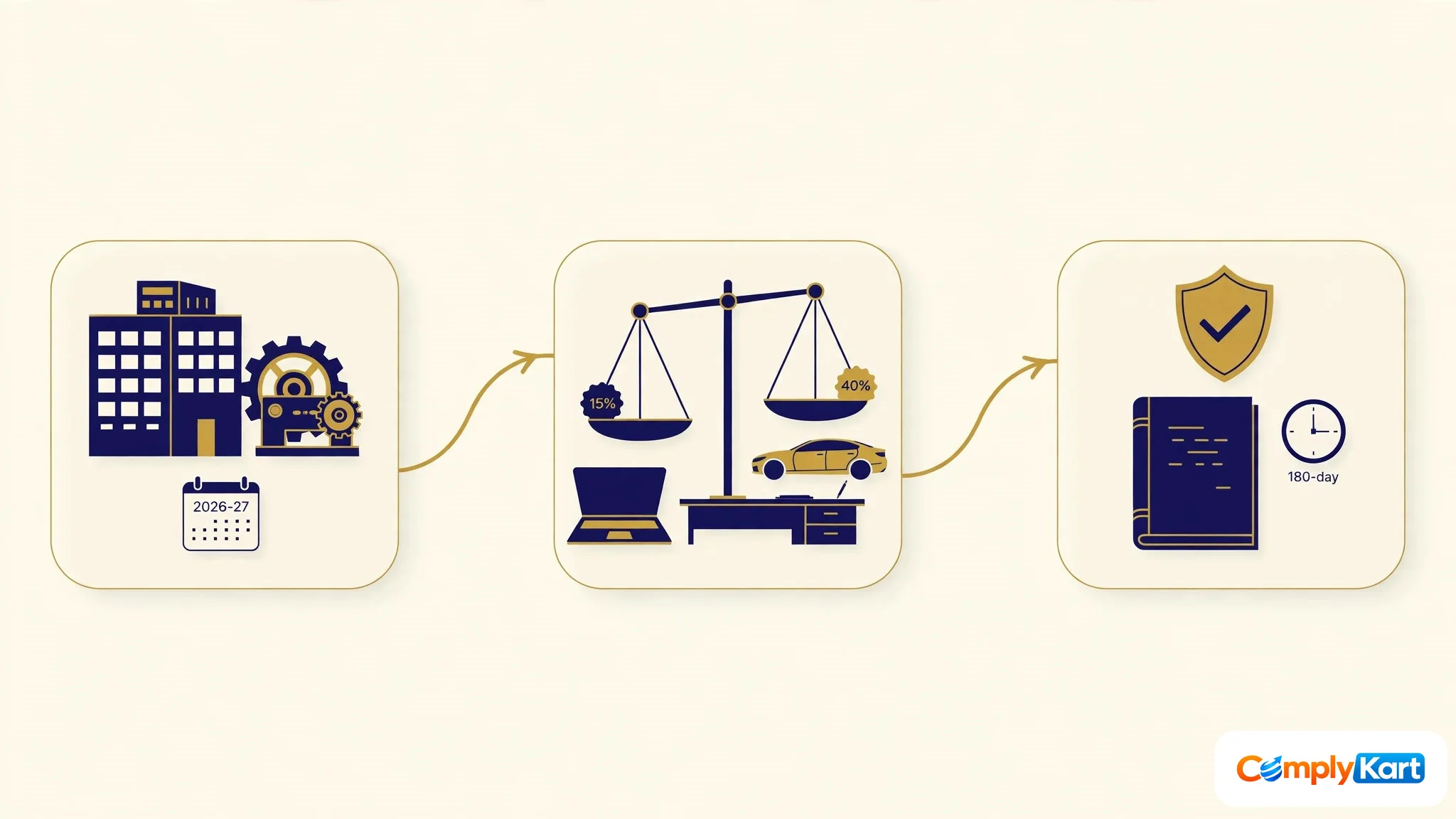
The Income-tax Act, 1961 was replaced by the Income-tax Act, 2025 from 1 April 2026, and salary TDS moved with it. The rates did not change. The numbers around them did. Old references in payroll templates, HR policies and employee letters now point at repealed provisions.
| What | Before 1 April 2026 | From 1 April 2026 |
|---|---|---|
| Duty to deduct tax on salary | Section 192, 1961 Act | Section 392, 2025 Act |
| New-regime default | Section 115BAC | Section 202 |
| Rebate | Section 87A | Section 156(2) |
| Salary TDS certificate to employee | Form 16 | Form 130 |
| Quarterly salary TDS statement | Form 24Q | Form 138 |
| Investment / deduction declaration | Form 12BB | Form 124 |
| Year name | Financial year 2026-27 / AY 2027-28 | Tax year 2026-27 |
A warning worth carrying into your own reading: several guides on the internet still show the old slabs — nil up to ₹3 lakh, 5% to ₹7 lakh, rebate only up to ₹7 lakh. Those were the FY 2024-25 figures. The Finance Act, 2025 rewrote the slabs to the chart above, and any page still printing the old table is out of date, however recently it claims to have been refreshed. If a guide tells you the rebate ceiling is ₹7 lakh, close it. The full section-number map, old Act to new, is in our Income-tax Act 2025 section map.
What your employer must actually do
The employer’s side of this is a small compliance calendar of its own. Your declaration comes first: HRA, home-loan interest, 80C investments and your regime choice go on Form 124 at the start of the year. Without it, your employer computes TDS on the new regime with no deductions beyond the standard deduction — and your monthly cut will be higher than it needs to be.
Each quarter, the employer files the salary TDS statement — Form 138, the old Form 24Q — by 31 July, 31 October, 31 January and 31 May. The tax itself is deposited by the 7th of the following month (30 April for March salary). After the year ends, you get your TDS certificate — Form 130, the old Form 16 — by 15 June. Check it against your Form 26AS and AIS on the income-tax portal before you file your return; a mismatch here is the single most common reason returns get flagged.
Two details payroll teams get wrong. First, the challan payment code for salary TDS is 1002 for a private employer and 1001 for a government employer — the wrong code sends the money to the wrong head. Second, if an employee has no PAN, or the PAN is inoperative, TDS jumps to 20% or the applicable rate, whichever is higher. That is not a penalty your employer invented; it is section 397(2) of the new Act.
Five mistakes that cost salaried people real money
- Never filing Form 124. No declaration means no HRA, no 80C, no home-loan interest in the estimate. Your employer deducts on the full salary and you wait a year for the refund.
- Choosing the regime once and forgetting it. You can switch your choice with your employer each year, and again at filing time. The regime that won last year may lose this year if your deductions changed.
- Ignoring the February–March correction. Employers revise the estimate in the last quarter. A bonus, an increment or a late declaration lands here — read the February payslip, not just the April one.
- Not checking Form 130 against Form 26AS. If the certificate and the portal disagree, the return will too. Raise it with payroll before you file, not after the notice arrives.
- Treating TDS as the final tax. TDS is an advance, not a settlement. Other income, capital gains and the final regime choice are all settled in the return. If TDS was short, the balance is payable with your return — and interest under the Act runs from April, so filing early is cheaper than filing late. Our advance-tax guide explains the interest clock.
Should you do this yourself, or get help?
For most salaried people, this is a do-it-yourself job: check the chart, run the three-step maths, file Form 124, and verify Form 130 in June. You need a professional when the picture gets complicated — salary from two employers in one year, stock options or ESOPs, foreign salary or a stint abroad, rental income alongside salary, or capital gains in the same year. In those cases the estimate your employer makes is only half the story, and the return is where the other half lands. That is the point at which a CA’s hour pays for itself — and it is also when getting your return filed properly matters more than getting the monthly TDS exactly right.
TDS is not a tax on top of your tax. It is your own tax, collected early, in instalments, on an estimate that you are allowed to correct. Know the chart, check the payslip, and the three letters stop being a mystery.
FAQs
What is the TDS rate on salary for FY 2026-27?
There is no single rate. Your employer applies the new-regime slabs — nil to ₹4 lakh, 5% to ₹8 lakh, 10% to ₹12 lakh, 15% to ₹16 lakh, 20% to ₹20 lakh, 25% to ₹24 lakh, 30% above — to your estimated annual income, then deducts the resulting tax at the average rate across the year’s salary payments.
How much TDS is deducted on a salary of ₹18 lakh?
Under the new regime, about ₹1,50,800 a year, or roughly ₹12,567 a month — after the ₹75,000 standard deduction. That is 8.38% of gross salary, not 20%.
What salary is tax-free in FY 2026-27?
Gross salary up to ₹12,75,000 a year pays no tax under the new regime: the ₹75,000 standard deduction brings taxable income to ₹12 lakh, and the ₹60,000 rebate wipes out the slab tax entirely.
Is TDS on salary still under section 192?
Only for salary paid up to 31 March 2026. From 1 April 2026, the Income-tax Act, 2025 applies and salary TDS sits in section 392. The rates are unchanged; the section number, the form numbers and the year’s name changed.
When will I get my Form 16 for FY 2026-27?
The certificate is now called Form 130, and your employer must issue it by 15 June 2027. Check it against Form 26AS and your AIS on the income-tax portal before filing your return.



Comments
No comments yet — ask the first question below.
Join the discussion
Questions go straight to our expert desk. Comments appear after a quick review — no spam, no noise.