
IN BRIEF
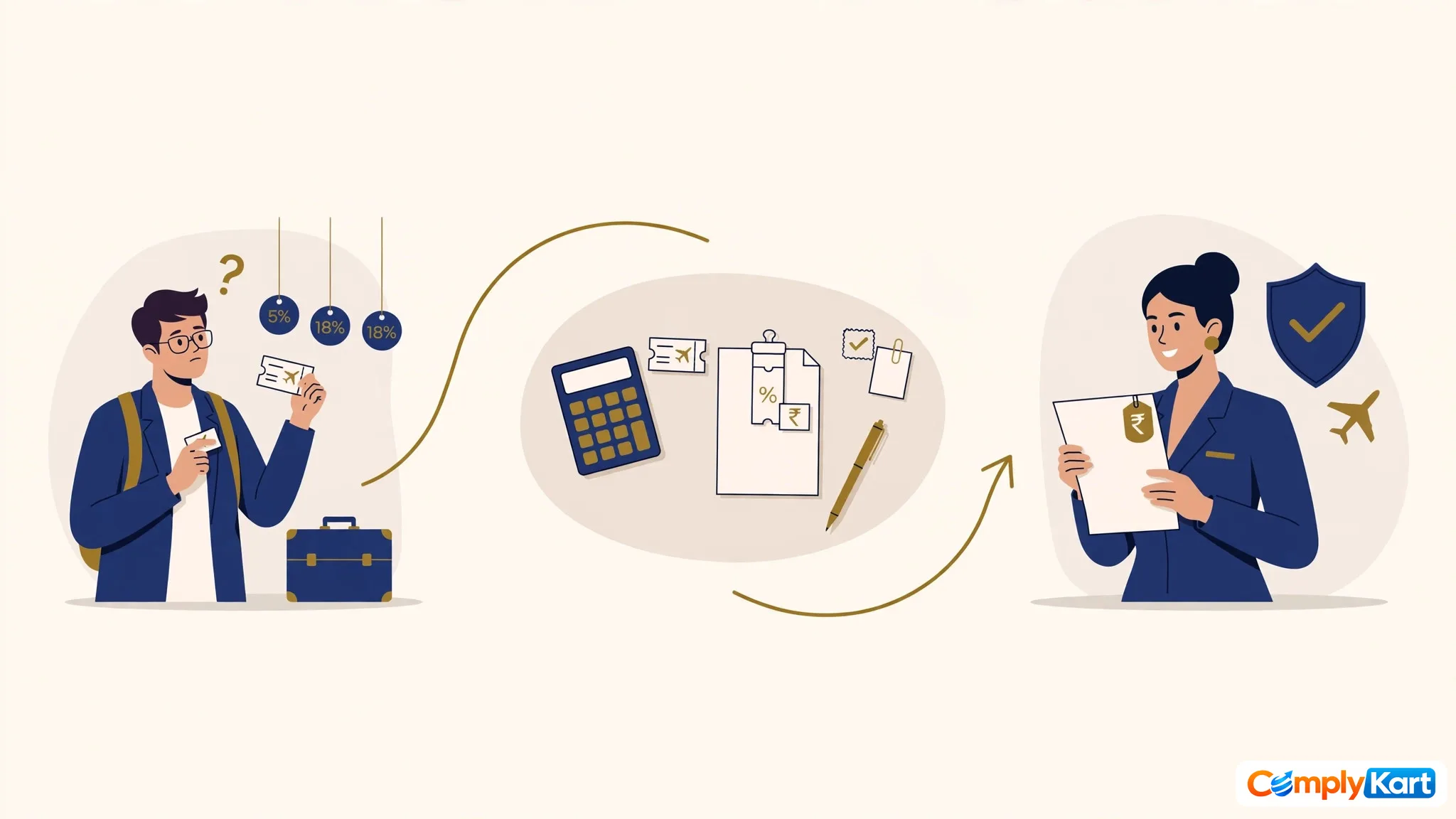
GST on flight tickets is the Goods and Services Tax charged on passenger air transport in India under SAC 996425: 5% on economy class since 1 July 2017 and 18% on premium economy, business and first class since 22 September 2025. The rate follows the class of travel, applies to the base fare plus fuel surcharge, and is set by Notification 11/2017-Central Tax (Rate) as amended by Notification 15/2025-Central Tax (Rate).
Economy class carries 5% GST. Every other cabin — premium economy, business and first — carries 18% since 22 September 2025. The tax falls on the base fare plus the fuel surcharge, not the airport levies, and the rate follows the class you fly. If you book travel for a business, that GST is usually recoverable — including the 5% on economy, despite what half the internet says.
What is the GST rate on flight tickets in India?
Two rates, and the class of travel decides which one applies. The entry sits in the rate notification under SAC 996425, scheduled passenger air transport.
| Class of travel | GST rate | Since | Notification |
|---|---|---|---|
| Economy | 5% | 1 July 2017 | 11/2017-Central Tax (Rate), entry 8(iii) |
| Premium economy, business, first | 18% | 22 September 2025 | 15/2025-Central Tax (Rate), entry 8(v) |
Before 22 September 2025 the premium cabins were taxed at 12%. The 56th GST Council meeting on 3 September 2025 folded the old 12% slab into the new two-rate structure of 5% and 18%, and premium air travel landed in the higher slab. IATA called the move disappointing the next day. The economy rate has sat at 5% since GST began.
What changed on 22 September 2025 — and what did not
Three things changed. First, the rate on every non-economy cabin rose from 12% to 18%. Second, the old 12% slab itself disappeared from the rate structure, so there is no middle rate left to fall back to. Third, the change applies to bookings made on or after 22 September 2025, not to travel on or after that date. The rate follows the time of supply — broadly, the booking and payment date. Book and pay for a business-class ticket before 22 September, and the old 12% applies even if you fly in December. Book after, and it is 18%.
What did not change: the economy rate, the SAC code, the way the tax base is worked out, and the exemption for economy flights to and from airports in the North-Eastern states and Bagdogra, which still carry no GST.
What is GST actually charged on?
Not the full ticket price. GST is charged on the base fare plus the fuel surcharge. The airport levies on the same invoice — passenger service fee, user development fee, aviation security fee — carry no GST; they are collected for the airport, not charged for the flight.
Take a Delhi–Mumbai economy ticket. Base fare ₹5,000, fuel surcharge ₹800. The taxable value is ₹5,800, and 5% of that is ₹290. The same route in business class: base fare ₹18,000, fuel surcharge ₹1,200, taxable value ₹19,200, and 18% of that is ₹3,456. The airport levies sit outside both calculations. If the GST line on your invoice is worked out on a bigger number, something is off — usually the airline charging GST on a levy, or an agent charging GST on the whole fare instead of its own fee.
Can your business claim ITC on flight tickets?
Yes. This is the point most guides get wrong, so let me be plain about it.
A GST-registered business can claim input tax credit on the GST charged in a flight invoice for business travel — at 5% on economy and at 18% on the premium cabins — provided the company's GSTIN is on the invoice and the travel is genuinely for business. The condition that sits inside the 5% economy entry binds the airline, not you. An airline charging 5% on economy fares can take credit only on input services in the same line of business. That is the airline's restriction. It does not travel down the invoice to the buyer.
Think of it the way you would a restaurant. A restaurant cannot claim GST on its own cooking gas, but that does not stop you claiming the GST on the meal you bought from it. The supplier's restriction and the buyer's credit are two different things, and several well-read guides mix them up. Kanakkupillai and Bajaj Finserv both print that no ITC is available on economy tickets. TraCarta and HappyFares print the correct position. The law sits with the second pair.
Two conditions, and both are practical. First, the GSTIN has to be on the invoice at the time of booking. Airlines generally do not reissue a tax invoice after travel, so a frequent flyer who books twenty trips a year without the company GSTIN on them has thrown away real money. Twenty economy trips at ₹290 of GST each is ₹5,800 of credit left on the table. Second, the travel has to be business travel. Section 17(5) blocks credit on travel benefits given to employees for personal reasons — leave travel concession and holiday trips sit in that blocked list. A client meeting in Bengaluru is business travel. A family holiday booked through the office is not, and no invoice wording fixes that.
One more place this matters: the annual return. Flight GST claimed through the year lands in the ITC reconciliation of GSTR-9, and a missing GSTIN on a batch of invoices shows up there as credit you never took. If your GSTR-9 reconciliation keeps throwing up small unexplained gaps, check the travel invoices first.
Are international flights zero-rated under GST?
No — not in the way several blogs claim. This is the second point worth correcting, because the wrong answer costs either the traveller or the airline.
An international ticket is not automatically an export of services. Export needs the place of supply to be outside India. For passenger transport, section 13(10) of the IGST Act fixes the place of supply where the passenger embarks. A flight leaving Delhi for Dubai embarks in Delhi, so the place of supply is India, and GST applies at the cabin rate — 5% on economy, 18% on the premium cabins — exactly as it would on a Delhi–Mumbai flight.
The Authority for Advance Rulings in West Bengal confirmed the rule in the Biman Bangladesh Airlines case. A passenger boarding in Dhaka and flying to Kolkata embarks outside India, so the place of supply is outside India and Indian GST does not apply.
So: a ticket sold and ticketed outside India for a journey that starts outside India — the trade calls these SOTO tickets — carries no Indian GST. A ticket for a journey that starts in India carries GST at the cabin rate, wherever it lands. The pages that state flatly that international flights are zero-rated are wrong, and a business that plans its travel budget on that reading will find the GST on the invoice anyway.
What GST does a travel agent pay?
Here the answer splits three ways, and the split is where agents lose money — either by paying tax on the full fare, which they should never do, or by charging the client tax they should not have charged.
The ticket itself is the airline's supply. The GST on the fare — 5% or 18% by cabin — belongs to the airline, and it is charged on the airline's invoice. The agent does not add GST to the fare again.
The agent's own earning is taxed at 18%. An agent has two ways to work out the value. The first is the special valuation in Rule 32(3) of the CGST Rules: the value of the agent's service is deemed to be 5% of the basic fare for domestic bookings and 10% for international bookings, and 18% GST applies to that deemed value. On a domestic ticket with a basic fare of ₹10,000, the deemed value is ₹500 and the GST is ₹90 — an effective 0.9% of the fare. On an international ticket with a basic fare of ₹60,000, the deemed value is ₹6,000 and the GST is ₹1,080 — 1.8% effective. The second way is simpler: charge 18% on the actual commission or service fee, under SAC 998551. The agent picks one route per transaction. What the agent must not do is charge 18% on the full ticket value. That is the mistake the old TAAI complaints were about, and it still shows up on invoices.
Online platforms are the same, with one extra line. An OTA's convenience fee is a separate service, taxed at 18% under SAC 998551. The flight component keeps the cabin rate. So a booking through an app shows two GST lines: the airline's 5% or 18% on the fare, and the platform's 18% on its fee. Both are claimable by a business traveller whose GSTIN is on the invoices.
Tour operators are a different supply. A bundled package — flights, hotel, sightseeing sold at one price by the operator as principal — is taxed at 5% without ITC under SAC 998555, or at 18% with ITC if the operator chooses the credit route. An agent who only books a single service for a client and charges a fee is not a tour operator, and the 5% package rate does not apply to that booking.
And the registration line: an agent whose commission crosses ₹20 lakh in a year — ₹10 lakh in the special-category states — has to register. Before you register, it is worth working out what registration and filing will cost, which is what the compliance fee calculator is for. Agents selling tickets for clients in several states should also read the multistate registration guide, because one registration does not cover every state you operate in. GST registration for an agent is usually straightforward; the expensive part is getting the invoicing wrong afterwards.
What GST applies when you cancel a flight?
The cancellation charge takes the ticket's own rate. CBIC settled this in Circular 178/10/2022-GST, dated 3 August 2022: a cancellation fee is consideration for allowing the cancellation, which is part of the booked service, so it is taxed at the same rate as the service itself — 5% for an economy ticket, 18% for a premium cabin. A no-show is treated the same way: a forfeited non-refundable fare is taxed like the ticket it came from.
In practice the rule has been misapplied for years. In September 2022 the Travel Agents Association of India wrote to the airlines and the ministries pointing out that cancellation and change fees — the K3 charges — were being billed at 18% on economy tickets, where 5% applied. That letter is four years old and the error still turns up. If your cancellation invoice shows 18% on an economy ticket, the rate is wrong, and the excess comes back through a credit note from the airline. Where tax was genuinely paid in excess and a credit note does not settle it, the GST refund route is the formal way to claim it back.
The frequent-flyer checklist
Most of the money here is lost in small, repeated omissions. Four habits cover nearly all of it.
Put the GSTIN on the booking, every time. Add it at the time of booking, not after travel. Airlines do not reissue tax invoices for past trips, and the credit is lost with the invoice. If you travel for work, make the GSTIN part of your traveller profile on every app and with every agent you use.
Watch the upgrade. An upgrade from economy to business changes the rate on the amount you pay for it. The upgrade fare is a business-class fare, and it carries 18%. A traveller who upgrades at the airport and expenses the receipt without checking will find the GST line higher than the 5% they expected. It is correct. The class you fly decides the rate.
Award tickets still carry tax. A ticket bought with miles has little or no base fare, but the taxes and surcharges on it are still payable. Check the breakup rather than assuming a zero-fare ticket means a zero-tax ticket.
Remember the North-East exemption. Economy flights to or from airports in the North-Eastern states and Bagdogra carry no GST. If an invoice on one of those routes shows 5%, it is wrong — and it is the kind of small error that repeats across a whole team's travel.
Five mistakes that cost real money
- Booking business travel without the GSTIN on the invoice. The credit is gone the moment the trip is flown. Fix the traveller profile once, and it stops happening.
- Believing economy tickets carry no ITC. The airline's restriction is not your restriction. A business can claim the 5% GST on an economy invoice for business travel.
- Treating an international ticket as zero-rated. A flight leaving India carries GST at the cabin rate. Only a journey embarking abroad escapes it.
- An agent charging GST on the full fare. The agent's tax is 18% on the commission or on the Rule 32(3) deemed value — 0.9% effective on a domestic ticket — not on the fare the airline already taxed.
- Paying 18% on an economy cancellation. The cancellation charge takes the ticket's rate. Check the K3 line on every cancellation invoice.
Frequently asked questions
What is the GST rate on flight tickets in India?
Economy class carries 5% GST and premium economy, business and first class carry 18% since 22 September 2025. The tax is charged on the base fare plus the fuel surcharge, under SAC 996425.
Can I claim ITC on flight tickets?
Yes, if you are GST-registered and the travel is for business. The GST in the ticket invoice is claimable at both 5% and 18%, provided your GSTIN is on the invoice. The no-ITC condition in the 5% entry applies to the airline's own input credit, not to yours. Personal or holiday travel does not qualify.
Is GST charged on international flight tickets?
Yes, on flights departing India — 5% on economy and 18% on other classes, the same as domestic. The place of supply is where the passenger embarks, so only tickets for journeys starting outside India escape Indian GST.
What GST does a travel agent charge on air tickets?
Either 18% on the actual commission or service fee, or 18% on a deemed value of 5% of the basic fare for domestic bookings and 10% for international bookings under Rule 32(3). The second route works out to 0.9% of a domestic fare and 1.8% of an international fare.
Is GST charged on flight cancellation charges?
Yes, at the ticket's own rate — 5% for economy and 18% for premium cabins — under CBIC Circular 178/10/2022-GST. If an economy cancellation invoice shows 18%, the rate is wrong.
Does GST apply to the full ticket price?
No. GST applies to the base fare plus the fuel surcharge. Airport levies such as the passenger service fee and user development fee carry no GST.
The rate on a flight ticket is decided by the cabin, the date you booked, and where you boarded — three facts you can check on any invoice in a minute. Check the GSTIN before you fly, check the rate on the cancellation line after you cancel, and check the agent's fee line before you pay it. The same 5%-versus-18% logic runs through other parts of GST too. If your travel billing keeps throwing up wrong rates, that is usually a process problem rather than a tax problem — and it is cheaper to fix the process than to keep paying the tax.




Comments
No comments yet — ask the first question below.
Join the discussion
Questions go straight to our expert desk. Comments appear after a quick review — no spam, no noise.