
ESIC Registration, Login & Online Payment: The Complete Employer Guide
Your tenth hire just joined. Congratulations — and welcome to ESIC. The moment headcount touches ten, the Employees' State Insurance Act, 1948 starts applying to your establishment, and the clock starts on registration, contributions, and deadlines that don't forgive forgetfulness. Here's the whole thing, the way I'd explain it to a founder hiring their first HR person. (Setting up the company itself? Our Pvt Ltd registration cost guide covers what that involves.)
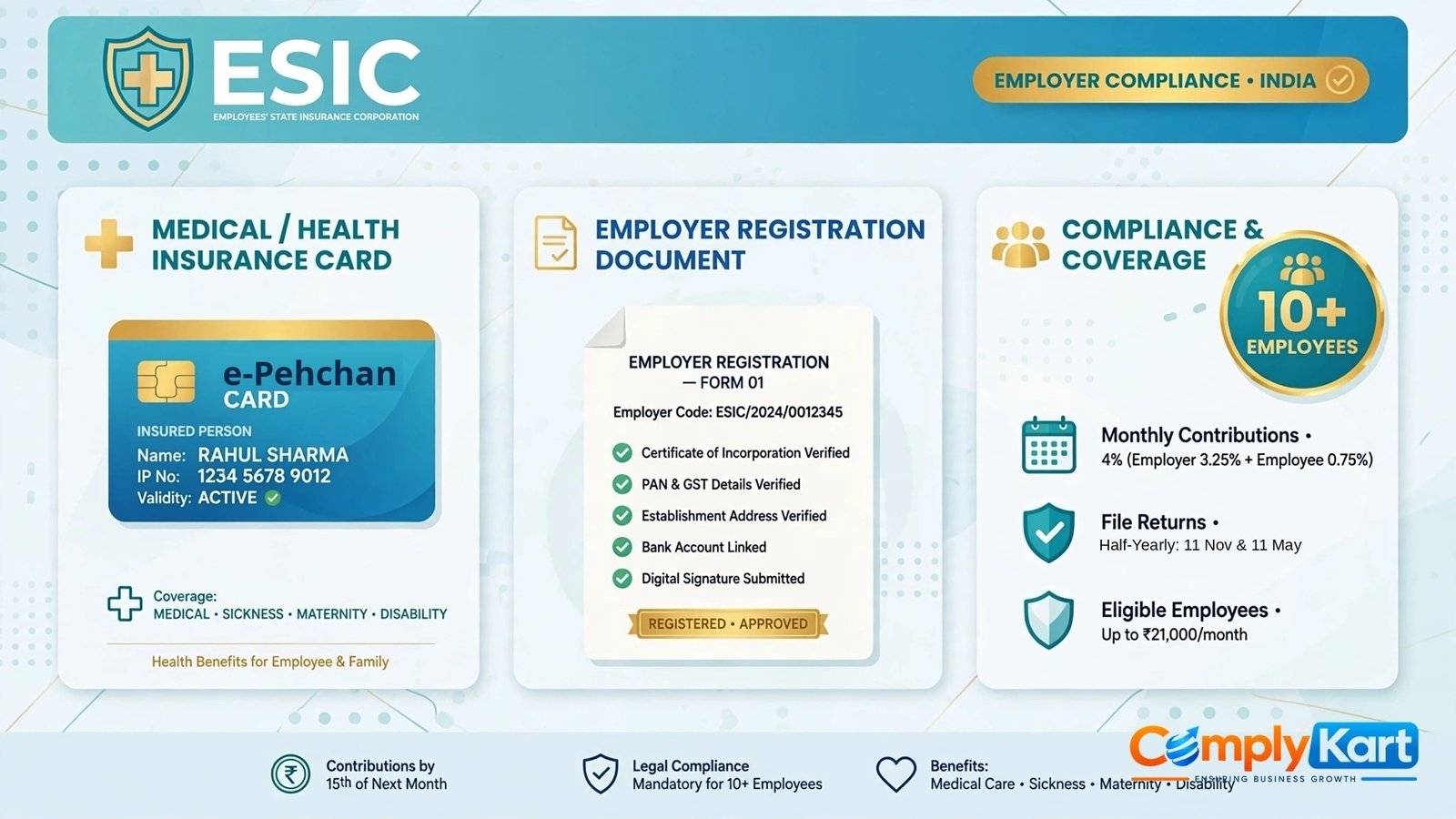
The short answer: Establishments with 10 or more employees must register on the ESIC employer portal and contribute 4% of gross wages every month — 3.25% from the employer, 0.75% deducted from the employee — for staff earning up to ₹21,000 a month. Payment is due by the 15th of the following month; delay attracts 12% annual interest plus damages of 5–25%.
Who has to register for ESIC?
The trigger is headcount: 10 or more employees (20 in some states, so check your state's position). It covers factories, shops, hotels, restaurants, transport firms, IT companies, hospitals and educational institutions. Contract workers count toward the threshold too — which is where many growing companies get caught. (The test applies whether you're a private limited company or an LLP.)
Registration must happen within 15 days of crossing the threshold. Not "when convenient." The Corporation can recover contributions from the date the Act first applied to you — not the date you finally registered — with interest and damages stacked on the entire back period. I've seen that arithmetic ruin a quarter. Our 90-day post-incorporation checklist keeps the first year's filings in order.
Who does ESIC cover — and what's the ₹21,000 ceiling?
ESIC applies to employees earning gross wages up to ₹21,000 a month (₹25,000 for employees with disabilities). Gross means gross — basic, DA, HRA and allowances, not just basic salary. Calculating contributions on basic alone is the single most common and most expensive mistake employers make.
If an employee's daily average wage is ₹176 or less, they're exempt from the employee contribution — but the employer still pays their 3.25%. And if someone crosses ₹21,000 mid-way through a contribution period (April–September or October–March), they stay covered till the period ends.
How much do you actually pay?
The math is simple once the wage base is right: 3.25% employer + 0.75% employee = 4% of gross wages, per covered employee, every month. At the ₹21,000 ceiling, that's ₹683 from the employer and ₹158 from the employee — ₹841 total per person at the top of the band.
The employee's share is deducted from salary like PF; the employer's share comes from the company's pocket. Both land in one monthly challan. Want the full year's compliance cost in one number? Our compliance fee calculator estimates it in under a minute.
Think of ESIC like a housing society's shared fund — everyone pays a small fixed share into one pool, and anyone who needs hospital care draws from it. You don't pay per illness; you pay for the safety net.
How do you register on the ESIC portal?
Everything happens on the ESIC employer portal at esic.gov.in (the employer login section). The flow, in order:
One: sign up as an employer — PAN, address, nature of business, bank details. Keep your GST certificate and cancelled cheque handy; the portal cross-verifies before issuing your code.
Two: complete the employer registration (Form 1 online). On verification you get your 17-digit employer code — your ESIC identity. Quote it on every challan and return.
Three: register each eligible employee and generate their IP (Insurance Person) number — within days of joining, not at month-end. A missing IP number means a missing contribution.
Four: set a monthly rhythm — compute, challan, pay, file the half-yearly return (payment and returns covered separately below).
How do you pay the monthly ESIC contribution online?
Contributions for a month are due by the 15th of the following month — January's land by 15 February. No grace period you should rely on.
On the portal: log in, go to monthly contributions, enter or upload the wage data, verify the computed amounts, generate the challan, and pay via net banking or UPI. Save the paid challan — it's your proof of deposit and the first thing asked for in an inspection.
Miss the 15th and two things start running: interest at 12% per annum on the delayed amount, and damages of 5% to 25% depending on how long the default continues. Repeated defaults can lead to prosecution — that isn't theoretical in ESIC enforcement.
Returns: the half-yearly filing most people forget
Payment is monthly; returns are half-yearly. The contribution periods are April–September and October–March, and returns are due 11 November and 11 May respectively. It reconciles monthly payments against employee-wise wage data — file it even when nothing changed; a missing return is its own default.
Five mistakes that cost employers real money
One: calculating on basic instead of gross. ESIC is on gross wages. Basic-only calculation means systematic underpayment — and the shortfall comes with interest and damages for the whole period.
Two: stopping deductions at ₹21,000 mid-period. The employee stays covered till the contribution period ends — stopping early creates a gap the Corporation will bill you for later.
Three: excluding overtime and allowances. If it's wages, it's in the base — overtime, incentives and most allowances count toward gross wages.
Four: registering employees late. Every month an eligible employee goes unregistered is a month of unpaid contributions — recoverable backwards with interest and damages.
Five: treating the 15th as flexible. It isn't. Set payment for the 10th in your internal calendar and give yourself a buffer. The employers who never pay ESIC penalties never flirt with the deadline.
ESIC employer guide: quick answers
Is ESIC mandatory for a company with 10 employees?
Yes — 10 or more employees, including contract workers, triggers mandatory registration within 15 days in most states. Some set the bar at 20, so confirm your state's position. (LLP founders: our LLP registration guide covers the entity side.)
What is the current ESIC contribution rate?
4% of gross wages in total: 3.25% paid by the employer and 0.75% deducted from the employee, for staff earning up to ₹21,000 a month (₹25,000 for employees with disabilities).
What is the due date for ESIC payment?
The 15th of the following month. Delay attracts 12% annual interest plus damages of 5–25% of the delayed amount.
Do I need to file ESIC returns if I paid every month?
Yes. Monthly payment and half-yearly returns are separate obligations — due 11 November and 11 May respectively.
What is an IP number in ESIC?
The Insurance Person number — a unique ID generated for each covered employee at registration. Contributions and benefits are tracked against it, so generate it within days of the employee joining.
ESIC rewards routine and punishes improvisation: ten minutes of payroll discipline a month, a calendar reminder for the 15th, and returns filed on time. That's the whole game — and if setting all of it up correctly from day one sounds like time better spent running your business, that's exactly what our team handles.




Comments
No comments yet — ask the first question below.
Join the discussion
Questions go straight to our expert desk. Comments appear after a quick review — no spam, no noise.