
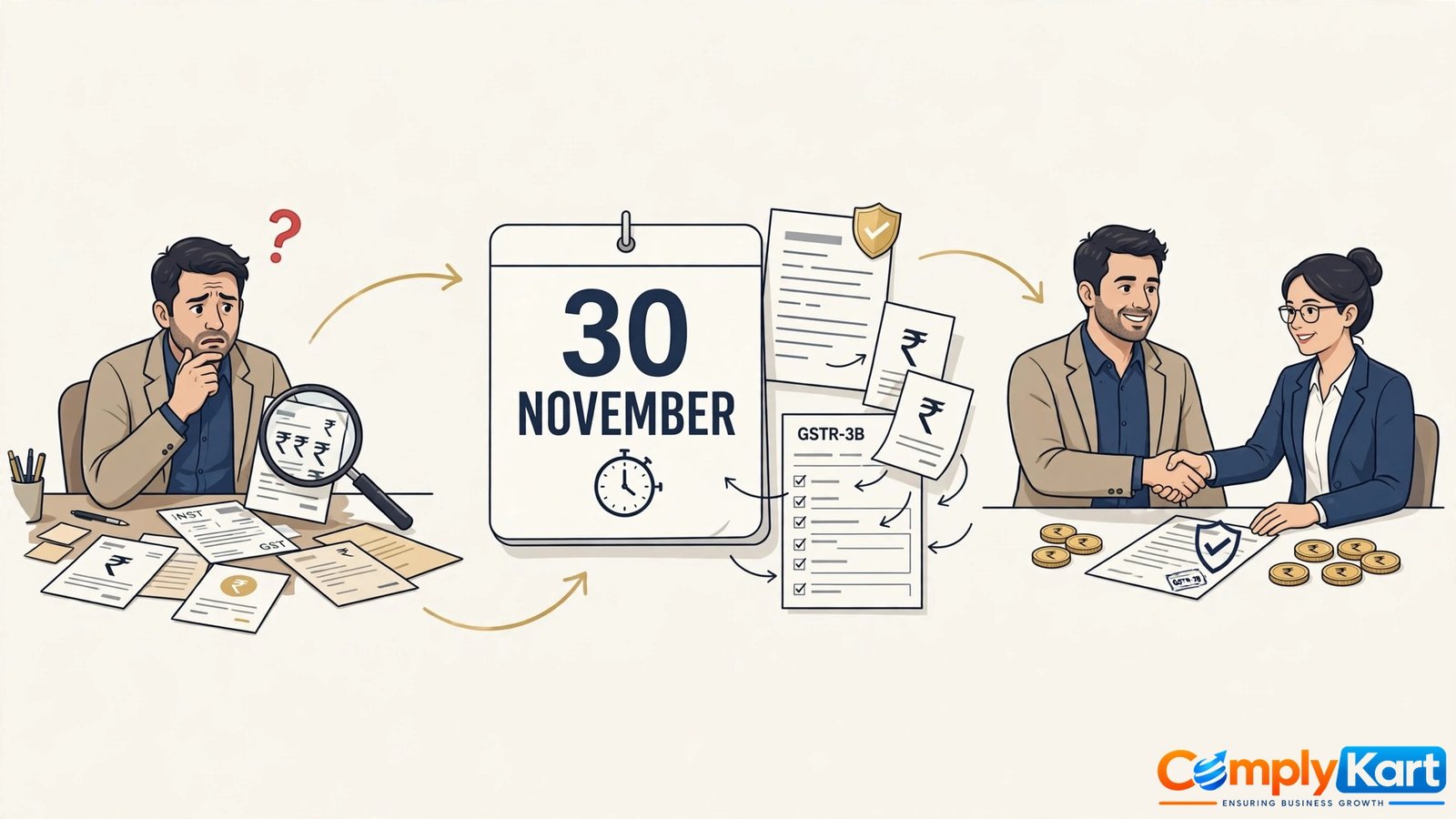
Somewhere in your purchase register sits an invoice from March 2026 whose GST your business paid to the supplier but never claimed back. Right now, that credit is recoverable. After 30 November 2026, it becomes a permanent cost — real money your business paid and will never see again. Section 16(4) doesn't negotiate.
The short answer: Under Section 16(4) of the CGST Act, input tax credit on invoices of FY 2025-26 must be claimed by 30 November 2026 or the date you file GSTR-9 for the year, whichever is earlier. In practice, that means claiming it in the GSTR-3B for October 2026, due 20 November 2026. After the deadline, the credit lapses permanently — no condonation, no appeal.
Why is "whichever is earlier" a trap?
Read the rule carefully: 30 November 2026 or the date of filing GSTR-9, whichever comes first. File your annual return early — say, mid-October — and you've just moved your own ITC deadline forward to mid-October. Any FY 2025-26 credit you hadn't claimed by then is gone.
This is the single most expensive sequencing mistake in GST compliance. Do not file GSTR-9 until your ITC reconciliation is fully complete. The annual return feels like the finish line; for ITC purposes, it's a door closing. (Filing GSTR-9 early also affects the reconciliation statement — see our GSTR-9C guide for the ₹5 crore-plus compliance picture.)
Is the September ITC deadline still valid?
If your team is still working to a "September return" cut-off, update the playbook. Since October 2022, the deadline moved from the September return to 30 November. Teams running on the old date are giving away two months of claim window — and worse, may be writing off live credit as dead. The law changed; make sure the process did.
Your six-week action checklist
One: pull every purchase invoice for FY 2025-26 and match it against GSTR-2B. Credit appears in 2B but was never claimed in any GSTR-3B? That's your recovery list. Two: chase suppliers whose invoices are in your books but missing from 2B — an invoice the supplier never reported can't be claimed until they report it, and the clock is ticking for them too.
Three: check the 180-day payment rule. If you haven't paid a supplier within 180 days of the invoice, the ITC must be reversed with interest — but it can be reclaimed on payment, and reclaimed credit sits outside the 16(4) time-bar. Four: review debit notes and credit notes for the year; missed debit notes are missed credit.
Five: file any pending GSTR-3B corrections before October-end (our GST return filing guide walks through the correction mechanics) so the October return — your last real claim vehicle — has a clean base. Six: hold GSTR-9 until every legitimate claim is in. Then file it.
Don't forget debit notes. A debit note issued by your supplier — for a price increase, say — carries additional ITC, and missed debit notes are missed credit exactly like missed invoices. Credit notes work the other way: they reduce your claim, and unrecorded credit notes are the mismatch the department's analytics flag first.
What does the department actually check? The 2B-vs-3B match, primarily — credit claimed in GSTR-3B that never appeared in GSTR-2B is the first thing system queries pick up. Then the 180-day payment ageing, then HSN consistency. Your reconciliation should answer all three before the officer asks.
How do you get suppliers to actually file?
The reconciliation tells you which credits are stuck; getting them unstuck is a people problem. Work the escalation ladder. Start with a direct reminder to the supplier's accounts team — most delays are forgetfulness, not malice, and a specific invoice number gets faster action than a vague "please file your returns."
No response in a week? Escalate formally: a written request citing the invoice, the 2B gap, and the November deadline, copied to the supplier's finance head. Still nothing? Use your commercial weight — hold the next payment or the next order until the filing is done. Suppliers respond to cash flow faster than to courtesy.
And know your fallback. If a supplier genuinely can't or won't file, the ITC isn't claimable — but recognising that now, in October, lets you plan around it instead of discovering it on 29 November. A credit you write off deliberately in October is a business decision. The same credit discovered dead in December is a failure of process.
What lapses, exactly?
First-time claims. That's the boundary. Credit you've already claimed and later reversed — say, under the 180-day rule — can be reclaimed on payment without the November guillotine hanging over it. But an invoice you simply never got around to claiming? After 30 November 2026, it's gone, and it goes to your profit and loss as an irrecoverable cost. Every year, businesses lose serious money this way — not through disputes or demands, but through inattention.
ITC deadline: quick answers
What happens if I miss the 30 November ITC deadline?
The credit lapses permanently. An invoice you never got around to claiming becomes an irrecoverable cost in your profit and loss — no condonation, no appeal, no "we'll fix it in the annual return." Every year, businesses lose serious money this way — not through disputes or demands, but through inattention.
I'm not GST-registered yet — does the ITC deadline apply to me?
No. Input tax credit only exists for registered taxpayers — you can't claim credit on purchases made before registration. If your turnover is approaching the threshold, get GST registration sorted first; the ITC clock only starts ticking once you're in the system.
Does filing GSTR-9 early really kill my ITC?
Yes — that's the "whichever is earlier" trap in Section 16(4). File your annual return in mid-October and your ITC deadline for the year moves forward to mid-October. Any FY 2025-26 credit unclaimed by then is gone. Finish the reconciliation first, then file.
What about ITC I reversed under the 180-day rule?
That's the boundary that saves you: credit already claimed and later reversed for non-payment within 180 days can be reclaimed on actual payment — and reclaimed credit sits outside the 30 November time-bar. What lapses is only the first-time claim you never made.
Six weeks, one reconciliation, one return filed in the right order. If you want to put a rupee figure on what inattention costs, the compliance fee calculator makes the arithmetic concrete. Run the checklist now, while there's still time to chase a supplier and fix a mismatch — our team does these ITC recovery reviews every October and November, and there's always credit hiding in the unreconciled pile.


Comments
No comments yet — ask the first question below.
Join the discussion
Questions go straight to our expert desk. Comments appear after a quick review — no spam, no noise.