
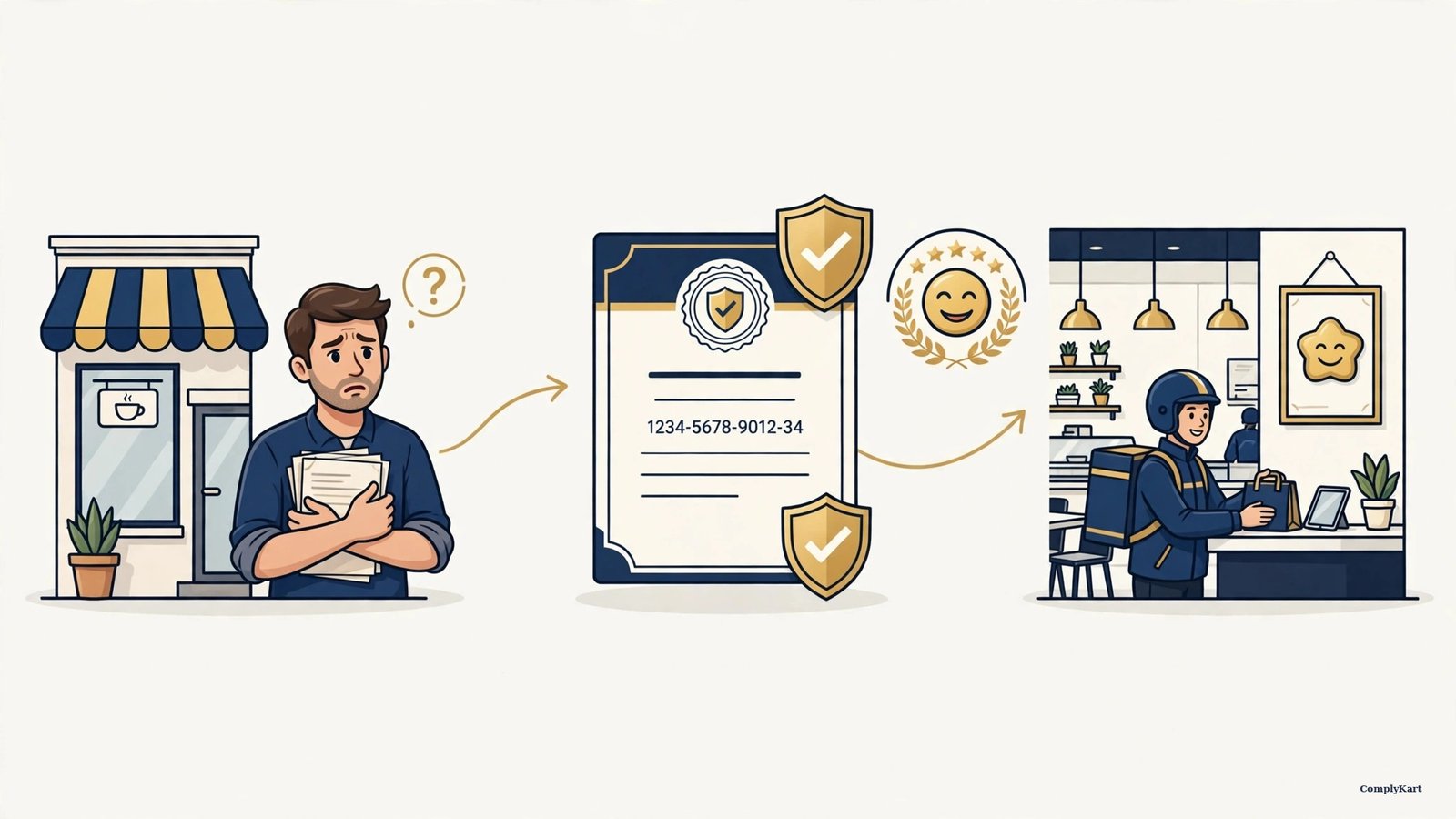
Before the first plate leaves your kitchen, one number has to be on your wall: a 14-digit FSSAI number — on your board, your menu, and your bills. The rules for who needs which tier changed on 1 April 2026, and old blog posts will mislead you.
Which FSSAI category does your restaurant fall into?
FSSAI classifies restaurants by annual turnover, not seating capacity (FoSCoS eligibility document, updated 1 April 2026):
- Up to ₹1.5 crore → Registration (Form A). Most single-outlet cafés and neighbourhood restaurants. ₹100 a year.
- ₹1.5–₹50 crore → State Licence (Form B). Established restaurants and small chains. ₹5,000 a year.
- Above ₹50 crore → Central Licence (Form B). Large national chains. ₹7,500 a year.
Two exceptions. Hotels go by star rating: five-star and above need a Central licence, up to four-star a State licence. And turnover is not the only trigger — importing speciality ingredients, for instance, can pull you into a higher category. Near a boundary? Check the FoSCoS matrix before applying; the wrong tier is the most common reason applications get bounced. Outlets in more than one state need coverage in each state — read how a State licence works before signing the second lease.
What does it cost, really?
The fee is the smallest line item. Around it sit water testing, one FOSTAC-trained supervisor, and — if you would rather not wrestle FoSCoS forms — a few thousand rupees for professional help.
New since 2026: because licences are perpetual, you can pay the annual fee for several years in advance, any time during the year. Paying three years of a ₹5,000 fee in one go and forgetting about it suits restaurant budgeting. Run the numbers alongside your other annual compliances so nothing ambushes you in March.
Do you still need to renew your licence every year?
No — and most owners have not heard this yet. The old system was a newspaper subscription: stop renewing and it lapsed. The new system is a club membership that never expires; you just keep paying annual dues. The licence stays valid unless suspended, cancelled, or surrendered. But perpetual is not free: an unpaid licence can be suspended.
Two things still need action on FoSCoS. Any material change — new address, new name, different business type — needs a modification application. And if you hold a pre-April-2026 licence, migrate it to the new categories: FSSAI's 27 March 2026 FAQ says migration is a self-declaration, your number stays the same, and there is no modification fee. Do not pay anyone a "migration charge" — there isn't one.
What is the hygiene rating, and should you bother?
FSSAI's voluntary scorecard for businesses serving consumers directly. An FSSAI-recognised audit agency inspects your outlet unannounced and awards one to five smileys: 81–100 Excellent, 61–80 Very Good, 41–60 Fair. Below 41 is a fail — no display. The certificate lasts a year and hangs where customers see it.
Voluntary, but the direction is clear: state authorities have pushed delivery aggregators to display ratings and favour outlets rated three and above. A four- or five-smiley certificate on your door costs less than a hoarding and says more. The checklist rewards basics — cleanable surfaces, non-slip flooring, personal hygiene, trained staff.
The staffing rule almost every small restaurant breaks
FOSTAC requires at least one trained, certified Food Safety Supervisor for every 25 food handlers — or part thereof. Twenty-six people on the floor means two supervisors, not one. The certificate goes in your FoSCoS record; inspectors ask for it.
Cheapest compliance on this page, most skipped. A course runs a day. Compare with Section 63 of the Food Safety and Standards Act, 2006: no licence can mean up to ₹5 lakh in fines and six months' imprisonment. Training is not the line to economise on.
What FoSCoS asks for, and the mismatch that stalls files
Form A for registration, Form B for licences, all on the FoSCoS portal. Keep ready: ID and address proof of proprietor/partners/directors; premises proof (rent agreement or ownership papers, plus the owner's NOC if rented); your menu or food-item list; partnership deed or incorporation certificate; a water testing report (several states ask); and your FOSTAC supervisor's details.
The real file-staller: names and addresses must match your GST registration and municipal trade licence exactly. Officers cross-check, and so do Zomato and Swiggy during onboarding. GST registration is a separate track with separate thresholds — the ₹1.5 crore FSSAI line has nothing to do with GST limits. Your Shops & Establishment registration is yet another separate requirement.
Five mistakes restaurant owners keep making
- Quoting the old thresholds. ₹12 lakh and ₹20 crore died on 1 April 2026. The lines are ₹1.5 crore and ₹50 crore now.
- One licence for the whole chain. A licence attaches to the premises — every outlet needs its own, the dine-in version of the rule we covered for cloud kitchens.
- No trained supervisor. One certified supervisor per 25 food handlers. Twenty-six handlers, two supervisors.
- Ignoring the annual fee. Renewals are gone; dues are not. Unpaid fees mean a suspended licence.
- Protecting everything except the name. Lakhs on interiors, years on an unregistered brand name. File the trademark before the second outlet, not after the first copycat. Still fuzzy on the tiers? Our registration-versus-licence explainer lays them out.
What to do this week
Total the last twelve months of food turnover and find your band. On FoSCoS, apply fresh or migrate your existing licence — migration keeps your number and costs nothing. Get one supervisor FOSTAC-trained. Put the 14-digit number on your board, menu, and bills. Want the smiley on the door? Book a hygiene-rating audit.
Frequently asked questions
I hold a State licence from 2024. Apply again?
No — migrate. Self-declare the new category on FoSCoS; your number stays unchanged and there is no modification fee. Apply fresh only if your facts changed: new address, new entity, new business type.
My café does ₹90 lakh a year. Registration or licence?
Registration — the line is ₹1.5 crore now, at ₹100 a year. It covers food safety only; you still need GST registration past GST thresholds and a municipal trade licence.
Is the hygiene rating mandatory?
No, voluntary. But it is a public scorecard, and aggregators increasingly surface it. A 4 or 5 rating is cheap, visible trust.
How long does FoSCoS approval take?
Registration is often days, with no pre-inspection. Licences take weeks and may include a premises inspection. Matching names and addresses across FSSAI, GST, and trade licence avoids the most common delay.
Does the FSSAI licence cover my bar?
Food only. Liquor needs a separate state bar/excise licence. Run both in parallel.
One licence for my restaurant plus cloud-kitchen brands from the same kitchen?
The licence attaches to the premises and activity there. Virtual brands from the same licensed kitchen share its number; a separate dine-in address needs its own. Doing both? Read our cloud-kitchen guide alongside this one.


Comments
No comments yet — ask the first question below.
Join the discussion
Questions go straight to our expert desk. Comments appear after a quick review — no spam, no noise.