
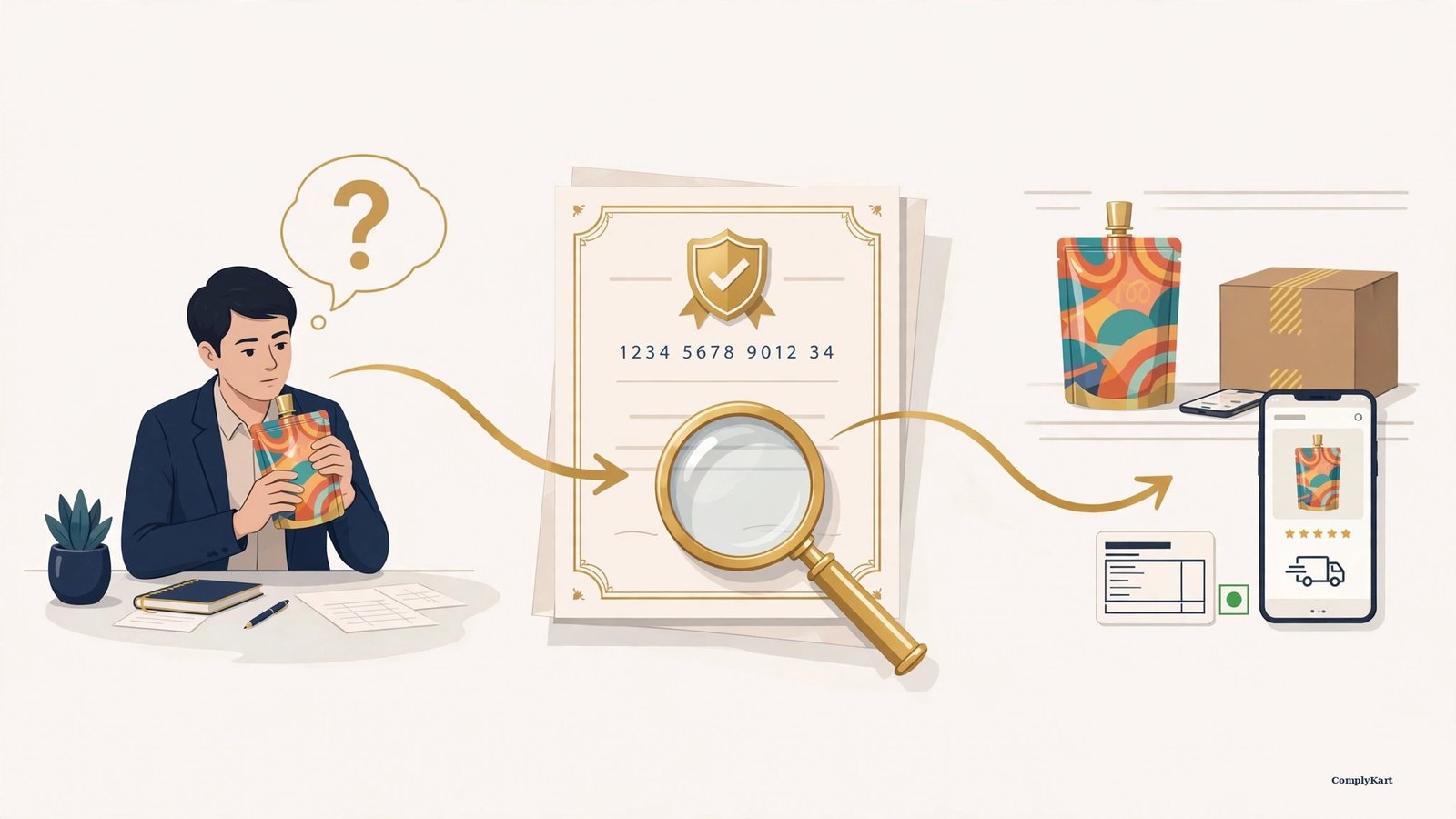
Your recipe is final. The co-packer has signed. The pouches look beautiful — and then your Amazon seller application asks for your FSSAI license number, and your co-packer says, "Don't worry, we already have one." A co-packer's license covers their factory, not your brand. If your name is on the pack, FSSAI wants your name on a license too.
The short answer: A packaged food brand owner is a "deemed manufacturer" (relabeller) under FSSAI — you need your own license, Central if you sell across states. It costs ₹7,500 + GST a year, stays valid for 1–5 years, and a clean FoSCoS application usually comes through in four to six weeks. Your label must carry both your license number and your manufacturer's.
Why your co-packer's license does not cover you
Think of it like a wedding invitation. The banquet hall cooked the food, but your name is on the card. If a guest falls sick that night, nobody calls the hall first. They call you. FSSAI thinks the same way: the licensing regulations treat a brand owner who outsources production as a "relabeller" — a deemed manufacturer. You never touched the food, but your brand made the promise on the pack, so the liability sits with you. The gazette amendment says it plainly: a relabeller is a deemed manufacturer and shall obtain a license.
Practically: you apply under the "Relabeller" kind of business on FoSCoS, and the license is issued against your registered office address — not the factory, which holds its own.
Which license: Basic, State, or Central?
Three tiers, decided by turnover and geography. Up to ₹12 lakh turnover: Basic registration, ₹100 a year. Between ₹12 lakh and ₹20 crore: State license, ₹2,000–₹5,000 a year. Above ₹20 crore, or operating in more than one state: Central license, ₹7,500 + 18% GST a year.
Now the D2C catch. You sell on your website, Amazon, and quick commerce — so your product ships to customers in more than one state, which makes you a multi-state operator. One Central license for your head office covers it. (Our FSSAI Central license service handles the FoSCoS filing, documents and follow-ups end to end.)
The co-packer rules nobody tells you
FSSAI does not let you relabel just anything. Four conditions:
- Your manufacturer must already hold an FSSAI license for your product category. Selling protein bars? Their license must list that category — if not, they add it first, and only then can you add it to yours.
- You need a no-objection certificate from the manufacturer, on their letterhead, signed and stamped, with their license number attached.
- Your label must show both parties — your name, address and license number, and the manufacturer's, each preceded by its role ("manufactured by", "marketed by"). One side missing is a non-compliant label.
- You nominate a compliance officer — someone FSSAI can actually reach.
What it costs and how long it takes
The Central license fee is ₹7,500 + 18% GST per year of validity. Take the longest validity you can afford — it is one less renewal to track. Under FSSAI's current norm, you pay only ₹1,000 + GST when you apply, and the balance within 30 working days after approval. Miss that window and the approval is auto-rejected. Set a reminder.
Documents: company incorporation proof, PAN, directors' Aadhaar and address proof, registered-office address proof, the manufacturer's license copy, and the NOC. File on FoSCoS and wait — a clean application usually comes through in four to six weeks. The regulations allow deemed approval if the authority does not decide within 60 days of a complete application, but do not start selling before you hold the number: selling without any license invites fines up to ₹5 lakh and six months' imprisonment under Section 63 of the Food Safety and Standards Act, 2006.
Renewal has teeth. Renew from 180 days before expiry. Miss the 30-days-before-expiry filing and a ₹100-a-day late fee kicks in. File 1–90 days after expiry: three times the annual fee. After 90 days: five times. (Check the exact fee for your setup on our compliance fee calculator.)
Your label: the 15 things FSSAI requires
The Food Safety and Standards (Labelling and Display) Regulations, 2020 (notified 17 November 2020) list fifteen mandatory declarations for pre-packaged food. Miss one and the pack is non-compliant:
- Name of the food — the true nature of what is inside, on the front of the pack; full ingredient list in descending order of weight (single-ingredient products exempt).
- Nutrition panel — values per 100 g/ml and per serve, with % RDA per serve. The per-serve column is the one designers keep dropping. Keep it.
- Veg or non-veg mark (green circle / brown triangle in a square) and additives with class names and INS numbers.
- Names, addresses and FSSAI license numbers of the brand owner and of the manufacturer/marketer/packer if different — each preceded by its role ("manufactured by", "marketed by"). Plus the FSSAI logo. All of it on the pack.
- Net quantity, MRP, batch/lot number; date of manufacture and expiry/use-by — both compulsory ("best before" is optional extra, not a substitute).
- Allergen declaration — eight categories, written as "Contains …"; customer-care details, instructions for use where needed, and country of origin for imports.
Two quick clarifications. A QR code is not mandatory — FSSAI recommended it in October 2023 for accessibility, but it is not law. And there is still no front-of-pack warning-label rule in force; that question is before the Supreme Court.
Selling on marketplaces and quick commerce
Amazon, Flipkart, Blinkit, Zepto — every one of them asks for your FSSAI license number during seller onboarding and verifies it, checking the name and address against your GST records. Same spelling everywhere, or the verification stalls. You will also need GST registration for settlements, and get the brand name itself protected with a trademark registration — a D2C brand without a trademark is an invitation to copycats. (Weighing D2C against a cloud kitchen model? Our cloud kitchen FSSAI guide covers the kitchen side of the same rules.)
Frequently asked questions
Do I need an FSSAI license if I only sell on my own website?
Yes — your own website counts, and e-commerce entities conducting food business must hold a license.
My co-packer already has an FSSAI license. Why do I need my own?
Because FSSAI treats you as a deemed manufacturer. Your name is on the pack, so the license is yours — theirs covers their factory, not your brand.
Can one license cover all my products?
Yes, as long as your manufacturer is licensed for each product category. New products get added via a FoSCoS modification.
What if I switch manufacturers?
Get a fresh NOC, confirm their license covers your product category, and update your label with their details — before the first batch ships.
Is a QR code mandatory on food labels?
No. FSSAI recommended QR codes in October 2023 for accessibility; it remains a recommendation, not law.
What happens if I sell without an FSSAI license?
Section 63 of the Food Safety and Standards Act, 2006: fines up to ₹5 lakh and imprisonment up to six months. Marketplaces will delist you too.



Comments
No comments yet — ask the first question below.
Join the discussion
Questions go straight to our expert desk. Comments appear after a quick review — no spam, no noise.