
IN BRIEF
The GST composition scheme is an optional simplified levy under Section 10 of the CGST Act, 2017 for small taxpayers with aggregate turnover up to ₹1.5 crore. It charges a flat rate on turnover — 1% for traders and manufacturers, 5% for restaurants, 6% for eligible services — in exchange for giving up input tax credit and issuing bills of supply instead of tax invoices.
Short answer: The GST composition scheme lets small businesses pay tax at a flat rate on turnover — 1% for traders and manufacturers, 5% for restaurants, 6% for eligible service providers — instead of charging GST at normal rates. The catch is that you give up input tax credit entirely. For a business that buys a lot of taxed inputs, the credit surrendered can cost far more than the flat rate saves.
A trader I will call Ramesh sells hardware in Indore. His turnover is well under ₹1.5 crore, so composition looks made for him. His accountant ran the numbers and told him to stay regular. The 1% headline was the cheapest-sounding option on the page. It was also, for his business, the most expensive. This guide shows you how to run that same check for your own business, so you pick the scheme on maths instead of on the headline rate.
What the composition scheme actually is
Section 10 of the CGST Act, 2017 offers an optional, simplified levy for small taxpayers. Instead of charging GST on each sale at 5%, 12%, 18% or 28% and setting off the GST you paid on purchases, you pay a fixed percentage of your total turnover and file far fewer returns. Four quarterly payment statements in Form CMP-08 replace the monthly GSTR-1 and GSTR-3B cycle, and one annual return in Form GSTR-4 closes the year.
Three conditions come with the simplicity, and they are the whole story. You cannot claim input tax credit on anything you buy. You cannot issue a tax invoice — you issue a bill of supply, and your business customers cannot claim any credit from you. And you must display the words “composition taxable person, not eligible to collect tax on supplies” at your premises and on your bills. Your customer sees, in plain text, that no credit flows from your invoice.
Who can opt, and who cannot
For traders and manufacturers, the test is aggregate turnover in the preceding financial year: up to ₹1.5 crore in most states, and up to ₹75 lakh in the special-category states named in Notification No. 14/2019-Central Tax — Arunachal Pradesh, Manipur, Meghalaya, Mizoram, Nagaland, Sikkim, Tripura and Uttarakhand. Older guides sometimes print a different state list, so check the notification entry for your state rather than trusting a blog's table, including mine, on this one point. Turnover counts PAN-India, across all your registrations: if one GSTIN under your PAN stays regular, none of them can be in composition.
Service providers get a narrower door under Section 10(2A): turnover up to ₹50 lakh and tax at 6%. A goods supplier may also supply services, but only up to 10% of turnover or ₹5 lakh, whichever is higher. Restaurants sit in their own lane at 5%, provided they do not serve alcohol.
Some doors are shut outright. You cannot opt if you make inter-state outward supplies, if you are a casual or non-resident taxable person, or if you manufacture ice cream, pan masala or tobacco products. And the e-commerce rule, which most guides still get wrong, deserves its own section below.
The break-even maths most guides skip
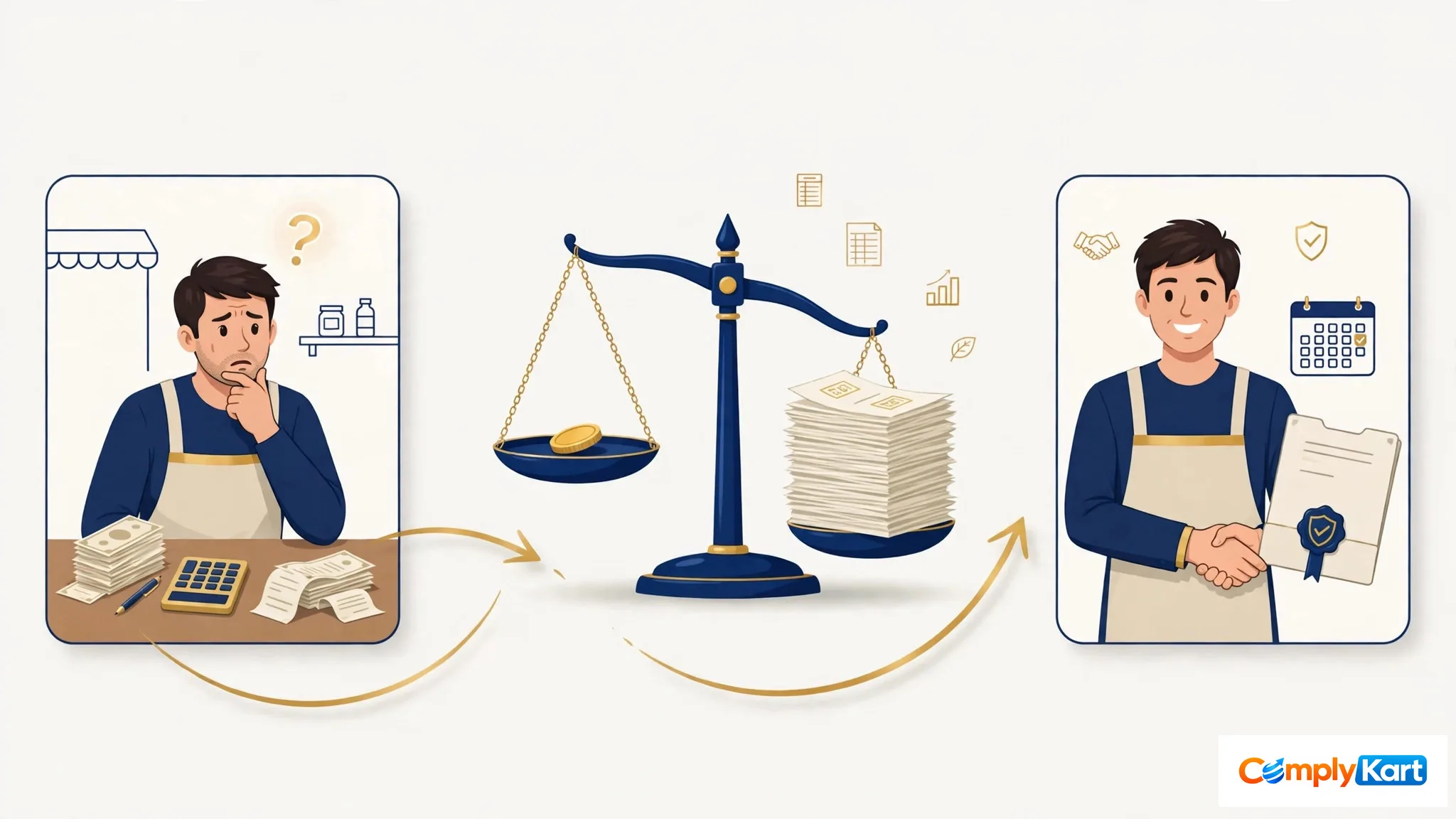
Think of it like a fixed thali versus ordering à la carte. The thali looks cheap until you count the dishes you paid for and never ate. In composition, the uneaten dishes are your input tax credit.
Take a trader who buys goods worth ₹50 lakh before GST in a year and pays 18% GST on them — ₹9 lakh — then sells goods worth ₹70 lakh before GST. Under the regular scheme, he collects 18% on his sales (₹12.6 lakh), sets off the ₹9 lakh he already paid, and deposits ₹3.6 lakh net. GST, for him, is mostly a pass-through: his real profit is the ₹20 lakh margin between purchase and sale value.
Under composition, the same trader pays 1% of his ₹70 lakh turnover — ₹70,000 — and that looks like a saving of nearly ₹3 lakh. It is not. The ₹9 lakh GST embedded in his purchases is now a dead cost he can never recover. His total GST burden is ₹9 lakh plus ₹70,000, or ₹9.7 lakh, against ₹3.6 lakh net under the regular scheme. Composition costs him ₹6.1 lakh more in the year, and his B2B customers lose the credit they would have claimed on his invoices, which can cost him their business too.
The maths flips when inputs are thin. A neighbourhood trader who buys mostly from unregistered suppliers, or sells mostly to end consumers who cannot use credit anyway, may genuinely come out ahead: 1% of turnover against almost no credit surrendered, plus four filings instead of twenty-four. Run both columns with your own purchase register before you choose. If your annual GST on purchases is more than a few lakh rupees, regular usually wins even though it files monthly.
One fairness note on the example above: it compares the same pre-GST selling value under both schemes. In real life a regular dealer charges GST on top of his price, so his shelf price to a walk-in customer runs higher than a composition dealer's. For a purely B2C shop, that price edge is composition's real argument — weigh it, but weigh it after the credit maths, not instead of it.
When composition still wins
Composition is the right call in three situations. First, a dine-in restaurant: the regular rate for a standalone restaurant is already 5% without credit, so composition at 5% costs the same tax and buys simpler filing. Second, a small trader or manufacturer whose purchases carry little GST — local unregistered suppliers, exempt goods, or a genuinely low input bill. Third, a business whose customers are all end consumers, so nobody misses the credit on your bill of supply. If none of those three fits you, the flat rate is probably a trap dressed as a discount.
Can you sell online under composition? The correction most guides miss
Many guides still print the old rule: composition dealers cannot sell through e-commerce operators at all. That stopped being true on 1 October 2023. Section 137 of the Finance Act, 2023 amended Section 10, and Notifications No. 36/2023 and 37/2023-Central Tax set the procedure: a composition dealer may supply goods through an e-commerce operator, but only intra-state, with the operator collecting tax at source and reporting the supplies in GSTR-8.
The trap sits one step away. Services through an operator are still barred where tax is collected at source — and a restaurant selling through Swiggy or Zomato is supplying a service, not goods. So a trader can sell packaged goods on a marketplace from composition, but a restaurant cannot keep its composition status while taking aggregator orders. If your restaurant's delivery orders run through an aggregator, composition is off the table however small your turnover is. Check which side of that line your sales fall on before you opt in.
Opting in, filing, and getting out
Existing taxpayers opt in through Form CMP-02 on the GST portal, before the financial year begins — for a switch from 1 April, the window closes on 31 March. New registrants can opt at registration itself. Within 90 days of opting, you reverse the credit standing on your stock through ITC-03, since a composition dealer holds no credit.
Each quarter you file CMP-08 and pay the tax by the 18th of the month after the quarter ends: 18 July, 18 October, 18 January and 18 April. GSTR-4, the annual return, follows by 30 April. Reverse charge still applies at full rates on notified supplies, and you pay it from your own pocket with no credit to set it against — the flat rate does not shield you from it.
Leaving matters as much as entering. The day your turnover crosses the limit in a financial year, the composition option lapses by law under Section 10(3) — not at year-end, the next day — and a 2026 ruling of the Hyderabad Bench of the GST Appellate Tribunal confirmed that the lapse is automatic. You must intimate the exit in Form CMP-04 within seven days, switch to regular invoicing, and claim credit on your closing stock through ITC-01. A voluntary exit works the same way, at the start of a financial year. Miss the crossing and you keep charging the flat rate on sales that legally owe full tax, with the difference recoverable later.
Five mistakes that cost composition dealers real money
- Opting in on the 1% headline without running the input-credit maths against your own purchase register.
- Selling to GST-registered customers who quietly move to a supplier whose invoice carries credit.
- Taking aggregator orders as a restaurant while staying in composition — the service-via-operator bar still applies.
- Missing the crossing: turnover is tracked through the year, and the option dies the day after the limit is crossed, not at filing time.
- Forgetting reverse charge and the ITC-03 reversal — both land in the first quarter after opting in, when attention is elsewhere.
Frequently asked questions
Can a composition dealer sell on Amazon or Flipkart?
Yes for goods, since 1 October 2023 — intra-state supplies only, with the operator collecting tax at source and reporting in GSTR-8. Services through an operator remain barred.
Can a restaurant on Swiggy or Zomato opt for composition?
No. Restaurant food delivered through an aggregator is a service supplied through an operator, which Section 10 still bars. A dine-in-only restaurant can opt; an aggregator restaurant cannot.
What happens if my turnover crosses ₹1.5 crore mid-year?
The composition option lapses from the day after the crossing. File CMP-04 within seven days, start issuing tax invoices, and claim stock credit through ITC-01.
Can I switch back to the regular scheme?
Yes, voluntarily at the start of a financial year through CMP-04, or automatically on crossing the limit. You cannot flip schemes mid-year on a whim.
Does composition remove GST on my purchases?
No. You still pay GST to your suppliers in full — you simply cannot claim it back. That unrecovered GST is the hidden price of the flat rate, and the reason the break-even maths matters more than the rate itself.
If your purchase register shows heavy taxed inputs, or your customers need credit on your invoices, the regular scheme is usually the cheaper honest choice despite its monthly filings. If your inputs are light and your customers are end consumers, composition buys you your evenings back for a fair price. Either way, decide from your own numbers — and if the numbers are close, get a professional to run them once before the 31 March window closes. For the filing itself, GST registration support and the compliance fee calculator can help you cost the route you pick. Restaurants weighing the 5% question should also read our GST for restaurants guide, and if a registration has already been cancelled, the REG-21 revocation route explains the way back.



Comments
No comments yet — ask the first question below.
Join the discussion
Questions go straight to our expert desk. Comments appear after a quick review — no spam, no noise.