
IN BRIEF
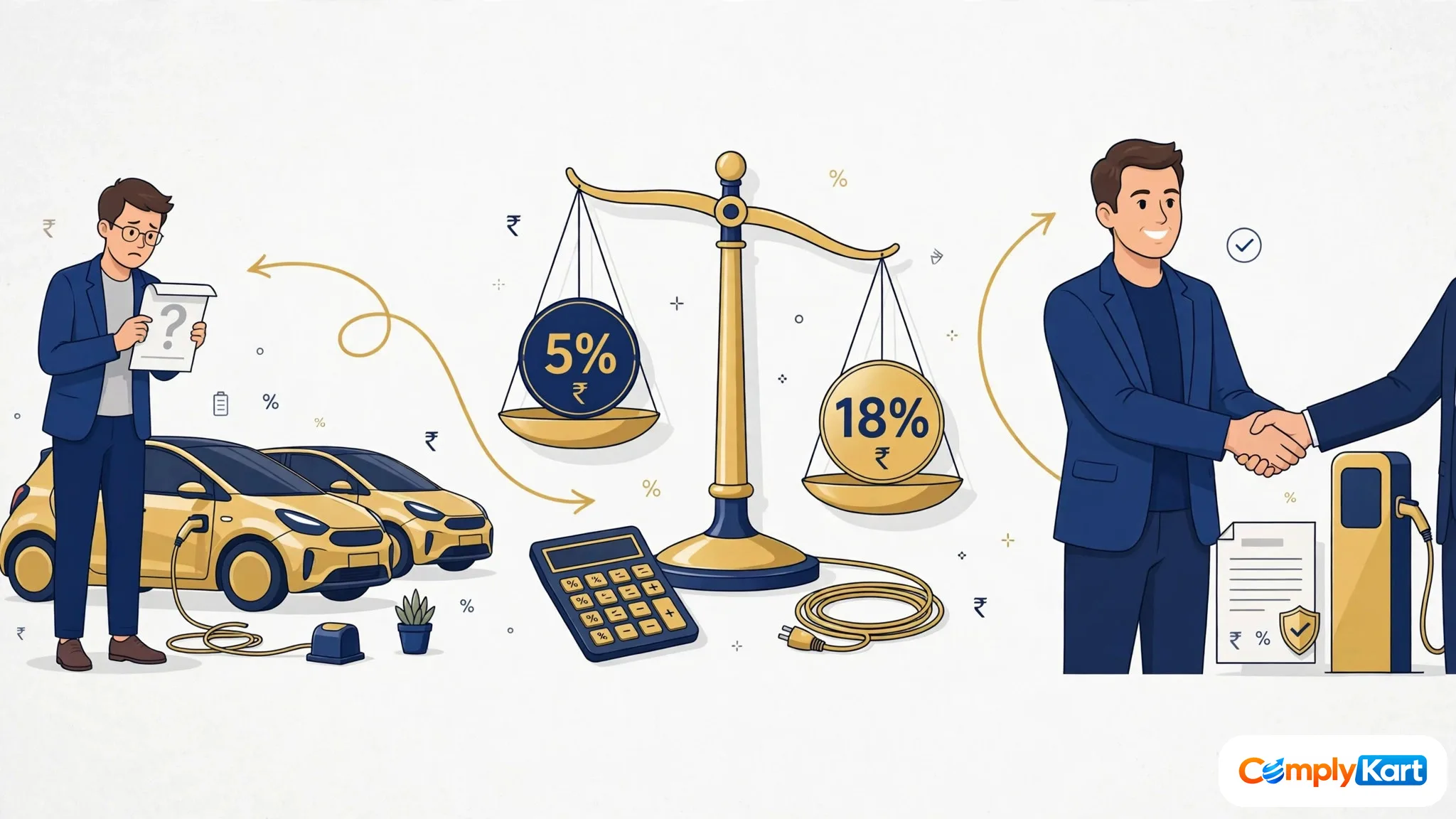
GST for electrically operated vehicle services is the tax on passenger transport and vehicle rentals supplied using EVs. From 1 November 2026, Notification No. 06/2026–Central Tax (Rate) lets such suppliers charge 5% with input tax credit restricted to same-line services and capped at 5%, or 18% without that special restriction, where battery-charging costs form part of the price.
If you run electric cars, cabs or delivery vans for customers, your invoices change on 1 November 2026. Not the vehicles, not the charging, just the tax line on the service you sell. From that date, passenger transport in electrically operated vehicles and the renting of such vehicles get their own GST entries, with a choice built in: 5% with restricted input tax credit, or 18% with credit under the normal rules. Picking wrong does not just change the tax on one invoice. It decides how much of the tax you pay on your own inputs stays stuck with you.
The short answer: Notification No. 06/2026–Central Tax (Rate), dated 27 October 2026, gives electrically operated vehicle services a choice where battery-charging costs form part of the price: 5% with credit restricted to same-line inputs and capped at 5%, or 18% without that special restriction. The right choice turns on who your customer is.
What exactly changed on 1 November 2026?
Before this notification, the 5% versus 18% structure already existed for comparable services run on petrol and diesel vehicles. An operator providing a vehicle with a driver could charge 5% with restricted credit, or 18% and claim eligible credit. Electric vehicles sat outside that express framework, which left fleet owners arguing from general entries. The 57th GST Council meeting on 8 October 2026 recommended technology-neutral treatment, and Notification No. 06/2026–Central Tax (Rate) — G.S.R. 936(E), dated 27 October 2026 — puts it into law by amending Notification No. 11/2017–Central Tax (Rate). The matching IGST notification, No. 06/2026–Integrated Tax (Rate), G.S.R. 937(E), does the same for inter-state supplies. Both take effect on 1 November 2026.
Three categories get the new entries: passenger transportation by electrically operated vehicles, renting of electrically operated vehicles designed to carry passengers, and renting of electrically operated vehicles for transporting goods. In each case, the entry applies where battery-charging costs form part of the consideration. That condition matters, and I come back to it below.
The notification also defines the vehicles. An electrically operated vehicle is a road vehicle that runs solely on electrical energy from an external source or from fitted batteries. The definition expressly includes e-bicycles. So a small e-bike rental outfit is inside the same framework as a 50-car cab fleet, even though their input costs look nothing alike.
Who does this cover — and who does it not?
You are inside the new entries if you supply one of the three services above and your price includes the cost of charging the battery. A cab aggregator fleet, a corporate staff-transport operator running EVs, a self-drive EV rental company and an EV goods-vehicle rental business all fit the description. A business that merely sells or leases vehicles without supplying a transport or rental service is not supplying these services at all, and this notification is not its rate entry.
Two things this notification does not do. First, it does not change the GST on buying the vehicle itself. An electric vehicle bought for your fleet is taxed separately from the service you later supply with it; do not mix the two rates in your head. Second, it does not touch the delivery-services entry that changed the same week. Deliveries made through an e-commerce operator sit under a different entry at 5% without credit, which I covered in the e-commerce delivery guide. If your vans do both — passenger trips and platform deliveries — each leg takes its own entry.
The two options, side by side
| 5% option | 18% option | |
|---|---|---|
| Combined rate | 5% (2.5% CGST + 2.5% SGST, or 5% IGST) | 18% (9% + 9%, or 18% IGST) |
| Credit on your inputs | Restricted: only same-line input services, and capped (see below) | Eligible credit under the normal rules, without the special 5% restriction |
| Price your customer sees | Lower tax line | Higher tax line — but a registered business customer can generally claim it as credit |
| Suits | Customers who cannot claim credit — retail passengers, unregistered buyers | Registered business customers who can use the credit |
Think of it like two airline tickets. The cheap ticket gets you there, but nothing is refundable. The full-fare ticket costs more at checkout, yet almost everything attached to it comes back. The 5% route is the cheap ticket: a low tax line, but the credit on your inputs is mostly gone. The 18% route costs your customer more on paper, but if that customer is a registered business, the extra tax is not really a cost to them at all — it flows through their own credit ledger.
The credit cap, with the notification's own numbers
The cap is where operators lose money without noticing. Under the 5% option, credit is allowed only on input services in the same line of business — for a passenger-transport supplier, that means passenger-transport services procured from another supplier, and similarly for rentals. And where that upstream supplier charges more than 2.5% CGST, your credit is capped at 2.5% of the input value.
The notification illustrates it with a hotel example that works identically for vehicles. Suppose you procure an input service worth ₹10,000 and the supplier charges you 9% CGST, which is ₹900. If you charge your own customer 2.5% CGST, you may take credit of only ₹250 — 2.5% of ₹10,000 — not ₹900. The other ₹650 is stranded. Under the IGST version, the same illustration caps credit at 5% of ₹10,000, which is ₹500, against ₹1,800 charged at 18%. Every rupee above the cap is a cost your business absorbs.
Everything outside the same line stays blocked under the 5% option: rent, office costs, software, marketing and general overheads give you no credit at all. That is the part most summaries skip, and it is the part that decides the maths.
A worked illustration: when 18% beats 5%
Take a small fleet operator billing ₹10,00,000 in a month, all to one corporate client, and procuring same-line input services worth ₹2,00,000 that carry 18% tax, which is ₹36,000.
On the 5% route, the operator charges ₹50,000 of tax. Credit is capped at 5% of ₹2,00,000, which is ₹10,000, so ₹26,000 of the ₹36,000 input tax is stranded. Net cash tax outgo on these two legs is ₹40,000.
On the 18% route, the operator charges ₹1,80,000 of tax and claims the full ₹36,000 as eligible credit, leaving ₹1,44,000 payable in cash. That looks worse — until you remember who pays it. The corporate client claims the ₹1,80,000 as its own credit, so the operator's higher tax line costs the client nothing extra. Meanwhile the operator has recovered ₹26,000 that the 5% route would have stranded. For a business-to-business operator, the 18% route usually wins.
Flip the customer and the answer flips. If the same ₹10,00,000 of billing goes to retail passengers who cannot claim any credit, the 18% route makes every ride 13% more expensive for no benefit to the passenger, and the operator risks losing trips to a competitor still charging 5%. The stranded ₹26,000 may be cheaper than the lost business. This is an illustration with round numbers, not a promise: your own break-even depends on your input mix, your customer mix and your margins, and you should run it on your actual figures before you switch.
The charging-cost condition: read your own invoices
The new entries apply where battery-charging costs form part of the consideration. Most operators bundle charging into the fare or rental, and for them the condition is plainly met. But if your contracts split the price — a rental charge plus a separately billed charging charge, for example — the split deserves a careful read against the entry before 1 November. The notification does not spell out a separate treatment for a split invoice, and I am not going to invent one. If your billing separates charging from the service, take advice on the structure before you assume the entry covers the whole invoice.
The same caution applies to mixed fleets. A petrol car and an electric car in the same fleet do not share one entry. The electric services take the new entries; the conventional services continue under their existing entries. Your rate master needs both, mapped vehicle by vehicle, not one blanket rate for the fleet.
Five mistakes to avoid
- Charging 5% and claiming full credit on all inputs. Under the 5% option, only same-line credit survives, and it is capped.
- Charging 18% to retail passengers and wondering why bookings fall. A customer who cannot use credit feels the full 13-point difference.
- Assuming the vehicle's purchase GST and the service GST are one rate. They are separate supplies with separate entries.
- Leaving the old rate in invoice templates, booking apps and aggregator rate cards past 31 October. The change is effective 1 November, not "sometime in November".
- Forgetting the IGST mirror. Inter-state supplies use the 5% IGST cap, not the 2.5% CGST cap — applying the CGST figure to an IGST invoice understates your credit.
What to do this week
First, sort your customers into two lists: registered businesses who can claim credit, and everyone else. That list alone points at your default option for each contract. Second, pull your last three months of input tax and split it into same-line services and everything else; the same-line share is the only credit the 5% route preserves. Third, update your rate master, invoice templates and any aggregator or corporate rate cards before the first 1 November invoice goes out. Fourth, tell corporate clients in writing which rate you will charge and why — a client that expected 5% and gets an 18% invoice without warning will query it, even when the credit makes them whole. Finally, if you are not yet registered, check whether you need to be: GST registration is the starting point, and your monthly filing discipline — see GST returns — is what turns a rate choice into credit actually claimed.
For a sense of where this fits in the wider 1 November package, the GST rate list for 2026 maps the new 5%, 18% and 40% structure, and the restaurant guide on 5% versus 18% for restaurants works through the same kind of rate-versus-credit choice in a different trade. The compliance fee calculator can help you size the filing work that follows any change in your registration or return pattern.
Frequently asked questions
Does the 5% EV option apply to e-bicycles too?
Yes. The notification's definition of an electrically operated vehicle covers road vehicles running solely on electrical energy from an external source or fitted batteries, and it expressly includes e-bicycles. An e-bike rental business falls inside the same entries as a car fleet.
Can I charge 5% to one customer and 18% to another?
The rate follows the supply and its entry conditions, not a single election for the whole business. In practice, operators apply the option that fits each customer relationship — 18% where the customer can use the credit, 5% where they cannot — but each invoice must satisfy the conditions of the entry it relies on, so document the basis per contract rather than switching rates invoice by invoice without a reason.
What happens to credit on charging costs themselves?
Charging is part of the consideration for the new entries, but the credit question is answered by the option you choose: under the 5% option, credit is restricted to same-line input services and capped, so general charging and energy costs do not automatically yield credit. Under the 18% option, eligible credit follows the normal rules. The invoice structure matters, so keep charging costs identifiable in your records.
Does this change anything for petrol and diesel fleets?
No. The conventional-vehicle framework already offered the 5% versus 18% choice, and this notification extends the same structure to electric vehicles so the treatment no longer depends on what powers the vehicle. It is an alignment, not a new rate for conventional fleets.
What if I keep charging my old rate after 1 November?
An invoice that applies the wrong rate creates a mismatch: either you short-pay tax, which draws interest and scrutiny, or you overcharge a customer who will dispute it. Since the notification's commencement date is fixed at 1 November 2026, the safe course is to update rate masters before the first November invoice, not after the first query arrives.
The electric fleet story was, until now, a story about vehicles. From 1 November it is also a story about arithmetic. Work out who your customer is, work out what your inputs cost you in stranded tax, and let those two answers choose your rate — before your first November invoice makes the choice for you.




Comments
No comments yet — ask the first question below.
Join the discussion
Questions go straight to our expert desk. Comments appear after a quick review — no spam, no noise.