
IN BRIEF
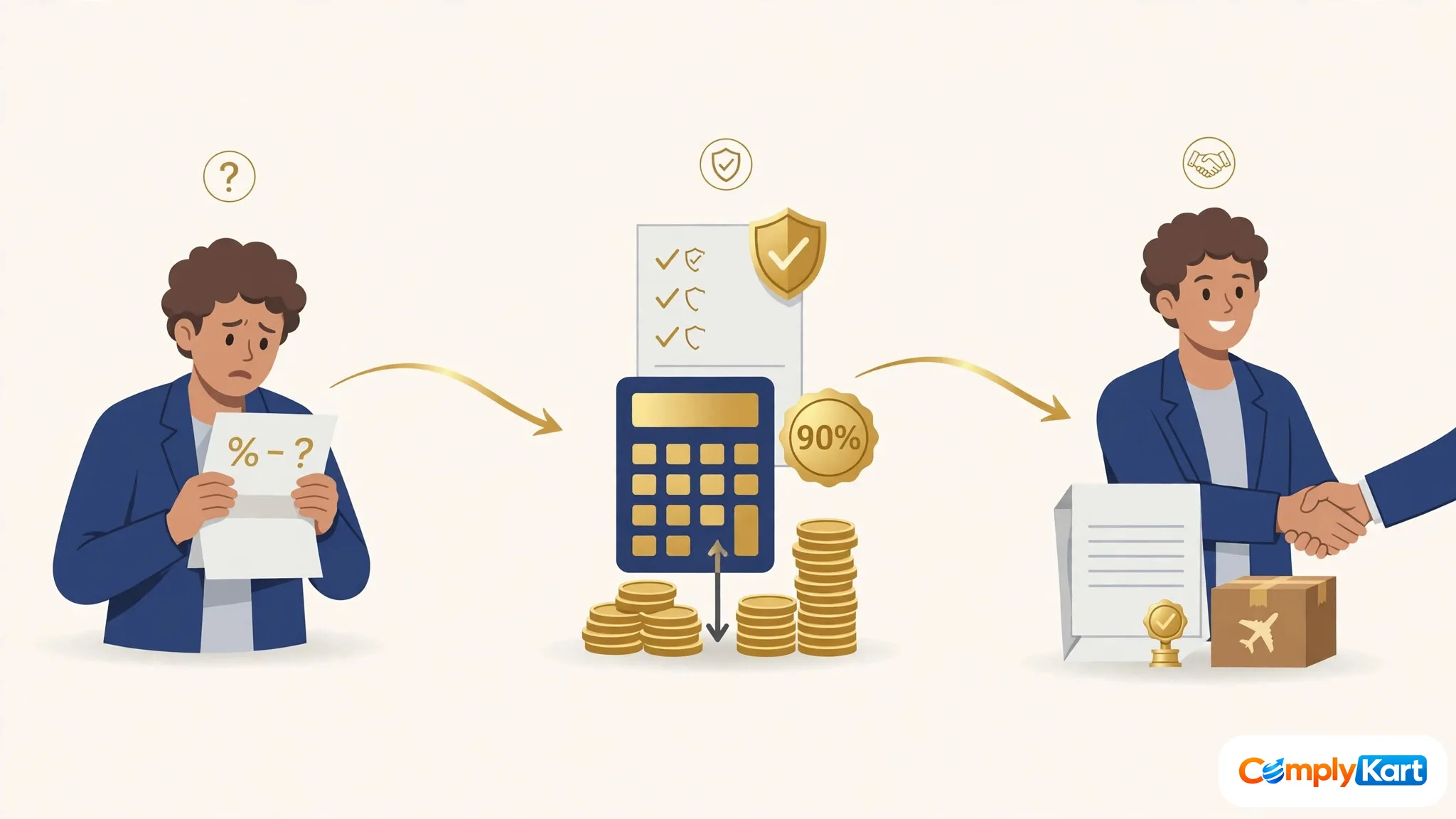
GST changes from 1 November 2026 are amendments to the CGST Act, 2017, brought into force by Notification No. 03/2026–Central Tax, that simplify post-sale discounts, extend 90% provisional refunds to inverted-duty-structure claims, and remove the ₹1,000 refund floor for goods exported with payment of tax.
From 1 November 2026, three GST changes take effect that touch almost every business that gives discounts, claims refunds, or exports goods. They come from a single notification — Notification No. 03/2026–Central Tax, dated 26 October 2026 — which brings Sections 153, 154 and 155 of the Finance Act, 2026 into force. Those sections amend Sections 15, 34 and 54 of the CGST Act, 2017.
In short: from 1 November 2026, a post-sale discount needs only a GST credit note plus the buyer's ITC reversal to reduce taxable value — no pre-agreement, no invoice linkage. Eligible inverted-duty refunds get 90% provisionally, and the ₹1,000 refund floor goes for goods exported with payment of tax. Nothing here is retrospective.
What exactly changes on 1 November 2026?
Three provisions change, and it helps to see them side by side before going into detail.
| Provision | Until 31 October 2026 | From 1 November 2026 |
|---|---|---|
| Section 15(3)(b) — post-sale discounts | Discount excluded from taxable value only if agreed before or at the time of supply, linked to specific invoices, and the buyer reversed the ITC | Prior agreement and invoice linkage go away; a credit note under Section 34 plus the buyer's ITC reversal is what counts |
| Section 34(1) — credit notes | Credit notes covered excess value or tax, returned goods, and deficient goods or services | Expressly covers a discount referred to in Section 15(3)(b) as well |
| Section 54(6) and 54(14) — refunds | 90% provisional refund mainly for zero-rated supplies; a ₹1,000 minimum applied to refund claims | 90% provisional refund extends to eligible inverted-duty-structure claims; the ₹1,000 floor is removed for goods exported with payment of tax |
If your business never gives post-sale discounts and never accumulates unutilised credit, this notification changes little for you. If it does either — and most manufacturers, distributors and dealer networks do the first — read on.
What is a post-sale discount, and why did the old rule hurt?
A post-sale discount is a discount decided after the sale: a year-end volume rebate, a target-achievement incentive, a scheme payout worked out once the quarter closes. The goods have gone, the invoice has been raised, GST has been paid on the full price — and only later does the seller give some money back.
Under the old Section 15(3)(b), that discount could come off the taxable value only if three conditions were all met: the discount was fixed in an agreement made at or before the time of supply, it was specifically linked to the relevant invoices, and the buyer reversed the ITC on it. In real life, volume rebates are rarely fixed invoice by invoice in advance. A distributor hits a slab in March; the scheme was announced in April; nobody linked anything to invoice numbers. The result: the discount stayed in the taxable value, the seller paid GST on money it had given back, and disputes followed. I have seen businesses simply stop claiming the adjustment rather than fight that paper trail.
How does the new discount rule work?
From 1 November 2026, the first two conditions are gone. A post-sale discount is excluded from the value of supply if two things happen: the supplier issues a credit note under Section 34, and the recipient reverses the ITC attributable to the discount. That is the whole test now.
Think of it like a restaurant bill split between two friends. If one friend gets a discount but the other still claims the full amount back from the office, the office pays twice. The law now works the same way: the seller's tax cut and the buyer's credit reversal are two sides of one adjustment. One without the other does not work, and that pairing is the part businesses must get right operationally.
Here is a worked example you can check. A manufacturer sells goods worth ₹10,00,000 to a dealer, charging 18% GST of ₹1,80,000. At year-end the dealer earns a 5% volume rebate: ₹50,000 plus the ₹9,000 tax on it. Under the old rule, without a pre-agreed, invoice-linked scheme, the manufacturer could not adjust. From 1 November, the manufacturer issues a GST credit note of ₹59,000, its output tax falls by ₹9,000, and the dealer reverses ₹9,000 of ITC. The taxable value of the supply is now ₹9,50,000. The economics are clean — provided the dealer actually reverses the credit.
Two cautions. First, the declaration deadline in Section 34(2) still applies, so a credit note decided too late can still miss its window — fix your discount-calculation calendar well before the cut-off. Second, the change is prospective. A discount given before 1 November is judged under the old conditions, even if the credit note is issued later.
What is the difference between a GST credit note and a financial credit note?
This is the trap most businesses walk into, and the new law makes it sharper. A GST credit note under Section 34 reduces the tax on the original supply — and it is this note that pairs with the buyer's ITC reversal. A financial or commercial credit note is different: it is a pure money adjustment between the parties, the original tax stays exactly as it was, and no ITC reversal is needed.
CBIC clarified this in Circular No. 251/08/2025-GST, dated 12 September 2025: where a discount comes through a financial credit note, the recipient does not reverse ITC, because nothing about the tax has changed. The earlier requirement that suppliers collect a CA or CMA certificate from the buyer to prove reversal — imposed by Circular No. 212/6/2024-GST — was withdrawn by Circular No. 253/10/2025-GST. So the paperwork burden is lighter, but the distinction matters more than ever: label the note correctly, or you will either reverse credit you never needed to reverse, or claim a tax cut the buyer never matched.
Who benefits from the 90% provisional refund for inverted duty structure?
An inverted duty structure is the situation where you pay more GST on what you buy than you charge on what you sell. Buy raw material at 18%, sell the finished product at 5%, and credit piles up every month with nowhere to go except a refund claim. Until now, the 90% provisional refund in Section 54(6) was mainly available for zero-rated supplies — exports and SEZ supplies. An inverted-duty claim waited for full verification before the money came back.
From 1 November 2026, Section 54(6) also covers eligible inverted-duty claims under Section 54(3). Take a manufacturer with an eligible claim of ₹4,00,000 of accumulated credit. It can now receive ₹3,60,000 provisionally — 90% — with the remaining ₹40,000 after final verification. That is working capital back in the business months earlier. The release is subject to the prescribed conditions, safeguards and risk-based verification, so it is not automatic for every claim — but for a clean, documented claim, the wait shrinks dramatically.
One boundary to respect: the provisional route covers eligible claims. A claim with blocked credits, mismatched returns or a disputed accumulation can still be held up at verification. File clean, and the 90% is real.
What does removing the ₹1,000 refund floor mean for small exporters?
Section 54(14) used to bar refund claims below ₹1,000. For a small exporter who paid, say, ₹800 of tax on goods exported with payment of tax, that meant the refund was simply not worth claiming — the law would not allow it. From 1 November 2026, that floor is gone for refunds of tax paid on goods exported out of India.
Note the limit of this change: it applies to that export category only. Other refund categories keep their existing rules. If you export goods with payment of tax in small lots, though, the small claims you used to write off are now claimable — and they add up across a year.
What is NOT changing on 1 November?
Three things are easy to confuse with this notification, and getting them wrong costs time.
First, the revamped GST return forms — GSTR-1, GSTR-1A and the Invoice Furnishing Facility — are not live on 1 November. They go on the MyGov portal that day for public comments until 30 November 2026, and the revised forms apply from 1 April 2027. Your current filing stays exactly as it is until then. The revamp matters — CBIC's GST Policy Wing has said nearly 80% of GST notices arise from return mismatches, and the new forms aim to fix that by aligning GSTR-1 with GSTR-3B — but it is a consultation, not a compliance change, on 1 November.
Second, a companion rules notification — Notification No. 05/2026–Central Tax, also dated 26 October 2026 — staggers some operational pieces, including refund-form changes, to later dates. Do not assume every form on the portal changes on 1 November; check the form you are actually filing.
Third, the simplified e-commerce registration route for small online sellers rolls out in phases from 1 November rather than switching on fully in one day. If you sell through a marketplace, follow the portal's phased instructions rather than assuming the new route is open to you on day one.
What should your business do this week?
Five steps, in order. One, list every discount scheme that pays out after the sale — volume rebates, target incentives, year-end schemes — and mark which ones previously failed the pre-agreement test. Two, rewrite the scheme documents so the credit-note-plus-reversal mechanism is the process, not an afterthought, and agree with your buyers in writing who reverses what and by when. Three, separate your GST credit notes from your financial credit notes in your accounting system, with different series if you can — mixing them is how the reversal trap happens. Four, if you carry accumulated inverted-duty credit, prepare the refund computation now so the claim can go in as soon as the provisional route is open to you. Five, diary the MyGov consultation: if return mismatches have cost you notices, the 30 November window is your chance to say what the new GSTR-1 should fix.
Five mistakes to avoid
First, issuing a GST credit note for a discount while the buyer keeps the full ITC — the department will pair the two sides, and the mismatch lands on you. Second, treating a financial credit note as a tax adjustment, or a GST credit note as a mere money note — the label decides the tax treatment. Third, assuming the change is retrospective and reopening old discounts — it is not. Fourth, missing the Section 34(2) declaration deadline because the discount was finalised late. Fifth, assuming the ₹1,000 floor removal covers every refund type — it covers goods exported with payment of tax only.
Frequently asked questions
Can I now give a post-sale discount without any prior agreement?
Yes, from 1 November 2026. The prior-agreement and invoice-linkage conditions are removed from Section 15(3)(b). What remains mandatory is the GST credit note from the supplier and the ITC reversal by the buyer. A discount with neither is still just a money rebate with no GST effect.
Does the buyer have to reverse ITC even if the discount is small?
Yes. The reversal is the condition that makes the supplier's adjustment valid, and it applies to the tax attributable to the discount, whatever its size. The practical fix is a standing arrangement with regular buyers: every GST credit note you issue is matched by their reversal in the same return period.
Will my inverted-duty refund really arrive faster?
For an eligible claim, 90% can now be released provisionally instead of waiting for full scrutiny, with the balance after verification. The release remains subject to prescribed conditions and risk-based checks, so a claim with mismatches or blocked credits can still be delayed. Clean documentation is what turns the 90% from a promise into cash.
Can I claim a ₹500 refund on exported goods now?
If it is tax paid on goods exported out of India with payment of tax, yes — the ₹1,000 minimum no longer blocks it from 1 November 2026. The removal does not extend to other refund categories, so check which category your claim falls in before filing.
Do I need to change my GST return filing from 1 November?
No. The draft GSTR-1, GSTR-1A and IFF forms open for public comment on MyGov from 1 November to 30 November 2026 and apply from 1 April 2027. Until then, file exactly as you do today, and use the consultation window to flag the mismatch problems the new forms should solve.
These three changes share one theme: the law is moving from paper conditions to paired actions. A credit note matched by a reversal. A refund claim matched by verification. A form redesign matched by public comment. Businesses that build those pairings into their process this week will feel the benefit first; businesses that wait for a notice will feel it last.
If you give post-sale discounts or carry accumulated ITC, this is worth a proper review before your November filings — our GST registration and GST refund pages cover the underlying filings, and the compliance fee calculator can help you size the cost of getting the filings right. Readers who sell online should also read our guide to the simplified GST registration route for e-commerce sellers, and those weighing regular versus composition filing should read when the composition scheme's 1% rate costs more than regular GST. The rate picture behind inverted-duty claims is covered in our GST rate list for 2026.




Comments
No comments yet — ask the first question below.
Join the discussion
Questions go straight to our expert desk. Comments appear after a quick review — no spam, no noise.