

Rent is one expense almost every business pays and almost nobody taxes correctly. Landlords assume it is the tenant's headache; tenants assume the landlord has charged it. Since October 2024, the rule deciding who pays has flipped for the commonest arrangement of all — small landlord, registered business tenant.
The short answer: GST on rent is 18% for commercial property — shops, offices, warehouses. Renting a home for personal living is exempt, unless the tenant is GST-registered, in which case the tenant pays 18% under reverse charge. Since October 2024, a registered tenant also pays reverse-charge GST when the landlord is unregistered.
What is the GST rate on commercial rent?
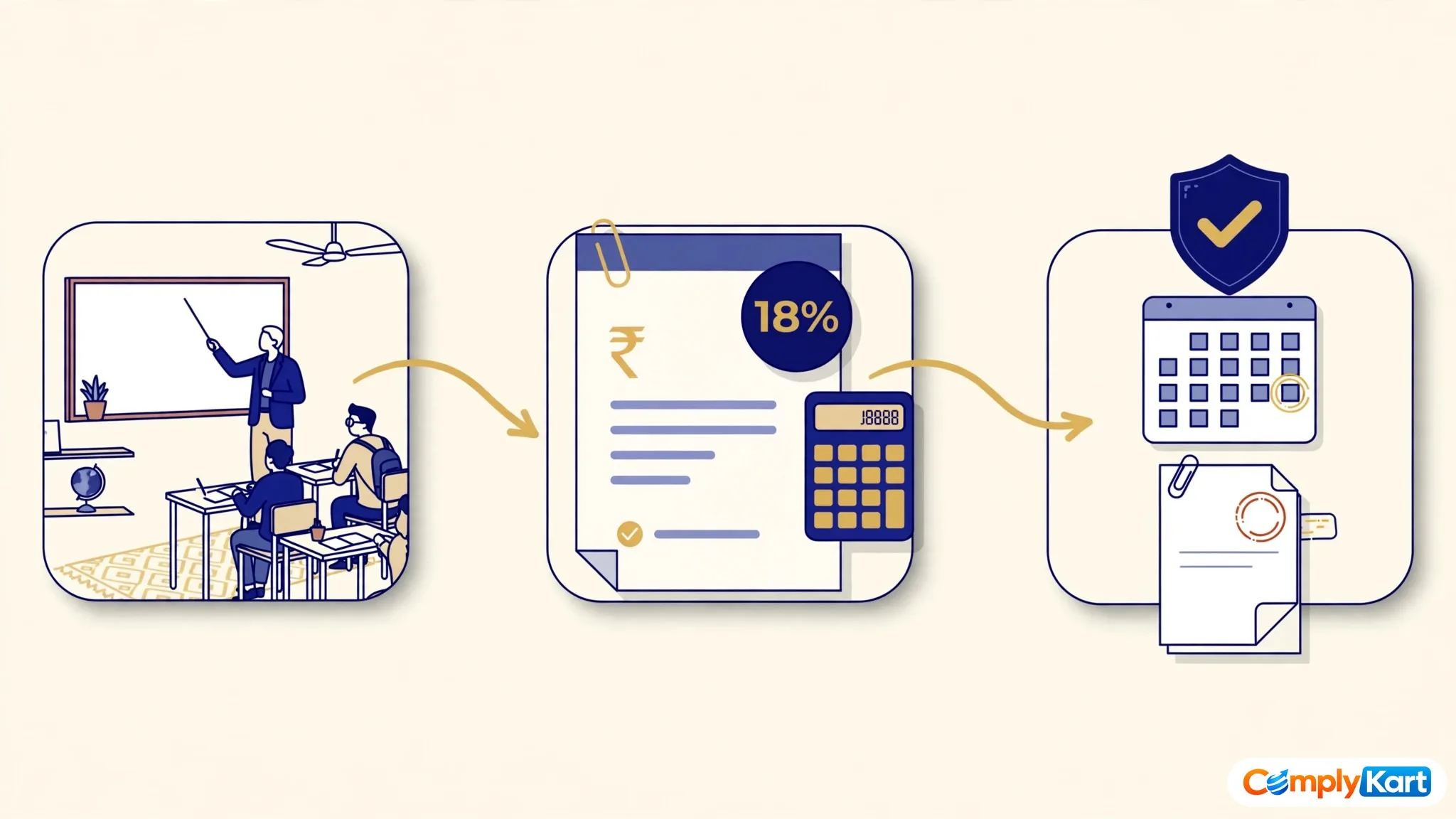
18%. Renting commercial property — offices, shops, godowns, co-working desks — is a taxable service (SAC 997212) charged at 18% under Notification 11/2017-Central Tax (Rate); the September 2025 rate rationalisation left it untouched. In the usual same-state case it splits into 9% CGST and 9% SGST on the landlord's invoice.
Is GST charged on house rent?
Usually, no. Entry 12 of Notification 12/2017-Central Tax (Rate) exempts renting of a residential dwelling for use as residence. Rent a flat to live in, with no GST registration in the picture, and neither side pays GST.
The exception arrived on 18 July 2022. Rent the same flat to a GST-registered person — a company taking it as an office or staff accommodation — and the exemption disappears. The registered tenant pays 18% under reverse charge (Entry 5AA of Notification 13/2017-Central Tax (Rate)), as CBIC's Circular 177/09/2022 confirms.
One carve-out protects the small proprietor. Run a proprietorship, hold a GSTIN for the business, and rent a home in your personal capacity, for your own residence and on your own account — the exemption survives, as Notification 15/2022-Central Tax (Rate) settled from 1 January 2023. The moment the business pays for it or uses it, the carve-out dies.
Who pays the GST — landlord or tenant?
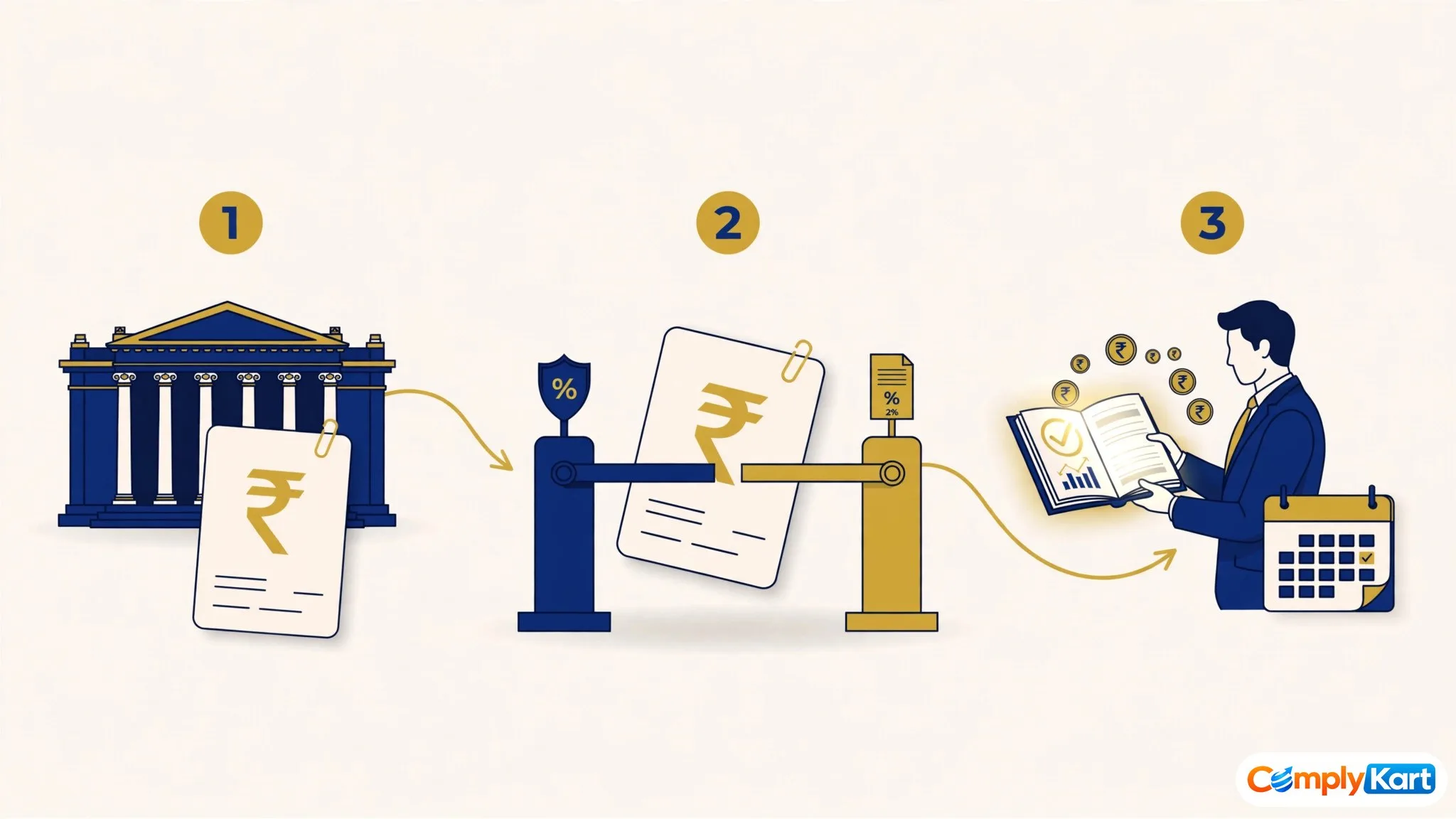
Think of GST as a relay baton: it must reach the government; only the carrier changes. Forward charge: the landlord invoices and deposits it. Reverse charge: he hands the baton to the tenant, who runs it in.
| Situation | Who pays the GST |
|---|---|
| Commercial property, landlord registered | Landlord — 18% on the rent invoice (forward charge) |
| Commercial, landlord unregistered, tenant registered | Tenant — 18% under reverse charge since 10 October 2024 (Entry 5AB) |
| Commercial, landlord unregistered, tenant under composition | Nobody — composition taxpayers excluded from Entry 5AB since 16 January 2025 |
| Commercial property, both unregistered | Nobody |
| Residential dwelling, tenant not registered | Nobody — exempt under Entry 12 |
| Residential dwelling, tenant GST-registered | Tenant — 18% under reverse charge (Entry 5AA), except the proprietor's own home taken personally |
A worked example: one office, three tax numbers
Your company rents an office at ₹80,000 a month from a retired individual, not GST-registered.
GST under reverse charge: 18% of ₹80,000 = ₹14,400 a month (₹7,200 CGST + ₹7,200 SGST). You pay it in cash in your GSTR-3B and claim the same ₹14,400 back as ITC in that very return. Over a year, ₹1,72,800 flows out and returns as credit — your real cost is cash flow, not tax.
TDS under Section 194-I: 10% of the rent = ₹8,000 a month, deducted before payment. He receives ₹72,000; the ₹96,000 a year returns as credit in his own return.
Had the landlord been registered, his invoice would read ₹80,000 + ₹14,400 = ₹94,400; the TDS stays ₹8,000, computed on rent alone, and the ₹14,400 becomes ITC from his invoice. Run your own rent through our GST calculator before signing.
How does a tenant pay GST under reverse charge?
- Confirm the landlord's GST status. No GSTIN on his side, registration on yours — reverse charge is yours.
- Raise a self-invoice under Section 31(3)(f), marked tax payable on reverse charge, plus a payment voucher (Section 31(3)(g)).
- Pay in cash through the electronic cash ledger — ITC cannot discharge reverse-charge tax, whatever your software suggests.
- Report the liability in Table 3.1(d) of GSTR-3B.
- Claim the same amount as ITC in Table 4(A)(3), if the premises serve your taxable business.
Missed it since October 2024? The liability still sits there, with interest at 18% a year under Section 50. Pay tax with interest in the current GSTR-3B; ITC stays claimable within the Section 16(4) deadline — 30 November following the financial year. Our GST return filing team and this guide to GST return filing cover the reporting.
Does a landlord need GST registration for rental income?
Only past the threshold. Registration kicks in when aggregate turnover crosses ₹20 lakh in a financial year — ₹10 lakh in the special category states. Aggregate means everything on your PAN — all properties, plus any other business income. Two shops at ₹11 lakh each put you over.
Two reliefs matter. If your only supplies are ones the tenant pays tax on under reverse charge, Notification 5/2017-Central Tax spares you registration for that alone — the landlord above stays unregistered quite legally. Registration is state-wise too: place of supply is where the property stands, so a property in another state needs its own registration. Our guide to GST registration across multiple states explains how; and GST registration itself takes two to three days.
Can the tenant claim ITC on rent?
Yes, in the standard business case — whoever paid it. Section 16 allows the credit if the premises serve your taxable supplies and you hold the invoice or self-invoice. Three blocks: composition dealers get no ITC; personal use is blocked by Section 17(5)(g); premises feeding exempt supplies earn no credit.
What about income-tax TDS on the same rent?
GST and TDS run on parallel tracks, and the same rent often attracts both. Businesses, firms, companies and anyone under tax audit deduct under Section 194-I: 10% on land, building and furniture, 2% on plant and machinery; since 1 April 2025 the threshold is rent above ₹50,000 a month — the old ₹2.4 lakh test is gone. Individuals and HUFs outside tax audit use Section 194-IB: 2% (cut from 5% on 1 October 2024) above ₹50,000 a month, deducted once a year through Form 26QC, no TAN needed. TDS is computed on rent excluding GST where GST is shown separately — our TDS calculator settles the number; TDS return filing handles the quarterly forms.
Mistakes I keep seeing on rent
- Registered tenants still not paying reverse charge on rent from unregistered landlords — a silent liability since October 2024, plus 18% interest.
- Companies assuming a staff flat is "exempt residential rent". In company hands, it is reverse-charge rent.
- Deducting TDS on rent plus GST combined, short-paying the landlord and creating a mismatch in his Form 26AS.
Find your row in the table, fix the past months, and rent stops being a notice risk.
GST on rent: quick answers
Is there GST on rent below ₹20,000 a month?
There is no rent-size threshold in GST; registration status decides. A registered landlord charges 18% even on ₹5,000 rent; two unregistered parties pay nothing. The ₹20 lakh figure is the landlord's annual turnover threshold.
I am a composition dealer renting from an unregistered landlord. Do I pay reverse charge?
No. Notification 07/2025-Central Tax (Rate) excluded composition taxpayers from Entry 5AB from 16 January 2025, and Circular 245/02/2025 regularised the October 2024–January 2025 window as-is-where-is.
Can I claim ITC of the reverse-charge GST in the same month?
Yes — pay in cash in Table 3.1(d), take the credit in Table 4(A)(3) of the same GSTR-3B. The cost is one month's cash flow.
Is GST charged on a refundable security deposit?
No, while it stays refundable — a deposit is not consideration for renting. GST applies only if the landlord adjusts it against rent or dues, on the amount adjusted.


Comments
No comments yet — ask the first question below.
Join the discussion
Questions go straight to our expert desk. Comments appear after a quick review — no spam, no noise.