
TDS on GST in Government Tenders: Section 51 Rate, GSTR-7 & How Contractors Claim It
You won the tender. You did the work. Then the department paid less than your invoice, and the payment advice shows two deductions, both labelled TDS. One belongs to GST, the other to income tax. Every rupee of it is claimable, if you know where it went.
The short answer: On a government contract above ₹2.5 lakh, the paying department, local authority, PSU or agency must deduct GST TDS at 2% under Section 51 of the CGST Act — 1% CGST plus 1% SGST in-state, or 2% IGST inter-state — on the contract value excluding GST. Income-tax TDS is cut separately. Both are amounts you claim back, not extra tax.
What is TDS on GST in a government tender?
Section 51 of the CGST Act, in force since 1 October 2018 (Notification No. 50/2018–Central Tax), requires specified government-linked buyers to deduct tax at source on payments to suppliers. It is not a second GST — just a slice of your payment parked with the government, returned as cash ledger credit once the department reports it.
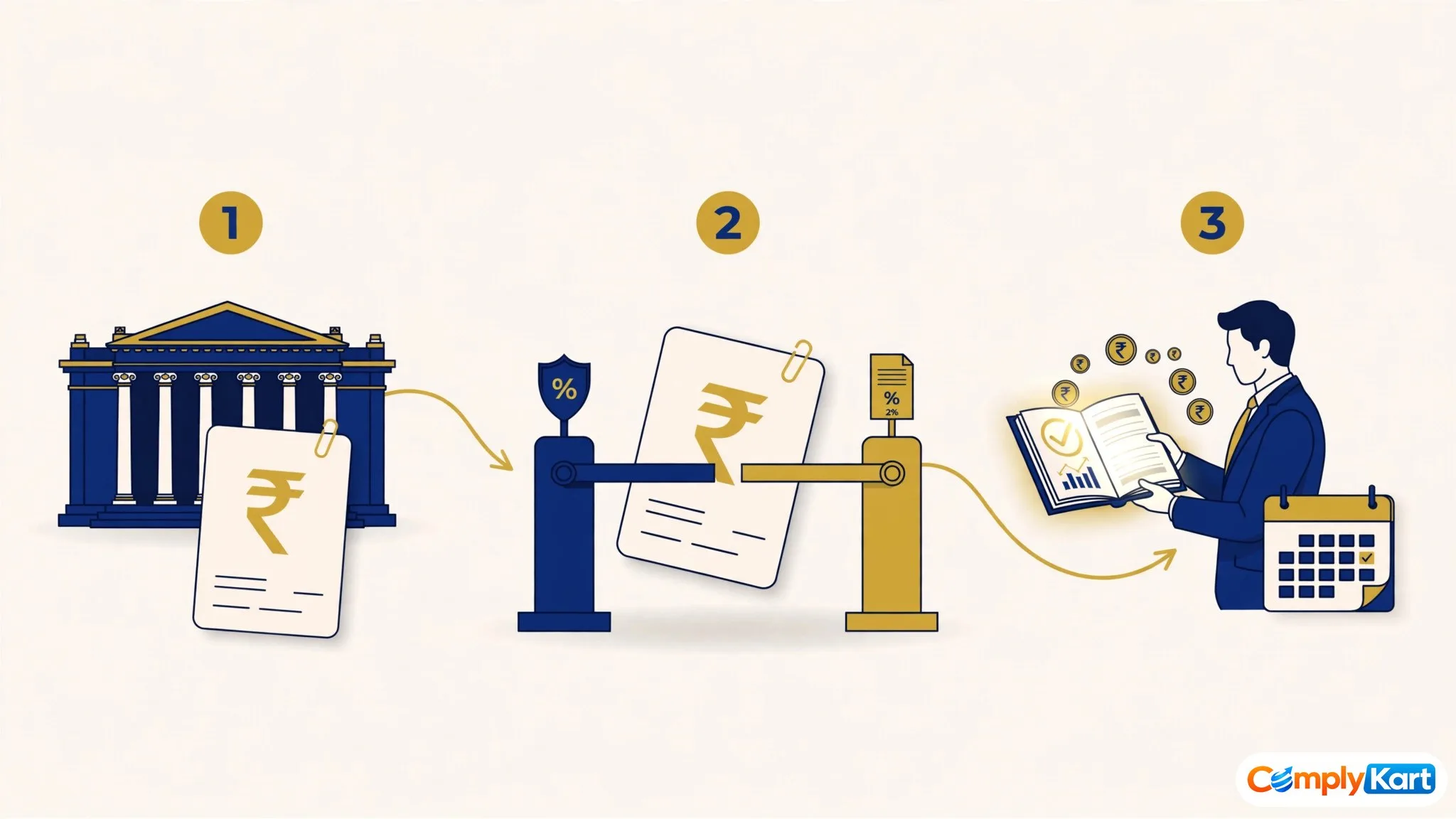
Think of your bill passing two toll gates on one road. The first gate belongs to GST and takes 2%; the second belongs to income tax and takes 1% or 2%. Two gates, two separate receipts — and a receipt from one never gets you through the other.
Who has to deduct GST TDS — and when does it not apply?
The duty sits only with: a Central or State Government department or establishment; a local authority; a governmental agency; an authority, board or body set up by Parliament or a State Legislature, or established by a government with 51%+ government participation; a government society; and PSUs. A private company, however large, does not deduct GST TDS.
Three conditions must line up. The supply is taxable. The contract's total value exceeds ₹2.5 lakh — read without the GST and cess on the invoice, and the whole contract counts, not each running bill. And deduction happens at payment or credit to your account, whichever is earlier, so advances are cut too. The deductor must hold a separate tax-deductor registration (Form GST REG-07), in all cases.
One clean exception: no TDS where both the supplier's location and the place of supply are in a different state from the recipient's registration state — the credit would strand in the wrong state's ledger.
How much is deducted? 2% — never on the GST amount
The rate is 2% of the taxable value: intra-state it splits 1% CGST + 1% SGST (or UTGST); inter-state it is 2% IGST. The GST on your invoice is never part of the base — the value of supply excludes the taxes and cess shown in the invoice. If a department deducts 2% on your GST-inclusive total, flag it before they file, not after.
The second cut: income-tax TDS on the same tender bill
The same payment usually attracts income-tax TDS on contractor payments — Section 393(1) of the Income-tax Act, 2025 (successor to Section 194C) — at 1% for an individual or HUF contractor, 2% for companies, firms and others. Here too the base excludes GST: CBDT Circular No. 23/2017 clarified that where GST on services is shown separately in the invoice, income-tax TDS skips the GST component. Both gates, same base — contract value, not invoice total. The department deposits it by the 7th of the next month and reports it quarterly; the deductor's TDS return filing is what protects your credit. Our Challan 281 guide covers that deposit step by step.
A ₹10 lakh tender bill, worked out in full
Your works contract bill is ₹10,00,000, GST at 18% adds ₹1,80,000, and as a company both deductions run at 2%:
| Item | Amount |
|---|---|
| Contract value (taxable value) | ₹10,00,000 |
| GST @ 18% | ₹1,80,000 |
| Invoice total | ₹11,80,000 |
| Less: GST TDS u/s 51 — 2% of ₹10,00,000 | ₹20,000 |
| Less: Income-tax TDS u/s 393 — 2% of ₹10,00,000 | ₹20,000 |
| Paid to you | ₹11,40,000 |
The ₹40,000 gap is not a loss. The GST TDS lands in your electronic cash ledger, ready to pay your next GST bill; the income-tax TDS becomes credit against your final tax bill for the year. An individual contractor's income-tax cut would be 1% (₹10,000), receiving ₹11,50,000. Run your own numbers through our TDS calculator before pricing a bid — it squeezes working capital even though it is not a cost.
How do you claim the GST TDS back?
Four steps, only the first in the department's hands. One, the deductor deposits the TDS and files GSTR-7 by the 10th of the following month. Two, download your auto-generated TDS certificate, Form GSTR-7A, from User Services. Three, accept the entry in your "TDS and TCS credit received" statement. Four, the amount lands in your electronic cash ledger — usable when you pay dues through your GST returns, or refundable as excess balance.
If the credit never appears, the department has not filed its GSTR-7 — the only door the credit comes through. Send the deduction proof and ask for the filing, in writing. Your own return deadlines keep running meanwhile — the discipline our GSTR-9C guide preaches for annual reconciliation applies here month by month.
If the department deducts late or wrongly
The deductor pays for delay, not you: late deposit carries interest at 18% per annum, and a late GSTR-7 costs ₹200 per day (₹100 CGST + ₹100 SGST), capped at ₹5,000 under each Act. GSTR-7 cannot be revised — errors wait for a later month's return. So a wrong GSTIN in the department's return is the costliest typo in this chain: the credit never reaches your ledger. Put your correct GSTIN in the tender documents themselves, not just on the invoice. Deductors register separately as tax deductors, distinct from a regular GST registration.
Over-deduction happens too: if the excess has not yet reached your cash ledger, the deductor claims the refund; once it sits there, only you can, as a refund of the cash balance. Catch it in the same month.
FAQs
My contract is ₹2.4 lakh, but the department later places a second order of ₹60,000. Is TDS deducted?
The ₹2.5 lakh test runs contract by contract. A genuinely separate second contract is tested on its own value — no TDS. But running bills under one ₹3 lakh contract are tested on the full value; splitting one contract into smaller bills does not escape the deduction.
The department deducted 2% but my cash ledger shows nothing. What should I do?
Check your "TDS and TCS credit received" statement first. If the amount is absent, the deductor has not filed GSTR-7 — or has filed it against a wrong GSTIN. Share your GSTIN and the payment advice, and ask for the filing or correction in writing; the credit cannot be created from your side.
My supply to the department is exempt from GST. Is TDS still deducted?
No. Section 51 applies only to taxable supplies. Exempt or nil-rated goods and services attract no GST TDS, whatever the contract value.
Do I claim GST TDS as input tax credit in GSTR-3B?
No — and this trips up many contractors. GST TDS is not ITC and never appears in GSTR-2B. It sits in your electronic cash ledger as cash, and you spend it at the payment stage of any return, exactly like money you deposited yourself.


Comments
No comments yet — ask the first question below.
Join the discussion
Questions go straight to our expert desk. Comments appear after a quick review — no spam, no noise.