
IN BRIEF
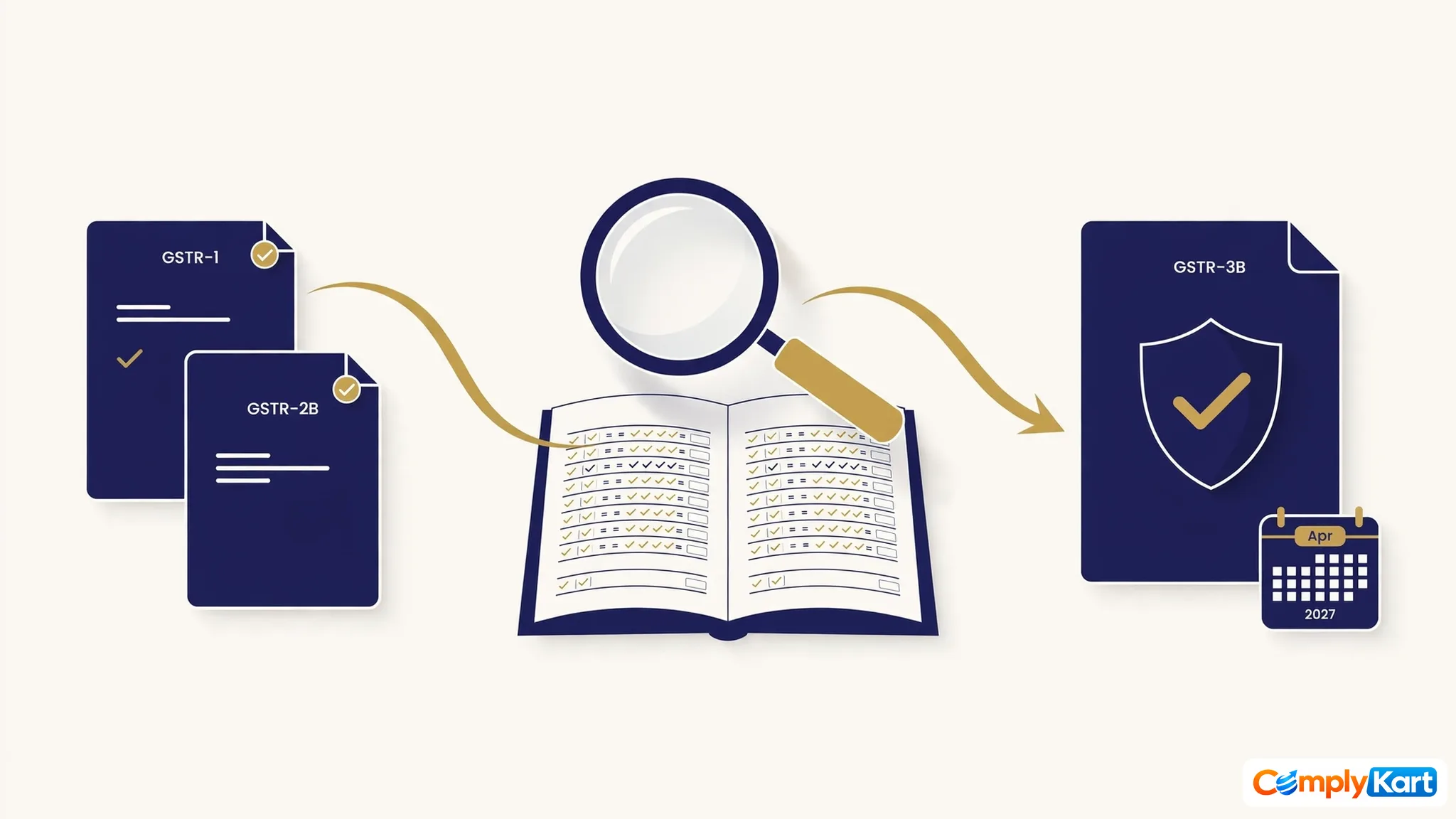
Proposed Rule 61(1A) and 61(1B) are draft amendments to the CGST Rules, 2017, recommended by the GST Council at its 57th meeting on 8 October 2026 and open for comment on MyGov until 30 November 2026. From the April 2027 return period, if notified, they would stop taxpayers editing figures in GSTR-3B: liability would have to match GSTR-1, GSTR-1A or IFF, and input tax credit would have to match GSTR-2B.
Most businesses that file GST have done it at least once. The figures auto-populate in GSTR-3B, something looks off, and instead of tracing the error back to GSTR-1 or GSTR-2B, you fix the number right there in the return. It works. The return gets filed. The mismatch quietly waits for a notice. That habit — the quiet edit — is what the GST Council now wants to end.
The short answer: Probably yes, from April 2027 — if the proposal is notified as drafted. The GST Council recommended at its 57th meeting on 8 October 2026 that liability in GSTR-3B must match GSTR-1, GSTR-1A or IFF, and input tax credit must match GSTR-2B. Corrections would move to those source statements and to the Invoice Management System, not to GSTR-3B itself. It is still only a proposal, open for public comment on MyGov until 30 November 2026.
Why the Council wants to stop the quiet edit
The problem is not the edit itself. It is what the edit leaves behind. GSTR-1 says one thing, GSTR-3B says another, and the department's systems flag the difference. The consultation paper names these differences as a frequent cause of demand notices from officers and of system-generated intimations. At a briefing on 22 October 2026, CBIC Commissioner Gaurav Singh said almost 80% of GST notices are issued because of return mismatches. That is the number driving this change: the Council is not trying to make filing harder, it is trying to take away the step that creates most of the notices.
There is a second reason, and it is about the tools that already exist. The portal already offers GSTR-1A, the Invoice Management System, a credit reversal statement and a reverse-charge statement. Only GSTR-1A sits in the CGST Rules today, and some taxpayers do not use the rest properly. The proposal gives each of them a rule and makes it the only route. Where differences are still settled by editing GSTR-3B each month, that practice has to end with the April 2027 return.
The one principle: fix the source, not the return
Think of a restaurant. The waiter writes your order on a ticket and sends it to the kitchen. The bill is drawn up from the ticket. If the bill is wrong, you do not correct the bill by hand and leave the ticket as it is — because the kitchen's records, the stock count and the next bill all still carry the wrong dish. You fix the ticket, and the bill follows.
GSTR-3B is the bill. GSTR-1 and GSTR-2B are the tickets. Under the proposal, the bill has to follow the tickets. A missed invoice is fixed in GSTR-1 or GSTR-1A. A wrong credit is fixed in IMS. The return itself stops being a place where figures get corrected.
What changes: today vs the proposal
| Today | Proposed, from the April 2027 return period | |
|---|---|---|
| Correcting tax liability | You edit the auto-populated liability in GSTR-3B before filing, even if GSTR-1 says something different | Liability in GSTR-3B must match GSTR-1, GSTR-1A or IFF (proposed Rule 61(1A)); corrections only through the outward-supply statement |
| Correcting input tax credit | You edit the auto-populated ITC in GSTR-3B, even if GSTR-2B says something different | ITC in GSTR-3B must match GSTR-2B (proposed Rule 61(1B)); credit managed through IMS and notified statements, not direct edits |
| Reverse-charge credit | Adjusted in GSTR-3B along with everything else | Governed by a new electronic statement, PMT-02B (proposed Rule 86D), with a cap on what can be claimed |
| Reclaimed ITC | Reported in Table 4(A)(5) with Table 4(D)(1) | Reported in a new Table 4(AA), capped by the balance in PMT-02A (proposed Rule 86C) |
| Excess ITC reversal | No systematic route back once reversed in Table 4(B)(1) | New Form PMT-10 to rectify it on self-assessment |
| Tax paid through DRC-03 | Reporting the invoice again in GSTR-1 can double-count the liability in GSTR-3B | New DRC-03 Part B, filed within 7 days of payment, stops the double count |
Rule 61(1A): your tax bill must match your GSTR-1
The proposed sub-rule is short and strict. The outward supplies reported in the return must not be at variance with those furnished in GSTR-1, as amended by GSTR-1A, or through the Invoice Furnishing Facility, for the same tax period. An omission or error discovered later is rectified only in the statement of outward supplies for the period in which it is noticed, subject to the time limit in section 37(3) of the CGST Act. Reverse charge is the exception: an error there can still be adjusted in a later GSTR-3B.
To make that workable, GSTR-1A is being widened. The amended proviso to Rule 59(1) would let a supplier amend or add details in GSTR-1A for an earlier tax period as well, subject to section 37(3) — and a recipient's GSTIN would become correctable through it. GSTR-1 itself would classify credit notes, debit notes and advances by the nature of supply — regular, section 9(5) or zero-rated — so they stop landing in the wrong table of GSTR-3B. These are small plumbing fixes, but they are the ones that make the big rule livable.
One practical consequence: the supplier's GSTR-1 discipline becomes the buyer's ITC position. If your supplier files late or wrong, your GSTR-2B carries the error, and from April 2027 you cannot paper over it in your own GSTR-3B. Supplier follow-up stops being good practice and becomes a filing dependency. Start the chasing earlier in the month.
Rule 61(1B): your ITC must match your GSTR-2B — and IMS becomes the law
The credit side works the same way. Proposed Rule 61(1B) says the ITC declared as available on supplies other than reverse charge must not be at variance with GSTR-2B for that period. Managing credit therefore moves to the Invoice Management System, which enters the rules as a new sub-rule (6A) of Rule 60.
In IMS, each document can be accepted, rejected or kept pending. A bill of entry can only be accepted or kept pending. A document left without any action when GSTR-3B is filed is deemed accepted — silence counts as a yes, so ignoring IMS is not a strategy. Two time limits are new. An invoice or debit note can be kept pending only up to the time allowed for taking ITC under section 16(4) or 16(6); after that it drops out of IMS. A credit note can be kept pending until the GSTR-3B of the second succeeding month is filed (monthly filers) or of the next quarter (quarterly filers), and is deemed accepted on that filing.
Keeping a credit note pending has a cost, and this is the detail most summaries skip. Under the proposed clause (v) of Rule 60(6A), a recipient who has already availed and used the ITC on the original invoice pays interest under section 50(3) on the amount attributable to the credit note. Interest runs at 18% a year from the due date of the return for the period in which the credit note appeared on IMS until the return in which it is accepted or deemed accepted. Take a credit note of ₹1,18,000, tax ₹18,000, where you already used that ₹18,000 to pay output tax. Leave it pending for two months and the interest is roughly ₹540 — small on one note, real across a year of them. The draft circular adds the right habit: where the conditions in section 16(2) are not yet met — the goods are yet to be received, for example — keep the document pending, do not accept it and then reverse the credit in Table 4(B)(2).
Rejecting a credit note cuts the other way. Under proposed Rule 67B, where a recipient rejects a credit note, the supplier pays the attributable tax with interest under section 50 in the next return, as if it were due from the original return date. And a mistaken rejection or acceptance, once GSTR-3B is filed, can only be undone by the supplier — the document is reported again in an amendment table of a later GSTR-1 or IFF, or amended in GSTR-1A, and the recipient acts on it again in IMS. The recipient cannot fix it alone. Supplier co-operation becomes part of your ITC position, in both directions.
Two new statements and two new forms
Two portal statements become rules. Proposed Rule 86D creates Form GST PMT-02B, the electronic statement of tax paid on reverse-charge basis and ITC claimed. ITC on reverse-charge supplies in Tables 4(A)(2) and 4(A)(3) may not exceed the reverse-charge liability declared in that return plus the balance in the statement. Proposed Rule 86C creates Form GST PMT-02A, the electronic credit reversal and reclaim statement: ITC reclaimed may not exceed the balance in the statement, which is credited with temporary reversals in Table 4(B)(2). Reclaimed ITC moves to a new Table 4(AA) of GSTR-3B, instead of Table 4(A)(5) together with Table 4(D)(1). Until Table 4(AA) is live, the method in Circular No. 170/02/2022-GST dated 6 July 2022 continues. Discrepancies in either statement are reported in Form GST PMT-04, which is being amended to cover them.
Both statements let taxpayers report a cumulative opening balance when they are introduced. Once the caps apply, the balance declared then becomes a ceiling on credit — so check it against your books before April 2027, because a wrong opening balance will cap your claims for months.
The two new forms fix gaps that have no clean answer today. Form GST PMT-10 lets an excess permanent reversal in Table 4(B)(1) — under Rules 38, 42 or 43 or section 17(5) — be rectified on self-assessment, within the time limit in the proviso to section 39(9). The amount is credited to the electronic credit ledger, or to the reclaim statement where it should have gone to Table 4(B)(2) in the first place. Until PMT-10 is on the portal, the draft circular allows the excess to be set off against the next period's 4(B)(1) reversal. And where tax is paid through Form GST DRC-03 after an audit, inspection, scrutiny or enforcement action, and the supplier then reports the invoice in GSTR-1 so that the buyer gets credit, the same liability is auto-populated again in GSTR-3B. The proposed Part B of DRC-03 lets the taxpayer declare the invoices or debit notes within seven days of the payment, so the liability is not added again and the recipient sees the document in GSTR-2B. Seven days is a short window — a DRC-03 payment meant to pass credit to a customer needs its invoice details ready when the tax is paid.
Worked example: one month, two numbers
Take a business filing for April 2027, if the proposal is notified as drafted. Its GSTR-1 shows outward supplies of ₹40,00,000 with output tax of ₹7,20,000 at 18%. Its accountant, filing GSTR-3B, notices one invoice of ₹1,11,111 — tax ₹20,000 — was missed in GSTR-1. Today, the accountant would type ₹7,00,000 into GSTR-3B and move on. Under proposed Rule 61(1A), GSTR-3B must show ₹7,20,000. The missed invoice can only be added through GSTR-1A — or the next period's outward-supply statement — subject to the section 37(3) time limit. The ₹20,000 does not disappear. It waits for the correct form.
On the credit side, its GSTR-2B shows ₹5,00,000 of ITC available. The accountant wants to claim ₹5,40,000, because ₹40,000 of it relates to invoices the supplier has not yet filed. Today, the edit goes through and the mismatch notice arrives later. Under proposed Rule 61(1B), the claim must be ₹5,00,000. The ₹40,000 has to be fixed where it belongs — chase the supplier, or keep the documents pending in IMS until they appear in GSTR-2B. That is the whole change in one month's numbers.
What to fix in your routine before April 2027
The months between now and April 2027 are enough time to prepare and not enough to ignore. Start with these.
1. Reconcile GSTR-1 and GSTR-3B every month, not at year end. The gap between the two is the exact figure the proposal makes unfixable in the return. A monthly match, done before the 11th, turns a notice into a five-minute correction in GSTR-1A. Our return filing guide walks through the monthly sequence.
2. Clean up IMS now. Accept, reject or pend every document the month it appears. Nothing should sit unactioned when GSTR-3B is filed, because silence will be treated as acceptance. Pay special attention to credit notes you have already used the ITC on — every month one sits pending, interest at 18% a year keeps running.
3. Check your reverse-charge and reclaim statement balances. When PMT-02A and PMT-02B arrive, the opening balance you declare becomes a ceiling on your credit. Reconcile them against your books before April 2027, and check any excess Table 4(B)(1) reversals you would want PMT-10 to fix. If you file in more than one state, remember the rule applies GSTIN by GSTIN — see our multistate registration guide for how the filings split.
4. Tighten supplier follow-up. Your ITC will only ever be as good as your suppliers' GSTR-1. Build the chase into the first week of the month, not the last. The same 30 November ITC cut-off that governs your annual return reconciliation is now, in effect, a monthly discipline.
5. Send a comment before 30 November 2026 if the draft creates a practical problem for you. The consultation is open on MyGov until Monday 30 November. If, say, the seven-day DRC-03 Part B window is too short for your audit cycle, or the credit-note interest rule hits a genuine commercial practice, that is what the window is for. The final rules may differ from the draft — and the drafts' dates of effect are still blank, which is itself a reminder that April 2027 is a recommendation, not a notification.
What this proposal is not
Three things, stated plainly. First, it is not law. The Council recommended it, the CBIC put the drafts out for comment, and the Rules and forms still have to be amended and notified. Second, it does not change any return due before the April 2027 return period. Your November, December and January filings work exactly as they do today. Third, it is not a blanket lock on ITC. The Council's own release does not establish any hard lock on credit — it establishes an alignment rule, with IMS, the two statements and the two new forms as the machinery for staying aligned.
Whether to handle the monthly reconciliation yourself or hand it to a professional is a real choice, and it depends on volume. A business with ten invoices a month can run the GSTR-1 vs GSTR-3B match in an afternoon. A business with ten thousand cannot — and for them the proposal is less a compliance change than a systems change: the reconciliation has to move from a year-end exercise into the monthly close. If you would rather have someone run it for you, start with our GST return filing service — and if you are still weighing whether your business needs to be registered at all, the GST registration guide sets out the thresholds. The compliance fee calculator gives a quick sense of what professional help costs before you decide.
Frequently asked questions
When will the GSTR-3B editing change start?
The GST Council has recommended the April 2027 return period. The proposal is under public consultation until 30 November 2026, and the Rules and forms must be finalised and notified before anything changes. The dates of effect in the draft rules and the draft circular are left blank, so treat April 2027 as the recommended start, not a fixed date.
Can I still edit GSTR-3B after April 2027?
If the proposal is notified as drafted, no — not the auto-populated liability and ITC figures. Liability would have to match GSTR-1, GSTR-1A or IFF, and ITC would have to match GSTR-2B. Corrections would go through those statements and IMS. Reverse-charge errors are the exception and can still be adjusted in a later GSTR-3B.
What happens if my supplier does not file GSTR-1?
The invoice does not appear in your GSTR-2B, so you cannot claim its ITC in GSTR-3B under proposed Rule 61(1B). The fix is supplier follow-up in the first week of the month, and keeping the document pending in IMS in the meantime — not an edit in your own return.
How long can a credit note stay pending on IMS?
Until the GSTR-3B of the second succeeding month is filed, for monthly filers — or of the next quarter, for quarterly filers. It is then deemed accepted. Remember the cost: if you already availed and used the ITC on the original invoice, interest at 18% a year under section 50(3) runs while the credit note sits pending.
Where do I send comments on the proposal?
Through the MyGov consultation page, where the CBIC has placed the 93-page consultation pack — the note, the draft rule amendments, the draft form amendments and the draft circular. The window runs from 1 November to Monday 30 November 2026, and suggestions for an area cannot be edited once submitted.
The quiet edit felt like a shortcut, and for years it was one. From April 2027 it is likely to become the thing that creates the notice. The fix is not complicated — match GSTR-1 before the 11th, act on every IMS document the month it appears, and keep the credit-note and reverse-charge statements honest. Do that between now and April and the new rule changes nothing about your filings. Keep editing the return instead, and it changes everything.





Comments
No comments yet — ask the first question below.
Join the discussion
Questions go straight to our expert desk. Comments appear after a quick review — no spam, no noise.