

IN BRIEF
A dormant company is a company under the Companies Act, 2013 that has obtained dormant status from the Registrar under Section 455 because it was formed for a future project, to hold an asset or intellectual property, or has become inactive, and records no significant accounting transaction. It keeps its name and CIN while filing a return in Form MSC-3, and it can stay dormant for up to five years.
A company that has stopped trading sits in an awkward spot. Shutting it down costs money and kills the name. Keeping it fully compliant costs money every year for nothing. Dormant status is the middle path the Companies Act built for exactly this situation — and most founders either don't know it exists or discover it two years too late, after the penalties have already piled up.
The short answer: a dormant company is a company that the Registrar of Companies has recorded as inactive under Section 455 of the Companies Act, 2013. It keeps its name and CIN, stops trading, and files one annual return — Form MSC-3 — instead of full compliance. It can stay dormant for up to five years and be woken up with Form MSC-4.
Think of it like locking up a house for a season instead of demolishing it. The house stays yours. The address stays yours. You stop paying the full running costs, you keep the place weatherproof, and when you're ready to move back in, you unlock the door. Strike-off is demolition. Dormancy is the locked house with the keys in your pocket.
What a dormant company actually is
Section 455 covers two kinds of companies. The first is a company formed and registered for a future project, or to hold an asset or intellectual property, that has no significant accounting transaction. You incorporated the company, the project hasn't started, and nothing has moved through the books. The second is an inactive company — one that has not carried on any business or operation, or has not made any significant accounting transaction during the last two financial years, or has not filed financial statements and annual returns during the last two financial years. Any one of those three tests makes it inactive.
The phrase that decides everything is "significant accounting transaction". The Explanation to Section 455 defines it by exclusion: a transaction counts as significant unless it falls into one of four narrow categories. Paying fees to the Registrar doesn't count. Paying something because a law requires it doesn't count. Allotting shares to meet a requirement of the Act doesn't count. And paying to maintain the office and records doesn't count. Everything else counts.
That closed list matters more than founders expect. Paying the auditor counts as a business transaction, but it is also a payment made to meet a legal requirement, so it sits inside the exclusions. Rent for the registered office is inside the exclusions. But a single sales invoice, an interest payment on a loan, or a payment to a vendor for anything other than keeping the company legally alive — those break dormancy. One stray transaction can take a company outside the definition, so the directors need to treat the four exclusions as the complete list, not as examples.
Who can go dormant — and who cannot
Almost any company can apply: a private limited company, a public company, or a one person company. The question is never the structure. It is the state of the company's affairs. Dormant status suits three situations well. A company incorporated for a project that hasn't started yet — the land is bought, the approvals are pending, the business is a year away. A company holding an asset or intellectual property — a trademark, a patent, a property — that needs the corporate shield around it but no trading. And a company whose business has paused — the founders ran out of runway, the market turned, the venture is on hold but not dead.
It does not suit a company trying to hide. If there is an inspection, inquiry or investigation ordered against the company, you cannot apply. If a prosecution is pending under any law, you cannot apply. If the company has outstanding public deposits, or is in default on them, you cannot apply. If it has outstanding loans, you cannot apply — with one exception I come to below. If there is a dispute over who owns or runs the company, you cannot apply. If it owes taxes or statutory dues, or has defaulted on workmen's dues, you cannot apply. And if its securities are listed on any stock exchange, in India or abroad, you cannot apply.
Those eight conditions come from Rule 3 of the Companies (Miscellaneous) Rules, 2014, and the company has to satisfy every one of them before it files. They are not a checklist you can mostly meet. One failure blocks the application.
The eight eligibility conditions, in one place
| Condition | What the rule requires |
|---|---|
| Investigations | No inspection, inquiry or investigation has been ordered, taken up or carried out against the company |
| Prosecution | No prosecution has been initiated or is pending against the company under any law |
| Public deposits | No outstanding public deposits, and no default in paying them or the interest on them |
| Loans | No outstanding secured or unsecured loans — except an unsecured loan with the lender's concurrence |
| Management | No dispute in the management or ownership of the company |
| Statutory dues | No outstanding taxes, dues or duties payable to the Central Government, a State Government or local authorities |
| Workmen's dues | No default in payment of workmen's dues |
| Listing | The company's securities are not listed on any stock exchange in India or abroad |
The loan condition catches more founders than any other. In a closely held company, promoter funding is often recorded on the balance sheet as an unsecured loan from a director. That loan blocks the application unless the lender — usually the director himself — gives written concurrence. The concurrence is still needed. What changed in 2023 is only the paperwork: the Companies (Miscellaneous) Amendment Rules, 2023 (G.S.R. 46(E) dated 20 January 2023, in force from 23 January 2023) moved Forms MSC-1, MSC-3 and MSC-4 to the MCA V3 portal and turned the old attachments — the lender's concurrence and the no-dispute certificate — into declarations inside the form. The underlying conditions did not change.
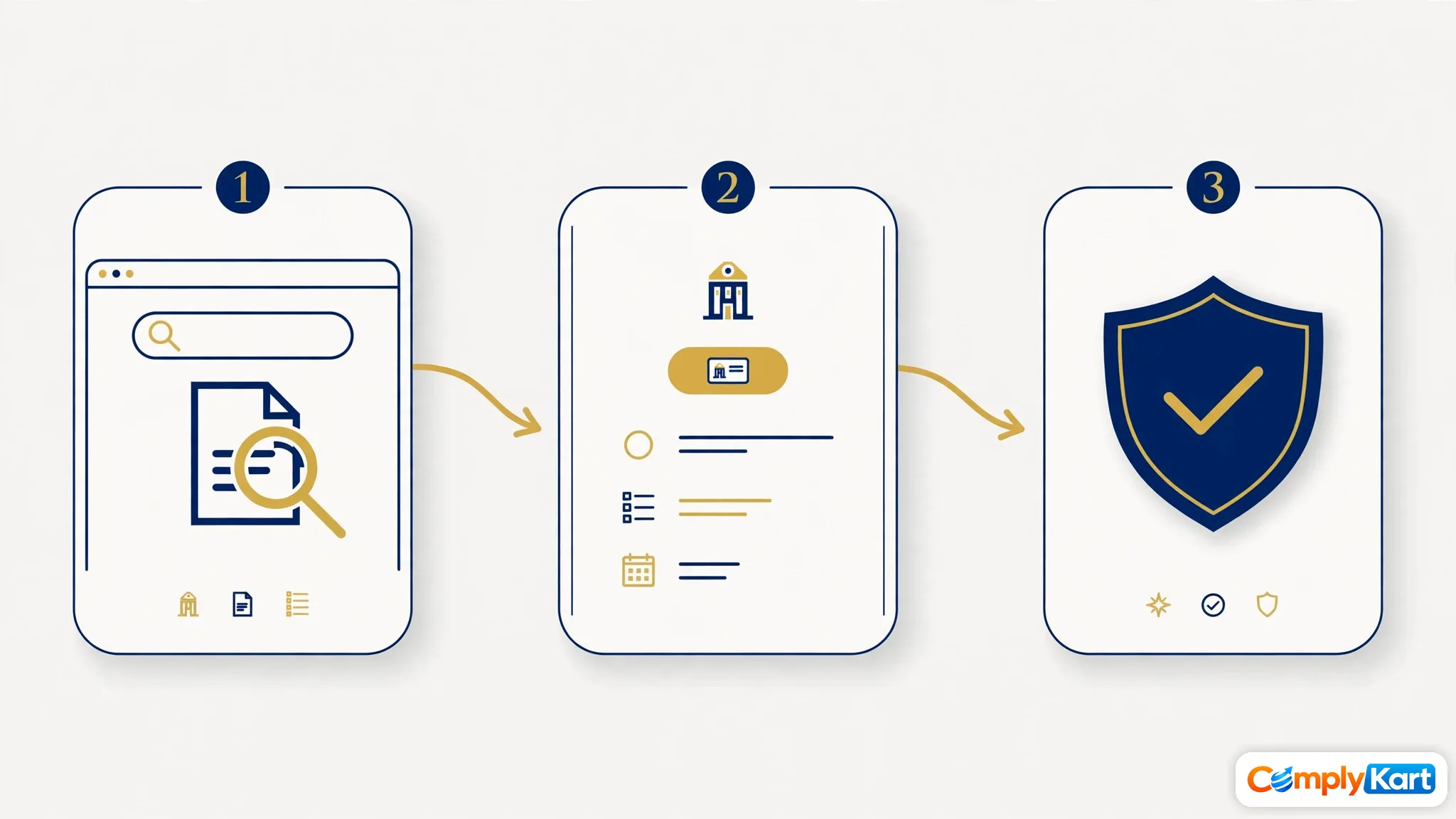
How to get dormant status: four steps
Step 1 — the board decides. The directors hold a board meeting, confirm the company meets all eight Rule 3 conditions, and pass a board resolution approving the application and choosing how the shareholders will approve it.
Step 2 — the shareholders approve. There are two routes, and founders often assume only the first exists. The company can pass a special resolution at a general meeting. Or it can issue a notice to all shareholders and get consent from shareholders holding at least three-fourths of the shares in value — no meeting needed. For a company with two or three cooperative shareholders, the consent route is usually faster. If you take the special-resolution route, file Form MGT-14 with the Registrar within 30 days of the resolution. The MCA's MSC-1 instruction kit expects the MGT-14 filing to be complete before MSC-1 goes in, so don't file them in the wrong order.
Step 3 — file Form MSC-1. The application goes to the Registrar with a statement of affairs certified by a chartered accountant, the auditor's certificate, the board and shareholder resolutions, and the lender's concurrence if an unsecured loan is outstanding. The statement of affairs has to be recent — dated within 30 days of the filing — so get the numbers first and file promptly; a stale statement of affairs is the most common avoidable rejection.
Step 4 — the Registrar issues Form MSC-2. If the Registrar is satisfied, it grants dormant status, issues the MSC-2 certificate, and enters the company in the register of dormant companies maintained on the MCA portal. The company's status in the MCA master data changes to dormant under Section 455.
What MSC-1 costs — the actual fee slabs
The fee for MSC-1, and the annual fee that goes with MSC-3 each year, comes from the Companies (Registration Offices and Fees) Rules, 2014. It depends on authorised capital, and small companies and OPCs pay less:
| Authorised capital | Other companies | Small company / OPC |
|---|---|---|
| Up to ₹25 lakh | ₹2,000 | ₹1,000 |
| ₹25 lakh to ₹50 lakh | ₹5,000 | ₹2,500 |
| ₹50 lakh to ₹5 crore | ₹10,000 | — |
| ₹5 crore to ₹10 crore | ₹15,000 | — |
| Above ₹10 crore | ₹20,000 | — |
A worked example makes the saving concrete. Take a private limited company with authorised capital of ₹10 lakh that has stopped trading. MSC-1 costs ₹2,000. The MGT-14 filing carries its own separate fee. The professional cost of the statement of affairs, the auditor's certificate and the filings is on top — get that quoted before you commit, since it varies by firm. Compare that with a year of full annual compliance: financial statements, annual return, board meetings, auditor, and the additional fees if anything slips. The government fee for going dormant is small. The saving is in everything you stop having to do every year — which is the next section.
One thing not to budget for: fee relief. The MCA's one-time Companies Compliance Facilitation Scheme, 2026, which let companies apply for dormant status at half the normal MSC-1 fee while it ran, has closed. Normal slab fees apply now. If a guide you are reading still presents that relief as available, it is out of date. If you want to work out what the filings will cost in your case, the compliance fee calculator gives you the numbers before you commit.
Life while dormant: what you still have to do
Dormant status is not a compliance holiday. It is a lighter routine, and the routine still has teeth. Here is what stays on the list.
Form MSC-3, every year, by 30 April. The return of a dormant company is due within 30 days of the end of each financial year, so 30 April for a March year-end. It carries the company's financial position, duly audited by a chartered accountant in practice, and the annual fee from the same slab table above. Miss it and the Registrar can start strike-off proceedings under Section 455(6). Our guide covers the annual MSC-3 filing in detail, including what goes into the audited financial position.
Minimum directors, always. Three directors for a public company, two for a private limited company, one for an OPC. The numbers never drop, dormant or not.
Two board meetings a year. Section 173(5) says a dormant company is treated as compliant if it holds at least one board meeting in each half of a calendar year, with a gap of at least 90 days between the two. A one-director OPC is exempt from this. Two meetings, ninety days apart, is the whole board calendar — but it still has to happen, and the minutes still have to exist.
Event filings continue. If the company allots shares or changes directors, the usual returns still go in on the usual deadlines. And the directors themselves still do DIR-3 KYC — the DIR-3 KYC rule is now once in three years, with the next round due by 30 June 2028, and it applies to directors of dormant companies exactly as it applies to everyone else.
The auditor stays, but rotation goes. Rule 6 expressly exempts dormant companies from the auditor-rotation rules under Section 139(2). The statutory audit itself does not go away — the financial position in MSC-3 has to be audited — but you are not forced to change auditors on the rotation clock.
The cash-flow statement drops out. The proviso to Section 2(40) lets a one person company, a small company, a dormant company or a DPIIT-recognised startup leave the cash flow statement out of its financial statements. It only helps once the company has actually obtained dormant status; simply being inactive does not qualify.
Income tax continues. Dormant status exists under the Companies Act. It changes nothing under the Income-tax Act. The company still files its return — usually a nil return — and keeps its PAN and TAN obligations. Forgetting the ITR because "the company is dormant" is one of the most common mistakes, and the tax department does not accept it as an excuse.
One honest uncertainty: AOC-4 and MGT-7. Sections 92 and 137 do not expressly exempt dormant companies from filing the annual return and financial statements, and professional opinion differs on whether a dormant company must keep filing them alongside MSC-3. In practice the MCA portal does not always accept those filings once a company holds dormant status. I am not going to pretend this is settled, because it isn't. Confirm the position with your Registrar before the deadline rather than assuming either outcome — and if you are already behind on those filings, read our guide on catching up on missed ROC filings before you apply.
The five-year clock
A company can remain dormant for a maximum of five consecutive financial years. If it stays dormant beyond that, the Registrar starts the process of striking its name off the register. Section 455(6) gives the Registrar the same power earlier if the company fails to comply with the section — missing MSC-3, not paying the annual fee, or letting the director count fall below the minimum are the usual triggers.
There is also a route you don't choose. Under Section 455(4), if a company fails to file financial statements or annual returns for two consecutive financial years, the Registrar issues a notice and enters its name in the register of dormant companies on its own. That is the Registrar putting a non-filing company into dormancy, not the company applying for it — and it arrives with the filing defaults still attached. Applying voluntarily, before the defaults pile up, is a much better position to be in.
Waking the company up: MSC-4
Reactivation is straightforward, and it has one deadline founders miss. File Form MSC-4 with the Registrar, together with Form MSC-3 for the financial year in which you apply. The Registrar issues a certificate of active status in Form MSC-5, and the company is back to full compliance from there.
The deadline is in Rule 8(3): if the company does anything that affects the grounds of its dormant application — it starts trading, takes a loan, signs a real contract — the directors must apply to become active within seven days. Seven days, not "when we get around to it". A company that quietly restarts business and files MSC-4 months later has spent months trading while dormant, which is exactly the position the seven-day rule exists to prevent. If the project is about to restart, file MSC-4 first.
Dormant vs strike-off: which one wins?
Both routes end the compliance burden. They differ in what survives. Strike-off under Section 248 dissolves the company — the name goes back into the pool, the CIN dies, and getting it back means incorporating again. Dormancy keeps everything and pauses the burden. Here is the decision in one table:
| Dormant (Section 455) | Strike-off (Section 248) | |
|---|---|---|
| Company survives? | Yes — name, CIN and identity kept | No — dissolved, name released |
| Reversible? | Yes — MSC-4, then MSC-5 | Effectively no — reincorporate |
| Government fee | MSC-1 ₹1,000–₹20,000 by capital slab; MSC-3 annual fee same slab | STK-2 ₹10,000 (plus clearing all dues first) |
| Yearly cost after | MSC-3 + audit + 2 board meetings | Nothing — the company is gone |
| Time limit | 5 consecutive financial years, then strike-off | None — it is final |
| Best when | The business may restart; an asset or IP needs the corporate shield; the pause is temporary | The business is truly over; nobody will ever need the name, history or CIN again |
The rule I use with founders: if there is any realistic chance the company trades again, or the name or the asset inside it has value, go dormant. If the venture is finished and everyone agrees it is finished, strike it off. Our guide on how strike-off actually works walks through the STK-2 route, and the voluntary strike-off service covers the filing itself. And if the choice is between the two because the company is small and the numbers are tight, remember that the small-company limits decide which fee slab you sit in for MSC-1 — a small company with authorised capital up to ₹25 lakh pays ₹1,000, not ₹2,000.
Six mistakes that cost dormant companies real money
- Paying a vendor invoice. Any transaction outside the four exclusions breaks the "no significant accounting transaction" test. One payment can undo the status.
- Leaving a director loan on the books. Promoter funding recorded as an unsecured loan blocks MSC-1 until the lender gives concurrence. Sort the loan before you apply, not after.
- Assuming the ITR goes away. It doesn't. A nil return is still a return, and a missed one still draws a notice.
- Missing MSC-3. The one annual filing that keeps the status alive. Miss it and Section 455(6) strike-off starts moving.
- Letting five years slip past. Dormancy has a clock. Diary the fifth year when you get the MSC-2, and decide — reactivate or strike off — before the Registrar decides for you.
- Restarting business before filing MSC-4. Seven days, Rule 8(3). File first, trade second.
A dormant company is a tool, not a hiding place. Used properly, it holds a name, an asset or a future project inside a live company for the price of one light filing a year. Used carelessly — a stray payment here, a missed MSC-3 there — it becomes a strike-off notice with a five-year fuse. The difference between the two is mostly paperwork, done on time. If your company has been quiet for a while and you are deciding between pausing it properly and closing it, the right answer depends on one question: will anyone ever need this company again? If the answer is maybe, dormant is the cheaper yes.
Frequently asked questions
Can a private limited company become dormant?
Yes. A private limited company, a public company and a one person company can all apply for dormant status under Section 455, as long as they meet all eight Rule 3 conditions — no investigations, no prosecutions, no outstanding public deposits or loans, no management dispute, no outstanding statutory or workmen's dues, and no listed securities.
How much does it cost to make a company dormant?
The government fee for Form MSC-1 depends on authorised capital: ₹2,000 up to ₹25 lakh, ₹5,000 up to ₹50 lakh, ₹10,000 up to ₹5 crore, ₹15,000 up to ₹10 crore and ₹20,000 above that. A small company or OPC pays ₹1,000 up to ₹25 lakh and ₹2,500 up to ₹50 lakh. The MGT-14 fee and professional costs are separate.
Does a dormant company need to file an income tax return?
Yes. Dormant status is a Companies Act concept and changes nothing under the Income-tax Act. The company must still file its return every year, usually a nil return, and keep its PAN and TAN active.
Can a dormant company have a bank account?
It keeps its existing account, but it should not be used for trading. Any real business receipt or payment through the account is a significant accounting transaction and breaks the basis of dormancy — keep the account only for the permitted payments like ROC fees and statutory dues.
What happens if a dormant company does not file MSC-3?
Missing MSC-3 is a failure to comply with Section 455, and under Section 455(6) the Registrar can strike the company's name off the register. MSC-3 is due within 30 days of each financial year-end, with the annual fee, and it is the one filing that keeps dormant status alive.




Comments
No comments yet — ask the first question below.
Join the discussion
Questions go straight to our expert desk. Comments appear after a quick review — no spam, no noise.