

IN BRIEF
The first board meeting after incorporation is the first formal meeting of a company's board of directors, which section 173(1) of the Companies Act, 2013 requires to be held within 30 days of incorporation. It appoints the first auditor, approves the registered office and bank account, issues share certificates and records the directors' disclosures, and its minutes must be entered in the minutes book within 30 days.
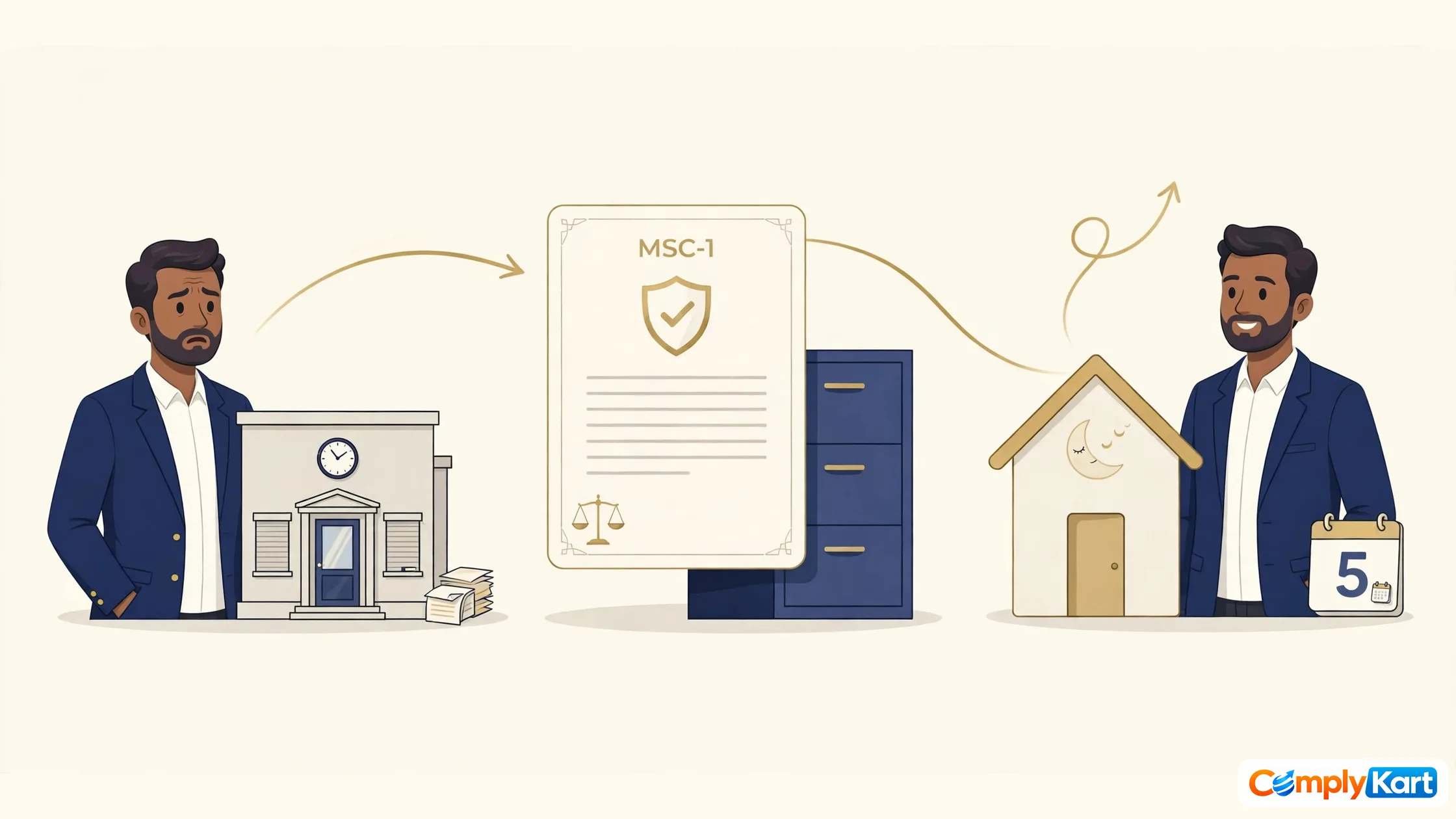
The certificate of incorporation lands in your inbox. You have a company now. And within 30 days of that date, your board has to meet — formally, with notice, an agenda and minutes. Most founders either do not know this meeting exists or hold it months late, when the paper trail is already cold. This guide covers what the first board meeting must do, by when, and what it costs to get it wrong.
A private limited company's first board meeting must be held within 30 days of incorporation under section 173(1) of the Companies Act, 2013. It appoints the first auditor, approves the registered office and bank account, issues share certificates and records the directors' disclosures. Its minutes must be entered in the minutes book within 30 days of the meeting.
When must the first board meeting be held?
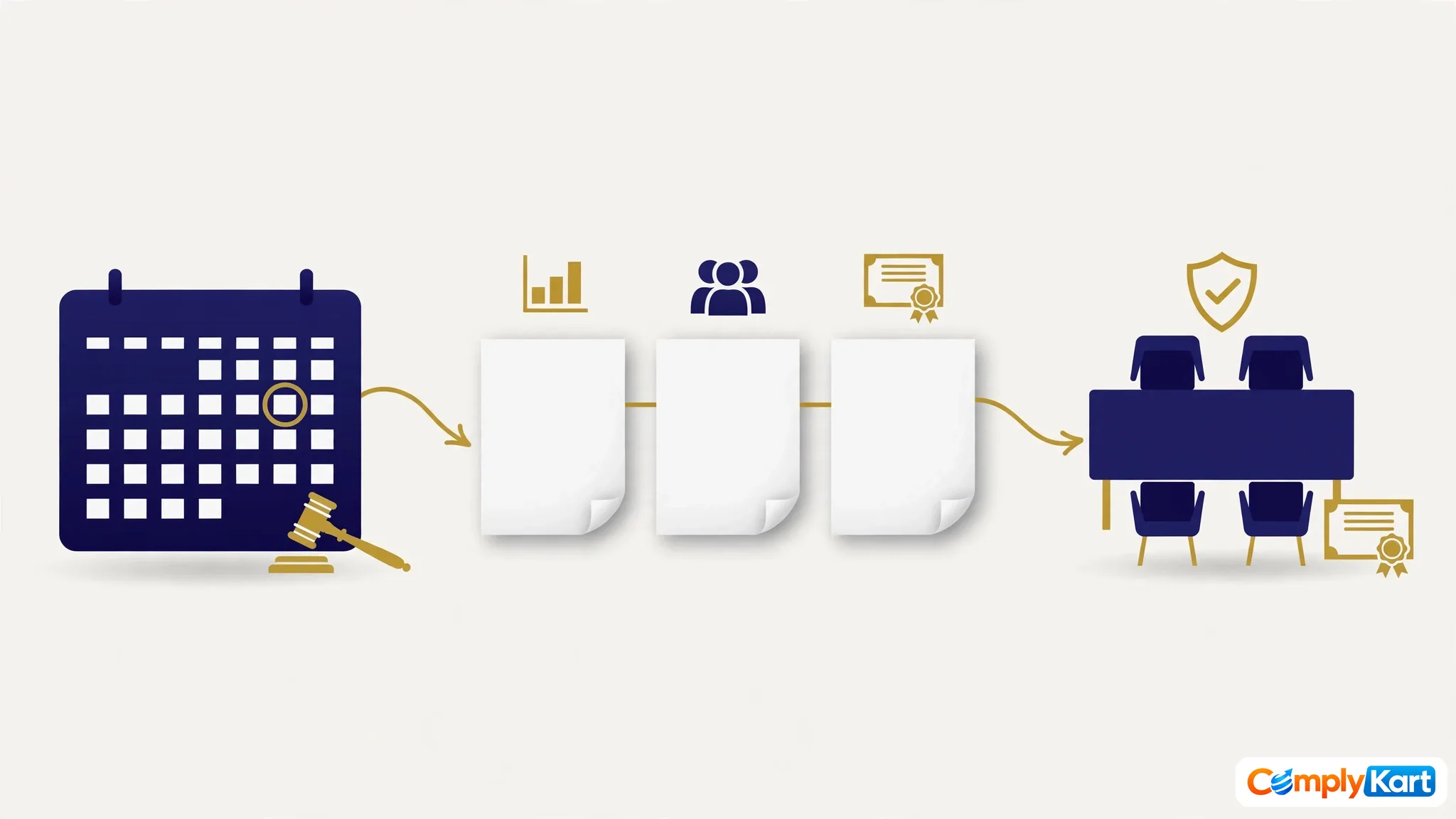
Thirty days from the date on the certificate of incorporation. Not thirty working days. Not a month. Thirty calendar days, and the clock starts on the incorporation date itself.
Take a real example. Your company is incorporated on Monday, 7 December 2026. Count thirty days forward and your first board meeting must be held by Wednesday, 6 January 2027. That is your last day, not your target day — aim for the second or third week, while the paperwork is still warm and every director still remembers what was agreed.
After this first meeting, the rhythm changes. Every company must hold at least four board meetings in a calendar year, with no more than 120 days between any two consecutive meetings. One person companies, small companies and dormant companies get a lighter rule: one meeting in each half of the calendar year, with at least 90 days between the two. The 30-day rule for the first meeting, though, applies to everyone. No exceptions.
What is the agenda of the first board meeting?
The agenda is not a formality. Each item exists because something downstream depends on it. Here is what a first meeting of a private limited company should cover, in the order I usually run it:
- Elect a chairman and note the incorporation. The board takes the certificate of incorporation on record and confirms the company's registered office address. If the office address in the incorporation papers was temporary, this is where the board approves the real one.
- Appoint the first auditor. Under section 139(6), the board must appoint the first auditor within 30 days of incorporation. The same 30-day clock as the meeting itself, so this item cannot wait for a later meeting.
- Take the directors' disclosures. Every director hands over two papers at this meeting: a general notice of interest in other companies and firms (Form MBP-1, section 184) and a declaration that they are not disqualified from being a director (Form DIR-8, section 164). Miss these and the disclosures sit undone for a year.
- Approve the bank account. The board authorises opening the company's current account and names who may operate it. Banks ask for this resolution. No resolution, no account — and the share application money has nowhere to go.
- Issue the share certificates. The board approves issuing share certificates to the subscribers. Section 56(4) gives you two months from incorporation to deliver them, but approving the issue at the first meeting keeps that clock from ever becoming a problem.
- Approve the common seal, letterhead and statutory registers. Small items, but the registers — members, directors, contracts — must exist from the start, not be reconstructed a year later.
- Note the share application money and allotment. The board records the subscription money received and allots the shares to the subscribers named in the memorandum.
- Appoint the first officers, if any. A company secretary, a chief financial officer, authorised signatories — whoever the business needs on day one.
None of this needs a long meeting. An hour, properly chaired, covers it. What it needs is a record — which brings us to notice and minutes.
How much notice does a board meeting need?
At least seven days' written notice to every director — by hand, by post or by email. The agenda and the notes on the agenda travel with the notice, so directors arrive having read what they are being asked to decide. That is Secretarial Standard SS-1, and it applies to the first meeting exactly as it does to the fiftieth.
There is a shorter-notice route, and it is also a trap. A meeting can be called at shorter notice, but only if at least one independent director — where the company has any — is present at the meeting. If no independent director is present, the decisions taken have to be circulated to and ratified by at least one independent director afterwards. Most brand-new private companies have no independent directors at all, which means the trap does not bite them yet. It bites the moment they appoint one and keep calling meetings on two days' notice out of habit.
My advice for the first meeting is simple. Do not use shorter notice at all. Seven days is not a burden when the meeting itself is the thing the whole first month is building towards.
What is the quorum — and what if it is not met?
The quorum for a board meeting is one-third of the total strength of the board, or two directors — whichever is higher. Any fraction rounds up to one. Directors attending by video conferencing count towards the quorum. A two-director board needs both directors present. A six-director board needs two. A nine-director board needs three.
Think of it like a cricket team. A match cannot start until the minimum number of players is on the field — and if too few turn up, the match is not cancelled. It is automatically rescheduled to the same time next week.
That is exactly what section 174(4) does. If a board meeting cannot be held for want of quorum, it stands adjourned automatically to the same day, the same time and the same place in the next week — or, if that day is a national holiday, to the next succeeding day that is not a national holiday. Your articles of association can provide otherwise, but if they do not, the adjournment is automatic. No fresh notice is needed for the adjourned meeting, and the 30-day clock for the first meeting does not pause while you wait. If your first meeting fails for want of quorum on day 28, the adjourned meeting lands on day 35 — late. Hold the first meeting early enough that a failed quorum still leaves you inside the thirty days.
One more quorum wrinkle worth knowing: if interested directors make up two-thirds or more of the board's total strength, the non-interested directors present — not less than two — form the quorum for that business. In a young company where the same two people are directors and shareholders and counterparties, this is the rule that quietly decides whether a resolution was validly passed.
What happens if the first board meeting is late?
There is no single fine printed next to section 173(1) that says "late first meeting: ₹X". The exposure comes through two other provisions, and together they are not small.
| Default | Provision | Penalty |
|---|---|---|
| Notice of the meeting not given to a director | Section 173(4) | ₹25,000 on every officer whose duty it was to give the notice |
| Board meetings not held as section 173 requires (including a late first meeting) | Section 172 | ₹50,000 on the company and on every officer in default, plus ₹500 per day while the failure continues — company cap ₹3,00,000, officer cap ₹1,00,000 |
| Minutes not prepared, signed or kept as required | Section 118(11) | ₹25,000 on the company and ₹5,000 on every officer in default, for each meeting |
So the honest answer to "what if we miss it" is: hold it late, and hold it properly. A late meeting with a clean record is a far smaller problem than a meeting that never happened. Record the delay in the minutes themselves — the date of incorporation, the date the meeting was actually held, and the reason for the delay, in one plain sentence. Do not back-date anything. A back-dated minute is a forgery problem; a late minute is a penalty problem. The two are not in the same league.
And remember the knock-on effects. If the first meeting is late, the first auditor's appointment is usually late too — section 139(6) gives the board the same 30 days. If the board fails to appoint, the members must appoint the auditor within 90 days at a general meeting. Late begets late. The cheapest day to hold the first meeting is the earliest one.
How are the minutes written — and by when?
Minutes are not a summary someone writes when they get around to it. Secretarial Standard SS-1 sets the timeline, and section 118 gives it teeth:
- Within 15 days of the meeting: draft minutes go to every director.
- Within 7 days of receiving them: directors send back their comments.
- Within 30 days of the meeting: the minutes are finalised, entered in the minutes book and signed by the chairman of that meeting (or the chairman of the next meeting).
The minutes book keeps its pages consecutively numbered, and the minutes of each meeting contain a fair and correct summary of the proceedings — who was present, what was decided, and any dissent recorded. Section 118(11) puts numbers on getting this wrong: ₹25,000 on the company and ₹5,000 on every officer in default, for each meeting whose minutes are defective. Four meetings with unsigned minutes in a year is ₹1,00,000 on the company before anyone has even looked at the substance.
One practical point: the minutes are the only proof the meeting happened. When a bank asks for the board resolution, when the auditor asks who approved the accounts, when a dispute turns on what the board decided in month one — the minutes book is the answer. Treat it as a legal record from the first entry, because that is what it is.
Does a one person company need a board meeting?
Not in the way a private limited company does. A one person company has a single director, and section 122(4) says the business that would need a board resolution is instead recorded by that director in the minutes book. There is no meeting to convene, no notice to send, no quorum to count.
The obligations do not disappear, though. The single director still has to appoint the first auditor within 30 days, still has to issue the share certificates within two months, and still has to keep the minutes book. The form changes; the deadlines do not. If you are weighing a one person company against a private limited company, that difference is real — but it is a difference of procedure, not of compliance.
Can the first board meeting be held on video call?
Yes. Section 173(2) lets directors participate through video conferencing or other audio-visual means, and their participation counts towards the quorum. For a founding team spread across cities, this is how the first meeting usually happens.
There is a limit. A handful of matters cannot be decided over video conferencing at all — approval of the annual financial statements, approval of the Board's report, approval of a prospectus, audit committee matters, and amalgamation, merger, demerger, acquisition or takeover proposals. None of those is on a first meeting's agenda, so the restriction rarely matters in month one. It matters later, and founders who get comfortable deciding everything on a call are the ones who trip over it.
Whatever the mode, record it. The minutes should state that the meeting was held by video conferencing, who attended from where, and that the audio-visual recording — if one was made — is kept with the company's records.
What forms follow the first board meeting?
The meeting itself needs no form and no MCA fee. It is a board act, not a filing. Its consequences are where the forms live:
- ADT-1, within 15 days of the first auditor's appointment. File it the week of the meeting, not the week you remember it.
- MGT-14, within 30 days of passing any resolution section 117 lists — appointments of a managing or whole-time director, borrowing resolutions and the other specified matters. Most first meetings do not pass an MGT-14 resolution, but check before you assume.
- Share certificates, within 2 months of incorporation under section 56(4). The board approved the issue at the meeting; the certificates still have to reach the subscribers.
- INC-20A, within 180 days of incorporation — the declaration of commencement of business. Our guide to the INC-20A commencement declaration covers its ₹50,000 plus ₹1,000-a-day penalty.
- Rule 9B demat check. This one is not a first-meeting item for most new companies, and it is worth saying so plainly. Rule 9B requires every private company that is not a small company to hold its securities in dematerialised form, but the test applies at each financial-year end on the audited financial statements, and the company then gets 18 months to comply. A brand-new small company has nothing to do in month one. The exception: a company that can never be a small company — a holding company, a subsidiary company or a section 8 company — should plan demat from the start.
Keep all of this on one page. Our post-incorporation checklist carries the same deadlines in the order they fall due, so the first meeting, the auditor filing and the commencement declaration stay on one list instead of three.
The mistakes I see most often
- Holding the meeting on day 40. The 30-day clock is the one founders discover in month three, when the auditor asks for the minutes.
- No notice, no agenda. A WhatsApp message saying "call at 4" is not seven days' written notice with an agenda. The meeting can be challenged, and the officer who should have given notice carries a ₹25,000 penalty.
- Minutes written from memory, months later. Draft minutes have a 15-day deadline for a reason. Memory fades; the minutes book does not forgive it.
- Forgetting MBP-1 and DIR-8. Two sheets of paper, collected at the first meeting, that otherwise sit undone until someone asks for them in a due-diligence exercise.
- Back-dating. Never. A late meeting minuted honestly is a penalty. A back-dated minute is a different conversation entirely.
- Treating the meeting as done once it is held. ADT-1 in 15 days, certificates in two months, INC-20A in 180 days. The meeting starts the clock on all of them.
The first board meeting is a small meeting with a long shadow. It sets the auditor, the bank account, the share certificates and the disclosures — and it sets the habit. Companies that minute their first meeting properly tend to minute every meeting properly. Companies that skip it tend to discover the gap years later, when fixing it costs ten times what holding it would have. Hold it early, minute it honestly, file what follows. That is the whole job.
If you are still at the stage of choosing the structure, our annual filing page sets out what the yearly cycle looks like once the first meeting is behind you. The certificate itself, and what to do the day it arrives, is covered in our guide to downloading the company registration certificate from MCA.
FAQs
Is the first board meeting compulsory for a private limited company?
Yes. Section 173(1) requires every company to hold its first board meeting within 30 days of incorporation. There is no exemption for a private limited company, however small. Only one person companies follow the section 122(4) route of recording decisions in the minutes book instead of holding a meeting.
What is the penalty for not holding the first board meeting on time?
There is no standalone fine printed next to section 173(1). The exposure runs through section 172 — ₹50,000 on the company and every officer in default, plus ₹500 per day while the failure continues — and through section 173(4), a ₹25,000 penalty on the officer who failed to give notice. Defective minutes add ₹25,000 on the company and ₹5,000 per officer under section 118(11).
Can the first board meeting be held before the certificate of incorporation arrives?
No. The board comes into existence with the company, and the 30-day clock runs from the incorporation date on the certificate. In practice the meeting is held in the days after the certificate arrives — which is why the certificate should be downloaded and the meeting called the same week.
Who can attend the first board meeting?
All directors named in the incorporation documents, plus any invitee the board wants present — the first auditor, the company secretary, a legal adviser. Only directors count towards the quorum and vote. Invitees attend; they do not decide.
Does the first board meeting need to be filed with the ROC?
No. The meeting itself is not filed. What gets filed are its consequences: ADT-1 within 15 days of the auditor's appointment, and MGT-14 within 30 days if the meeting passed a resolution section 117 requires to be filed. The minutes stay in the company's minutes book.



Comments
No comments yet — ask the first question below.
Join the discussion
Questions go straight to our expert desk. Comments appear after a quick review — no spam, no noise.