
IN BRIEF
GST same-line input tax credit is the credit allowed from 1 November 2026 under Notification No. 06/2026–Central Tax (Rate) to a 5% hotel, restaurant or caterer on a service bought in the same line of business and resold, such as accommodation bought from another hotel. The credit is capped at 2.5% central tax, or 5% integrated tax, of the inward value where the upstream supplier charged more.
The short answer: From 1 November 2026, a hotel, restaurant or caterer charging GST at 5% can claim credit on the same kind of service bought from another supplier in that line of business — a room from another hotel, catering from another caterer. Other purchases stay blocked, and hotel and catering credit is capped at 2.5% central tax of the inward value.
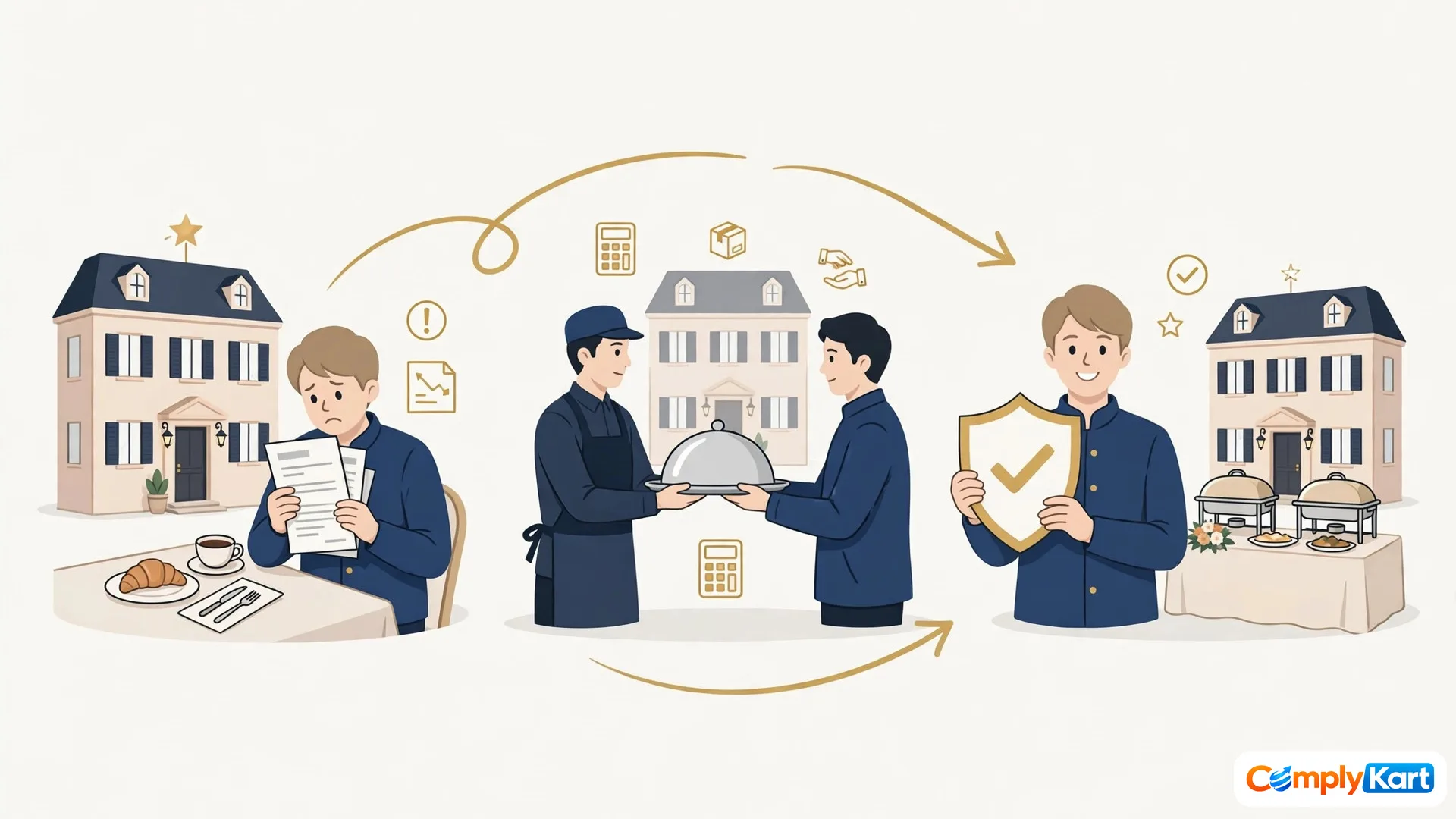
For years, the 5% hospitality rate came with a catch that every hotelier and caterer understood in their bones. You paid tax on what you bought, and you charged tax on what you sold, but the two never met. A travel agent who booked a room from a hotel, then sold that room on to a guest, paid GST twice on the same night's stay — once inside the hotel's bill, once on their own. It was like paying the toll twice for one journey. The 57th GST Council said this double hit should stop for services bought and resold in the same line of business, and Notification No. 06/2026–Central Tax (Rate), dated 27 October 2026, is the document that actually changes the rule. It takes effect on 1 November 2026.
What exactly changed on 1 November 2026?
Notification No. 06/2026–Central Tax (Rate), issued as G.S.R. 936(E), amends Notification No. 11/2017–Central Tax (Rate), the services rate notification from 28 June 2017. Its IGST mirror, Notification No. 06/2026–Integrated Tax (Rate), G.S.R. 937(E), amends Notification No. 8/2017–Integrated Tax (Rate) in the same words. Both take effect on 1 November 2026. The change sits in serial number 7 of the rate table, the entry that covers hotel accommodation, restaurant services, railway food supplies and outdoor catering at the concessional rate.
Before this change, the condition against those entries was blunt: credit of input tax on goods and services used in supplying the service had not been taken. In plain terms, a 5% supplier took no credit at all. The substituted condition keeps that block, then carves out one exception: credit on an input service in the same line of business. That single carve-out is the whole story of this post, and it is narrower than the headlines suggest.
Who gets the new credit, and on what?
The table below states the position entry by entry, as the substituted conditions read. Keep it beside your invoices, because the four rows are not identical.
Hotel accommodation — serial 7, item (i). Credit is allowed on hotel accommodation service procured from another supplier of hotel accommodation service. If that upstream supplier charged central tax above 2.5%, the credit is capped at 2.5% of the value of the inward accommodation service. Under IGST, the same cap is 5% of the value, because IGST carries both halves of the tax in one charge.
Restaurant services — serial 7, item (ii). Credit is allowed on a restaurant service procured from another service provider of restaurant service, other than at specified premises. Note two things. First, the restaurant entry does not carry the 2.5% cap sentence that the hotel and outdoor catering entries carry — read the entry, not the headline. Second, a restaurant service bought from a provider at specified premises falls outside the wording of the exception, so a restaurant that buys in food service from a specified-premises outlet should not assume the credit follows.
Railway food supplies — serial 7, item (iii). This row is worded more widely than the others. Credit is allowed on inputs and input services in the same line of business — food, articles for human consumption or drinks, whether in trains or at platforms — procured from Indian Railways or IRCTC or their licensees. Where hotels and caterers get an exception for input services only, the railway row expressly covers inputs too, but only from that named supply chain.
Outdoor catering — serial 7, items (iv) and (v). Credit is allowed on outdoor catering service procured from another supplier of outdoor catering service. The 2.5% central tax cap applies here as it does for hotels, and 5% under IGST.
If your business is a restaurant working out whether the 5% or the 18% route suits it, the rate choice itself is a separate decision from this credit change — our guide to GST for restaurants at 5% versus 18% walks through it, and the rate list in our GST rate list for 2026 puts the entries in context.
How does the cap work? The notification's own numbers
The notification does not leave the cap to guesswork. It illustrates it twice, and both illustrations repay a careful read because they show the same trap: the credit follows the value of the inward service, not the tax printed on the upstream invoice.
Take the hotel illustration. A guest books accommodation from an intermediary for ₹7,000 per unit per day. The intermediary procures that accommodation from another hotel for ₹10,000 per unit per day, and that hotel charges central tax at 9%, which is ₹900. The intermediary charges its guest central tax at 2.5%. The intermediary's credit on that inward accommodation is ₹250 — 2.5% of ₹10,000 — and not the ₹900 charged upstream. The missing ₹650 is simply not credit. Under IGST the same facts give ₹500, which is 5% of ₹10,000, against ₹1,800 charged upstream. Add the two halves of a combined charge together and the maths agrees: 2.5% central plus 2.5% state equals the 5% combined rate, and the cap is that 5% of the inward value.
Now the wedding catering illustration. A caterer charges a client ₹1,00,000 for a composite supply of outdoor catering together with renting of premises, at premises other than specified premises. To deliver it, the caterer engages another outdoor caterer for ₹60,000, who charges central tax at 9%, which is ₹5,400. The principal caterer charges central tax at 2.5%, which is ₹2,500. Its credit on the subcontracted catering is ₹1,500 — 2.5% of ₹60,000 — and not ₹5,400. Again, the credit is capped at the concessional rate applied to the inward value, even though the upstream invoice shows far more tax.
I find the relay race the clearest way to picture this. The baton is the service itself — a room-night, a catered event. Each runner in the relay pays tax when the baton passes, but only the baton itself now carries credit forward. Everything the runners eat, wear and travel on along the way stays outside the relay.
What is still blocked? Almost everything else
This is where a careless reading costs money. The substituted condition still says credit on goods and services used in supplying the service, other than the same-line exception, has not been taken. For a hotel, that means no new credit on food and beverages bought for the restaurant, linen, housekeeping contracts, repairs, marketing or rent merely because this notification exists. For a restaurant, it means no new credit on ingredients, crockery, delivery bikes or staff transport. For a caterer, it means no new credit on groceries, fuel, tents or waiters hired through an agency. The exception covers a service bought in the same line and resold — a room bought from a hotel and sold as a room, a catering job subcontracted to another caterer and sold as catering. It does not turn a 5% supplier into a full-credit supplier.
Two further cautions belong here. First, the general conditions for claiming credit still apply — the inward supply must be a genuine taxable supply, supported by a proper invoice, and used in the course of business. A same-line label on an invoice does not cure a supply that is not what it claims to be. Second, the change takes effect on 1 November 2026. The substituted condition does not rewrite earlier periods in its text, so do not go back and re-claim credit on pre-November invoices on the strength of this notification. If you have old-period credit questions, they need advice on their own facts.
What should a hotel, restaurant or caterer do this week?
Start with your own outward entry, not with your purchase ledger. Confirm which serial 7 item your outward supply actually falls under, and whether you charge at the concessional rate or, for a specified-premises restaurant, at 18% with credit. The same-line exception only matters if you sit under one of the restricted-credit entries.
Then separate your inward invoices into two piles. Pile one: services in the same line of business, from a supplier in that same line — a hotel buying rooms from a hotel, a caterer subcontracting to a caterer, a restaurant buying restaurant service from a non-specified-premises restaurant. Pile two: everything else. Only pile one goes near the new credit, and for hotels and caterers, run the cap calculation on each pile-one invoice before you book the credit: 2.5% of the inward value for central tax, 5% for IGST, and take the lower of that figure and the tax actually charged. If the upstream supplier charged at or below the cap rate, the cap does not bite; the trap only springs when the upstream rate is higher, which is exactly when a busy intermediary is most likely to over-claim.
Finally, keep the proof that the inward supply really is same-line: the supplier's description of the service, the booking or event record that ties it to your outward supply, and the invoice showing the value the cap was calculated on. When an officer asks why a 5% supplier is suddenly claiming credit, that file is your answer. Businesses already registered for GST can check their registration details through our GST registration service, and if the new credit changes how you file, our GST returns service and the compliance fee calculator can help you price the work.
Five mistakes to avoid
Claiming the full tax on the upstream invoice instead of the capped figure. That is the ₹900-versus-₹250 error in the notification's own illustration, and it will be the most common mistake in November returns.
Treating food, rent, housekeeping or marketing as same-line supplies. They are inputs to the business, not the same service resold, and the block on them is unchanged.
Assuming a restaurant bought from a specified-premises outlet qualifies. The restaurant exception is worded for services procured other than at specified premises.
Mixing up the CGST and IGST caps. The cap is 2.5% of value in the central tax notification and 5% in the IGST notification — the same combined 5%, counted once, not twice.
Backdating the relief to pre-November invoices. The substituted conditions take effect on 1 November 2026; earlier periods sit under the old condition.
Frequently asked questions
Can a hotel now claim ITC on everything it buys? No. Only hotel accommodation service bought from another hotel supplier qualifies, and the credit is capped at 2.5% central tax (5% IGST) of the inward value where the upstream supplier charged more. Food, linen, repairs and all other purchases stay blocked under the entry.
Does a restaurant get full ITC now? No. A restaurant under the concessional entry gets credit only on restaurant service bought from another restaurant provider other than at specified premises. Ingredients and other running costs stay blocked, and the 18% specified-premises route, with its own credit position, is a different entry altogether.
Why is there no 2.5% cap sentence for restaurants? Because the substituted condition for serial 7, item (ii) does not include one, unlike the hotel and outdoor catering items. That is a difference in the notification's text, not a promise of unlimited credit — the general credit conditions still govern, and restaurants should read the entry with their adviser before claiming on a large subcontracted value.
How do the CGST and IGST caps relate? They are the same ceiling expressed per tax. Central tax caps the credit at 2.5% of the inward value and state tax mirrors it, giving 5% combined; a single IGST charge caps at 5% of the value. Never add the two caps together on one supply.
Does the relief apply to supplies made before 1 November 2026? No. Both notifications state they come into force on 1 November 2026. The old condition governed earlier supplies, and the new exception should be applied only from that date.
The same notification also rewrote the entries for electric vehicle transport and delivery services, which we covered separately for EV fleet operators and for e-commerce delivery services. Read this post alongside those two and the picture of the 1 November package is complete: the Council is not handing hospitality a general credit, it is unblocking one specific chain — the same service, bought and sold again — and capping it at the rate the final customer actually bears.


Comments
No comments yet — ask the first question below.
Join the discussion
Questions go straight to our expert desk. Comments appear after a quick review — no spam, no noise.