
IN BRIEF
From 1 November 2026, GST scrap reverse charge and TDS under Notifications No. 04/2026–Central Tax (Rate), No. 06/2026–Central Tax and No. 07/2026–Central Tax require a registered buyer to pay the tax on used cooking oil, plastic, tyre, metal or electronic-waste scrap bought from an unregistered seller, deduct 2% from a registered seller, and end the registration exemption for sellers of these goods.
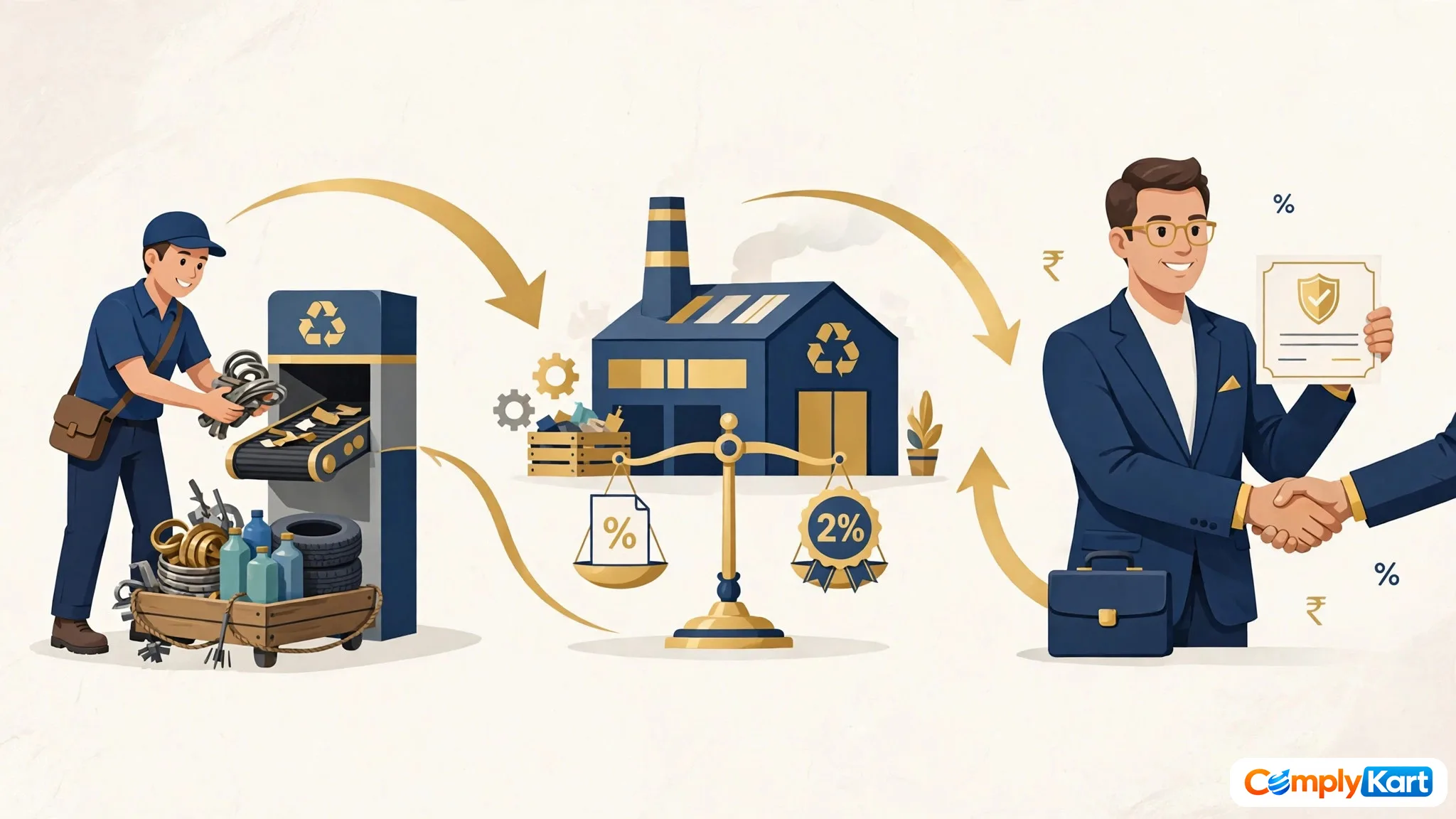
If you buy or sell scrap in India, tomorrow changes how tax moves on your deals. From 1 November 2026, three GST notifications issued on 27 October 2026 pull used cooking oil, plastic waste, tyre waste and electronic waste into the same system metal scrap has lived under since October 2024. The buyer either pays the tax himself or holds back 2% of the payment. And the seller can no longer hide behind the buyer's tax payment to stay unregistered.
The short answer: from 1 November 2026, a registered buyer who purchases used cooking oil, plastic scrap, tyre scrap or electronic waste from an unregistered seller must pay the GST on that purchase under reverse charge. If the seller is registered, the buyer instead deducts 2% tax at source where the contract value crosses ₹2.5 lakh. Sellers of all five goods, metal scrap included, lose the special registration exemption and must register once they cross the normal turnover threshold.
The three notifications, side by side
All three notifications are dated 27 October 2026 and take effect from 1 November 2026. They came on the recommendation of the GST Council at its 57th meeting on 8 October 2026. Each one does a different job, and you need all three to see the full picture.
| Notification | What it does | Who it bites |
|---|---|---|
| 04/2026–Central Tax (Rate), G.S.R. 927(E) | Extends reverse charge under section 9(3) of the CGST Act to four new goods bought from unregistered sellers | Registered buyers |
| 06/2026–Central Tax | Withdraws the registration exemption under section 23(2) for sellers of the five goods | Scrap sellers above the threshold |
| 07/2026–Central Tax | Extends section 51 TDS to registered buyers of the five goods from registered sellers | Registered buyers paying registered sellers |
Notice the pattern. The government is closing the same gap from three sides at once: it taxes the purchase when the seller is outside the system, it holds back part of the payment when the seller is inside it, and it stops sellers from using the buyer's tax payment as a reason to stay outside. I have seen this playbook before. Metal scrap got exactly this treatment in October 2024, and now the net widens to four more trades.
The five goods on the list
| Goods | Tariff heading | New from 1 November 2026? |
|---|---|---|
| Used cooking oil | 1518 | Yes |
| Waste and scrap of plastics | 3915 | Yes |
| Waste and scrap of tyres | 4004 | Yes |
| Electrical and electronic waste and scrap | 8549 | Yes |
| Metal scrap | Chapters 72 to 81 | No — already covered since October 2024 |
If your trade is not on this list, these notifications do not touch you. If it is, keep reading, because the rest of this guide is about your next invoice.
What reverse charge actually means
Normally the seller charges GST and deposits it. Under reverse charge, the charge flips. The buyer pays the tax straight to the government instead of paying it to the seller as part of the bill.
Think of a toll gate. Normally the driver ahead of you pays and you follow through. Reverse charge moves the toll booth to your lane. You stop, you pay, you carry on. The road is the same. Only the person handing over the money changes.
From 1 November 2026, Notification No. 04/2026–Central Tax (Rate) puts four new entries into the reverse charge notification (No. 4/2017–Central Tax (Rate)). Each entry names the supplier as "any unregistered person" and the recipient as "any registered person". So the rule fires only in one combination: unregistered seller, registered buyer. Two practical points follow. First, the buyer issues a self-invoice for the purchase, because an unregistered seller cannot issue a tax invoice. Second, reverse charge tax is paid in cash through the electronic cash ledger, not adjusted against your input tax credit balance. You can then claim input tax credit on the purchase if you are otherwise eligible, like any other business purchase.
One honest gap to flag: the reverse charge notification itself prescribes no tax rate. It only says who pays. The rate comes from the rate schedule for that item. Do not let anyone quote you a single "RCM rate" for all five goods — the notification does not contain one.
Who pays what: the decision matrix
Every scrap deal from tomorrow falls into one of four boxes. Find yours.
| Your position | Seller unregistered | Seller registered |
|---|---|---|
| You are a registered buyer | You pay GST under reverse charge and issue a self-invoice | Seller invoices with GST; you deduct 2% TDS if the contract exceeds ₹2.5 lakh |
| You are an unregistered buyer | No reverse charge duty and no TDS duty — both entries name a registered recipient | Seller invoices normally; no TDS duty on you |
The matrix is the whole reform in one picture. A registered buyer can no longer buy scrap without a tax consequence in either direction. That is the point. The scrap trade ran for years on cash deals and loose paper, and the government has decided every registered purchase must now leave a tax trail.
How the 2% TDS works
Tax deducted at source under section 51 of the CGST Act is not a new tax. It is a slice of the payment held back and deposited with the government by the buyer. The seller gets credit for it in the electronic cash ledger and uses it against future GST dues. Nothing is lost. The money just travels through the government instead of straight from buyer to seller.
Notification No. 07/2026–Central Tax substitutes clause (d) of Notification No. 50/2018–Central Tax. Until now that clause covered metal scrap alone, added in October 2024 after the 54th Council meeting. From 1 November 2026 it covers all five goods. Any registered person receiving any of them from another registered person must deduct TDS. Here are the mechanics that matter:
- Rate: 2% of the taxable value, excluding GST. Within a state that splits as 1% CGST plus 1% SGST. Between states it is 2% IGST.
- Threshold: only where the total value of supply under one contract exceeds ₹2.5 lakh, measured on the value excluding GST. It is a per-contract test, not a per-invoice test.
- Payment and return: deposit the deducted amount and file Form GSTR-7 by the 10th of the next month. The supplier gets the TDS certificate in Form GSTR-7A on the portal.
- Registration: a buyer who must deduct needs TDS deductor registration in Form GST REG-07. Your normal GSTIN does not cover this. If you already deduct TDS on metal scrap, your existing registration covers the new goods too.
A round-number illustration, not a real deal: your recycling unit buys plastic scrap worth ₹6,00,000 under one purchase order from a registered dealer in your state. GST is charged on top at the applicable rate. You deduct 2% of ₹6,00,000, which is ₹12,000 — ₹6,000 CGST and ₹6,000 SGST. You pay the dealer the invoice amount less ₹12,000, deposit ₹12,000 by the 10th of next month, and file GSTR-7. The dealer sees ₹12,000 in the electronic cash ledger and uses it against the next return. The dealer is not ₹12,000 poorer. The payment is only routed differently.
Do scrap sellers have to register now?
This is the change small dealers will feel first. Notification No. 5/2017–Central Tax once said something generous: if every supply you make is one on which the buyer pays tax under reverse charge, you need not register at all, whatever your turnover. Metal scrap sellers lost that shelter in October 2024 through Notification No. 24/2024–Central Tax. Notification No. 06/2026–Central Tax, issued under section 23(2), now replaces that proviso with a wider one covering all five goods.
From 1 November 2026, the exemption is gone for these goods. Only the normal turnover threshold decides. For goods, that threshold is ₹40 lakh a year in most states, with a lower ₹20 lakh limit in the special-category states. So two dealers in the same town face different answers. A dealer selling ₹60 lakh of plastic scrap a year must register — the buyer's reverse charge payment no longer excuses it. A dealer selling ₹15 lakh of used cooking oil a year need not register, and the registered buyer simply pays reverse charge on those purchases and issues a self-invoice.
If you cross the threshold, apply within 30 days of becoming liable, as section 25(1) requires. Once you are registered, the whole picture flips for your buyers: you raise a proper tax invoice and charge GST, reverse charge stops applying to your sales, and your registered buyers start deducting 2% TDS instead. Registration is not a punishment here. It is what lets you sell to large buyers without friction, and it is what turns the 2% holdback into usable cash-ledger credit rather than a mystery deduction.
Your before-1-November checklist
If you buy scrap, do these four things this week. First, list every supplier of the five goods and mark each one registered or unregistered — your tax treatment now depends on that single fact. Second, if you are not already a TDS deductor, apply for REG-07 registration before your next payment run. Third, tell your accounts team to build two separate payment codes: reverse charge for unregistered suppliers, 2% TDS for registered ones. Mixing them up is the easiest way to get this wrong. Fourth, check your self-invoice format is ready, because you will need it for every unregistered purchase from tomorrow.
If you sell scrap, do these three things. First, add up your sales of the five goods for this financial year. If you have crossed ₹40 lakh, or will cross it soon, apply for GST registration now rather than waiting for a buyer to ask why you have no GSTIN. Second, warn your regular buyers that registered-buyer payments will arrive 2% short, and reconcile that 2% against your cash ledger every month. Third, if you stay below the threshold, keep a simple turnover record — your buyers may ask for it before they pay reverse charge on your supplies.
Five mistakes to avoid
- Treating TDS as an extra cost. It is not. The supplier gets full credit in the cash ledger. Price your deals on the invoice value, not on the net payment.
- Deducting TDS on an unregistered supplier. TDS applies only between registered persons. An unregistered supplier means reverse charge, not TDS.
- Paying reverse charge out of input credit. Reverse charge liability is discharged in cash. Set the cash aside when the purchase is booked, not at return-filing time.
- Testing the ₹2.5 lakh limit invoice by invoice. The test is per contract. Three ₹1 lakh deliveries under one ₹3 lakh order cross the limit, even though no single invoice does.
- Registering when you do not need to, or skipping it when you do. Below the threshold, registration is optional and the buyer handles the tax. Above it, the exemption no longer protects you — delay only builds up a liability.
What has not changed
Three things stay exactly as they were. Metal scrap dealers and buyers keep doing what they have done since October 2024 — the new notifications extend their system, they do not rewrite it. The TDS rate and the ₹2.5 lakh contract threshold are unchanged; only the list of goods grows. And no new tax has been invented. The same GST on the same goods is simply collected at a different point, by a different hand, with a paper trail the department can follow. For the honest dealer, that paper trail is protection, not trouble. It proves the tax was paid, whoever paid it.
If you deal in any of these five goods, tomorrow is a compliance deadline disguised as an ordinary Saturday. Sort your suppliers into registered and unregistered, fix your payment codes, and file the registration if your turnover says so. The compliance fee calculator can help you size the cost of getting registered and staying current, and our 1 November GST changes guide covers the discount and refund changes landing the same day. The GST rate list for 2026 and the simplified registration guide for online sellers are worth a read alongside this one, and GST return filing covers the GSTR-7 and GSTR-3B mechanics mentioned above.
Frequently asked questions
What GST rate applies to scrap bought under reverse charge? The reverse charge notification names who pays, not the rate. The rate comes from the rate schedule for that particular item, so check the heading — 1518, 3915, 4004, 8549, or Chapters 72 to 81 — rather than assuming one rate fits all five goods.
My buyer deducts 2% TDS. Do I lose that money? No. The deducted amount lands in your electronic cash ledger once the buyer files GSTR-7, and you use it to pay your own GST. If it piles up unused, it can be claimed as a refund under the normal rules.
I sell under ₹40 lakh of scrap a year. Must I register from 1 November? No. The withdrawal of the exemption only removes a special shelter; the normal threshold still decides. Below it, you stay unregistered and your registered buyers pay reverse charge on your supplies.
Does TDS apply if my contract is ₹2,00,000? No. The threshold is a contract value above ₹2.5 lakh on the taxable value excluding GST. At ₹2,00,000 the buyer pays you in full, and you invoice normally if you are registered.
I buy scrap for my factory but I am not a scrap dealer. Does this apply to me? Yes, if you are registered and you buy any of the five goods. The entries name "any registered person" as recipient. Factories buying used cooking oil or plastic scrap as raw material are squarely inside the new rules.



Comments
No comments yet — ask the first question below.
Join the discussion
Questions go straight to our expert desk. Comments appear after a quick review — no spam, no noise.