
IN BRIEF
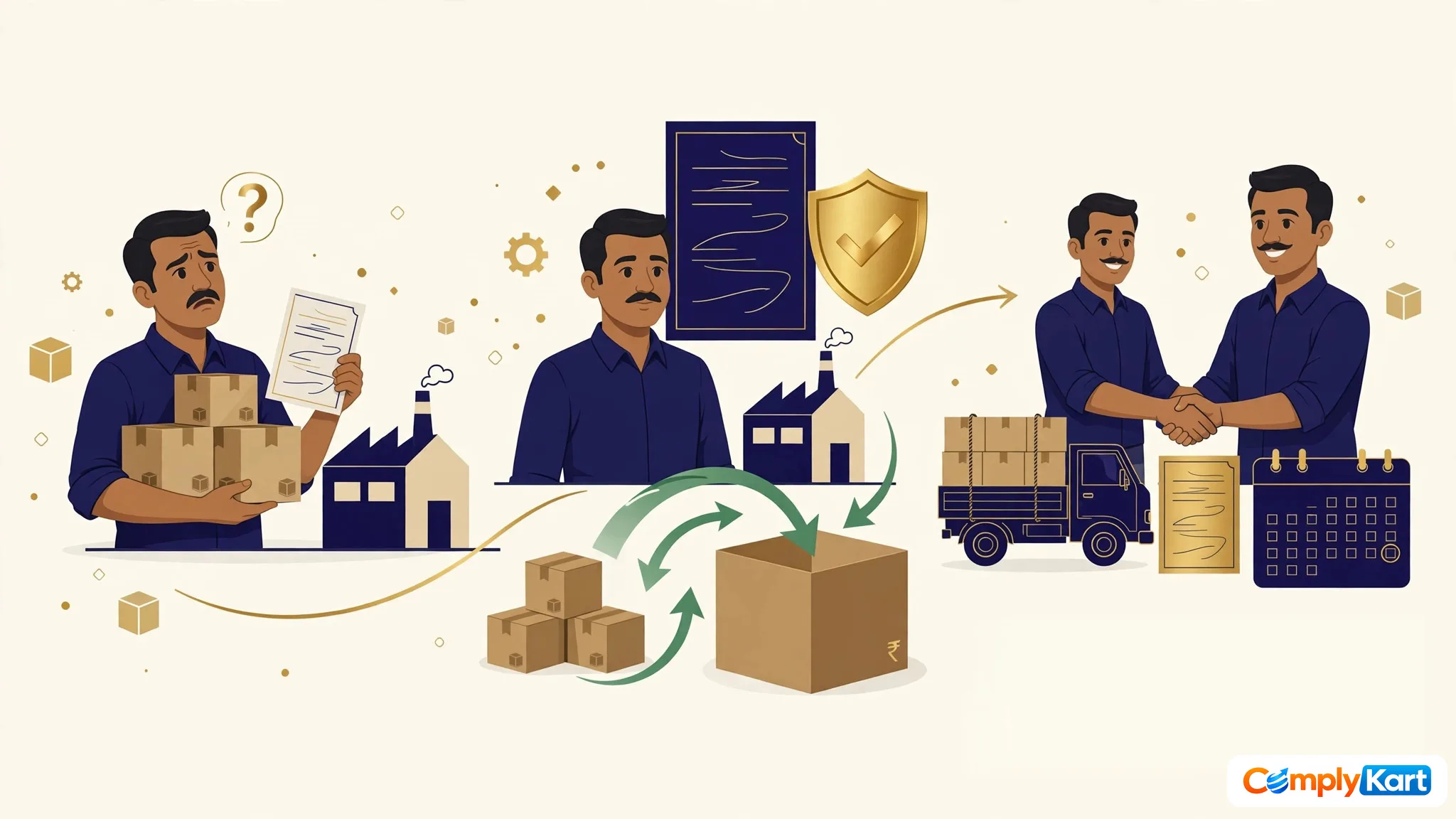
GST for manufacturers is the set of Goods and Services Tax rules that apply when a business makes goods in India: registration once aggregate turnover crosses ₹40 lakh, tax charged on the supply of the finished goods at 5%, 18% or 40% under the CGST Act, 2017, input tax credit on raw materials and machines, and the job-work procedure in sections 19 and 143 for goods sent out for processing.
Short answer: GST for manufacturers turns on five things: register once turnover crosses ₹40 lakh, charge 5% or 18% on most goods, claim input tax credit on raw materials and machines, send goods for job work on a challan with a 1-year or 3-year return clock, and file GSTR-1 and GSTR-3B on time. Get those five right and GST runs itself.
I have sat with enough factory owners to know how GST feels from their side of the desk. You bought steel, you paid GST on it, you turned it into something, you sold it and charged GST again. Somewhere in that chain sits the question every manufacturer asks: how much of the tax I paid can I get back, and what paperwork keeps me out of trouble? This guide answers that, in the order you will actually need it. Remember first that GST taxes the supply, not the making — you are taxed when you sell, not when you manufacture.
Do you have to register for GST?
Yes, once your aggregate turnover crosses ₹40 lakh in a financial year. In the special-category states — the north-east, Himachal Pradesh, Uttarakhand, Jammu & Kashmir — the line is ₹20 lakh. Aggregate turnover means everything under your PAN: taxable sales, exempt sales, exports, even job-work receipts. It is not profit, and it is not one factory's sales. Count it all.
Three situations force registration whatever your turnover is. Sell goods to another state and you must register from the first rupee — section 24 of the CGST Act makes inter-state supply of goods a compulsory-registration case. Supply through an e-commerce operator who collects tax at source, and the same rule bites. And if your buyers are bigger companies, they will ask for your GSTIN before they place an order, because without your invoice they cannot claim their own credit. I tell small units to register a little before they must, for exactly that reason: an unregistered vendor loses B2B orders.
Registration itself is online on the GST portal, with Aadhaar authentication. The government charges no fee for the application. Our GST registration page walks through the documents and the turnover-band choice.
What rate do you charge on what you make?
Since 22 September 2025, GST 2.0 runs on three slabs: 5%, 18% and 40%. Most manufactured goods sit at 5% or 18%. The 40% list is short — aerated sugary drinks, larger cars and motorcycles, and a handful of other luxury items. Notifications 9/2025 and 15/2025 (Central Tax (Rate)), both dated 17 September 2025, carry the full schedules.
Your exact rate comes from your product's HSN code, not from what you call it. A steel casting under heading 7325 is 18%. A food product is usually 5%. Get the HSN wrong and the rate follows the error, so check the code in the HSN finder before you raise your first invoice. Two HSN details matter for paperwork: if your turnover is up to ₹5 crore you must quote at least 4 digits on B2B invoices; above ₹5 crore, 6 digits.
One more rate point. If you buy inputs at 18% and sell finished goods at 5%, credit piles up faster than you can use it. Section 54(3)(ii) lets you claim a refund of that unutilised ITC on inputs — not on services or machines — through RFD-01 under the Rule 89(5) formula. Claim it each cycle rather than letting a year's credit sit idle; the GST refund route is where it starts.
Composition or regular — which scheme suits a manufacturer?
If your turnover in the previous year was up to ₹1.5 crore (₹75 lakh in the eight special-category states), you can opt for the composition scheme under section 10. You pay a flat 1% of turnover — 0.5% CGST plus 0.5% SGST — file a quarterly statement in CMP-08 and one annual return in GSTR-4, and skip invoice-level reporting. You opt in with CMP-02 before the year starts.
But composition has a price, and for most manufacturers it is too high: you cannot claim input tax credit, you cannot charge GST on your invoices, and you cannot sell goods to other states. Ice cream, pan masala and tobacco makers cannot opt in at all.
Run the numbers before you choose. Take a unit with ₹1.2 crore of sales and ₹60 lakh of input purchases in the year.
- Regular scheme: you collect 18% on ₹1.2 crore of sales, which is ₹21.6 lakh, and you claim the ₹10.8 lakh GST you paid on inputs. You pay the government ₹10.8 lakh net — all of it money your customers handed you.
- Composition: you pay 1% of ₹1.2 crore, which is ₹1.2 lakh, from your own pocket. And the ₹10.8 lakh GST on your inputs never comes back. Your real tax cost is ₹12 lakh.
That is why I rarely recommend composition to a manufacturer who sells to other businesses. Your buyers want your ITC; without it, your invoice costs them more than a competitor's. Composition fits a small unit selling locally to consumers, with thin input purchases and no inter-state ambition. If that is not you, stay regular.
What credit can you claim?
Input tax credit is the heart of GST for a manufacturer. You pay GST on raw material, packing, consumables, plant and machinery, and you set it off against the GST you collect on sales. You pay tax only on the value you added. Four things have to line up for a credit to be yours: a valid tax invoice, goods actually received, the supplier having paid the tax to the government, and the supplier having filed the return so the invoice shows in your GSTR-2B. If your vendor does not file, your credit does not appear — no matter how correct your own paperwork is. Check 2B before you pay a vendor's full bill, not after.
Machines deserve a paragraph of their own, because a wrong idea about them is everywhere. You claim the full ITC on a machine in the month you receive it, through your regular GSTR-3B. It is not spread over the machine's useful life — that is how income-tax depreciation works, not GST. One catch: if you claim income-tax depreciation on the GST part of the machine's cost, you lose the credit on that part (section 16(3)). Pick one. For most units the ITC is worth more.
Some credits are blocked outright under section 17(5), however genuine the purchase. Motor vehicles, food and beverages, club memberships, and works contracts for your own building sit on that list. A new shed for the factory does not earn ITC on its construction; the machines inside it do.
Job work: sending goods out without paying GST on the movement
Almost every manufacturer sends something out — cutting, dyeing, polishing, assembly, plating. Under GST that is job work: processing done on goods that belong to you, by someone else. Section 2(68) defines it, section 143 sets the procedure, and section 19 protects your credit while the goods are away.
Think of it like lending your neighbour your mixer-grinder with the return date written on the box. The law writes the date for you. Inputs and semi-finished goods must come back, or be sold from the job worker's premises on your behalf, within one year of dispatch. Capital goods get three years. Moulds, dies, jigs, fixtures and tools have no time limit at all. Miss the clock and the law treats the dispatch as a supply made on the day you sent the goods — tax plus interest under section 50, and the credit you claimed comes back with it.
The paperwork is small but strict. Every movement goes on a delivery challan under Rule 55, and you report it in Form ITC-04. Since Notification 35/2021, ITC-04 is half-yearly if your preceding-year turnover exceeds ₹5 crore and annual otherwise, due on the 25th of the month after the period. The portal does not fill it in for you; if you forget it, the department's first question in any job-work inquiry is why it is missing.
The job worker charges GST on the job-work service, and you claim ITC on that charge. The rate changed recently, and old guides still quote the old one. From 22 September 2025, general job work is 18% — it was 12% before. A specified list stays at 5%: job work on food products, textiles, leather, printing, bricks, pharmaceuticals, jewellery, handicrafts and umbrellas. Check which list your goods fall in before you agree a price with the job worker, because an 18% charge where you budgeted 12% eats margin fast.
| Job work on | GST rate from 22 Sep 2025 |
|---|---|
| Food products, textiles, leather, printing, bricks, pharma, jewellery, handicrafts, umbrellas | 5% |
| Manufacture of alcoholic liquor, bus body building | 18% |
| All other job work (engineering, plastics, electronics, metals) | 18% (12% before 22 Sep 2025) |
Two practical notes. The job worker can supply finished goods directly from his premises to your customer on your behalf — useful when the goods never need to come back to you. And payments to a job worker attract TDS under section 194C of the income-tax law: 1% if the worker is an individual or HUF, 2% for others.
E-invoicing and e-way bills: the two electronic gates
E-invoicing applies once your aggregate annual turnover reaches ₹5 crore in any financial year since 2017-18 (Notification 10/2023, in force from 1 August 2023). Once you cross it, the requirement stays even if turnover falls later. You report B2B and export invoices on the Invoice Registration Portal and print the IRN and QR code on the invoice.
E-way bills are about movement. Any consignment moved in a vehicle with a value above ₹50,000 — invoice value including GST — needs one under Rule 138, whether the movement is a sale, a stock transfer, a return, or a job-work dispatch. Within a state, the limit is whatever your state has notified, and some states set it higher. Two traps: an e-way bill cannot be generated on an invoice older than 180 days, and if you skip two consecutive GSTR-3Bs, Rule 138E blocks you from generating e-way bills at all — usually discovered on dispatch day, when the truck is already loaded.
What you file, and when
Monthly filers report outward supplies in GSTR-1 by the 11th and pay tax and claim credit in GSTR-3B by the 20th. If your turnover is up to ₹5 crore you can choose the QRMP scheme instead: GSTR-1 quarterly by the 13th, GSTR-3B quarterly by the 22nd or 24th depending on your state, and a monthly tax payment in PMT-06 by the 25th for the first two months of the quarter.
Then the year closes. GSTR-9, the annual return for FY 2025-26, is due on 31 December 2026. It is mandatory if your turnover for the year is above ₹2 crore and optional below it. Above ₹5 crore you also file the self-certified reconciliation in GSTR-9C. The date that matters more than 31 December is 30 November 2026: under section 16(4), that is the last day to claim ITC on FY 2025-26 invoices, or the date you file GSTR-9 if that comes first. File GSTR-9 early and the window shuts early. Our GSTR-9 reconciliation guide for FY 2025-26 walks through the tables one by one.
Five mistakes that cost manufacturers money
- Registering late. The ₹40 lakh line counts aggregate turnover — exempt sales and exports included. Cross it in October and the department can ask why you registered in January.
- Paying GST on job-work dispatches. Goods sent on a challan are not a supply. Pay tax on the movement and you have given money away that no rule asked for.
- Missing the job-work clock. One year for inputs, three for machines. Put the return date in your system the day the challan is raised, not when someone remembers.
- Claiming blocked credits. Section 17(5) items — the company car, the canteen, the new shed — come back as demands with interest.
- Filing GSTR-9 before claiming every credit. The 30 November 2026 cut-off arrives before the 31 December deadline. Claim first, file after.
If you run a unit with plants or warehouses in more than one state, the registration and ITC picture changes again — our multistate GST registration guide covers the Master TRN route. And if you also run a food business from the same premises, the rate logic differs again: see GST for restaurants — 5% vs 18%. Before you act on any of this, check the numbers against your own books with your CA — the compliance fee calculator will give you a rough sense of what professional help costs.
Frequently asked questions
What is the GST registration limit for manufacturers?
₹40 lakh of aggregate turnover in a financial year, or ₹20 lakh in special-category states. Inter-state supply of goods needs registration from the first rupee, whatever your turnover is.
What GST rate do manufacturers charge?
Most manufactured goods are taxed at 5% or 18% since GST 2.0 began on 22 September 2025, with a short luxury list at 40%. The exact rate follows your product's HSN code, so check the code before invoicing.
Can I claim GST paid on machinery?
Yes. You claim the full input tax credit in the month the machine is received, through GSTR-3B. But if you claim income-tax depreciation on the GST part of its cost, you lose the credit on that part.
What happens if goods sent for job work do not return in time?
Inputs must return within one year and capital goods within three years. Miss the deadline and the dispatch is treated as a supply made on the original dispatch date, with tax and interest. Moulds, dies, jigs, fixtures and tools have no time limit.
Is e-invoicing compulsory for manufacturers?
Yes, once aggregate annual turnover reaches ₹5 crore in any financial year since 2017-18. The requirement stays even if turnover falls below ₹5 crore later.
Should a small manufacturer choose the composition scheme?
Only if you sell mostly to local consumers, buy few taxable inputs, and never sell to other states. At 1% of turnover it looks cheap, but you lose all input tax credit — and B2B buyers will prefer a supplier whose invoice gives them credit.
GST rewards the manufacturer who keeps three habits: invoice correctly, match credit in 2B before paying vendors, and watch the clocks — the job-work clock and the 30 November ITC cut-off. The rest is paperwork, and paperwork done on time is cheap. Done late, it is the most expensive thing in your factory.




Comments
No comments yet — ask the first question below.
Join the discussion
Questions go straight to our expert desk. Comments appear after a quick review — no spam, no noise.