
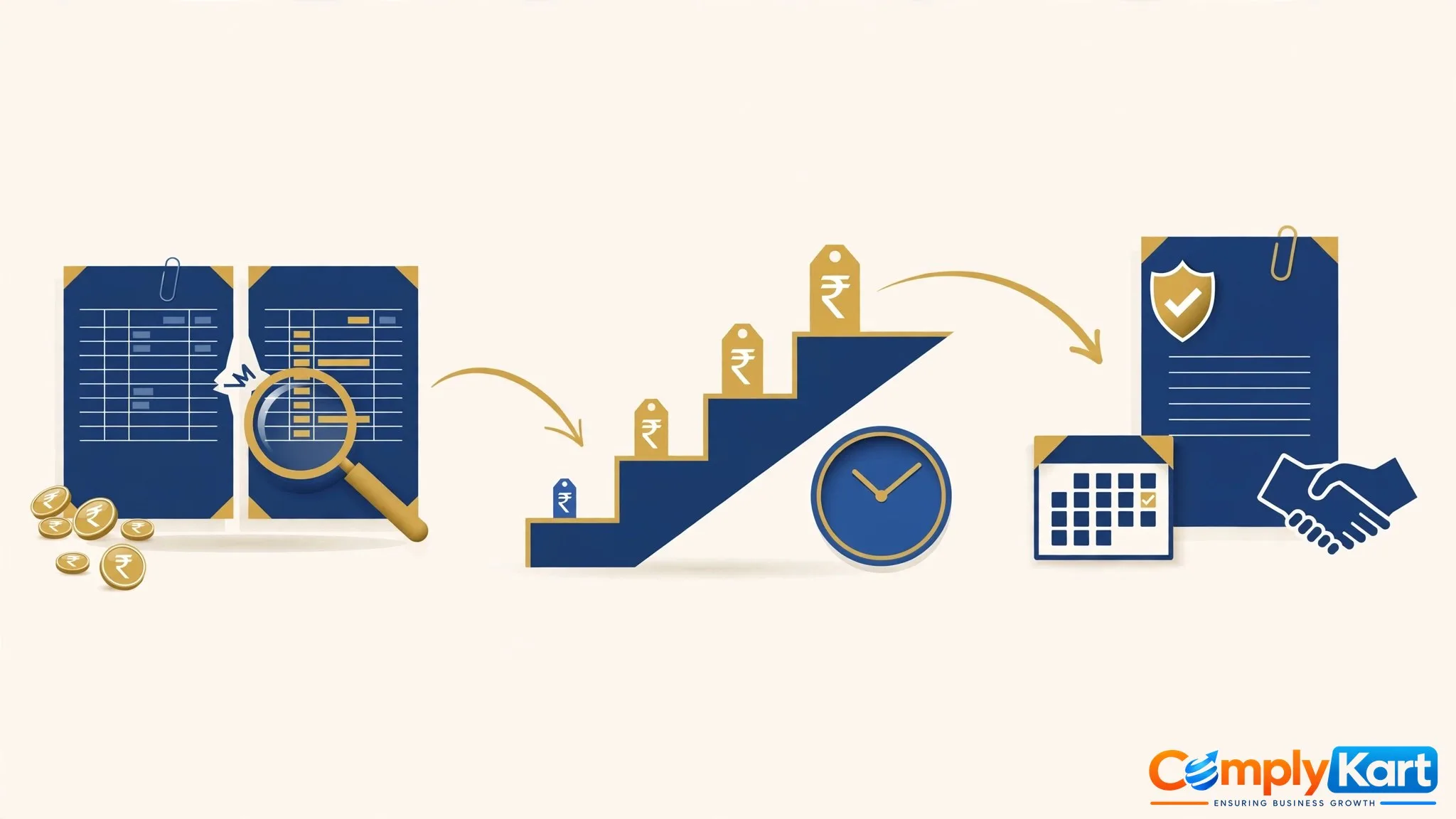
Somewhere in an old year's books there's a gap: a client paid into a second bank account; your GST turnover and ITR turnover never quite matched. The year feels closed — but the gap still sits there, visible to the department's systems. ITR-U exists for this moment: correct the old return yourself, before a notice does it for you.
The short answer: ITR-U, the updated return under Section 139(8A), lets you add missed income to a past year's return within 48 months of that assessment year ending. You pay tax, interest, and additional tax of 25% to 70% depending on how late you are — and it can only raise what you owe, never create a refund or a fresh loss.
What can ITR-U fix?
Three kinds of trouble. Income you missed — bank interest, rent, a capital gain, receipts that never reached the return. A year you never filed at all. And errors of classification — wrong head of income, wrong tax rate. Anyone can file — individual, HUF, firm, LLP, company — return filed earlier or not.
One hard limit shapes everything: only one ITR-U per assessment year. Fix one gap, file, then find a second — there is no second door. The reconciliation before filing matters more than the filing itself. Our ITR-U filing service starts exactly there: every record for that year, every gap, one pass.
How much time do you have? The 48-month window
The clock runs from the end of the assessment year, not the day you filed. The Finance Act 2025 stretched the window from 24 months to 48:
| Assessment year | Last date for ITR-U |
|---|---|
| AY 2023-24 | 31 March 2028 |
| AY 2024-25 | 31 March 2029 |
| AY 2025-26 | 31 March 2030 |
| AY 2026-27 | 31 March 2031 |
For AY 2026-27 and earlier, this is Section 139(8A) of the 1961 Act. From Tax Year 2026-27 it is Section 263(6) of the Income-tax Act, 2025, additional tax under Section 267 — same window, same rates. Only the number changes.
What does ITR-U cost? The additional tax ladder
You pay in layers: tax on the missed income, interest under Sections 234A, 234B and 234C, the Section 234F late fee where it applies — and on top, the additional tax under Section 140B. That last layer punishes waiting:
| ITR-U filed within | Additional tax |
|---|---|
| 12 months from end of the AY | 25% of tax + interest |
| 13–24 months | 50% |
| 25–36 months | 60% |
| 37–48 months | 70% |
Railway dynamic pricing works the same way: same seat, higher price the closer departure gets. Here, departure is the day the department finds the gap first.
An example. GST returns for FY 2024-25 showed ₹48 lakh of sales; the ITR for AY 2025-26 reported ₹42 lakh. The ₹6 lakh gap carries tax of ₹1,80,000 and interest of, say, ₹36,000 — ₹2,16,000 together. File ITR-U now, inside the window's first year: additional tax 25%, ₹54,000; total ₹2,70,000. Leave the same gap to the final year: additional tax 70%, ₹1,51,200, total ₹3,67,200 — interest still growing behind it. Same gap. ₹97,200 more, purely for waiting.
Why business owners meet ITR-U through GST
Your GST returns declare turnover to one system; your ITR declares income to another. The department reads both together, with your AIS and Form 26AS. A GST-versus-ITR mismatch is one of the most common reasons an old year lands on our desk.
Sometimes the gap is honest — exempt sales, timing differences, sales under a second GSTIN in another state. Document it and keep the working. But where income was genuinely missed, explanation won't fix it — only a corrected return will. And keep both systems telling the same story now: clean GST return filing this year stops next year's mismatch.
What ITR-U cannot do
ITR-U is a one-way door, and the provisos to Section 139(8A) are blunt. It cannot be a loss return. It cannot reduce the tax liability of your earlier return. It cannot produce a refund, or enlarge one. Forgot a deduction that would have cut your tax? That needed a revised return while its window was open.
Two exceptions matter: a loss return filed on time can be converted into income through ITR-U, and a carried-forward loss can be reduced — with matching ITR-Us for the later years that used it, as the FAQ below explains.
Who is locked out of ITR-U completely?
The door closes once the department reaches your file. No ITR-U after a search under Section 132, a survey under Section 133A, or a requisition under Section 132A. None if assessment, reassessment, recomputation or revision for that year is pending — or completed. None if prosecution has begun, a Section 148A notice was issued after the 36-month mark, or the department already holds information on you under the Benami, money-laundering or Black Money laws, or a tax treaty (Sections 90/90A).
Check the cheaper doors first. If the belated window is still open — for AY 2026-27 it runs until 31 December 2026 — or a revised return is still possible, those routes cost only a fee and interest. Our ITR form selector settles which form a year needs; a gap touching the current year is fixed through advance tax before 15 December. The rest starts at the income tax return filing desk.
How do you file ITR-U?
Five steps. One: reconcile the year fully — Form 26AS, AIS/TIS, GST returns, bank statements — and list every gap, not just the known one. Two: compute the whole amount — tax, interest, late fee, additional tax. Three: pay before you file, through challan ITNS-280 (minor head 500); the form will not submit without it. Four: file Form ITR-U on the portal, pick the right form for that year, state the reason honestly. Five: e-verify within 30 days — unverified counts as never filed. Keep the reconciliation, challan and acknowledgement together — proof the disclosure was voluntary and complete.
Fix it yourself, or wait for the notice?
If the department finds the gap first, the same tax and interest come due — plus penalty under Section 270A: 50% of the tax on under-reported income, 200% for misreporting — plus assessment proceedings. Compare the ladders: ITR-U's worst band, 70%, costs less than the penalty route — and a voluntary ITR-U closes a year quietly while a notice opens it loudly. The law built this window so you'd use it before you're made to.
Frequently asked questions
I never filed any return for that year. Can I still use ITR-U?
Yes — return furnished or not, as long as the 48-month window is running and no bar (search, survey, pending proceedings) applies.
After filing ITR-U, I found another gap for the same year. Can I file again?
No. One updated return per assessment year, full stop. Anything left over can only surface in assessment proceedings — why the pre-filing reconciliation must be exhaustive.
Does filing ITR-U guarantee the department won't question that year?
No. The department can still examine the return; anyone who promises otherwise is overselling. What changes is the price of the gap: the designed 25–70% additional tax instead of Section 270A penalty (50%, or 200% for misreporting) if it's found in assessment. It is the cheaper route the law intends, not an immunity certificate.
My updated return reduces the loss I carried forward. Is that allowed?
Yes — reducing a carried-forward loss, unabsorbed depreciation or tax credit is a stated use. The reduced figure flows forward, though — file ITR-U for each later year it affects.


Comments
No comments yet — ask the first question below.
Join the discussion
Questions go straight to our expert desk. Comments appear after a quick review — no spam, no noise.